Facial bar
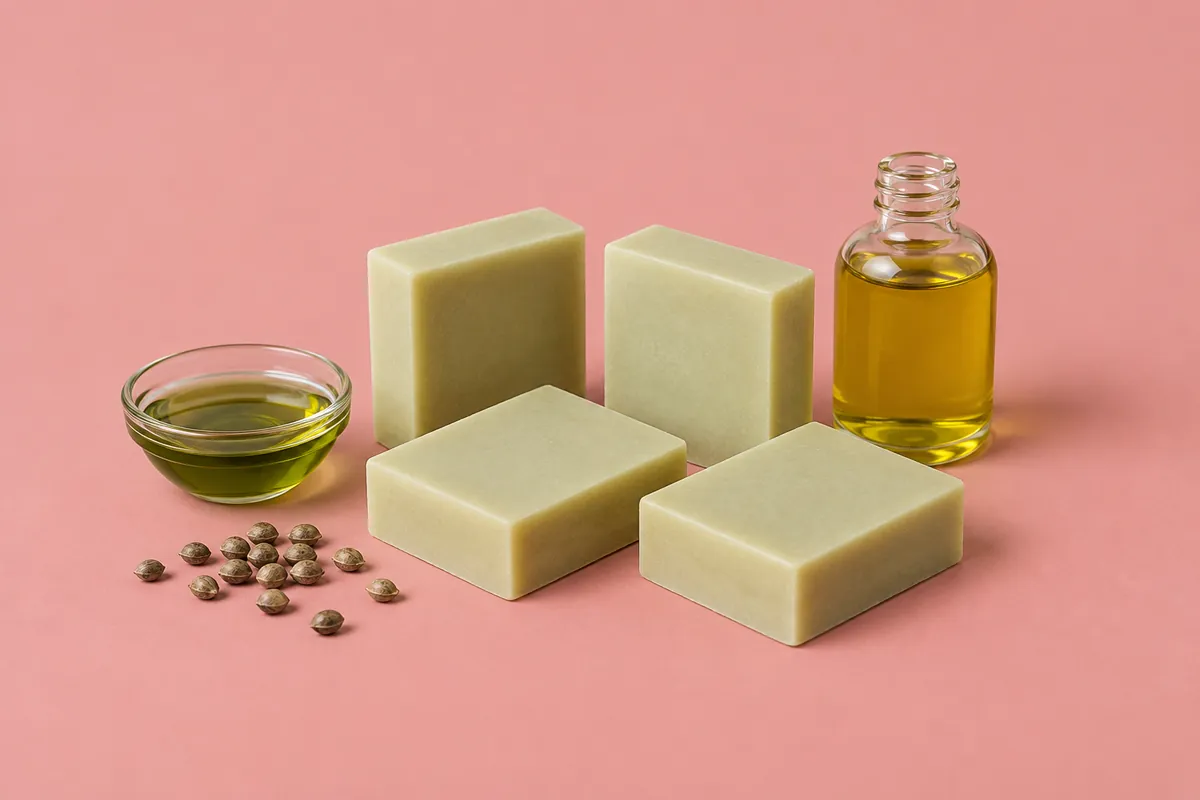
A mild, unscented face bar: olive oil with hemp seed oil, shea butter and a tenth jojoba, the liquid wax, at an 8 % superfat. It cleans lightly with a soft, low lather, and a pinch of rosemary extract helps the hemp oil keep.
- Skill
- Beginner
- Method
- Cold process
- Batch
- 1000 g of oils about 1376 g of batter
- Hands-on
- 1 hour
- Cure
- 6 weeks
- Gel phase
- Either way gel or not, both work
What you need
For 1000 g of oils, which fills a 1.5 litre loaf mould. Weigh everything, liquids included.
| Olive Oil · 40.0 % | 400 g | 14.11 oz |
| Hemp Seed Oil · 15.0 % | 150 g | 5.29 oz |
| Shea Butter · 15.0 % | 150 g | 5.29 oz |
| Coconut Oil · 15.0 % | 150 g | 5.29 oz |
| Castor Oil · 5.0 % | 50 g | 1.76 oz |
| Jojoba Oil · 10.0 % | 100 g | 3.53 oz |
| Sodium hydroxide (NaOH) · the lye, 100 % pure | 124.0 g | 4.37 oz |
| Distilled water · for a 33 % lye solution | 251.7 g | 8.88 oz |
| Rosemary extract (ROE) · about 20 drops, stirred into the liquid oils; an antioxidant against rancid orange spots, not a scent | 0.5 g | 0.02 oz |
- Superfat
- 8 %
- Temperatures
- Oils and lye solution each at 35 to 40 °C (95 to 104 °F)
Method
-
Get ready
Put on splash goggles, nitrile gloves and long sleeves, open a window or turn on the extractor fan, and keep children and pets out of the room. Line a 1.5 litre loaf mould and set it where it can stay for two days. -
Weigh the oils
Weigh 150 g shea butter and 150 g coconut oil into the soaping pot, and 400 g olive oil, 150 g hemp seed oil, 100 g jojoba and 50 g castor oil into a jug. Add 0.5 g rosemary extract, about 20 drops, to the jug and stir. -
Make the lye solution
Weigh 251.7 g distilled water into a heat-safe jug and 124.0 g sodium hydroxide into a dry container. At the open window or under the fan, pour the lye slowly into the water, never the water onto the lye, stir until clear and leave it to cool, labelled and out of reach. -
Melt the butters
Melt the shea butter and coconut oil together on the lowest heat until clear, take the pot off the heat and pour in the jug of liquid oils. The hemp oil never needs heating, and it keeps better if it isn't. -
Check the temperatures
Carry on when the oils and the lye solution are each between 35 and 40 °C (95 and 104 °F). -
Blend to light trace
Pour the lye solution into the oils down the shaft of the stick blender, tap the blender to let trapped air out, then pulse for a few seconds at a time, stirring between pulses. This olive-rich batter traces slowly; stop at light trace, when a drizzle leaves a faint line that sinks back within seconds. -
Pour and cover
Pour into the mould, tap it on the worktop to release air bubbles and smooth the top. Lay baking paper on the surface to keep soda ash off, then cover with a board or lid. -
Clean up
With your gloves still on, wipe the batter off the pot and tools with paper towels into the bin, then wash them in hot soapy water. -
Unmould and cut
After 36 to 48 hours, when the loaf is firm, unmould it with gloves on and cut it into bars about 2.5 cm (1 in) thick. Cut each bar in half if you like: a small face bar dries out between uses and lasts longer. -
Cure
Stand the bars on edge on a rack in a dry, airy room out of direct sun for six weeks, turning them every few days. -
Store in the dark
Once cured, wrap the bars in paper or keep them in a box somewhere cool and dark, and use them within about a year; light and warmth are what turn hemp oil rancid.
Tips
- The calculator weighs lye for the jojoba as if it all turned into soap. Much of it does not, so the lye it was given goes to the other oils: if none of the jojoba reacted, their own superfat would be about 3 %, with the jojoba left free on top. That is still a safe margin, and it is why the recipe runs at 8 % rather than 5 %.
- Unrefined hemp seed oil is green and smells grassy; it tints the bar a pale sage cream that fades towards beige as it cures. Refined hemp oil gives a paler bar.
- For a face bar with kaolin clay and silk, see the kaolin and silk facial bar. The variants of this recipe swap the hemp for rosehip, evening primrose or other seed oils.
The oils
| Oil | Share |
|---|---|
| Olive Oil (virgin / refined / olive oil) | 40.0 % |
| Hemp Seed Oil | 15.0 % |
| Shea Butter | 15.0 % |
| Coconut Oil | 15.0 % |
| Castor Oil | 5.0 % |
| Jojoba Oil | 10.0 % |
How it is made
| Process | Cold process |
| Alkali | NaOH |
| Superfat | 8 % |
| Water | lye water at 33 % |
| Iodine value | 80 |
| INS | 109 |
Why make it
This bar is built for washing a face rather than a body: 10 for cleansing and 62 for conditioning on our scale, and no scent. The jojoba is a liquid wax, not an oil, and reacts with lye far more slowly than true oils, so much of it stays in the bar unchanged; Susan Miller Cavitch valued it for exactly that, as a stable, unsaponified superfat. Hemp seed oil brings a lot of linoleic and linolenic acid, which makes a softer bar that can turn rancid, hence the pinch of rosemary extract. The American Academy of Dermatology advises a gentle, non-abrasive, alcohol-free cleanser, lukewarm water and fingertips rather than a cloth. The honest caveat is pH: every true soap is alkaline, and in one Indian study most bars tested had a pH of 9 to 10, well above the skin's own 5 or so, so anyone whose face feels tight after soap may prefer a soap-free cleanser.
Sources
- The Natural Soap Book (Susan Miller Cavitch) · Storey Publishing, 1995
- Face washing 101 · American Academy of Dermatology
- Evaluation of pH of bathing soaps and shampoos for skin and hair care · Indian Journal of Dermatology (Tarun et al.), 2014
What tradition, makers' experience and research say about soaps like this, each labelled for what it is. It is not medical advice, and no soap treats a skin condition: if you have one, ask a doctor or pharmacist.
What the numbers say
- Lauric acid 7.4 %
- Myristic acid 2.8 %
- Palmitic acid 8.9 %
- Stearic acid 8.4 %
- Ricinoleic acid 4.4 %
- Oleic acid 39.0 %
- Linoleic acid 14.7 %
- α-Linolenic acid 3.6 %
- Other 12.7 %
Saturated : unsaturated 30 : 70
Computed from the fatty acids of the fats above. The bands are what the craft has settled on, not chemistry — a bar outside one is not wrong.
Try it differently
17 variationsThe same soap with one thing moved. Each opens in the calculator ready to change again.
- Rosehip Seed Oil instead of Hemp Seed Oil
- Evening Primrose Oil instead of Hemp Seed Oil
- Black Cumin Seed Oil instead of Hemp Seed Oil
- Tamanu Oil instead of Hemp Seed Oil
- Neem Oil instead of Hemp Seed Oil
- 6 % superfat
- 10 % superfat
- Rosehip Seed Oil instead of Hemp Seed Oil and 6 % superfat
- Rosehip Seed Oil instead of Hemp Seed Oil and 10 % superfat
- Evening Primrose Oil instead of Hemp Seed Oil and 6 % superfat
- Evening Primrose Oil instead of Hemp Seed Oil and 10 % superfat
- Black Cumin Seed Oil instead of Hemp Seed Oil and 6 % superfat
- Black Cumin Seed Oil instead of Hemp Seed Oil and 10 % superfat
- Tamanu Oil instead of Hemp Seed Oil and 6 % superfat
- Tamanu Oil instead of Hemp Seed Oil and 10 % superfat
- Neem Oil instead of Hemp Seed Oil and 6 % superfat
- Neem Oil instead of Hemp Seed Oil and 10 % superfat
From the guides
All guides
Superfat and lye discount: why recipes leave some oil unsaponified
What superfat and lye discount mean, how the calculator applies them, where makers set them for each soap, and why oil added at trace isn't the oil left over.
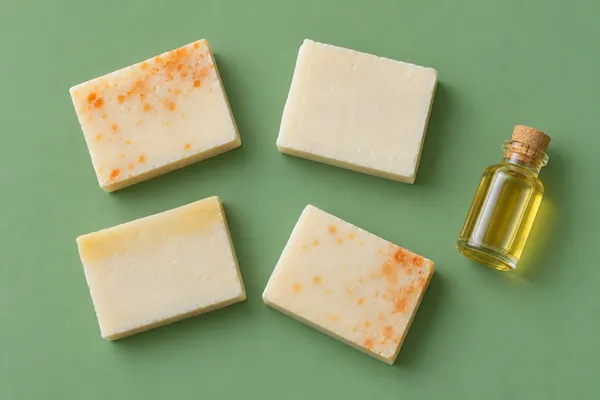
Dreaded orange spots (DOS) and rancid soap
What the orange spots on handmade soap are, why polyunsaturated oils, old fats and trace metals cause them, and which additives the tests show actually help.
Antioxidants and chelators: keeping soap from going off
What rosemary extract, vitamin E, BHT, EDTA and sodium citrate do in soap, the doses in our database, and how much evidence stands behind each one.
Where these proportions come from
Our own formulation: an olive-rich face bar with 15 % coconut oil for a light lather, hemp seed oil and shea butter, and 10 % jojoba, a liquid wax that reacts with lye far more slowly than true oils, so much of it stays in the bar as free, unreacted material alongside the 8 % superfat.