In short
- DOS is oxidation. Oxygen attacks the double bonds of unsaturated fatty chains, and trace metals, heat and light speed it up.
- Linoleic and linolenic chains oxidise many times faster than oleic, so sunflower, soybean, grapeseed and hemp oils carry the most risk.
- In Kevin Dunn's tests, soap with no superfat turned orange at the same time as soap with 10 %. A higher superfat deepened the colour but did not bring it on sooner.
- EDTA and rosemary extract each held the colour off for the whole 300-hour test. Vitamin E, vitamin C, grapefruit seed extract and sodium citrate on their own did nothing.
- Spots can't be reversed. Cut them out for your own use, and don't sell or give away rancid soap.
On this page
Weeks or months after a batch has cured, small orange spots appear on some of the bars, often with a stale smell. Soapmakers call them dreaded orange spots, or DOS. They are the visible sign of rancidity, the same slow oxidation that spoils a forgotten bottle of cooking oil, and they are one of the few soap faults that has been studied with some care. This guide sets out what is known, what is only believed, and what to do about it.
What DOS looks like
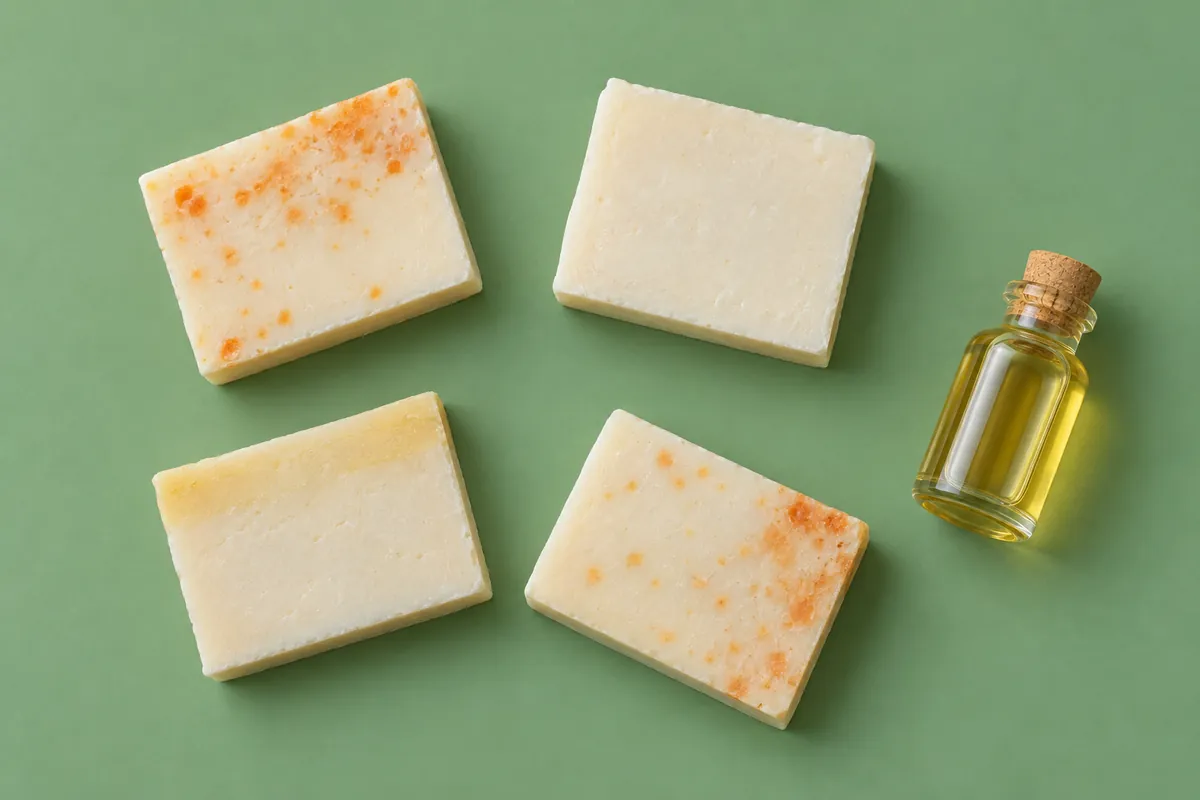
Pale yellow to rust-orange dots or blotches, a few millimetres across, scattered over the bar or gathered towards one end; sometimes a general yellowing instead. They arrive weeks or months after the soap was made, never on the first day, and they don’t wash off. The smell can come first or follow. DeeAnna Rouse of Classic Bells says rancid soap smells musty or “off” before it spots, and that some people liken it to old crayons; Susan Miller Cavitch saw it the other way round, one small yellowish circle first, more over the following weeks, and “an off-odor follows the first circle of rancidity”.
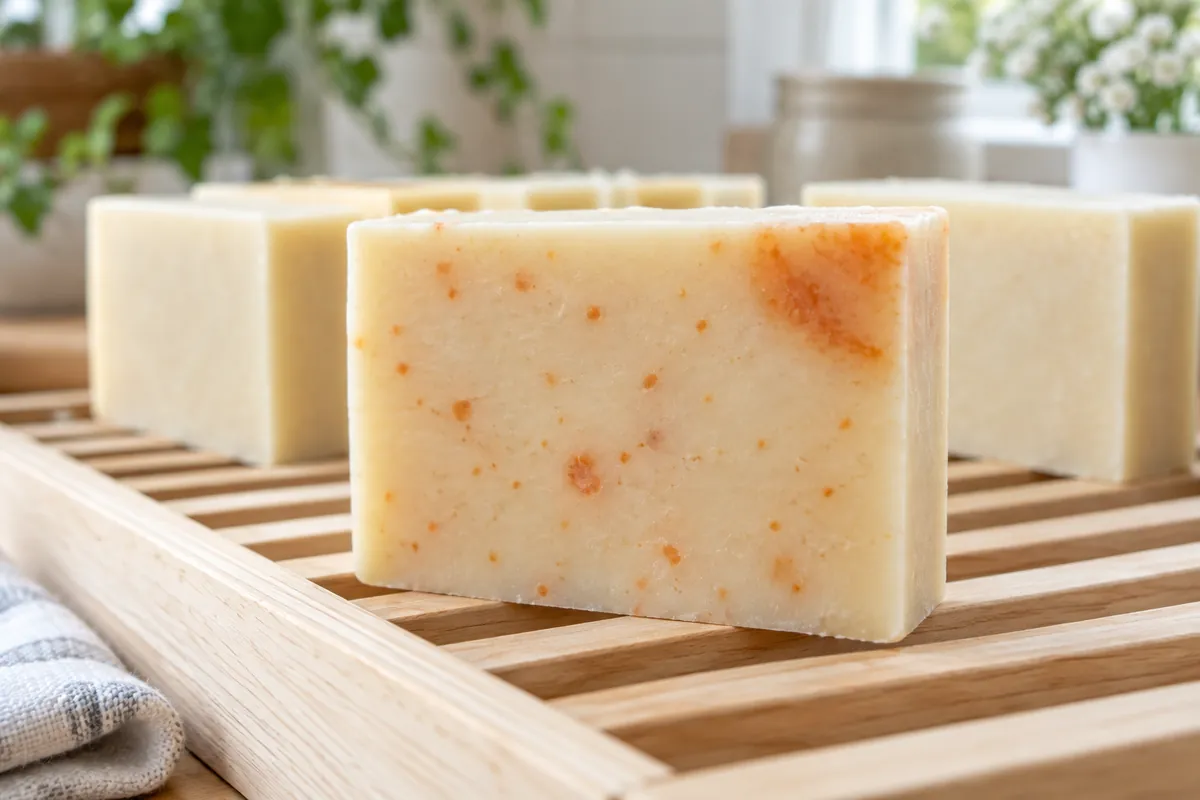 Dreaded orange spots on a cured bar: small, soft-edged and orange to rust, appearing long after the soap was made.
Rancid soap still cleans, and no one has shown it harms the skin; Rouse doubts it would hurt anyone to wash with it. But the smell can linger on the skin, and spotted soap should never be sold or given away.
Other colours can be mistaken for DOS. The timing usually tells them apart.
| What you see | What it probably is | The clue |
|---|---|---|
| Orange spots or blotches, weeks to months later, with a stale smell | DOS | Late, patchy, smells rancid |
| An even tan to brown that starts on the outside within days, in a vanilla or bakery scent, or with clove or cassia oil | Browning from the fragrance: Simmons and Appleton list clove, cassia, heliotropin and vanillin as scents that darken soap | Early and even, smells of the fragrance |
| Tan to orange-brown from the day it was cut, in a milk, honey or sugar soap | Scorched sugars | There from the start |
| Coloured rings spreading from bits of herb, tea or fresh plant matter | The botanical bleeding | Centred on the plant material |
Oxidation, and why some fats are more at risk
A fat goes rancid when oxygen from the air attacks its fatty chains. The attack happens at the double bonds of unsaturated chains, and it runs as a chain reaction: once some chains have been attacked, the products go on to attack others. Along the way the chains break into smaller molecules, among them the aldehydes and ketones that smell rancid, and coloured products that show as yellow and orange.
The unsaturated chains are not all alike. Oleic acid, the main fatty acid of olive oil, has one double bond; linoleic acid has two and linolenic acid three, and the carbon that sits between two double bonds is where oxygen gets in most easily. Ralph Holman and Otto Elmer measured in 1947 that each extra double bond at least doubles the rate of oxidation. In a 2009 storage study at 55 °C, linoleic acid was lost up to twelve times as fast as oleic acid, and linolenic acid up to twenty-six times as fast.
The iodine value that soap calculators show is a measure of total unsaturation, and it is a fair rough guide. But it counts a double bond in oleic acid the same as one in linolenic acid, and in 2002 Gerhard Knothe argued that it is too general to predict oxidative stability. The linoleic and linolenic figures for a recipe are the better numbers to watch; the iodine value guide explains the difference.
Where the oxidation happens in a bar
Makers often blame the superfat, the oil left unsaponified on purpose. Kevin Dunn tested that. He aged pure olive oil soap at 60 °C in pure oxygen and in nitrogen, measured its colour from scans, and compared soap made with a 10 % lye discount against soap made with none. The 10 % soap ended up more orange, but both began to turn at the same time, about 75 hours into the test. Soap made with no lye discount at all still went orange.
The simplest explanation is that the soap itself oxidises as well as the leftover oil: sodium linoleate is as unsaturated as the linoleic acid it was made from. Soap boilers knew it; Simmons and Appleton warned in 1908 that “oleates are very liable to go rancid”. The superfat adds to the load, and it is a richer load than the recipe suggests, because the fat that stays unsaponified is not a fair sample of the oils. In a second study Dunn’s students extracted the leftover fat from finished soap and analysed it. In a soap of 90 % palm oil and 10 % grapeseed oil, whose fatty acids were 9 % linoleic, the leftover fat was 17 to 19 % linoleic. The unsaturated oils react more slowly, so they are what remains, and it made no difference whether the grapeseed oil went in at the start or at trace. Dunn called these results preliminary.
The same experiment showed how much oxygen matters. Stored under nitrogen, the olive soap coloured far more slowly than in oxygen. That is why full, closed oil bottles keep better than half-empty ones.
How the orange colour itself forms is less settled than the smell. Lever Brothers’ soap chemists wrote in 1970 that rancid odour was generally accepted to come from oxidation, but that spotting and discolouration were “less clearly understood”; what they could show was that traces of copper and iron made both worse.
What raises the risk
| Factor | What the evidence says | What to do |
|---|---|---|
| Polyunsaturated oils: sunflower, soybean, cottonseed, grapeseed, hemp, walnut, flax; canola in larger amounts | Strong. The chemistry and the storage studies agree; Cavitch also found cottonseed’s keeping varied with the weather the crop met after ripening | Keep them a small share of the oils, or use high-oleic versions |
| Old or badly stored oils | Strong. Oxidation starts in the bottle, and Holman and Elmer found free fatty acids oxidise faster than whole fats | Buy fresh, store cool, dark and full, and use within their shelf life |
| Trace metals: tap water, copper or iron tools, metal racks | Strong. A 1970 Lever Brothers patent reports that as little as 0.2 parts per million of copper had a significant effect on the colour and smell of soap bars, and Dow sells EDTA for bar soap against brown spotting and rancidity. The idea that every spot sits on a speck of metal is Rouse’s observation, not a test | Distilled water, plastic or stainless steel, never cure on bare metal, add a chelator |
| A high superfat | Measured by Dunn: a deeper colour, not an earlier start | Keep it moderate; Soap Queen sees more DOS at 5 % and above |
| Heat and light | Strong. Heat is how Dunn sped his test up; light drives its own kind of oxidation, which Hall and Cuppett’s study was about | Cure and store cool and out of the sun |
| Humid, stuffy curing, or wrapping too soon | Maker experience (Soap Queen, Anne-Marie Faiola) | Cure with airflow and wrap only once cured |
| Oxidised essential oils | Maker experience: Rouse has seen old lavender oil set off rancidity, and Cavitch found citrus oils “vulnerable after just six months” | Use essential oils within their shelf life |
| Botanicals rich in copper, such as spirulina | One maker’s photographs, reported by Rouse | Worth knowing; not proven |
“Strong” means well established in the chemistry of fats and consistent with what soapmakers see; “maker experience” means consistent reports without a controlled test.
The oils that carry the risk
| Oil | Linoleic (%) | Linolenic (%) | Iodine value |
|---|---|---|---|
| Coconut | 1–2.5 | 0–0.2 | 6.3–10.6 |
| Cocoa butter | 1.6–4.8 | 0–1.5 | 33–42 |
| Tallow | 1–6 | up to 1.5 | 40–53 |
| Shea butter | 4.4–7.9 | – | 30–75 |
| Palm | 9–12 | 0–0.5 | 50–55 |
| Lard | 4–12 | up to 1.5 | 55–65 |
| Olive | 3.5–21 | up to 1.2 | 75–94 |
| High-oleic sunflower | 2.1–17 | 0–0.3 | 78–90 |
| Avocado | 6–20 | up to 3 | 75–95 |
| Sweet almond | 20–30 | 0–0.5 | 85–109 |
| Rice bran | 21–42 | 0.1–2.9 | 90–115 |
| Canola | 15–30 | 5–14 | 105–126 |
| Cottonseed | 46.7–58.2 | 0–0.4 | 100–123 |
| Soybean | 48–59 | 4.5–11 | 124–139 |
| Sunflower | 48.3–74 | 0–0.3 | 118–141 |
| Grapeseed | 58–78 | 0–1 | 128–150 |
| Hemp seed | 44.5–65.5 | 13.5–30.5 | 145–170 |
Ranges from the sources behind each oil’s page: the Codex food standards for most, and pharmacopoeia monographs, supplier specifications or published analyses for the rest. A dash means the source gives no figure.
Classic Bells’ rule of thumb is to keep linoleic and linolenic acids together at or below 15 % of a recipe’s fatty acids. Rouse is candid that the rule has no strong scientific basis; it simply seems to work. The chemistry supports its direction, so it is a sensible target, but it is not a line: a bar at 16 % is not doomed, and one at 12 % is not safe from a rusty rack.
The calculator makes the check easy. A bar of olive oil 40 %, coconut oil 25 %, ordinary sunflower oil 20 % and shea butter 15 % comes out at 18.8 % linoleic and linolenic together, with an iodine value of 70. Swap the sunflower oil for high-oleic sunflower oil and the same bar comes out at 8.5 %, with an iodine value of 61, and needs 139.0 g of sodium hydroxide per 1000 g of oils instead of 139.4 g. Our budget bar keeps canola to a quarter of the oils for the same reason, the supermarket oils bar holds it to 15 % and comes out at 12.4 %, and our palm-free classic uses the high-oleic sunflower.
Make the swap. The high-oleic version of this bar needs 139.0 g of sodium hydroxide for 1000 g of oils. The link adds EDTA and rosemary extract at 0.1 % of the oils each, the dose Dunn tested.
Open it in the calculatorWhat the tests say about additives
Dunn tested the additives soapmakers recommend against DOS, each at 0.1 % of the oil weight, in the same aged olive oil soap.
| Additive, 0.1 % of the oils | Result |
|---|---|
| None | Colour took off at about 75 hours |
| Grapefruit seed extract, vitamin C, vitamin E or sodium citrate, each alone | No different from no additive |
| BHT | Held off to about 150 hours, twice as long |
| Rosemary extract (ROE) | Had not taken off by the end of the test, about 300 hours; stayed below his “noticeably orange” mark |
| EDTA | The same as rosemary extract |
| ROE with EDTA, or BHT with EDTA | Past 300 hours, and paler than either alone |
| BHT with sodium citrate | The best: past 300 hours at about the colour of fresh soap |
| ROE with sodium citrate | Worse than rosemary extract alone |
Dunn, “The Dreaded Orange Spot”, 2005/2006: 1 g samples of soap aged at 60 °C in oxygen, colour measured from daily scans.
How to use them
EDTA. Tetrasodium EDTA is the grade for soap. Dow’s handbook gives 0.1 to 0.2 % for bar soap, Dunn tested 0.1 % of the oils, and Classic Bells gives 0.05 to 0.25 % of the batch against rancidity. It uses no lye. Dow advises adding a chelator early, “during the water phase”, and Dunn adds it to the lye; our calculator puts it in the water before the lye goes in, which suits an ordinary lye solution. Rouse has seen EDTA come out of strong lye as a thick white sludge, though: it stayed dissolved below about 35 % sodium hydroxide in her tests, and another maker saw it come out at 33 %. With a strong solution, dissolve it in a little of the recipe’s water held back for the purpose and stir that into the oils instead. Disodium EDTA is a grade for neutral products; it uses up some lye, which the calculator allows for.
Rosemary extract (ROE). An oil-soluble extract rich in carnosic acid, and a different thing from rosemary essential oil, which does not do the same job. Dunn used 0.1 % of the oils. Food studies suggest more is not better: in soybean oil exposed to light, 0.02 to 0.05 % protected best and 0.5 % acted as a pro-oxidant, and in rapeseed oil stored at room temperature 50 to 200 mg per kg (0.005 to 0.02 %) was the best range. Extracts are sold at different strengths, so follow the supplier’s figure; Classic Bells keeps to 0.05 % of the fats, and adds it to the oils as soon as they are bought rather than waiting for soap day. Our Aleppo-style laurel bar stirs 1 g into its 1000 g of fresh oils, Dunn’s 0.1 %, to carry it through a long cure.
BHT. A synthetic antioxidant that dissolves in warm oil. At 0.1 % of the oils it doubled the time to colour in Dunn’s test, and with 0.1 % sodium citrate it did best of all. EU law allows up to 0.8 % in rinse-off products, so 0.1 % is well inside it. Dunn’s own advice was practical: if your customers prefer natural ingredients, use ROE; if they don’t mind, BHT with sodium citrate is likely to do better.
Sodium citrate. No help against DOS on its own at 0.1 %, but a good partner for BHT. Craft doses are far higher, 1.3–3.9 % of the oils (Classic Bells), and no one has tested those against DOS. In the bar it binds metal traces; it cannot soften the water you rinse with (see soap in hard water).
Vitamin E. It did nothing in Dunn’s test. In food oils, alpha-tocopherol has repeatedly behaved as a pro-oxidant: added to soybean oil at levels from 0.002 to 5 %, it sped oxidation at every level except the lowest. Add it for other reasons if you like, but not to prevent DOS. The antioxidants and chelators guide goes further into all of these.
Storage and handling that help
- Oils. Buy them fresh and in amounts you will use. Keep them cool and dark in full, closed containers, and refrigerate fragile ones such as hemp and grapeseed. Smell an oil before you soap it: rancid fat makes rancid soap.
- Water. Make the lye with distilled or deionised water. Tap water is often blamed for DOS; the chemistry supports that, and many makers use tap water without trouble, so it is a risk to reduce rather than a certain cause.
- Tools. Plastic or stainless steel; never copper, brass or bronze, and not cast iron, which Cavitch found discolours soap.
- Curing. On wood, plastic or card, never on bare metal. Rouse warns that metal ions migrate through paint and paper, so cover metal shelving with thick cloth or sturdy plastic. Cure somewhere cool, dry and airy, out of the sun, and wrap bars only once they are cured. Cavitch never stacked curing bars and kept them out of closets and drawers, which she found gave too little air “for maximum protection against rancidity”.
- Keep an eye on stock. Store older bars apart from new ones, and use bars made with the less stable oils first.
The curing and storing guide covers racks, airflow and packaging.
If your soap has spots
Rancidity can’t be reversed, and Rouse is clear that rebatching does not cure it. If a bar has only a few spots, cut them out and keep the rest for your own use. Throw away bars that are rancid all through, and any liquid soap that smells rancid, since there are no spots to cut out of a bottle. Don’t sell or give away spotted soap. Keep affected bars away from the rest of the batch, then look for the cause: the age of the oils, the water, the rack, the storage room. The pattern usually points to it. Spots on the faces that touched a rack point to metal; an even yellowing and a rancid smell through every bar point to the oils.
Recipes to try
All recipesSources
- The Dreaded Orange Spot . Kevin M. Dunn, The Handcrafted Soapmaker (Handcrafted Soapmakers Guild) , 2005/2006. Olive oil soap aged at 60 °C in oxygen or nitrogen; lye discount and additives at 0.1 % of the oils compared by colour.
- Superfatting and the Lye Discount . Kevin M. Dunn, The Handcrafted Soapmaker 2007-2 , 2007. The unsaponified fat is enriched in the slower-reacting unsaturated oils, whenever the superfat oil is added.
- The rates of oxidation of unsaturated fatty acids and esters . R. T. Holman and O. C. Elmer, Journal of the American Oil Chemists' Society 24(4):127-129 , 1947.
- Prooxidant activity of oxidized alpha-tocopherol in vegetable oils . T. M. Chapman, H. J. Kim and D. B. Min, Journal of Food Science 74(7):C536-C542 , 2009.
- Structure indices in FA chemistry. How relevant is the iodine value? . G. Knothe, Journal of the American Oil Chemists' Society 79(9):847-854 , 2002.
- The effects of surfactant type, pH, and chelators on the oxidation of salmon oil-in-water emulsions . J. R. Mancuso, D. J. McClements and E. A. Decker, Journal of Agricultural and Food Chemistry 47(10):4112-4116 , 1999.
- The effects of bleached and unbleached rosemary oleoresins on light-sensitized oxidation of soybean oil . C. A. Hall and S. L. Cuppett, Journal of the American Oil Chemists' Society 70(5):477-482 , 1993.
- Antioxidant efficacy of rosemary extract in improving the oxidative stability of rapeseed oil during storage . M. Guo et al., Foods 12(19):3583 , 2023.
- Prooxidant effect of α-tocopherol on soybean oil . A. S. Martin-Rubio et al., Food Chemistry 245:312-323 , 2018.
- Superfatted soap bar containing a synergistic preservative mixture of EHDP and EDTA (US 3,511,783) . J. W. Waring, Lever Brothers Company , 1970. Heavy metals an important cause of odour deterioration, spotting and discoloration in soap bars; 0.2 ppm of copper has a significant effect.
- VERSENE Chelating Agents for Personal Care Formulations . The Dow Chemical Company , 2007. Bar soap: 0.1 to 0.2 %, to help prevent softening, brown-spotting, rancidity, cracking and discoloration due to metal ions.
- Commission Regulation (EU) 2022/2195 (BHT in cosmetic products) . Official Journal of the European Union , 2022.
- Standard for Named Vegetable Oils (CXS 210-1999) . Codex Alimentarius Commission (FAO/WHO) .
- Rancidity and DOS . DeeAnna Rouse, Classic Bells .
- Tetrasodium EDTA in soap . DeeAnna Rouse, Classic Bells .
- Sodium citrate . DeeAnna Rouse, Classic Bells .
- The Natural Soap Book . Susan Miller Cavitch, Storey Publishing , 1995. Rancidity showing as one small yellowish circle, then more, with the off smell following; cast iron discolouring soap; citrus oils vulnerable after six months; cottonseed oil's rancidity varying with the harvest weather; curing bars unstacked, out of closets and drawers.
- The Handbook of Soap Manufacture . W. H. Simmons and H. A. Appleton, Scott, Greenwood & Son (Project Gutenberg edition) , 1908. Oleates very liable to go rancid; clove, cassia, heliotropin and vanillin darkening soap on keeping.