Neem dog bar
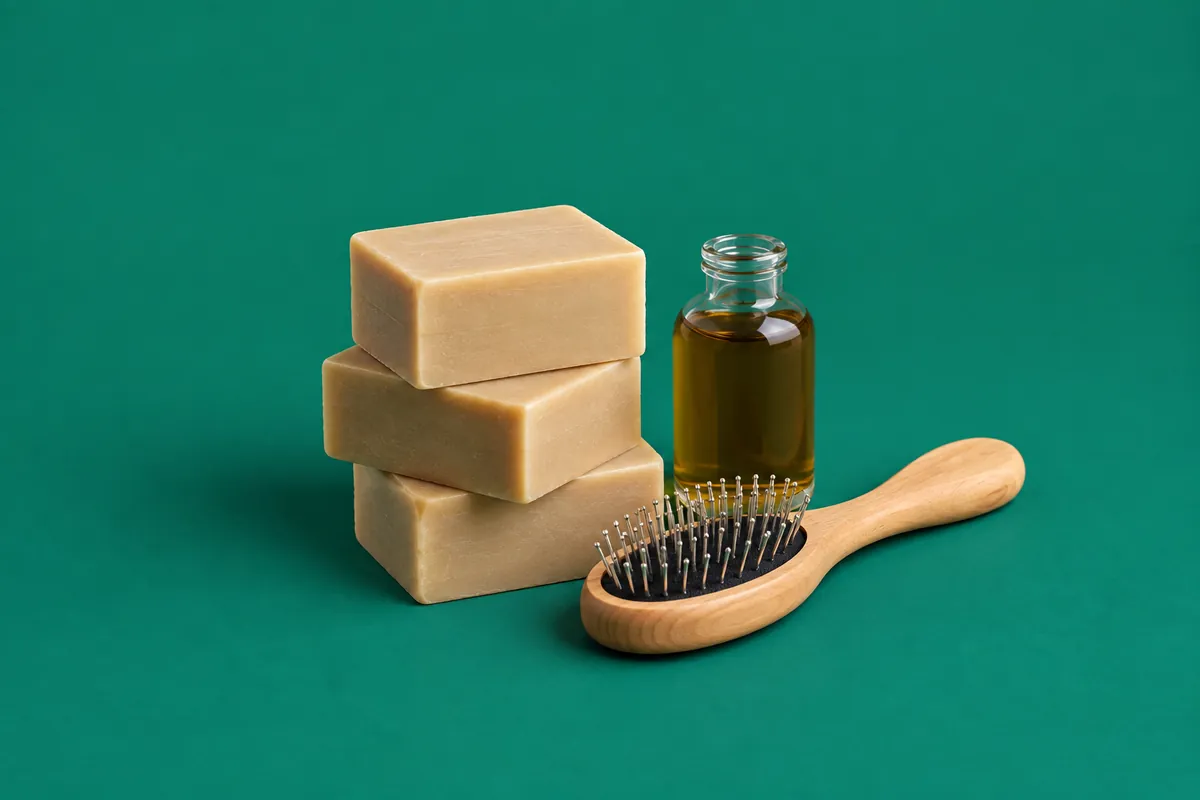
A mild, unscented bar for washing dogs: mostly olive oil, with palm oil for a firm bar, coconut oil for lather and a tenth neem oil, the traditional dog-soap oil. It carries no essential oils, because many are unsafe for dogs and more so for cats.
- Skill
- Beginner
- Method
- Cold process
- Batch
- 1000 g of oils about 1418 g of batter
- Hands-on
- 1 hour
- Cure
- 6 weeks
- Gel phase
- Either way gel or not, both work
What you need
For 1000 g of oils, which fills a 1.5 litre loaf mould. Weigh everything, liquids included.
| Olive Oil · 45.0 % | 450 g | 15.87 oz |
| Coconut Oil · 20.0 % | 200 g | 7.05 oz |
| Palm Oil · 25.0 % | 250 g | 8.82 oz |
| Neem Oil · 10.0 % | 100 g | 3.53 oz |
| Sodium hydroxide (NaOH) · the lye, 100 % pure | 137.8 g | 4.86 oz |
| Distilled water · for a 33 % lye solution | 279.8 g | 9.87 oz |
- Superfat
- 6 %
- Temperatures
- Oils and lye solution each at 38 to 43 °C (100 to 110 °F)
Method
-
Get ready
Put on splash goggles, gloves and long sleeves, open a window and keep children and your dog out of the room. Line a 1.5 litre loaf mould. -
Warm the neem oil
Neem oil thickens and turns cloudy in a cool room, so stand the bottle in a bowl of warm water until it is clear, then shake it well. Expect a strong, garlicky smell; it is normal for neem. -
Weigh the oils
Stir the tub of palm oil right through, since its hard and soft parts separate, then weigh 250 g palm oil and 200 g coconut oil into the pot. Weigh 450 g olive oil and 100 g neem oil into a jug. -
Make the lye solution
Weigh 279.8 g distilled water into a heatproof jug and 137.8 g sodium hydroxide into a dry container. At the open window, pour the lye slowly into the water, never the reverse, stir until clear and leave it to cool, labelled and out of reach. -
Melt the fats
Melt the palm and coconut oils on a low heat until clear, then stir in the olive and neem oils. Let the oils and the lye solution each come to 38 to 43 °C (100 to 110 °F). -
Blend to light trace
Pour the lye solution into the oils and stick blend in short bursts, stirring between them. With this much olive oil it traces slowly; keep going until a drizzle leaves a faint line on the surface. -
Pour and cover
Pour into the mould, tap it on the worktop to release air, and cover it with a board and a folded towel. It may gel into a darker centre, which evens out as it cures. -
Unmould and cut
After about 48 hours, when the loaf is firm, unmould it with gloves on and cut it into bars; give it another day if it still feels soft. -
Cure
Stand the bars on a rack with air around them for at least six weeks, turning them now and then. The neem smell softens as they cure but never quite goes. -
Wet the coat
Soak your dog's coat to the skin with lukewarm water, which takes longer than you might think with a thick coat. -
Lather
Rub the bar along the coat or lather it in your hands and work it down to the skin, keeping it away from the eyes, ears and mouth. -
Rinse thoroughly
Rinse until the coat no longer feels slippery and the water runs clear, since your dog will lick off whatever soap is left. Towel dry, and keep the bar out of reach afterwards.
Tips
- Do not add a scent. Many essential oils are toxic to dogs, tea tree oil the most often reported, and cats are more sensitive still. A dog's nose is far keener than ours, and a clean coat needs no perfume.
- Neem is here for its traditional place in dog soap, not as a treatment. No soap is an insecticide or a medicine: talk to your vet about fleas, ticks or any sore, red or broken skin before bathing.
- It is for dogs. Cats groom off whatever stays on their coat, rarely need a bath and are far more sensitive to plant oils, so ask a vet before washing a cat with anything.
- If the neem smell puts you off, our gentle unscented dog shampoo bar leaves it out, and the list under Try it differently swaps the palm oil for tallow, lard or a butter.
The oils
| Oil | Share |
|---|---|
| Olive Oil (virgin / refined / olive oil) | 45.0 % |
| Coconut Oil | 20.0 % |
| Palm Oil | 25.0 % |
| Neem Oil | 10.0 % |
How it is made
| Process | Cold process |
| Alkali | NaOH |
| Superfat | 6 % |
| Water | lye water at 33 % |
| Iodine value | 64 |
| INS | 142 |
Why make it
A plain washing bar for dogs, mild by the numbers: cleansing 14 and conditioning 58 on our scale, mostly olive oil, with palm oil for hardness and a fifth coconut oil for lather. Neem oil is the traditional part. In India it has gone into soap for generations, and the National Research Council reported in 1992 that it had been a major soap ingredient there for at least 50 years; makers still add it to dog soaps for that reputation. There is no good evidence that a neem soap does anything for a dog's skin or coat, and no soap is an insecticide or a medicine. Neem smells strongly of garlic, and the bar carries no essential oils: many are toxic to dogs and more so to cats, which break some of their compounds down poorly and groom off whatever stays on the coat. Keep it for dogs.
Sources
- Neem: A Tree for Solving Global Problems · National Research Council, National Academy Press, 1992
- Toxicoses From Essential Oils in Animals · Kia Benson, Merck Veterinary Manual, 2025
What tradition, makers' experience and research say about soaps like this, each labelled for what it is. It is not medical advice, and no soap treats a skin condition: if you have one, ask a doctor or pharmacist.
What the numbers say
- Lauric acid 9.9 %
- Myristic acid 4.1 %
- Palmitic acid 20.6 %
- Stearic acid 4.5 %
- Oleic acid 46.7 %
- Linoleic acid 10.3 %
- Other 4.4 %
Saturated : unsaturated 42 : 58
Computed from the fatty acids of the fats above. The bands are what the craft has settled on, not chemistry — a bar outside one is not wrong.
Try it differently
13 variationsThe same soap with one thing moved. Each opens in the calculator ready to change again.
- Edible Tallow (beef/mutton dripping) instead of Palm Oil
- Lard (pure rendered pork fat) instead of Palm Oil
- Shea Butter instead of Palm Oil
- Kokum Butter instead of Palm Oil
- Cocoa Butter (Theobroma Oil) instead of Palm Oil
- Mango Butter instead of Palm Oil
- 8 % superfat
- Edible Tallow (beef/mutton dripping) instead of Palm Oil and 8 % superfat
- Lard (pure rendered pork fat) instead of Palm Oil and 8 % superfat
- Shea Butter instead of Palm Oil and 8 % superfat
- Kokum Butter instead of Palm Oil and 8 % superfat
- Cocoa Butter (Theobroma Oil) instead of Palm Oil and 8 % superfat
- Mango Butter instead of Palm Oil and 8 % superfat
From the guides
All guides
Superfat and lye discount: why recipes leave some oil unsaponified
What superfat and lye discount mean, how the calculator applies them, where makers set them for each soap, and why oil added at trace isn't the oil left over.
The soaping oils: what each one brings to a bar
Twenty-five soaping oils, butters and waxes: what each does in a bar and why, the share makers give it, and what to watch for, with figures from our records.
Your first cold process soap, step by step
A complete first batch of cold process soap: one simple recipe with exact lye and water for 500 g and 1 kg of oils, and every step from goggles to cure.
Where these proportions come from
Fragrance and essential oils on animals are a veterinary question, not a formulation one.
Our own construction: a mild, mostly olive bar with palm oil for hardness and a fifth coconut oil for lather, at a 6 % superfat, a point above everyday because neem oil's saponification value varies. Neem at 10 % is the traditional inclusion in dog soaps; no claim is made about what it does, and the bar is unscented because many essential oils are unsafe for dogs and more so for cats.