Gentle unscented dog shampoo bar
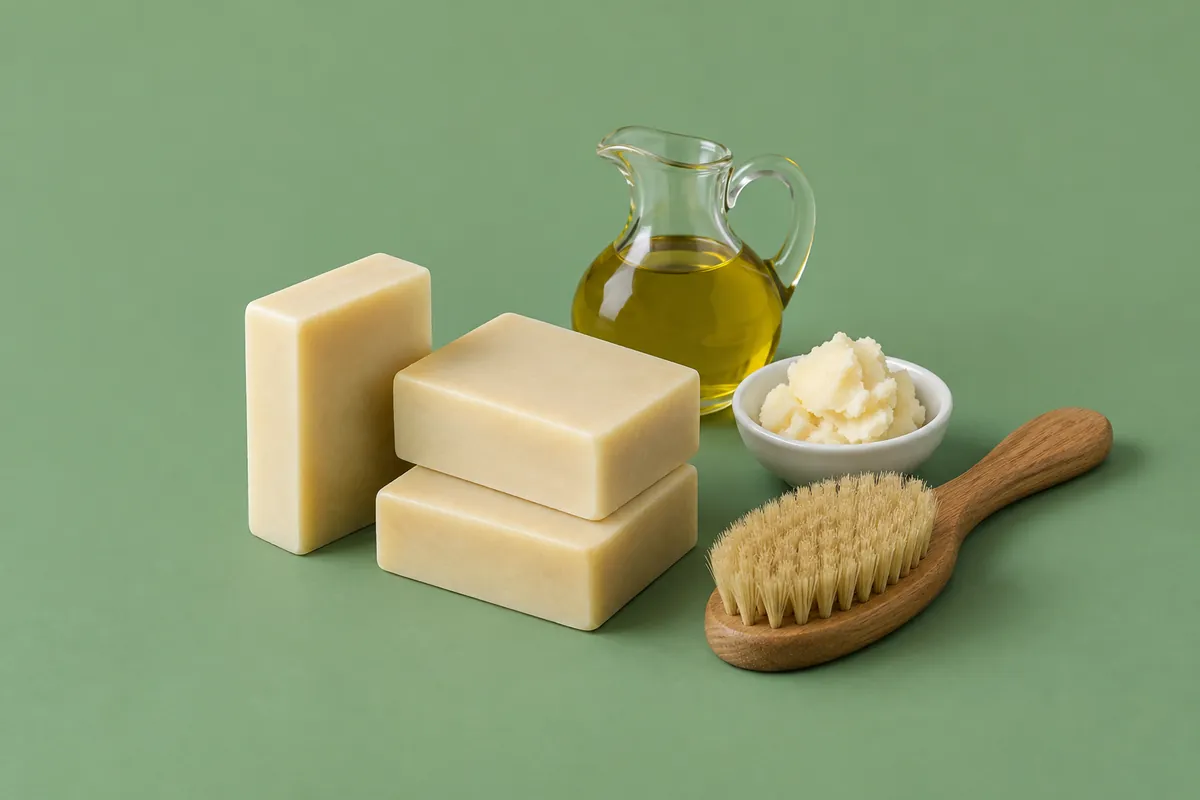
A plain, mild bar for washing dogs: mostly olive oil, with coconut oil for lather, shea butter for a firmer bar and an 8 % superfat. It has no essential oils, neem or cedarwood, because a dog lives with the smell of its coat and licks what stays in it.
- Skill
- Beginner
- Method
- Cold process
- Batch
- 1000 g of oils about 1407 g of batter
- Hands-on
- 1 hour
- Cure
- 6 weeks
- Gel phase
- Either way gel or not, both work
What you need
For 1000 g of oils, which fills a 1.5 litre loaf mould. Weigh everything, liquids included.
| Olive Oil · 55.0 % | 550 g | 19.40 oz |
| Coconut Oil · 25.0 % | 250 g | 8.82 oz |
| Shea Butter · 15.0 % | 150 g | 5.29 oz |
| Castor Oil · 5.0 % | 50 g | 1.76 oz |
| Sodium hydroxide (NaOH) · the lye, 100 % pure | 134.5 g | 4.74 oz |
| Distilled water · for a 33 % lye solution | 273.0 g | 9.63 oz |
- Superfat
- 8 %
- Temperatures
- Oils and lye solution each between 32 and 43 °C (90 and 110 °F)
Method
-
Get ready
Put on goggles, gloves and long sleeves, open a window and keep pets and children out of the room. Line a 1.5 litre loaf mould, then weigh 250 g coconut oil and 150 g shea butter into the pot, 550 g olive oil and 50 g castor oil into a jug, 273.0 g distilled water into the lye jug and 134.5 g sodium hydroxide into a dry container. -
Make the lye solution
Pour the sodium hydroxide into the water, never the water onto the lye, and stir until it runs clear, keeping your face away from the vapour. Let it cool to between 32 and 43 °C (90 and 110 °F). -
Melt and combine the oils
Melt the coconut oil and shea butter until just clear, then stir in the olive and castor oils and let the oils settle in the same range. -
Blend to light trace
Pour the lye solution into the oils and stick blend in short pulses, stirring between them. With this much olive oil the batter traces slowly: keep going past the smooth, thin emulsion until a drizzle leaves a faint line on the surface. -
Pour and cover
Pour into the mould, tap it on the worktop to let air out, and cover it with a lid or board and a folded towel. It may gel into a darker centre, which is fine either way. -
Unmould and cut
After about 48 hours, when the loaf is firm, unmould it with gloves on and cut it into bars; give it another day if it still feels soft. -
Cure for six weeks
Stand the bars on a rack with air between them for six weeks, turning them now and then. A mostly-olive bar needs the full cure to harden and lather well. -
Wet the coat right through
Soak your dog's coat to the skin with lukewarm water; a thick coat takes longer to wet than you expect. -
Lather and work it in
Rub the bar along the coat or lather it between your hands, and work the lather down to the skin, keeping it away from the eyes, ears and mouth. -
Rinse until the water runs clear
Rinse until the coat no longer feels slippery and the water runs clear, because whatever soap stays in the coat gets licked off. Towel dry. -
Store the bar
Keep the bar on a draining dish between washes, out of your dog's reach.
Tips
- No essential oils, on purpose. A dog's nose is far keener than ours, dogs lick their coats, and some essential oils, tea tree among them, are toxic to dogs and more so to cats, which break down many plant compounds slowly. A washed dog needs no perfume, and neem oil, common in dog soaps, is left out for its strong smell.
- For a dog with sore or broken skin or a skin condition, ask your vet before using any soap.
- It is made for dogs. Cats groom themselves and rarely need a bath; ask a vet before washing a cat with anything.
The oils
| Oil | Share |
|---|---|
| Olive Oil (virgin / refined / olive oil) | 55.0 % |
| Coconut Oil | 25.0 % |
| Shea Butter | 15.0 % |
| Castor Oil | 5.0 % |
How it is made
| Process | Cold process |
| Alkali | NaOH |
| Superfat | 8 % |
| Water | lye water at 33 % |
| Iodine value | 61 |
| INS | 144 |
Why make it
A plain bar for bathing a dog, for owners who would rather know what goes on their animal's coat. It is mostly olive oil at an 8 % superfat, cleansing 17 on our scale, and it has no essential oils, because the ASPCA warns that pets who get essential oils on their coat can become ill, and a dog licks what the rinse leaves behind. Handmade dog soap is a maker's tradition rather than a veterinary recommendation. The American Kennel Club notes that a dog's skin is less acidic than ours and that alkaline soap can raise its pH, so for frequent bathing, or for a dog with any skin trouble, ask your vet and use a dog shampoo. Whatever you use, rinse until the coat squeaks.
Sources
- The essentials of essential oils around pets · ASPCA, 2022
- Can I wash my dog with soap? · American Kennel Club, 2026
What tradition, makers' experience and research say about soaps like this, each labelled for what it is. It is not medical advice, and no soap treats a skin condition: if you have one, ask a doctor or pharmacist.
What the numbers say
- Lauric acid 12.3 %
- Myristic acid 4.7 %
- Palmitic acid 10.4 %
- Stearic acid 8.6 %
- Ricinoleic acid 4.4 %
- Oleic acid 47.1 %
- Linoleic acid 8.3 %
- Other 5.2 %
Saturated : unsaturated 39 : 61
Computed from the fatty acids of the fats above. The bands are what the craft has settled on, not chemistry — a bar outside one is not wrong.
From the guides
All guides
Superfat and lye discount: why recipes leave some oil unsaponified
What superfat and lye discount mean, how the calculator applies them, where makers set them for each soap, and why oil added at trace isn't the oil left over.

Scenting soap: essential oils and fragrance oils
How much essential or fragrance oil to use in soap, what ounces per pound mean in percent, the IFRA limits for common essential oils, and EU allergen labelling.
Your first cold process soap, step by step
A complete first batch of cold process soap: one simple recipe with exact lye and water for 500 g and 1 kg of oils, and every step from goggles to cure.
Where these proportions come from
Adapted from the pet shampoo bar in Kelly Cable's Natural Soap Making Book for Beginners: her olive, coconut and castor oils, with shea butter in place of part of the olive oil for a firmer bar, at an 8 % superfat in place of her 10 % lye discount, and without her cedarwood and geranium oils.
Formulation adapted from The Natural Soap Making Book for Beginners by Kelly Cable (Althea Press, 2017). The method and notes are ours.