In short
- Soapmakers dose scent as a share of the oils. Three percent is a sensible start, and one ounce per pound of oils (PPO) is 6.25 %.
- IFRA limits are a share of the finished soap, not of the oils. In a typical bar, 3 % of the oils is about 2.1 % of the soap.
- Each essential oil has its own maximum in soap, set by what it contains: none for lavender or sweet orange, about 1.67 % for lemongrass, 0.27 % for spearmint and 0.085 % for rose.
- In the EU, soap placed on the market from 1 August 2026 names every listed allergen above 0.01 %, and several essential oils, lavender among them, are named in their own right.
- Flash point is a fire-safety figure for storage and transport. It is not the temperature at which a scent burns off in soap.
On this page
- Essential oils and fragrance oils
- Why not food flavourings or perfume
- How much to use
- A percentage of the oils, and what PPO means
- A percentage of the finished soap
- IFRA limits: why each oil has its own
- Soap is category 9
- What sets an essential oil’s maximum
- The limits for common essential oils
- Allergens on the label
- The European Union
- Great Britain, Canada and the United States
- How scents behave in cold process
- Acceleration, ricing and separation
- Browning from vanillin
- Fading, and how to anchor a scent
- The flash point myth
- Blending
- Five blends to start with
A bar can be perfectly made and still disappoint if its scent fades in a month or turns the batter to a lump in the pot. Scent is also the ingredient whose limits come from its chemistry rather than from habit. This guide covers where soap scents come from, how much to use and what the numbers mean, why each essential oil has its own maximum, what EU labels now have to say, and how scents behave in cold process soap.
Essential oils and fragrance oils
An essential oil is the aromatic oil of a plant, drawn off by steam distillation or, for citrus peels, pressed out (Faiola). It is a natural mixture of dozens of compounds, and its make-up shifts with the harvest, so two lots of the same oil can smell and behave a little differently.
A fragrance oil is a blend composed by a perfumer from natural and synthetic materials, sometimes including essential oils (Fisher). Its formula is not disclosed. It can smell of things no plant yields as an oil, since there is no essential oil of chocolate or cherry (Faiola), and some fragrance oils hold their scent in soap better than the essential oil they imitate, citrus especially.
Natural does not mean skin-safe, and synthetic does not mean unsafe (Fisher). What matters is that the oil is sold for cold process soap, with the supplier’s IFRA certificate and allergen declaration. Fragrance oils made for candles often are not (Watson; Faiola). Concentrated scent oils can sensitise skin that touches them often, so wear gloves when you measure them (Fisher).
Why not food flavourings or perfume
Candy flavourings and baking extracts do not survive the high pH of raw soap, and the bar comes out barely scented (Faiola). Many are mostly carrier anyway: vanilla extract, by the US standard of identity, is at least 35 % alcohol by volume (21 CFR 169.175). Perfume is fragrance in an alcohol base (Failor), so a bottle is mostly alcohol and scents very little soap at a very high price, and you have no certificate or allergen declaration for using it in soap.
How much to use
A percentage of the oils, and what PPO means
Soapmakers dose scent against the weight of the oils in the recipe. Older books write it in ounces per pound of oils, PPO, which is a percentage in disguise: a pound is 16 ounces, so one ounce per pound is 1 ÷ 16 = 6.25 % of the oils.
| Rate | Per 1000 g of oils | Share of the oils |
|---|---|---|
| 0.5 oz per lb | 31.25 g | 3.125 % |
| 0.7 oz per lb | 43.75 g | 4.375 % |
| 1 oz per lb | 62.5 g | 6.25 % |
Fisher starts at 0.5–0.7 oz per pound (14–20 g per 454 g of oils), with less for strong scents such as peppermint and more for delicate florals. Faiola counts per pound of finished soap: 0.5–1 oz, which in our reference bar is about 4.6–9.5 % of the oils, with about 0.7 oz in her own recipes. She uses less for a strong oil and finds that more than 1 oz rarely makes a weak one stronger. The calculator starts every scent at 3 % of the oils and lowers it if the oil’s IFRA maximum is lower.
A percentage of the finished soap
Every limit that matters, IFRA’s and the law’s, is a share of the finished product, not of the oils. The finished soap weighs far more than its oils, because it also holds the lye and the water, so the same dose is a smaller number:
| On the oils | Grams per 1000 g of oils | Share of the finished soap |
|---|---|---|
| 3 % | 30 g | 2.07 % |
| 0.5 oz per lb | 31.25 g | 2.15 % |
| 0.7 oz per lb | 43.75 g | 2.99 % |
| 1 oz per lb | 62.5 g | 4.22 % |
For our palm-free classic at a 5 % superfat and 33 % lye concentration, which weighs 1419.6 g before the scent goes in. Share of the soap = scent ÷ (everything else + scent). A recipe with more water gives slightly lower shares.
The soap a customer buys has also lost water while it cured, and that concentrates the scent: a bar that has lost a tenth of its weight carries a ninth more fragrance per gram, so 2.07 % at the pour becomes 2.30 % on the shelf. Leave that much room under any maximum.
See both numbers. The palm-free classic with lavender oil at 3 % of the oils: 30 g in a 1000 g batch of oils, 2.07 % of the finished soap. The calculator shows both percentages and checks the IFRA maximum.
Open it in the calculatorIFRA limits: why each oil has its own
Soap is category 9
The International Fragrance Association (IFRA) publishes Standards that cap how much of each restricted fragrance substance a finished product may contain, with different caps for different kinds of product. Soap is category 9, “products with body and hand exposure, primarily rinse off”, along with liquid soap, shampoo, body wash, bath products and shaving cream (IFRA Guidance, 2023). The Standards are voluntary, and responsibility for the finished soap stays with whoever makes it.
For a fragrance oil, your supplier’s Certificate of Conformity gives its maximum in each category; read the category 9 line. The certificate is issued by the fragrance supplier, not by IFRA, which takes no part in it (IFRA Guidance, section 7.15), and it does not replace a safety assessment (section 7.14).
What sets an essential oil’s maximum
IFRA restricts substances, not scents. An essential oil is limited by each restricted substance it contains: its maximum is that substance’s limit divided by the substance’s share of the oil, and the lowest result sets the maximum, unless a Standard on the oil itself sets a lower one (IFRA Guidance, section 7.12). IFRA publishes typical shares for many oils in an annex to the Standards; an analysis of your own lot, where the supplier gives one, is better.
Three examples show how different the answers come out:
- Lemongrass is about 72–73 % citral (the two forms, geranial and neral, counted together) in IFRA’s typical figures, and citral’s category 9 limit is 1.2 %. So lemongrass oil can be at most about 1.2 ÷ 0.72 = 1.67 % of the finished soap, which in our reference bar is about 2.4 % of the oils. At the common 3 %, a lemongrass bar is over.
- Spearmint is about 66 % carvone, and carvone’s limit is 0.18 %, so spearmint oil can be at most 0.27 % of the soap: roughly an eighth of an ordinary scent load. Peppermint carries almost no carvone and has no limit in soap.
- Clove is mostly eugenol, which on its own would allow about 6 % clove oil. But IFRA’s typical figure puts 0.1 % methyl eugenol in clove oil, and methyl eugenol is limited to 0.0017 % of a soap, which holds clove oil to 1.7 %.
The limits for common essential oils
| Essential oil | Most it can be of the finished soap | Set by | About this share of the oils |
|---|---|---|---|
| Lavender, lavandin | no limit | ||
| Sweet orange, mandarin | no limit | ||
| Peppermint | no limit | ||
| Atlas cedarwood | no limit | ||
| Clary sage | no limit | ||
| Lemon | 20 % | 7-methoxycoumarin | far above any scent load |
| Geranium | 15.8 % | geraniol | far above any scent load |
| Virginian cedarwood | 9.6 % | cedrene | far above any scent load |
| Tea tree | 3.4 % | methyl eugenol | 5.0 % |
| Palmarosa | 3.4 % | geraniol | 5.0 % |
| Litsea (may chang) | 1.74 % | citral | 2.5 % |
| Clove, bud or leaf | 1.7 % | methyl eugenol | 2.5 % |
| Citronella (Java) | 1.7 % | methyl eugenol | 2.5 % |
| Lemongrass, East Indian | 1.67 % | citral | 2.4 % |
| Lemongrass, West Indian | 1.64 % | citral | 2.4 % |
| Ylang-ylang | 1.4 % | its own Standard | 2.0 % |
| Cinnamon leaf | 0.83 % | safrole | 1.2 % |
| Cinnamon bark | 0.65 % | cinnamic aldehyde | 0.93 % |
| Cassia | 0.62 % | cinnamic aldehyde | 0.88 % |
| Spearmint | 0.27 % | carvone | 0.39 % |
| Sweet fennel | 0.18 % | estragole | 0.25 % |
| Star anise | 0.12 % | estragole | 0.18 % |
| Rose | 0.085 % | methyl eugenol | 0.12 % |
| Bay laurel leaf | 0.053 % | methyl eugenol | 0.075 % |
| Patchouli, rosemary, eucalyptus (globulus), lime, black pepper, Roman chamomile | no figure in our database | ask for the certificate |
IFRA category 9 maxima under the 51st Amendment (2023), worked out from IFRA’s typical composition for each oil; “no limit” means nothing in the oil’s typical make-up is restricted at a level that could matter in soap. The last column converts the maximum for our reference bar before cure. A certificate for your own lot comes first. IFRA expects to notify a 52nd Amendment in 2027, and some of these figures will change with it.
When a blend holds several limited oils, add up the share of its own maximum that each one uses; the total must stay at or below 100 %. That is the conservative check the fragrance and allergen tool runs, because certificates do not say which restricted substances each fragrance contains.
Older books can mislead here. Faiola’s 2013 list of essential oils that behave well in cold process includes spearmint and fennel; at her usual 0.5–1 oz per pound of soap, spearmint would be 11 to 23 times today’s category 9 maximum, and fennel 18 to 35 times.
Allergens on the label
The European Union
Until now, EU labels named 24 fragrance allergens. Regulation (EU) 2023/1545 adds 57 more entries, substances the EU’s Scientific Committee on Consumer Safety found have clearly caused allergies in people, for 81 in all. Each one is named in the ingredient list, after “parfum”, when it makes up more than 0.01 % of a rinse-off product such as soap, or 0.001 % of a leave-on product. Products placed on the market from 1 August 2026 must follow the new list; stock placed on the market before then may be sold until 31 July 2028.
Several essential oils are now allergens in their own right and are named as themselves, on top of the allergens they contain: lavender as “Lavandula Oil/Extract”, sweet orange as “Citrus Aurantium Peel Oil”, lemongrass as “Lemongrass Oil”, clove as “Eugenia Caryophyllus Oil”, and peppermint, patchouli, geranium, ylang-ylang and rose among others.
The threshold is low enough that almost every essential oil puts something on the label. An allergen’s share of the soap is the oil’s share of the soap times the allergen’s share of the oil, and the second figure comes from your supplier’s allergen declaration. In the lavender and cedar blend below, the lavender is 1.38 % of the soap, so anything making up more than about 0.7 % of the lavender oil crosses 0.01 %. If the declaration gives the oil 30 % linalool, the bar holds 0.41 % linalool, forty times the threshold. Work it out on the weight of the cured bar, since cure concentrates everything. The fragrance and allergen tool does the arithmetic from your supplier’s sheet.
Great Britain, Canada and the United States
Great Britain has not adopted the 2023 changes and still names the original list of 24; Northern Ireland follows the EU. Canada names the original 24 now, and the EU’s longer list on new products from 1 August 2026 and on everything from 1 August 2028. In the United States, federal law requires no allergen list yet: the 2022 cosmetics law tells the FDA to make one, and a bar sold and labelled only as soap is not a cosmetic at all. The labelling guide and the regulatory calendar have the details.
How scents behave in cold process
Acceleration, ricing and separation
Some scents make batter thicken fast (acceleration), a few turn it solid in the pot (seizing), and some make it grainy like cooked rice (ricing) or split it into an oily, curdled mess (Faiola). Floral and spice scents are the usual suspects (Fisher). The defences are simple:
- Read the supplier’s cold process notes, and test a new scent in a batch of 454 g (1 lb) or less before you trust it (Faiola).
- Add scent at thin trace, after the colour, and stir it in by hand unless you know it behaves (Faiola).
- Soap cooler, around 29–32 °C (85–90 °F), keep the rest of the recipe simple, and do not cut the water too far (Fisher).
- Premix the scent into a little of the warm oils before it goes in (Fisher).
Ricing often stirs out with the stick blender, and a batch that seizes can be pressed into the mould or cooked as hot process. The seizing and ricing guide covers the rescue.
Browning from vanillin
Vanillin, the main scent compound in vanilla, turns soap brown over days to weeks, and most vanilla fragrance oils contain it, as do many bakery scents (Faiola; Fisher). The colour runs right through the bar and ranges from tan to dark brown with the amount. Either design for it, or ask the supplier for a scent’s vanillin content before you buy.
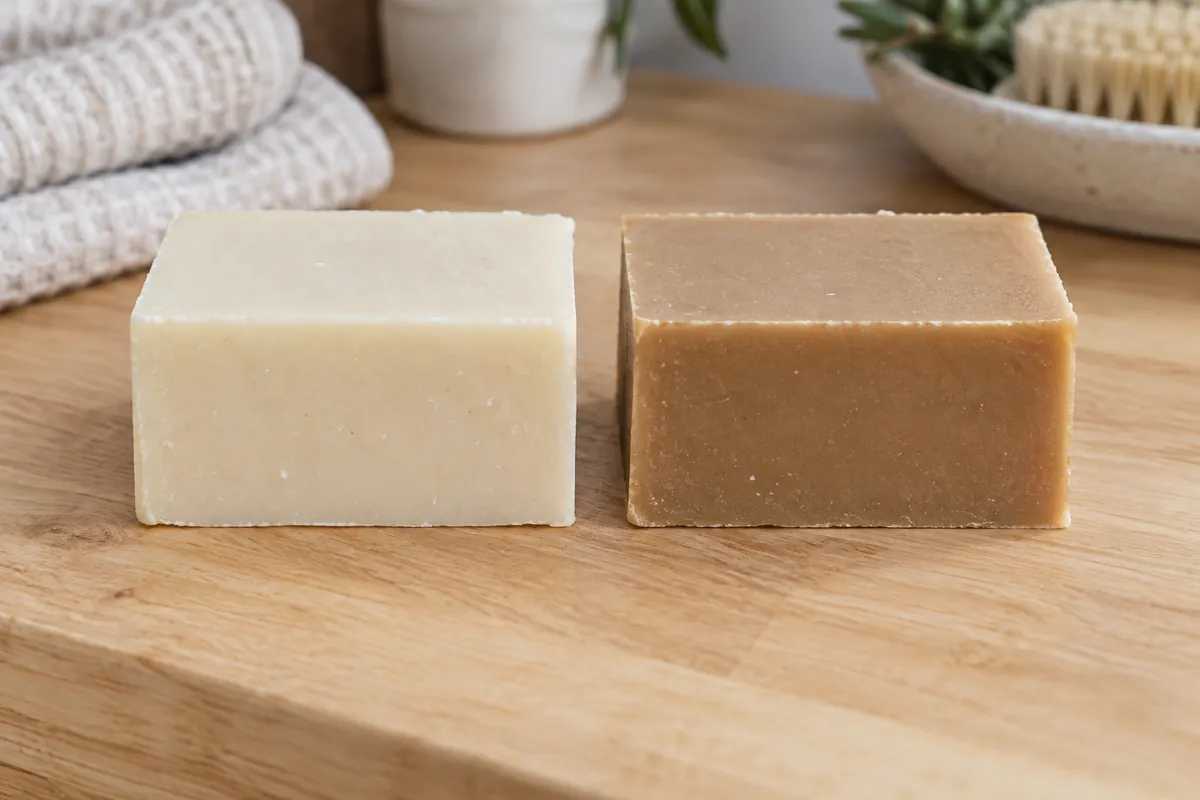 The same soap with and without a vanilla fragrance, a few weeks after pouring.
Fading, and how to anchor a scent
Scent is strongest in fresh soap and fades as it cures (Letcavage and Harden), and the lightest notes go first. Faiola finds ordinary distilled orange oil vanishes from cold process soap, while redistilled orange, sold as 5-fold or 10-fold, lasts. The cure for fading is to anchor the light notes to heavier ones: pair a top note with middle and base notes (Cable), use patchouli or cedarwood as a base (Fisher), or, for lemon, blend 85 % lemon oil with 15 % litsea, which Fisher finds holds it better.
If scent pools as oil on the top of the soap or in pockets inside it, it was not mixed in fully or there was too much; Faiola cuts the amount by a tenth next time.
The flash point myth
A scent oil’s flash point is the lowest temperature at which it gives off enough vapour to form a mixture with air that a flame could ignite (OSHA). It is a fire-safety figure for storing and shipping the oil. It is not a boiling point, and it is not the temperature at which a scent “burns off” in soap: nothing in a soap pot ignites without a flame, and scent evaporates at every temperature, faster when warmer. d-Limonene, a major component of citrus peel oils, has a flash point of 48 °C (ILO/WHO), yet citrus fades from cold process soap because it is volatile (Failor), over the weeks of cure long after the batter has cooled; a threshold has nothing to do with it. Where the number is useful is hot process, where the soap is cooked: Fisher suggests scents with flash points above 66 °C (150 °F), added after the cook, because a low flash point marks an oil that evaporates easily.
Blending
Perfumers sort scents into top notes, smelled first and gone first (citrus, mints, eucalyptus); middle notes, the body of a blend (lavender, geranium, rosemary, tea tree); and base notes, which last and hold the others (patchouli, cedarwood, vetiver, sandalwood) (Cable; Fisher). Fisher’s starting point is 30 % top, 50 % middle and 20 % base, adjusted by nose. Cable keeps her blends to four oils or fewer. Mix a trial in drops first, let it sit a few hours and smell it again, and write down what you did (Fisher); Failor tests blends with an eyedropper, one drop standing for each teaspoon.
Five blends to start with
Each blend is 30 g of essential oil for 1000 g of oils, 3 % of the oils, worked in our reference bar; halve the grams for 500 g of oils.
| Blend | Oils per 1000 g of soap oils | Share of IFRA allowance used |
|---|---|---|
| Lavender and cedar | lavender 20 g, Atlas cedarwood 10 g | none (no limit on either) |
| Orange, litsea and cedar | sweet orange (5-fold) 18 g, litsea 6 g, Atlas cedarwood 6 g | 24 % (the litsea) |
| Peppermint and lavender | peppermint 10 g, lavender 20 g | none (no limit on either) |
| Lemongrass, geranium and cedar | lemongrass 10 g, geranium 8 g, Atlas cedarwood 12 g | about 45 % |
| Tea tree and lavender | tea tree 10 g, lavender 20 g | 20 % (the tea tree) |
Shares worked with the conservative check above. Every one of these still names allergens on an EU label, and the lavender, orange, lemongrass, geranium, peppermint and Atlas cedarwood are named as oils in their own right.
The first is a forgiving place to start: neither oil has a limit, and Faiola lists both among the essential oils that behave well in cold process. The second anchors orange with litsea and cedar, so it outlasts orange alone. The third is strong, so keep the peppermint to a third. The fourth shows how quickly citral adds up: 10 g of lemongrass is already two-fifths of the allowance.
Our finished recipes put these limits to work. The cedarwood and lavender bar is the first blend exactly. The tea tree and lemongrass bar keeps lemongrass to 1 % of the oils, and the eucalyptus and spearmint shower bar holds spearmint to 0.25 % of the oils, about 0.17 % of the soap, inside its maximum. The men’s cedar and orange bar pairs sweet orange with Virginian cedarwood.
Recipes to try
All recipesSources
- Guidance for the use of IFRA Standards, 51st Amendment . International Fragrance Association (IFRA) , 2023. Product categories (soap is category 9); section 7.12 on the safe use level of a natural material; sections 7.14 and 7.15 on certificates.
- IFRA Standards: Carvone (2020), Citral (2020), Geraniol (2023), Methyl eugenol (2023) . International Fragrance Association (IFRA) , 2020, 2023. Category 9 limits: carvone 0.18 %, citral 1.2 %, geraniol 2.8 %, methyl eugenol 0.0017 %.
- Annex on contributions from other sources, 51st Amendment . International Fragrance Association (IFRA) , 2023. Typical levels of restricted substances in essential oils.
- Commission Regulation (EU) 2023/1545 on the labelling of fragrance allergens in cosmetic products . European Commission, Official Journal of the European Union , 2023.
- Regulation (EC) No 1223/2009 on cosmetic products, as it applies in Great Britain, Annex III . legislation.gov.uk .
- 29 CFR 1910.1200 Appendix B.6: Flammable liquids . US Occupational Safety and Health Administration .
- d-Limonene, International Chemical Safety Card, via PubChem CID 440917 . ILO/WHO; US National Library of Medicine .
- 21 CFR 169.175: Vanilla extract . US Food and Drug Administration, Code of Federal Regulations .
- Soap Crafting . Anne-Marie Faiola, Storey Publishing , 2013. Usage rates, adding fragrance at thin trace, vanillin, oils that fade, testing new fragrances.
- The Complete Photo Guide to Soap Making . David Fisher, Creative Publishing International , 2018. Starting rates, scent categories and blending, preventing seizing, flash point in hot process.
- The Natural Soap Making Book for Beginners . Kelly Cable, Althea Press , 2017.
- Making Transparent Soap . Catherine Failor, Storey Publishing , 2000.
- Smart Soapmaking . Anne L. Watson, Shepard Publications , 2013.