Unscented shampoo bar
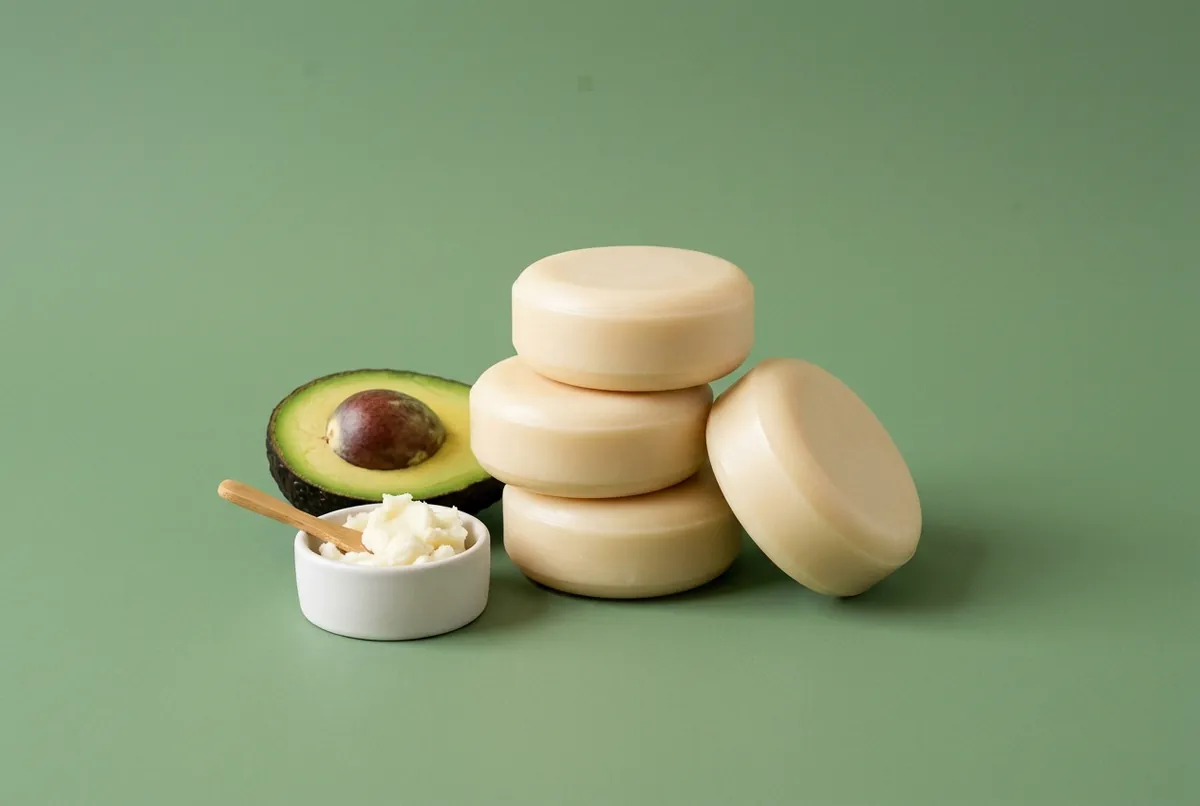
A plain soap shampoo bar with no scent: a quarter coconut oil for lather, 15 % castor oil to hold it, and olive, avocado and shea for mildness. Small round bars are easy to rub over wet hair, and a vinegar rinse afterwards lifts the film soap leaves in hard water.
- Skill
- Beginner
- Method
- Cold process
- Batch
- 500 g of oils about 709 g of batter
- Hands-on
- 45 min
- Cure
- 6 weeks
- Gel phase
- Either way gel or not, both work
What you need
For 500 g of oils, which fills round silicone cavity moulds holding about 750 ml in all, such as eight cavities of 90 to 100 ml. Weigh everything, liquids included.
| Coconut Oil · 25.0 % | 125 g | 4.41 oz |
| Olive Oil · 30.0 % | 150 g | 5.29 oz |
| Castor Oil · 15.0 % | 75 g | 2.65 oz |
| Shea Butter · 15.0 % | 75 g | 2.65 oz |
| Avocado Oil · 15.0 % | 75 g | 2.65 oz |
| Sodium hydroxide (NaOH) · the lye, 100 % pure | 68.8 g | 2.43 oz |
| Distilled water · for a 33 % lye solution | 139.8 g | 4.93 oz |
| Vinegar (5 %), for the rinse · in a mug of water, about 250 ml, poured through the hair after each wash | 1 tbsp |
- Superfat
- 5 %
- Temperatures
- Oils and lye solution each at about 38 °C (100 °F)
Method
-
Get ready
Put on splash goggles, gloves and long sleeves, open a window and keep children and pets out of the room. Stand the cavity moulds on a tray so you can move them once they are full. -
Weigh everything
Weigh 125 g coconut oil and 75 g shea butter into the pot, and 150 g olive oil, 75 g avocado oil and 75 g castor oil into a jug. Weigh 139.8 g distilled water into a heatproof jug and 68.8 g sodium hydroxide into a dry container. -
Make the lye solution
At the open window, pour the sodium hydroxide slowly into the water, never the water onto the lye, and stir until clear, keeping your face out of the vapour. Leave it to cool to about 38 °C (100 °F), labelled and out of reach. -
Melt the oils
Melt the coconut oil and shea butter on a low heat until just clear, then stir in the olive, avocado and castor oils and let them settle at about 38 °C (100 °F). -
Blend to light trace
Pour the lye solution into the oils and stick blend in short bursts, stirring between them. Castor oil speeds trace, so stop as soon as the batter is like thin custard and a drizzle leaves a faint line on the surface. -
Fill the moulds
Pour the batter into the cavities while it is still fluid, then tap the tray on the worktop to release air bubbles. -
Leave to set
Leave the moulds uncovered, or loosely covered with a sheet of card, somewhere warm and still. Small bars rarely gel, which is fine. -
Unmould
After 48 hours, put your gloves back on and press the bars out of their cavities. If they dent or stick, give them another day. -
Cure
Stand the bars on a rack with air around them for six weeks, turning them now and then. A young shampoo bar is harsher and wears away quickly. -
Wash your hair
Wet your hair right through, then rub the bar over it a few times or lather it between your hands, and work the lather down to the scalp. -
Rinse well
Rinse for longer than you would after a liquid shampoo, since any soap left in the hair is what hard water turns into a dull film. -
Use the acid rinse
Stir 1 tbsp (15 ml) of ordinary 5 % vinegar into a mug of water, about 250 ml, pour it through your hair and work it in, then rinse with water if you like. Keep it out of your eyes; the smell goes as your hair dries. -
Keep the bar dry
Leave the bar on a draining dish between washes, out of the stream of the shower.
Tips
- Your water decides more than the recipe does. Calcium and magnesium in hard water turn some of any soap into a waxy film on hair; that film, not a detox or a transition, is what a heavy, dull feel in the first weeks usually is, and the acid rinse lifts it. Your water supplier publishes its hardness, and if yours is very hard, a syndet bar may suit you better.
- To scent it, stir 10 to 15 g of essential oil, 2 to 3 % of the oils, into the batter at light trace; shampoo sits in IFRA category 9 like bar soap. Our nettle shampoo bar uses rosemary and cedarwood, and the shampoo bar for normal to oily hair lemon, lavender and rosemary.
- A quarter teaspoon of citric acid, about 1 g, in the same mug of water makes a rinse with no smell. It is a little stronger than the vinegar rinse.
- The list under Try it differently swaps the avocado oil for rice bran, argan, camellia or moringa oil and opens each in the calculator; the lye moves by less than half a gram.
The oils
| Oil | Share |
|---|---|
| Coconut Oil | 25.0 % |
| Olive Oil (virgin / refined / olive oil) | 30.0 % |
| Castor Oil | 15.0 % |
| Shea Butter | 15.0 % |
| Avocado Oil | 15.0 % |
How it is made
| Process | Cold process |
| Alkali | NaOH |
| Superfat | 5 % |
| Water | lye water at 33 % |
| Iodine value | 61 |
| INS | 142 |
Why make it
A plain shampoo bar for anyone who wants to wash their hair with true soap and no perfume. A quarter coconut oil gives quick lather, castor oil holds it, and olive, avocado and shea keep it mild: cleansing 17 and conditioning 61 on our scale. Many makers choose a shampoo bar to do without plastic bottles, and some people use nothing else for years. The chemistry sets the limits. Soap is alkaline, about pH 9 to 10 in solution, and the higher the pH the more negative charge hair carries, which means more friction and tangles. In hard water, soap also leaves a dull film of calcium soap on hair, which is why a vinegar or lemon rinse has gone with soap shampoo for generations. In soft water it works well; in very hard water a syndet bar may suit you better.
Sources
- Evaluation of pH of Bathing Soaps and Shampoos for Skin and Hair Care · Tarun J. et al., Indian Journal of Dermatology 59(5):442–444, 2014
- The Shampoo pH can Affect the Hair: Myth or Reality? · Gavazzoni Dias M.F.R. et al., International Journal of Trichology 6(3):95–99, 2014
- The Role of Detergents in Shampoos · Powers D.H. and Fox C., Journal of the Society of Cosmetic Chemists 10(2):116–122, 1959
What tradition, makers' experience and research say about soaps like this, each labelled for what it is. It is not medical advice, and no soap treats a skin condition: if you have one, ask a doctor or pharmacist.
What the numbers say
- Lauric acid 12.3 %
- Myristic acid 4.7 %
- Palmitic acid 9.4 %
- Stearic acid 8.7 %
- Ricinoleic acid 13.3 %
- Oleic acid 39.6 %
- Linoleic acid 7.7 %
- Other 5.6 %
Saturated : unsaturated 38 : 62
Computed from the fatty acids of the fats above. The bands are what the craft has settled on, not chemistry — a bar outside one is not wrong.
Try it differently
9 variationsThe same soap with one thing moved. Each opens in the calculator ready to change again.
- Rice Bran Oil instead of Avocado Oil
- Argan Oil instead of Avocado Oil
- Camellia Oil (Camellia japonica seed oil) instead of Avocado Oil
- Moringa Oil instead of Avocado Oil
- 8 % superfat
- Rice Bran Oil instead of Avocado Oil and 8 % superfat
- Argan Oil instead of Avocado Oil and 8 % superfat
- Camellia Oil (Camellia japonica seed oil) instead of Avocado Oil and 8 % superfat
- Moringa Oil instead of Avocado Oil and 8 % superfat
From the guides
All guides
Shampoo bars: what true soap does to hair
Soap shampoo bars, honestly: what alkaline soap and hard water do to hair, why an acid rinse helps, when a syndet bar is the better choice, and a recipe.
Soap in hard water: scum, chelators and rinse
Why soap turns to scum in hard water, how much soap each litre wastes, what a chelator in the bar can and cannot do, and why coconut soap copes best.
Soap pH: what's normal, and how to test a bar for free lye
Why a cured bar reads about pH 9 to 10, why pH can't tell a mild bar from a lye-heavy one, and what phenolphthalein, strips, meters and the zap test show.
Where these proportions come from
IFRA category 9 for fragrance, as a rinse-off hair product.
Our own construction: coconut oil held to a quarter of the oils for lather without harshness, castor oil at 15 % to hold the lather, and olive, avocado and shea for mildness, at an everyday 5 % superfat. A true soap shampoo bar is alkaline and behaves nothing like a syndet bar, so an acid rinse is part of using it.