In short
- True soap is alkaline, about pH 9 to 10 in solution. Above about pH 3.7 hair carries a negative charge, and the higher the pH the more of it: more friction, more tangles, more frizz.
- In hard water, soap forms calcium and magnesium soap that settles on hair as a dull, waxy film. The so-called transition period is usually that film building up; there is no detox.
- An acid rinse afterwards, such as a tablespoon of vinegar in a mug of water (about pH 3), helps lift the film and brings the hair's surface back towards its own pH.
- Syndet bars, made from synthetic surfactants, form no scum and can sit near pH 5.5. Our syndet calculator does their arithmetic.
- A soap shampoo bar wants moderate coconut, 10 to 15 % castor oil and an ordinary superfat. Our recipe is below.
On this page
A shampoo bar made the soapmaker’s way, from oils and lye, is soap. Nothing in the recipe changes that: it is alkaline, and in hard water it forms scum. Hair can do perfectly well with it, but only if you understand those two facts and work with them. This guide is honest about both, and about when a syndet bar will serve you better.
Two products called shampoo bar
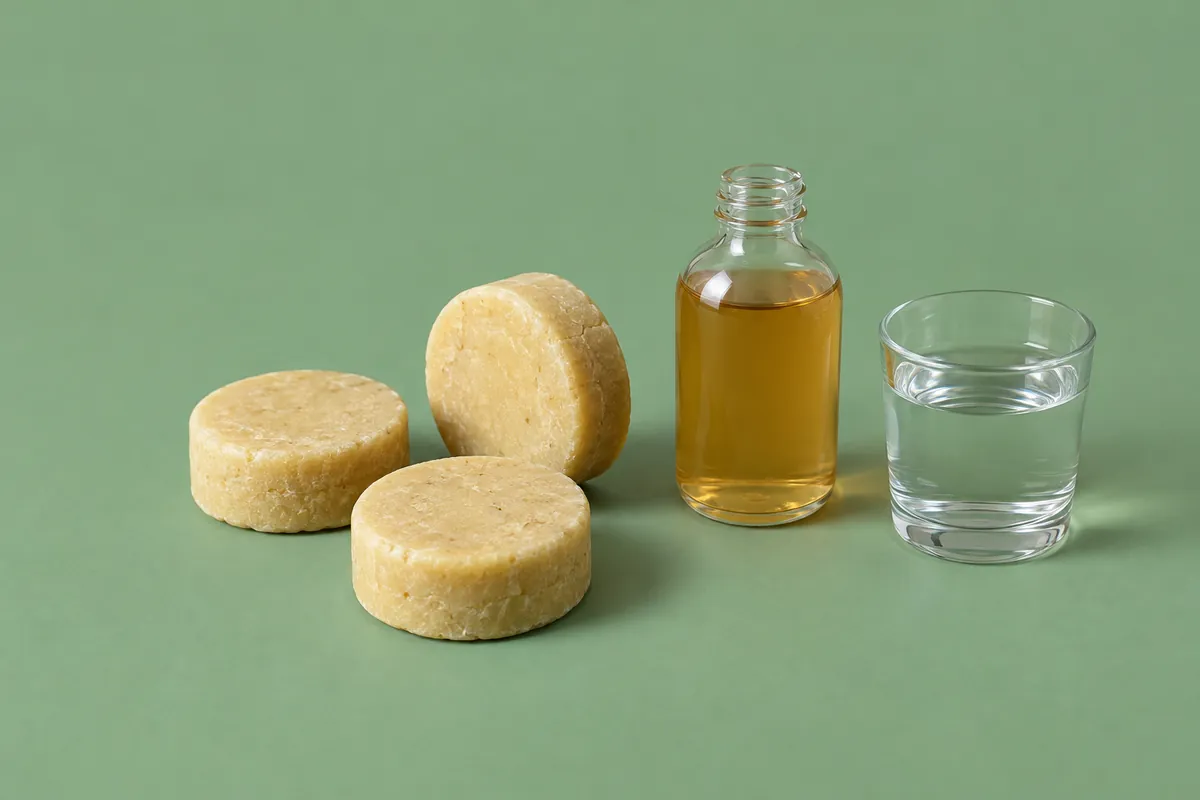
Many shampoo bars sold in shops are not soap at all. They are syndet bars: synthetic surfactants such as sodium cocoyl isethionate, pressed or moulded with binders and conditioners. A soap shampoo bar is the cold process bar on this page: the sodium salts of fatty acids, with the glycerin and superfat that come with them.
The pH is where they part company. Soap is the salt of a weak acid and a strong base, so a solution of it is alkaline: 53 of 64 bath soaps in one survey measured pH 9 to 10 as a 1 % solution. That is what soap is, not a sign of free lye, and it cannot be formulated away. Add enough acid to a soap to bring it to pH 5 and it stops being soap; it turns back into fatty acid. The soap pH guide explains why. Syndets are usually made at pH 5.5 to 7, and some at 5.0 to 5.5.
What soap’s pH does to hair
Hair is protein, and like any protein it carries electric charge that depends on the pH around it. Its isoelectric point, the pH at which the charges balance, is about 3.7, a little lower or higher depending on how much natural oil sits on the fibre. Above that pH the fibre carries a net negative charge, and the higher the pH, the more of it. Charged fibres repel one another and drag against each other and the comb: more friction, more static, more tangles and frizz. A review in the International Journal of Trichology argues that over time the extra friction can wear the cuticle and break fibres, and recommends that shampoos stay at or below pH 5.5.
Be clear about what that rests on. The review surveyed the pH of 123 shampoos but measured no hair and tested no soap; its case is built on hair chemistry rather than on a trial. The direction is not in doubt. How much it matters over months of washing with soap has been studied far less than the confident posts on either side suggest.
Hard water and the waxy film
The bigger problem is usually the water. Calcium and magnesium in hard water react with soap to make calcium and magnesium soaps, which do not dissolve. In a bath they are the grey ring; in hair they are a film that builds up wash after wash. Two cosmetic chemists described both sides in 1959. In soft water, they wrote, a well-formulated soap shampoo gives “a rich, wet, dense, copious lather, which rinses easily and leaves the hair lustrous and manageable”. In hard water, lime soaps are “precipitated onto the hair”, leaving it tacky, hard to comb and dirtier-looking. In their panel test in water of 150 to 300 ppm hardness, the plain soap shampoo lathered well but came last for lustre, manageability and cleanliness.
That is why synthetic shampoos took over. Procter & Gamble launched Drene, the first detergent-based shampoo, in 1934, and synthetics grew because they lathered in hard water and left no scum on the hair.
Your water supplier publishes its hardness. On the US Geological Survey’s scale, water with up to 60 mg of calcium carbonate per litre is soft, 61 to 120 moderately hard, 121 to 180 hard and above 180 very hard. The softer your water, the better a soap shampoo bar works.
The transition period
People switching to soap shampoo bars are often told to expect a transition of a few weeks while the hair “detoxes” from commercial shampoo, silicones or its own oils. We found no study that describes any such process. The heavy, waxy, dull feel that prompts the explanation matches the lime soap film the 1959 paper describes, and a film does not wear off with time: it builds up. What changes it is softer water, a thorough rinse, and an acid rinse after washing.
The acid rinse
The acid rinse is as old as the soap shampoo. The same 1959 paper records that women “corrected this condition by following the soap shampoo with a lemon or vinegar rinse”, and that the rinses “helped to remove the hard water soaps, leaving the hair more nearly lustrous”. The chemistry is simple: acid turns calcium soap back into free fatty acid and a soluble calcium salt, which rinse away far more easily than the scum. A rinse below hair’s isoelectric point also takes away the surface’s negative charge, so hair combs more easily. Reviews add that the cuticle scales lie flatter, which is a reasonable explanation more than a measured one.
The usual acids are vinegar and citric acid. A tablespoon (15 ml) of ordinary 5 % vinegar in a mug of water, 250 ml, gives a rinse of about pH 3; Grosso uses much the same, a tablespoon of herb-infused vinegar to 8 fl oz (237 ml) of water, at least once a week. Cable sprays half vinegar and half water, which is about pH 2.6 and stronger than you need, and Cavitch’s rinse was the same half and half, cider vinegar or lemon juice in boiled, cooled water. A quarter teaspoon of citric acid, about 1 g, in the same mug gives about pH 2.5, stronger than the vinegar rinse, with no smell. Pour it through the hair after rinsing out the soap, work it in, and rinse again with water if you like; vinegar’s smell goes as hair dries. Keep it out of your eyes, like the soap itself.
Formulating a soap shampoo bar
A shampoo bar is formulated like any bar, with the balance moved towards lather and away from harshness. The 1959 paper put it in one line: a soap shampoo needs “the proper ratio of C12 to C18 fatty acids”, the lauric acid of coconut oil for lather and the oleic and stearic acids of olive oil and shea butter for mildness.
- Coconut oil for lather, but held back. Coconut soap cleanses hardest and lathers most. Faiola finds that above 25 % of the oils some people feel it drying, and Fisher notes that most makers stay under about 30 %. A quarter of the oils gives a shampoo bar plenty of lather.
- Castor oil to hold the lather. Castor’s ricinoleic acid soap makes lather stable and creamy. Shampoo bars commonly use 10 to 15 %, and above about 20 % many makers find a bar stays soft and tacky however long it cures. Cavitch’s 1995 shampoo bars went higher, 19 and 28 %, with more lye than her bath bars: our calculator puts them at about a 5 and a 3 % superfat, against 14 % for her Soap Essentials Bar. Her reason, that castor needs more lye than its saponification value says, is wrong, since the value already accounts for it. She found the 28 % bar hardened quickly but preferred the 19 % one, because “less castor oil makes the soapmaking mixture less temperamental”.
- Liquid oils and a butter for mildness. Olive, avocado or rice bran oil and some shea butter make up the rest.
- An ordinary superfat. Hair does not need much of the spare oil that skin likes. We use an everyday 5 %; Cable’s shampoo bars go as high as 15 %.
A chelator in the bar, such as tetrasodium EDTA, is there to protect the bar itself, binding the metal traces that speed rancidity. It cannot soften the water you rinse with: Zussman pointed out in 1949 that a sequestrant in a soap shampoo “is not adequate … to neutralize the hardness of all the rinse water used”. Tetrasodium EDTA is dosed at 0.1 to 0.2 % of the batch, 0.7 to 1.4 g in the whole batch below, against litres of rinse water. For hair in hard water, the acid rinse does far more. The chelators guide covers what they do in the bar.
The recipe: shampoo bar
This is our shampoo bar for 500 g of oils. It makes 708.6 g of soap, about seven bars of 100 g; small round moulds make a bar that is easy to hold and rub over wet hair.
| Ingredient | Grams | Ounces |
|---|---|---|
| Olive oil | 150 | 5.29 |
| Coconut oil | 125 | 4.41 |
| Castor oil | 75 | 2.65 |
| Shea butter | 75 | 2.65 |
| Avocado oil | 75 | 2.65 |
| Sodium hydroxide (100 %) | 68.8 | 2.43 |
| Water | 139.8 | 4.93 |
5 % superfat, a 33 % lye concentration. Hardness 35, cleansing 17, conditioning 61, bubbly 30, creamy 31: the quality numbers are a craft convention for comparing recipes, not a verdict on how a bar treats hair.
Open the shampoo bar. 500 g of oils at a 5 % superfat take 68.8 g of sodium hydroxide and 139.8 g of water for a 33 % solution.
Open it in the calculatorMake it as any cold process bar, following the first batch guide. Castor oil speeds trace, and Corley Barto soaps her castor recipes cooler than the rest, at about 38 °C (100 °F), so have the mould ready. Avocado oil can be swapped for rice bran, argan, camellia or moringa oil; run the swap through the calculator, which will move the lye by less than half a gram. Cure it the full four to six weeks: a young bar is harsher and wears away faster.
For fragrance, shampoo sits in the same IFRA category as bar soap, category 9, and the scenting guide covers the limits.
How to use a soap shampoo bar
Wet the hair thoroughly first. Rub the bar between your hands, or directly over the hair a few times, and work the lather through to the scalp. Rinse for longer than you would with a liquid shampoo, since any soap left behind is what hard water turns into film. Then use the acid rinse, and rinse again if you like. Let the bar dry between uses on a draining dish.
When a syndet bar is the better choice
If your water is hard and you cannot soften it, or your hair is long and tangles easily, a syndet bar is the better tool. Syndets form no scum in hard water and can be made at pH 5 to 6, so they need no acid rinse. They tend to be gentler on eyes too, though mostly because of which surfactants they use: baby shampoos rely on amphoteric surfactants that sting less, and pH is only part of the story. Syndets are made by blending surfactants rather than saponifying oils, and their arithmetic is different: most surfactants are sold as solutions or flakes that are only partly active matter. Our syndet calculator converts raw-material weights to active surfactant, shows the charge split and counts the water the liquid ones bring.
Recipes to try
All recipesSources
- The Role of Detergents in Shampoos . Powers D.H. and Fox C., Journal of the Society of Cosmetic Chemists 10(2):116–122 , 1959. Soap shampoos in soft and hard water; lime soap film; lemon and vinegar rinses; why synthetic shampoos took over.
- Shampoo Formulation . Zussman H.W., Journal of the Society of Cosmetic Chemists 1(5):354–361 , 1949. Sequestrants in a soap shampoo cannot neutralise the hardness of all the rinse water.
- The Shampoo pH can Affect the Hair: Myth or Reality? . Gavazzoni Dias M.F.R. et al., International Journal of Trichology 6(3):95–99 , 2014. A narrative review with a survey of 123 shampoos; recommends shampoos at pH 5.5 or below.
- Evaluation of pH of Bathing Soaps and Shampoos for Skin and Hair Care . Tarun J. et al., Indian Journal of Dermatology 59(5):442–444 , 2014. 53 of 64 bath soaps between pH 9.01 and 10 as 1 % solutions.
- Chemical and Physical Behavior of Human Hair, 5th edition . Clarence R. Robbins, Springer , 2012. The isoelectric point of keratin fibres and how surface lipid shifts it.
- Skin Cleansing without or with Compromise: Soaps and Syndets . Mijaljica D., Spada F. and Harrison I.P., Molecules 27(6):2010 , 2022. Soap at pH 8.5 to 11; syndets at 5.5 to 7, some at 5.0 to 5.5.
- Essentials of Hair Care often Neglected: Hair Cleansing . Draelos Z.D., International Journal of Trichology 2(1):24–29 , 2010. Bar soap leaves a scum in hard water that is hard to rinse from hair; amphoteric surfactants in baby shampoo.
- A Company History 1837–Today . Procter & Gamble , 2006. 1934: Drene, the first detergent-based shampoo.
- Hardness of Water . U.S. Geological Survey, Water Science School .
- Guidance for the use of IFRA Standards (51st Amendment) . International Fragrance Association , 2023. Category 9: bar soap, shampoo of all types and rinse-off conditioner.
- Ionisation Constants of Organic Acids in Aqueous Solution (IUPAC Chemical Data Series 23) . Serjeant E.P. and Dempsey B., Pergamon, via PubChem , 1979. Acetic acid pKa 4.76 at 25 °C.
- The Natural Soap Book . Susan Miller Cavitch, Storey Publishing , 1995. Vegetable and Tropical Shampoo Bars with 28 and 19 % castor and extra lye; the mistaken claim that castor needs more lye than its SAP value; a hair rinse of equal parts cider vinegar or lemon juice and water.
- The Everything Soapmaking Book, 3rd edition . Alicia Grosso, Adams Media , 2013. Herbal vinegar rinse, 1 tablespoon per 8 fl oz of water, at least weekly after soap shampoo.
- Soap Crafting . Anne-Marie Faiola, Storey Publishing , 2013.
- The Complete Photo Guide to Soap Making . David Fisher, Creative Publishing International , 2018.
- The Natural Soap Making Book for Beginners . Kelly Cable, Althea Press , 2017.
- The Natural Soap Chef . Heidi Corley Barto, Ulysses Press , 2012.