In short
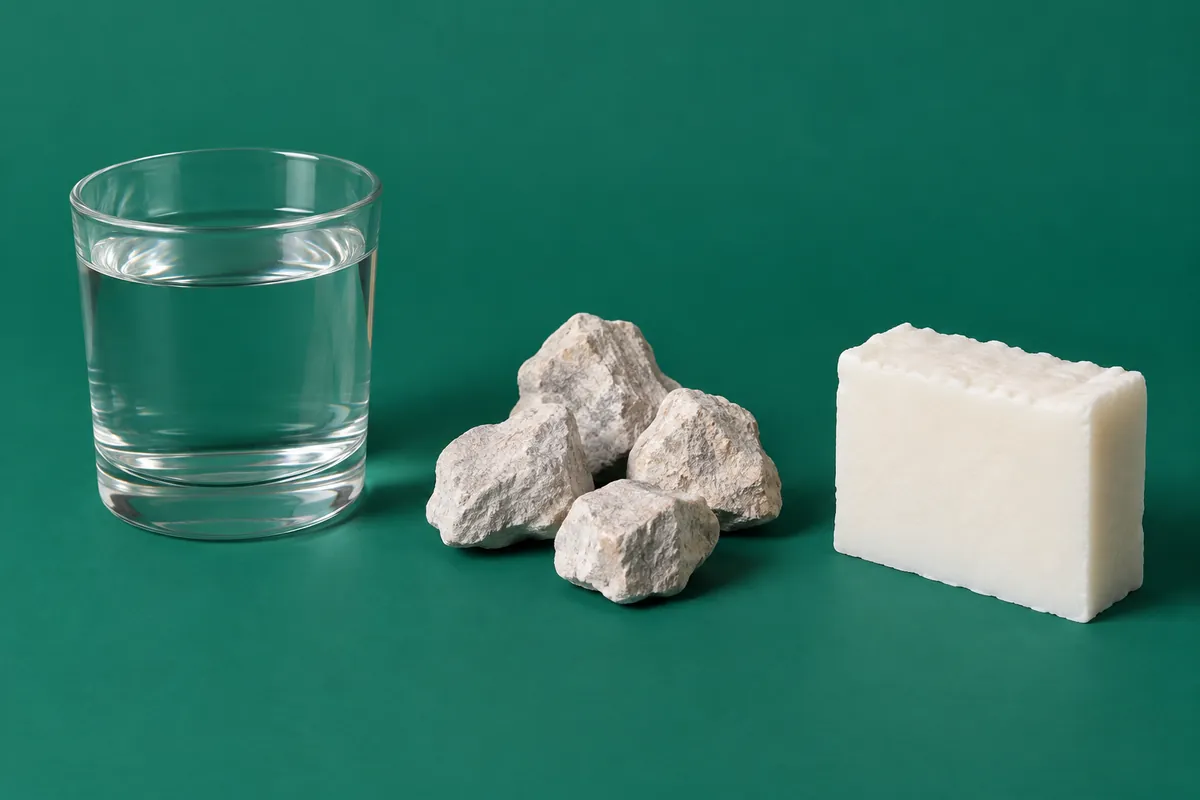
- Hardness is mostly calcium and magnesium. Each ion turns two soap molecules into insoluble calcium or magnesium soap, which is the scum.
- A litre of very hard water, 300 mg/L as calcium carbonate, turns about 1.8 g of olive oil soap into scum before any of that litre can lather.
- Coconut soap loses about a quarter less by weight, stays dissolved in brine that salts other soaps out, and dissolves readily in cool water. That is why marine soap was coconut soap.
- A chelator in the bar travels with the soap. At usual doses it can hold the hardness of a few millilitres of water per gram of soap, never the litres you rinse with.
- Hard tap water in the recipe costs well under a gram of soap in a 1.4 kg batch. The better reasons for distilled water are trace metals and clear transparent soap.
On this page
Water hardness is, by its oldest definition, a measure of what water does to soap. The World Health Organization’s background paper on it opens: “Water hardness is the traditional measure of the capacity of water to react with soap, hard water requiring considerably more soap to produce a lather.” This guide follows that reaction from the basin to the skin, puts numbers on it, and sorts what actually helps from what makers hope helps.
What hardness is
Hard water carries dissolved calcium and magnesium picked up from limestone and chalk, with smaller amounts of iron, manganese and other metals. It is reported as milligrams of calcium carbonate per litre, whatever the ions actually are, and the World Health Organization’s background document on hardness uses the usual bands.
| Hardness (mg/L as calcium carbonate) | Description |
|---|---|
| Below 60 | Soft |
| 60–120 | Moderately hard |
| 120–180 | Hard |
| Above 180 | Very hard |
WHO, Hardness in Drinking-water (2011). Your water supplier publishes the figure for your area.
A handy conversion: divide the figure by 100 to get millimoles of calcium and magnesium per litre. Water at 300 mg/L carries 3 mmol of them in every litre.
What happens when soap meets it
A soap molecule is a fatty-acid chain with a negative charge at one end, balanced in the bar by a sodium ion. In water the sodium drifts off. A calcium or magnesium ion carries two positive charges, so it pairs with two soap molecules at once, and the compound they make is insoluble:
2 soap⁻ + Ca²⁺ → calcium soap (solid)
That solid is the scum. Thomssen’s 1922 soapmaking manual calls these “insoluble soaps of lime and magnesia” and notes that they “act as inert bodies as far as their value for the common use of soap is concerned”. They do not lather or clean, and the soap that went into them is gone. Lather only builds once the hardness in the water has been used up, which is why hard water needs more soap for the same lather.
The loss is easy to work out. Two soap molecules per ion, times the weight of a soap molecule, gives the soap that each litre destroys.
| Hardness (mg/L) | Soap molecules lost per litre | Olive oil soap | Coconut oil soap |
|---|---|---|---|
| 60 | 1.2 mmol | 0.37 g | 0.27 g |
| 120 | 2.4 mmol | 0.73 g | 0.55 g |
| 180 | 3.6 mmol | 1.10 g | 0.82 g |
| 300 | 6.0 mmol | 1.83 g | 1.37 g |
Average molar masses from the middle of each oil’s SAP range on its page: about 305 g/mol for sodium soap of olive oil and 228 g/mol for coconut oil.
Where the scum forms depends on the ratio of soap to water. While you lather, a lot of soap meets a little water, the hardness in that water is used up at once and the rest of the soap foams. When you rinse, a trace of soap meets litres of hard water, and nearly all of it ends up as calcium soap: in the basin, as the grey ring the WHO calls “bathtub ring”, and on you.
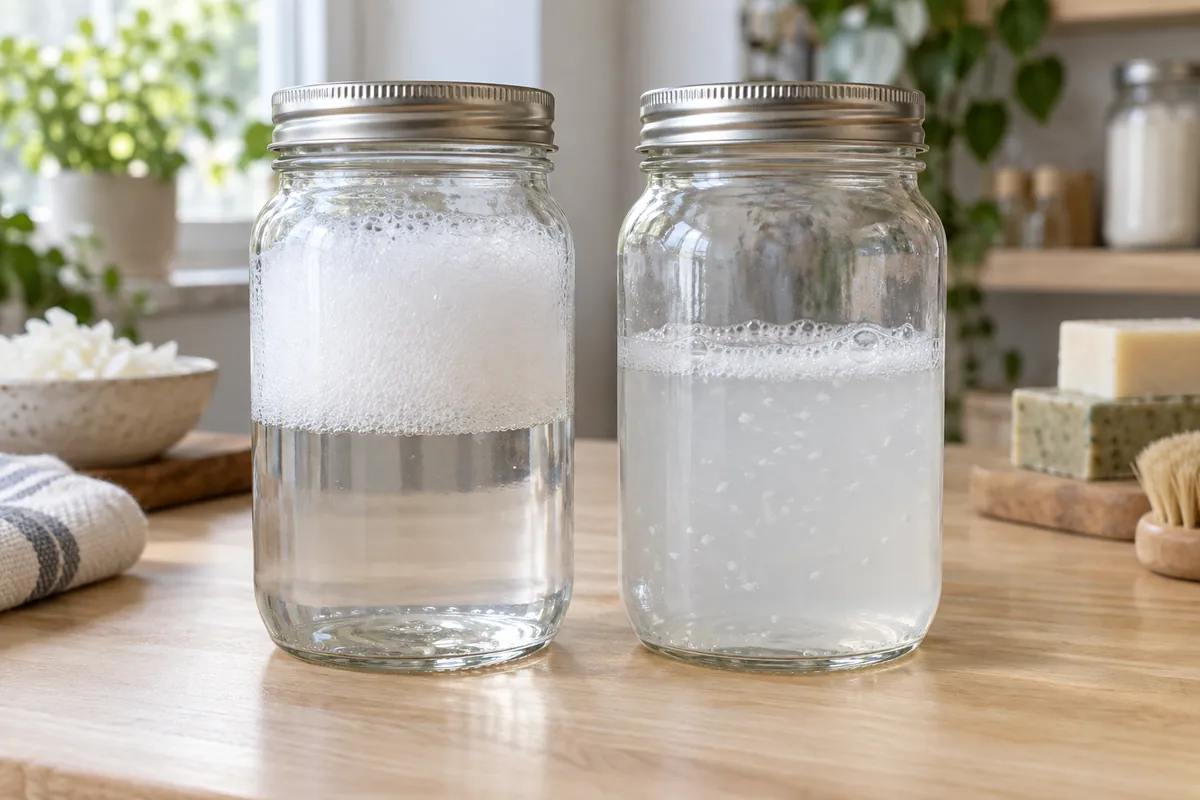 The same soap shaken in soft water (left) and hard water (right). The hard water turns cloudy with calcium soap and holds little foam.
On skin and hair
The scum does not all go down the drain. Tanaka and colleagues put it plainly: “Mineral ions in tap water react with fatty acids in soap, leading to the formation of insoluble precipitate (metallic soap) on skin during washing.” In the human part of their study, washing with ultra-pure soft water for four weeks reduced dryness and itching in people with dry skin.
The best measurements are for a synthetic surfactant rather than soap. Danby and colleagues washed test sites on the skin of 80 volunteers with sodium lauryl sulfate in waters of different hardness. Hard water at about 395 mg/L left 2.8 times as much surfactant on the skin as deionised water did, and ion-exchange softening to below 25 mg/L cut the residue sharply. The residue raised water loss through the skin and caused irritation, most in people with eczema who carry a filaggrin gene mutation.
What that means for everyday skin is less settled. In a randomised trial of 336 children with eczema living in hard water areas, installing an ion-exchange water softener gave no extra improvement in eczema severity over 12 weeks (Thomas and colleagues, 2011). Hard water leaves more surfactant on the skin; how much that matters varies from person to person, and the evidence that softening the water helps eczema is weak.
On hair the chemistry is the same, though we found no controlled study of soap bars on hair in hard water. Calcium soap left in hair is the reason an acid rinse is part of washing hair with true soap: a dilute acid, vinegar or citric acid in water, turns calcium soap back into free fatty acid and a soluble calcium salt that rinses away. The shampoo bar guide covers the rinse, and our shampoo bar recipe assumes one.
Why coconut soap copes best
Soap made from coconut or palm kernel oil has three advantages in hard or salty water, and they have different causes.
It stays dissolved in brine. Salt pushes soap out of solution; soap boilers use this, “salting out”, to separate their soap from the lye. Simmons and Appleton’s 1908 handbook records that tallow soap is the easiest to salt out, and that “soaps made from cocoa-nut and palm-kernel oils require very large amounts of salt to grain out thoroughly”, because they dissolve in weak brine. That is why marine soaps, made for washing in sea water on ships, were made of coconut or palm kernel oil: they are “soluble in brine” and so “capable of use in sea-water”. Thomssen gives the same reason for the name: marine soap readily forms “a lather with salt water”.
It loses less by weight. Hardness destroys soap molecule by molecule, and coconut soap’s molecules are lighter, so the same litre costs about a quarter less soap by weight: 1.37 g against 1.83 g of olive oil soap at 300 mg/L.
It dissolves in cool water. Below a temperature called the Krafft point, a sodium soap behaves as a poorly soluble salt and forms no micelles. For sodium laurate, the main soap of coconut oil, that point is about 25 °C (77 °F), and for myristate 45 °C (113 °F). For the palmitate and stearate that make up much of palm oil and tallow soap it is 60 °C (140 °F) and 71 °C (160 °F) (Raiguel and colleagues, 2025). A coconut bar puts soap into cool water quickly, enough to swamp the hardness in the lather and have some to spare.
None of this stops the scum. Sea water is the extreme case: at the reference composition it carries 0.41 g of calcium and 1.28 g of magnesium per kilogram, a hardness of about 6300 mg/kg as calcium carbonate, 35 times the WHO’s “very hard” threshold. Each litre of it can turn about 30 g of coconut soap into magnesium and calcium soap. Marine soap works because the lather on your skin holds a lot of soap in very little water, not because the chemistry spares it.
Coconut’s advantages come with its drawback: its soap cleanses harshly. Our pink salt spa bar, 70 % coconut oil, carries an 18 % superfat for that reason, and a 100 % coconut bar 20 %. Neither rinses clean in hard water: a salt bar makes scum like any other soap. The salt bar guide goes into the balance.
What a chelator in the bar can do
Chelators such as EDTA and sodium citrate bind calcium and magnesium, and soapmakers add them to bars partly for that reason. The trouble is the arithmetic. A chelator in a bar goes into the water only as fast as the soap does, and each molecule can hold at most one calcium or magnesium ion.
| In the bar | Dose in our additive database | Water at 300 mg/L it can soften, per gram of soap |
|---|---|---|
| Tetrasodium EDTA | 0.1–0.2 % of the bar (Dow) | about 1–2 mL |
| GLDA, 47 % liquid | 0.25 % of the bar | about 1 mL |
| Sodium citrate | 1.3–3.9 % of the oils (Classic Bells) | at most 10–30 mL |
One calcium or magnesium ion per chelator molecule. That is a ceiling: citrate binds calcium far more weakly than EDTA and holds less in practice. The citrate figures are for a 1000 g-oil batch of about 1.4–1.5 kg.
So a chelator in the bar cannot touch the rinse. EDTA at bar-soap doses is there for another job, binding the iron and copper that drive rancidity, which the antioxidants and chelators guide covers; Dow also lists poor foaming and rinsing among the problems metal ions cause in bar soap. Sodium citrate is the one makers dose for hardness, “more for hard water, less for soft” in the words of one supplier guide. But citrate is a weak chelator, and Nouryon, which makes a stronger one, reports that adding citrate to a liquid soap in medium-hard water had “limited benefit” in stopping the scum. No test of citrate in a handmade bar in hard water turned up in our search.
What does work acts on the water or on the chemistry of the wash:
- Softer water. An ion-exchange softener swaps calcium and magnesium for sodium, which soap tolerates. Danby’s residues fell sharply below 25 mg/L.
- An acid rinse, for hair especially, which lifts calcium soap already deposited.
- A different cleanser. Non-ionic surfactants do not react with hardness ions the way soap and other anionic surfactants do, Nouryon notes. Anionic ones are not immune: sodium lauryl sulfate was the surfactant Danby measured. If you want to build a bar that is not soap, the syndet calculator does the arithmetic.
Making soap with hard tap water
The water in a recipe is a different matter from the water you wash with, and hardness there is almost irrelevant. A 1000 g-oil olive soap at a 33 % lye concentration uses 261.2 g of water. At 300 mg/L that water carries 0.78 mmol of calcium and magnesium, enough to spoil 0.48 g of soap in a 1390 g batch: 0.03 %. It will not change the lather or the hardness of the bar. Nor is it the white powder on a curing bar, which is soda ash, formed from the lye and the air.
Two reasons for distilled water survive the arithmetic.
Trace metals. The US Environmental Protection Agency’s secondary standards, its guidelines for nuisance chemicals in drinking water, are 0.3 mg/L of iron and 1.0 mg/L of copper. At those levels the same 261.2 g of water brings 0.08 mg of iron and 0.26 mg of copper, which puts about 0.19 ppm of copper into the batch. That is close to the 0.2 ppm that Lever’s soap patent found enough to spoil colour and odour. Those are upper limits, not typical values: your supplier’s annual water quality report gives the real figures, and corroding copper plumbing, as the EPA notes, can add more. Iron from the tap matters less: the Codex standard lets a kilogram of virgin oil carry up to 5.0 mg of iron, more than sixty times what the water brings. Makers often blame tap water for orange spots. The numbers say it can contribute, through copper, but the oils bring metals of their own, and no controlled test that we know of has compared the two.
Clear soap. For transparent soap hardness does show. Simmons and Appleton warned that hard water “is liable to produce opaque streaks of lime soap”, and Failor calls for distilled or soft water in her transparent recipes.
Soapmakers have wanted soft water for their lye for well over a century: Simmons and Appleton asked for water “free from calcium and magnesium salts”. Distilled water costs little, removes the variable, and makes a recipe behave the same in every town. If you use tap water anyway, EDTA dissolved in it before the lye goes in will bind the metals it brings.
Recipes to try
All recipesSources
- Hardness in Drinking-water: background document for development of WHO Guidelines for Drinking-water Quality (WHO/HSE/WSH/10.01/10/Rev/1) . World Health Organization , 2011. Definition by soap consumption; soft below 60 mg/L, very hard above 180 mg/L; ion-exchange softening replaces calcium and magnesium with sodium.
- The Soap-Maker's Manual . E. G. Thomssen, D. Van Nostrand (Project Gutenberg edition) , 1922. Insoluble lime soaps in hard water; marine soap from coconut oil lathers in salt water.
- The Handbook of Soap Manufacture . W. H. Simmons and H. A. Appleton, Scott, Greenwood & Son (Project Gutenberg edition) , 1908. Coconut and palm kernel soaps need very large amounts of salt to grain out and are soluble in brine; soft water for the lye; hard water gives opaque streaks in transparent soap.
- Ultra-pure soft water ameliorates atopic skin disease by preventing metallic soap deposition in NC/Tnd mice and reduces skin dryness in humans . Tanaka A. et al., Acta Dermato-Venereologica 95 , 2015.
- The effect of water hardness on surfactant deposition after washing and subsequent skin irritation in atopic dermatitis patients and healthy control subjects . Danby S. G. et al., Journal of Investigative Dermatology 138 , 2018.
- A randomised controlled trial of ion-exchange water softeners for the treatment of eczema in children . Thomas K. S. et al., PLoS Medicine 8(2): e1000395 , 2011.
- Removal of lithium from aqueous solutions by precipitation with sodium and choline alkanoate soaps . Raiguel S., Avdibegović D., Binnemans K., Green Chemistry 27 , 2025. Table 1: Krafft points of sodium laurate, myristate, palmitate and stearate.
- The composition of Standard Seawater and the definition of the Reference-Composition Salinity Scale . Millero F. J. et al., Deep-Sea Research I 55, as tabulated in the TEOS-10 Manual (IOC Manuals and Guides 56), Table D.3 , 2008.
- Dissolvine GL technical brochure . Nouryon , 2022. Citrate of limited benefit against calcium soap scum; non-ionic surfactants do not react with hardness ions.
- VERSENE Chelating Agents for Personal Care Formulations . The Dow Chemical Company, Form No. 113-01504 , 2007.
- Secondary Drinking Water Standards: Guidance for Nuisance Chemicals . US Environmental Protection Agency . Iron 0.3 mg/L; copper 1.0 mg/L.
- Superfatted soap bar containing a synergistic preservative mixture of EHDP and EDTA (US 3,511,783) . Lever Brothers Company , 1970.
- Standard for Named Vegetable Oils (CXS 210-1999), 2015 print . Codex Alimentarius Commission (FAO/WHO) .
- Making Transparent Soap . Catherine Failor, Storey Publishing , 2000. Distilled or soft water for clear soap.
- Sodium citrate . Classic Bells (soapmaking supplier guide) . Secondary source for the craft dose: 1.3–3.9 % of the fats, more for hard water.