In short
- A 1 % solution of a cured bar reads about pH 9 to 10, a little higher if the soap is mostly olive oil or other long-chain fat. That is what soap is; a bar sold as pH-neutral is a synthetic detergent.
- pH barely registers the free lye that matters. One part per thousand of excess sodium hydroxide lifts the reading by about 0.3, less than the gap between a coconut soap and an olive soap.
- Phenolphthalein starts to turn pink at pH 8.2, so it colours any soap in water. A faint pink is normal; an instant, vivid magenta, especially in spots, is not.
- We don't recommend the zap test. It catches only a gross excess, and it puts soap on your tongue at the moment it is most likely to be caustic.
- A lye-heavy batch can be rescued only when you know how much lye went in. The calculator then tells you how much oil to add.
On this page
Soap is the salt of a fatty acid and a strong alkali, and in water every such salt makes the water alkaline. So a well-made bar never tests neutral, and a high pH on its own proves nothing. What you actually want to know is whether the bar holds free lye, sodium hydroxide that found no oil to react with. This guide explains what a normal reading is, why pH is a poor measure of free lye, and what each of the usual home tests can and cannot tell you.
Why every true soap is alkaline
A soap molecule is a fatty acid with its acidic hydrogen replaced by sodium, or by potassium in soft soap. Fatty acids are weak acids and sodium hydroxide is a strong base, so in water a small share of the soap takes a hydrogen back from the water, becoming fatty acid again and leaving a hydroxide ion behind. That hydroxide is why soapy water is alkaline, and it is there in a perfectly made bar with no free lye at all.
How alkaline depends on the fatty acids. Longer chains pack together in water, and packed together they hold on to that hydrogen more tightly, so their soaps take it back from the water more readily and read higher; each double bond in the chain brings the reading down a little. The differences are not small.
| Soap, 1 % in water | pH |
|---|---|
| Castor oil soap (sodium castorate) | 9.5 |
| Coconut oil soap (sodium cocoate) | 9.7 |
| Palm oil soap (sodium palmate) | 10.3 |
| Olive oil soap (sodium olivate) | 11.0 |
| Pure sodium stearate | 11.4 |
Figures Kevin Dunn presented in 2015 for 1 % solutions of pure soaps with no free lye, drawing on Kanicky and Shah’s measurements of fatty-acid pKa.
A cured bar reads a little lower than those pure soaps, and most sit between 9 and 10. When Tarun and colleagues tested 64 bath soaps as 1 % solutions, 53 read between 9.01 and 10. Dunn’s own cold-process bars drifted down as they aged, even sealed in a bag: olive oil soap from 11.4 to 10.3, palm from 10.3 to 10.2, coconut from 10.1 to 9.9, while castor stayed at 9.5. So expect a well-made bar to read about pH 9 to 10, and a bar made mostly from olive oil or other long-chain fat to read towards the top of that or a little above. Shop soaps vary more: in a Brazilian survey by Mendes and colleagues, most children’s bars read above 10, up to 11.55, and antibacterial bars 10.28 to 11.34. Skin’s own surface sits at about pH 5.5.
Why soap can’t be made pH-neutral
To bring soap down to pH 7 you would have to turn most of it back into fatty acid, which no longer dissolves or lathers like soap. Dunn tried gentler routes on finished cold-process bars, storing pieces in carbon dioxide and over vinegar. The vinegar did most, and it took olive oil soap only to 9.9 and castor soap to 8.8. His conclusion was that cold-process soap is very resistant to changes in pH.
Bars sold as pH-balanced or pH 5.5 are syndets, synthetic detergents such as sodium cocoyl isethionate; in the Mendes study a syndet bar read 5.81 and the liquid syndets 5.30 to 7.36. Under US rules (21 CFR 701.20) they are not “soap”, a word kept for products whose bulk and cleaning action are alkali salts of fatty acids. If a low-pH bar is what you want, the syndet calculator formulates one; cold-process soap cannot get there.
A high pH is not the same as free lye
Soap standards say this in their own way: they limit free alkali, not pH. The East African toilet soap standard, for example, allows at most 0.1 % free caustic alkali as sodium hydroxide, measured by ISO 456, and 0.2 % total free alkali as sodium oxide, measured by ISO 684, and sets no pH requirement at all.
The reason is that pH responds weakly to the amounts that matter. Classic Bells, working from Dunn’s book, estimates that a lye excess of 1 part per thousand raises a soap’s pH by about 0.3, and a large excess of 5 parts per thousand by about 0.7. Set that against the table above: a perfect olive oil soap reads 1.5 units higher than a perfect castor oil soap. A castor-rich bar with some free lye in it can read lower than a flawless castile.
Superfat does little to the reading either. The free oil sits beside the soap and neutralises nothing; the fatty acids the soap is made from set its pH. And the white soda ash that can form on a bar’s surface is sodium carbonate, itself alkaline (ISO 684 counts it in total free alkali), which is why any test belongs on a freshly cut face.
There is one reading that does mean something on its own. No pure soap in Dunn’s table reaches 12, so a 1 % solution that reads 12 or more has free alkali in it. Watson’s rule for strips agrees: above 12, don’t use the soap, don’t handle it bare-handed, and rebatch or discard it.
Measuring pH properly
If you test pH at all, test it in a way that can be compared:
- Make a 1 % solution. Dissolve 1 g of soap, shaved from inside the bar, in 99 g of distilled water that has been boiled and cooled. Boiling drives off carbon dioxide, which would otherwise pull the reading down; the standard laboratory guide, ASTM D1172, uses freshly boiled water and a fixed temperature for the same reason.
- Let it dissolve completely. Tarun’s group left their solutions 24 hours before measuring.
- Use a meter if you can. Calibrate it with pH 7 and pH 10 buffer solutions before each session and measure at room temperature.
- Compare like with like. A reading means most next to a known-good bar of the same recipe, tested the same way.
Test strips are a blunter instrument. They need a range running from at least 7 to 11, which rules out pool, aquarium and saliva strips, according to Watson. Classic Bells reports that cheap strips commonly read soap 2 to 3 units low and that even good ones resolve only half a unit. Strips can flag a grossly lye-heavy bar; they cannot tell a mild bar from a slightly lye-heavy one.
The phenolphthalein test
Phenolphthalein is an acid-base indicator: colourless in acid and neutral solutions, turning pink as the pH rises from 8.2 to about 9.8. Soap makers keep it as a 1 % solution in alcohol and put a drop on a freshly cut face of the bar.
Because a solution of well-made soap sits at about pH 9 to 10, above the point where the indicator starts to turn, a drop on a moist bar will often go faintly pink even when there is no free lye, especially on young soap that still holds a lot of water. What should worry you is an instant, vivid magenta, and above all one that appears only in spots or streaks: that is the look of free lye, or of a pocket of it.
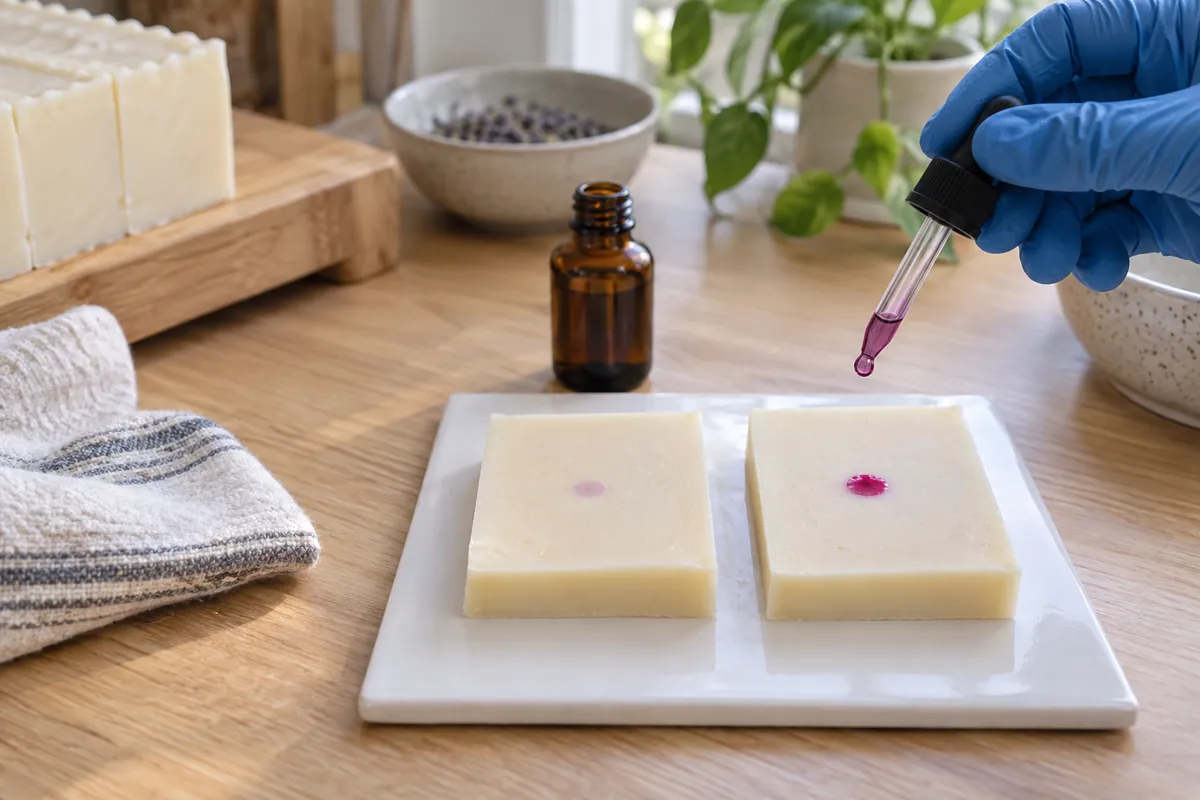 Phenolphthalein on fresh cuts. A faint pink that creeps in slowly shows up on well-made soap too; an instant, vivid magenta is worth investigating.
A laboratory gets a cleaner answer by changing the solvent. Dissolved in alcohol rather than water, soap barely splits back into fatty acid and hydroxide, so the indicator responds to free alkali alone. That is how the standard method works: ISO 456 dissolves the soap in neutralised ethanol and titrates the free caustic alkali with acid. Dunn used the same principle in his studies, and most of his cured bars turned out to hold no free alkali at all, only a trace of free fatty acid.
On a bar, the drop test cannot tell you how much free alkali there is, cannot tell hydroxide from carbonate, and says nothing about a pocket your knife did not cut through. Strong colours in the soap can hide it. And in strongly alkaline conditions the pink slowly fades as the indicator turns into a colourless form, a reaction chemistry students time in class, so read the colour straight away.
The zap test
The zap test is the old way of checking for free lye by feel: dampen a fingertip, rub it on the bar and touch the fingertip to the tongue. Free lye gives an immediate sharp sting, often likened to a battery, quite unlike soap’s ordinary bitter taste. We don’t recommend it, and neither does Watson, who calls tasting soap “the soapmaker’s version of Russian roulette”.
At best it shows a gross excess of free alkali at the spot you sampled. It cannot show a small excess, an amount, or anything about the rest of the bar. It is subjective, and it raises false alarms: compounds in cinnamon, clove, wintergreen and mustard oils and in ginger switch on TRPA1, one of the receptors behind a burning sensation, so a bar scented with them can sting for reasons that have nothing to do with lye.
When to test
Test once the reaction is over. In Dunn’s studies, with the soap kept warm for its first four hours, most of the saponification was over within 24 hours, and Faiola, citing his work, puts what happens over the following weeks at 3 % of the reaction or less. A bar tested in its first day is still finishing, so give it two or three days before judging it, as Classic Bells advises.
Curing does not make soap neutral: in Dunn’s storage experiments, bars kept sealed or in air stayed above pH 9, and the weeks of cure are mostly about water leaving the bar, as the curing guide explains. A cure does let a small excess of free lye fade. In Dunn’s low-water palm soap, the free alkali at the bottom of the bar fell from 4.9 to 0.9 parts per thousand over 60 days. So a young bar that tests strongly alkaline is worth testing again in a few weeks, as Classic Bells suggests. Pockets of lye and gross weighing errors are another matter.
If a batch is lye-heavy
The signs are physical as often as chemical: clear liquid in pockets or weeping from the bar, white gritty crystals, a hard, chalky or crumbly layer under an oily one, an instant magenta from phenolphthalein, or a 1 % solution reading 12 or more. First check the likely causes in the recipe itself, because they decide the fix: sodium hydroxide weighed from a potassium hydroxide figure (see the NaOH and KOH guide), the wrong purity, a misread scale, or an oil left out when weighing.
A set bar with pockets of liquid in it is not a rescue candidate. The lye in the pockets is concentrated and unevenly spread, and Faiola’s advice is to discard the batch: wear gloves, let the soap harden as far as it will, bag it well and dispose of it with household rubbish, following local rules. (Batter that separates while it is still soft can sometimes be cooked back together as hot process; the troubleshooting guide covers that.)
A batch that is evenly lye-heavy, from a weighing error you can put a number on, can be rebatched with extra oil for the free lye to react with. The calculator does the sum. Enter the oils you actually used, in grams, set the superfat you want, then add a line of oil and raise it until the calculator’s sodium hydroxide equals what you actually weighed. Suppose 1000 g of the 40 % olive, 30 % coconut and 30 % palm bar were made with 160 g of sodium hydroxide instead of 144.1 g: the soap is at a superfat of −5.5 %. Adding 123.4 g of olive oil during the rebatch brings the calculator’s figure at 5 % up to 160.0 g, so that is the oil the rescue needs; 61.3 g would only bring the superfat to zero.
Work out the rescue. With 123.4 g more olive oil, the calculator asks for 160.0 g of sodium hydroxide at a 5 % superfat, which is what went into the batch.
Open it in the calculatorThe oil has to react, so the grated soap and oil are heated together with a little water and cooked through like hot process, then moulded, left a few days and tested again. The rebatching guide covers the method. If you cannot say how much lye went in, there is nothing to calculate from: a laboratory can measure the free alkali by the ISO method, and otherwise the batch is best discarded.
Sources
- Evaluation of pH of Bathing Soaps and Shampoos for Skin and Hair Care . Tarun J. et al., Indian Journal of Dermatology 59(5):442–444 , 2014. 64 bar soaps at 1 %: 53 between pH 9.01 and 10.
- Critical assessment of the pH of children's soap . Mendes B. R. et al., Jornal de Pediatria 92(3):290–295 , 2016. 1 % solutions (Table 1): 47 children's bars 7.41–11.55, median 10.87; antibacterial bars 10.28–11.34; syndet bar 5.81; liquid syndets 5.30–7.36.
- Little White Lyes (Handcrafted Soap and Cosmetic Guild conference) . Kevin M. Dunn , 2015. pH of 1 % solutions of pure soaps (after Kanicky); phenolphthalein 8.2–9.8; cold-process bars stored sealed, in air, in CO2 and over vinegar.
- Effect of Degree, Type, and Position of Unsaturation on the pKa of Long-Chain Fatty Acids . Kanicky J. R., Shah D. O., Journal of Colloid and Interface Science 256:201–207 , 2002.
- Effect of Chain Length on the pKa of Fatty Acid Salt Solutions . Kanicky J. R. et al., Langmuir 16(1):172–177 , 2000.
- The "Water Discount" . Kevin M. Dunn, The Handcrafted SoapMaker (Handcrafted Soapmakers Guild), issue 2008-2 , 2008. Free alkali titrated in ethanol with phenolphthalein; under 1 ppt NaOH treated as safe.
- ISO 456:1973 Surface active agents: Analysis of soaps, Determination of free caustic alkali . International Organization for Standardization .
- ISO 684:1974 Analysis of soaps: Determination of total free alkali . International Organization for Standardization .
- EAS 186:2011 Toilet soap: Specification . East African Community , 2011. Free caustic alkali at most 0.1 % as NaOH; no pH requirement.
- ASTM D1172, Standard Guide for pH of Aqueous Solutions of Soaps and Detergents . ASTM International .
- 21 CFR 701.20, Detergent substances, other than soap, intended for use in cleansing the body . US Code of Federal Regulations .
- Kinetics of the fading of phenolphthalein in alkaline solution . Nicholson L., Journal of Chemical Education 66(9):725 , 1989.
- Noxious cold ion channel TRPA1 is activated by pungent compounds and bradykinin . Bandell M. et al., Neuron 41(6):849–857 , 2004.
- International Chemical Safety Card 0360: Sodium hydroxide . ILO / WHO , 2010.
- Smart Soapmaking . Anne L. Watson, Shepard Publications , 2013.
- Soap Crafting . Anne-Marie Faiola, Storey Publishing , 2013.
- Soap pH (Soapy Stuff) . Classic Bells . Secondary source: strip accuracy, and the size of the pH shift from excess lye, after Dunn.
- Zap test (Soapy Stuff) . Classic Bells . Secondary source: the fingertip method, the wait of two to three days, and the warning never to lick a bar.