Dead Sea mud facial bar
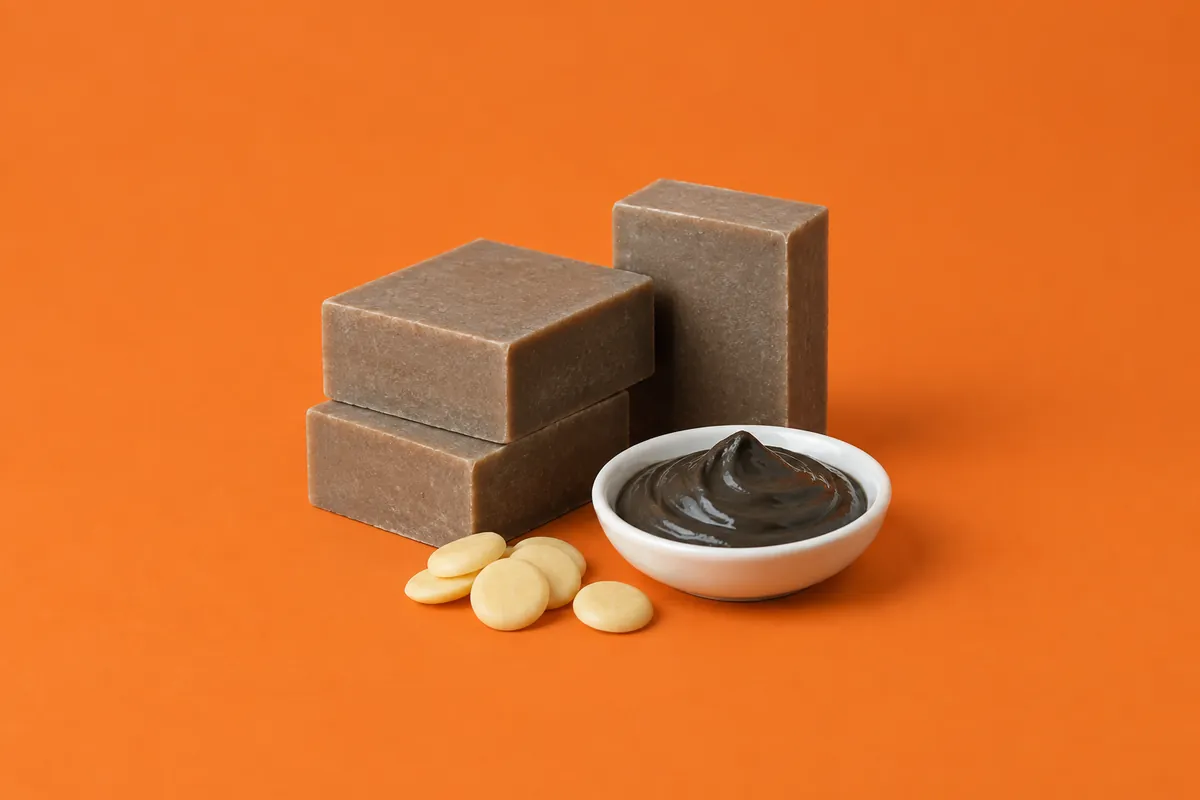
A soft grey face bar with a couple of spoonfuls of Dead Sea mud in a mild olive, cocoa butter and avocado base, lightly scented with lavender and vetiver. The mud is kept to a small dose on purpose: its salts draw water from the air, and too much makes a soft, damp bar.
- Skill
- Beginner
- Method
- Cold process
- Batch
- 1000 g of oils about 1498 g of batter
- Hands-on
- 1 h 10 min
- Cure
- 6 weeks
- Gel phase
- Either way gel or not, both work
What you need
For 1000 g of oils, which fills a 1.5 litre loaf mould. Weigh everything, liquids included.
| Olive Oil · 45.0 % | 450 g | 15.87 oz |
| Coconut Oil · 20.0 % | 200 g | 7.05 oz |
| Cocoa Butter · 15.0 % | 150 g | 5.29 oz |
| Avocado Oil · 15.0 % | 150 g | 5.29 oz |
| Castor Oil · 5.0 % | 50 g | 1.76 oz |
| Sodium hydroxide (NaOH) · the lye, 100 % pure | 135.8 g | 4.79 oz |
| Distilled water · 262 g for a 34 % lye solution, 40 g set aside | 302.2 g | 10.66 oz |
| Dead Sea mud · plain black mud, about 2 tbsp, loosened with 40 g of water held back from the recipe's water | 40 g | 1.41 oz |
| Lavender essential oil · 1.5 % of the oils, at trace | 15 g | 0.53 oz |
| Vetiver essential oil · 0.5 % of the oils, at trace | 5 g | 0.18 oz |
- Superfat
- 6 %
- Temperatures
- Oils and lye solution each at 35 to 40 °C (95 to 104 °F)
Method
-
Get ready
Open a window, put on splash goggles, nitrile gloves and long sleeves, and line or set out a 1.5 litre loaf mould. -
Weigh everything
Weigh 200 g coconut oil and 150 g cocoa butter into the pot, and 450 g olive oil, 150 g avocado oil and 50 g castor oil into a jug. Weigh 302.2 g distilled water into the lye jug and pour 40 g of it into a bowl for the mud, then weigh 135.8 g sodium hydroxide last, into a dry container. -
Make the lye solution
At an open window or under the extractor fan, pour the sodium hydroxide slowly into the water left in the lye jug, never the water onto the lye, and stir until clear. Keep your face out of the vapour and leave it to cool, labelled and out of reach. -
Loosen the mud
Stir 40 g (about 2 tbsp) Dead Sea mud into the 40 g of held-back water until it is smooth and pourable, with no lumps. -
Melt the fats
Melt the coconut oil and cocoa butter on the lowest heat, then pour in the olive, avocado and castor oils. Let the oils and the lye solution each come to 35 to 40 °C (95 to 104 °F); if the oils cool much below that, the cocoa butter can start to set and thicken the batter falsely. -
Blend to light trace
Pour the lye solution into the oils down the shaft of the stick blender, then pulse for a few seconds at a time, stirring between pulses. Stop at light trace, when the batter looks like thin custard and a drizzle leaves a faint line that sinks back within seconds. -
Add the scent and mud
Stir in 15 g lavender and 5 g vetiver essential oil, then whisk in the mud slurry and give two or three short pulses until the batter is an even grey. -
Pour and cover
Pour into the mould, scraping the pot clean, and tap the mould on the worktop to release air bubbles. Cover it with its lid or a board; if it gels, the grey comes out a little deeper, and either way is fine. -
Clean up
With your gloves still on, wipe the batter off the pot and tools with paper towels into the bin, then wash everything in hot soapy water. -
Unmould and cut
After 36 to 48 hours, when the loaf is firm to a pressed finger and has pulled away from the sides, put your gloves back on, unmould it and cut it into bars about 2.5 cm (1 in) thick. -
Cure and keep dry
Stand the bars on edge on a rack, a finger's width apart, somewhere dry and out of the sun, for six weeks, turning them every few days. Store them somewhere dry and use them from a dish that drains.
Tips
- Buy plain Dead Sea mud, whose ingredient list is the mud alone. Mud sold as a face mask often has preservatives, glycerin or fragrance added.
- Dead Sea mud carries the sea's own salts, mostly magnesium and calcium chlorides, and magnesium chloride starts to draw water from air at about 33 % humidity. That is why Dead Sea salt makes a soft, wet salt bar, and why this recipe keeps the mud small and adds no Dead Sea salt.
- The magnesium in the mud also takes a little of the lye, as Epsom salt does. At 40 g of mud that is a small amount, and it moves the superfat up, which is the safe direction.
- Vetiver oil is as thick as treacle. Weigh it straight into the glass rather than counting drops.
The oils
| Oil | Share |
|---|---|
| Olive Oil (virgin / refined / olive oil) | 45.0 % |
| Coconut Oil | 20.0 % |
| Cocoa Butter (Theobroma Oil) | 15.0 % |
| Avocado Oil | 15.0 % |
| Castor Oil | 5.0 % |
How it is made
| Process | Cold process |
| Alkali | NaOH |
| Superfat | 6 % |
| Water | lye water at 31 % |
| Iodine value | 62 |
| INS | 140 |
Why make it
A mild face bar for people drawn to the spa tradition of the Dead Sea, where visitors have bathed and coated themselves in the black mud since ancient times. The base is gentle, cleansing 14 and conditioning 61 on our scale, and the mud adds a soft grey and a little slip. The research on Dead Sea therapy concerns treatments taken at the sea itself, its sunlight, bathing and mud packs, not soap; in a bar rinsed off within a minute the mud has little time to do anything, so choose it for the colour and the feel. An analysis of the mud and of mud cosmetics found no worrying levels of heavy metals. The caveats: the mud's magnesium and calcium salts draw damp from the air, so keep the bar dry, and the lavender and vetiver scent is deliberately light.
Sources
- Scientific evidence of the therapeutic effects of Dead Sea treatments: a systematic review · Seminars in Arthritis and Rheumatism, 2012
- Low levels of toxic elements in Dead Sea black mud and mud-derived cosmetic products · Environmental Geochemistry and Health, 2009
What tradition, makers' experience and research say about soaps like this, each labelled for what it is. It is not medical advice, and no soap treats a skin condition: if you have one, ask a doctor or pharmacist.
What the numbers say
- Lauric acid 9.8 %
- Myristic acid 3.8 %
- Palmitic acid 14.3 %
- Stearic acid 7.5 %
- Ricinoleic acid 4.4 %
- Oleic acid 47.2 %
- Linoleic acid 8.5 %
- Other 5.2 %
Saturated : unsaturated 38 : 62
Computed from the fatty acids of the fats above. The bands are what the craft has settled on, not chemistry — a bar outside one is not wrong.
From the guides
All guides
Soap additives: salt, sugar, sodium lactate, clays, oats, silk and more
What common soap additives do, how much to use and when they go in: sourced doses for sodium lactate, salt, sugar, honey, citric acid, clays, oats and silk.
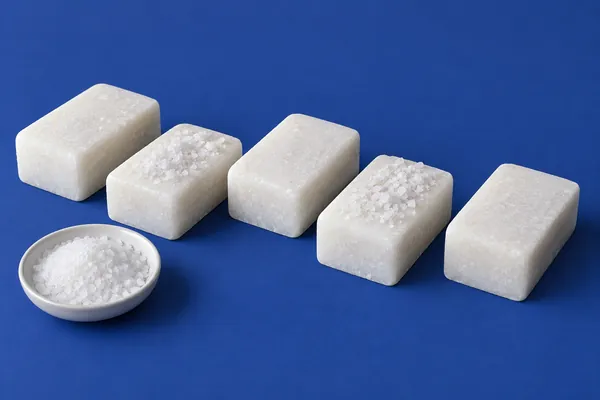
Salt bars: spa soap with sea salt
Why salt bars are mostly coconut oil at a 15 to 20 % superfat, how much salt to use and which to avoid, when to cut them, and how brine bars differ.

Natural colourants: what herbs, clays and spices really do in soap
Clays, charcoal and plant colours in cold-process soap: doses per 500 g of oils, infused oil, powder or lye, and the colour each one actually turns.
Where these proportions come from
Our own formulation: a mild olive oil face bar with a fifth coconut oil, cocoa butter for firmness, avocado oil and a little castor, at a 6 % superfat. The mud is kept to 40 g per kilo of oils because its salts draw water from the air, and the water is set at a 31 % lye solution so the mud's slurry can come out of it.