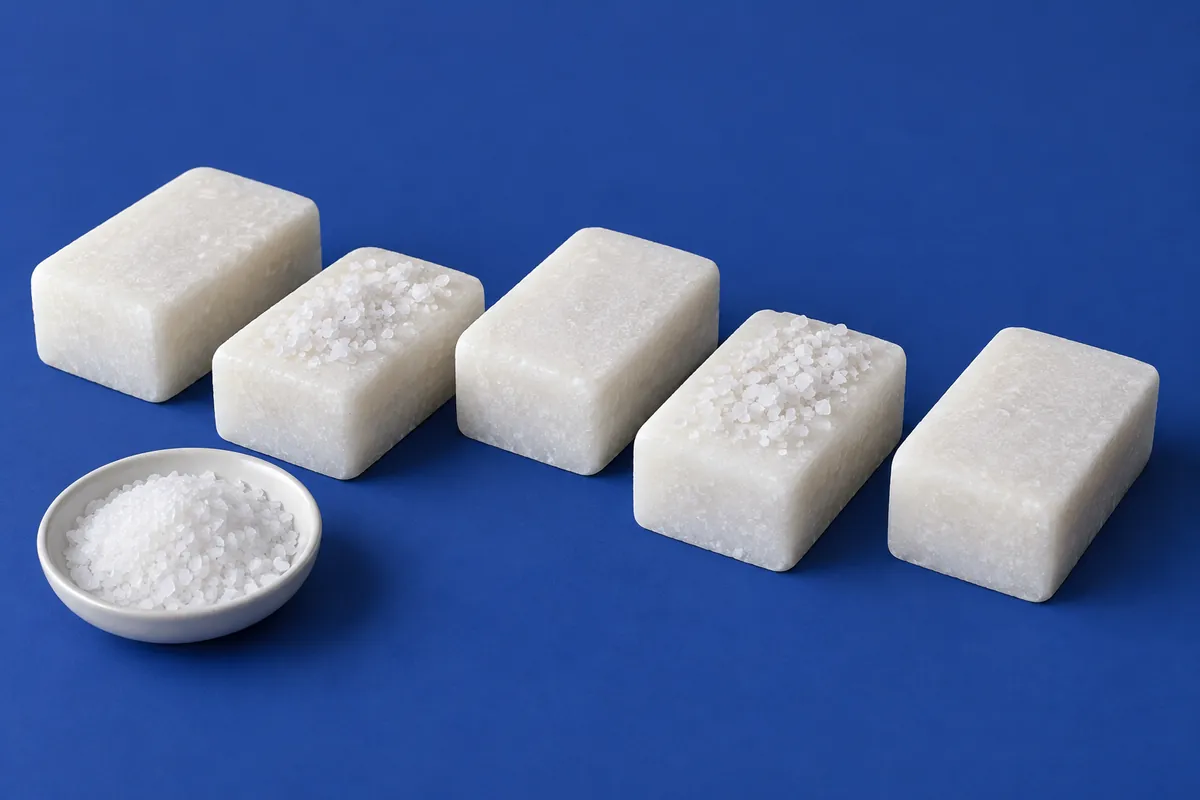
In short
- Salt pushes soap out of solution and cuts its lather. Coconut soap stands up to salt best, so salt bars are 70 to 100 % coconut oil.
- A 15 to 20 % superfat keeps that much coconut soap from stripping skin. It is a craft convention, and the quality numbers cannot show it.
- Stir in 50 to 100 % of the oil weight in fine sea salt or table salt. Dead Sea salt makes a soft, weeping bar, and Epsom salt uses up lye.
- Pour into single cavities, or cut a loaf within hours: a salt loaf left overnight shatters under the knife.
- A brine bar dissolves the salt in the water instead, but a lye solution holds far less salt than water does.
On this page
Salt goes into soap in two very different amounts. Half a teaspoon per pound of oils, dissolved in the water, makes an ordinary bar a little harder. A salt bar uses about a hundred times that, between half and all of the oil weight, stirred in as grains at trace. This guide is about the second, and about the brine bar that sits between the two.
What salt does to soap
Soap and salt share an ion. Soap is the sodium salt of fatty acids, and adding more sodium, as sodium chloride, pushes soap out of solution. Soap factories rely on it: they boil the fats with lye, then add salt, and the soap rises as curds above a salty liquor that carries the glycerin away. The soapmaking basics guide describes that process. In a bar, the same effect means less soap dissolves when you wet it, so the bar lathers less and wears away more slowly.
Not every soap gives up equally. Simmons and Appleton recorded in 1908 that sodium stearate, the soap of tallow’s hardest acid, is thrown out of a salt solution as weak as 5 %, while sodium laurate, the main soap of coconut oil, needs 17 %, and the soaps of the shortest acids stay dissolved even in saturated brine. Coconut soap needs so much salt to separate that their factories grained it with strong lye instead, and it could take up large amounts of salt solution without separating while staying firm. That made it the soap for use at sea: their marine soaps held as much as 80 % water, and the US Navy’s specification, quoted by Lamborn in 1918, called for soap of pure coconut oil that would dissolve and lather in sea water and fresh water alike. That is the whole logic of a salt bar: it is built on the one soap that still foams in brine. Faiola puts salt bars at 80 to 100 % coconut oil, and most recipes sit somewhere from 70 % up.
Why so much superfat
Coconut soap is also the one makers find most drying on skin, which is the other half of the recipe. At an everyday 5 % superfat, 80 % coconut oil makes a bar harsh enough for the laundry. Salt bars carry 15 to 20 % instead, so that a good share of the oil stays in the bar as oil. That figure is a craft convention, settled by makers using the bars rather than by any measurement, but it is a very consistent one.
Our salt bar sits at 17 %. The calculator’s quality numbers cannot show what that does, because they are worked out from the fatty acids alone: the same recipe reads cleansing 54 at a 5 % superfat and at 20 %. The superfat is the part you feel.
A superfat this high might look like an invitation to rancid, orange-spotted soap, but superfat is not the whole story. In Kevin Dunn’s tests, soap with no superfat began to turn orange as soon as soap with 10 %, which only ended up a deeper colour. How unsaturated the oils are matters more, along with traces of iron and copper, heat and light. That is in a salt bar’s favour: coconut oil is almost all saturated fat, and the blend’s iodine value is 21, against 52 for our everyday bar. The guide to orange spots explains why that number matters.
How much salt, and which
Makers use 50 to 100 % of the oil weight. More salt gives a harder, heavier bar with less lather. At 100 % Fisher found the bars a little crumbly and the lather much reduced, and settled on about 75 %, which is where our pink salt spa bar sits. The calculator suggests 50 %, which is a forgiving place to start.
| Salt, % of the oils | Salt for 500 g of oils | Fresh batch | Salt share of the fresh bar |
|---|---|---|---|
| 50 % | 250 g | 966.9 g | 26 % |
| 75 % | 375 g | 1091.9 g | 34 % |
| 100 % | 500 g | 1216.9 g | 41 % |
The recipe below with three amounts of salt, from our calculator. The share rises a little over the cure as water leaves the bar.
Use fine salt. Fine grains disappear into the bar, which cures smooth: as Corley Barto puts it, a salt bar is not a scrub. Coarse grains stay as grit you can feel; keep them for a sprinkle on top. Grosso sees it differently: she stirs in coarse sea salt at the full weight of the oils and finds the bars scrubby only at first, their sharp edges soon wearing smooth, like stone. Sea salt and plain table salt are both almost all sodium chloride and behave the same way.
Two salts do not belong in a salt bar. Dead Sea water is dominated by magnesium, and salt sold from it typically carries a large share of magnesium chloride, with calcium chloride besides. Both pull water out of ordinary room air: magnesium chloride starts to take up water at about 33 % relative humidity and calcium chloride at about 31 %, where sodium chloride holds out to 75 %. A bar made with them draws water from almost any indoor air, and Fisher and Lovin Soap describe the same result, a soft, weeping, wet bar. Epsom salt is magnesium sulfate: it takes lye out of the batter as magnesium hydroxide (the calculator counts 0.32 g of sodium hydroxide for every gram), and magnesium meeting soap makes magnesium soap, the insoluble scum of hard water.
Nor does the salt do what some labels claim. There is no evidence that a salt bar detoxifies skin or feeds it minerals, and it forms scum in hard water like any other soap. What the salt changes is the soap: harder, longer-lasting, with a denser, lower lather.
Moulds, and cutting within hours
Coconut soap sets fast and salt makes it set harder still. In a loaf mould, the window between too soft to cut and too hard to cut cleanly is a few hours: Corley Barto unmoulds and cuts hers within about two hours of pouring, Cable at about four, and Lovin Soap anywhere from four to eight; Grosso slices hers as soon as it is hard, even while it is still warm. Leave a salt loaf overnight and it shatters under the knife.
Individual cavity moulds avoid the race, and Faiola uses them for any salt-hardened soap, because a loaf becomes too hard and brittle to cut without damaging the bars. Each bar is already its own shape, and Fisher leaves hers in the moulds for a day before turning them out. Don’t insulate salt bars; they heat up well enough on their own. The moulds guide covers sizing a batch to a cavity mould.
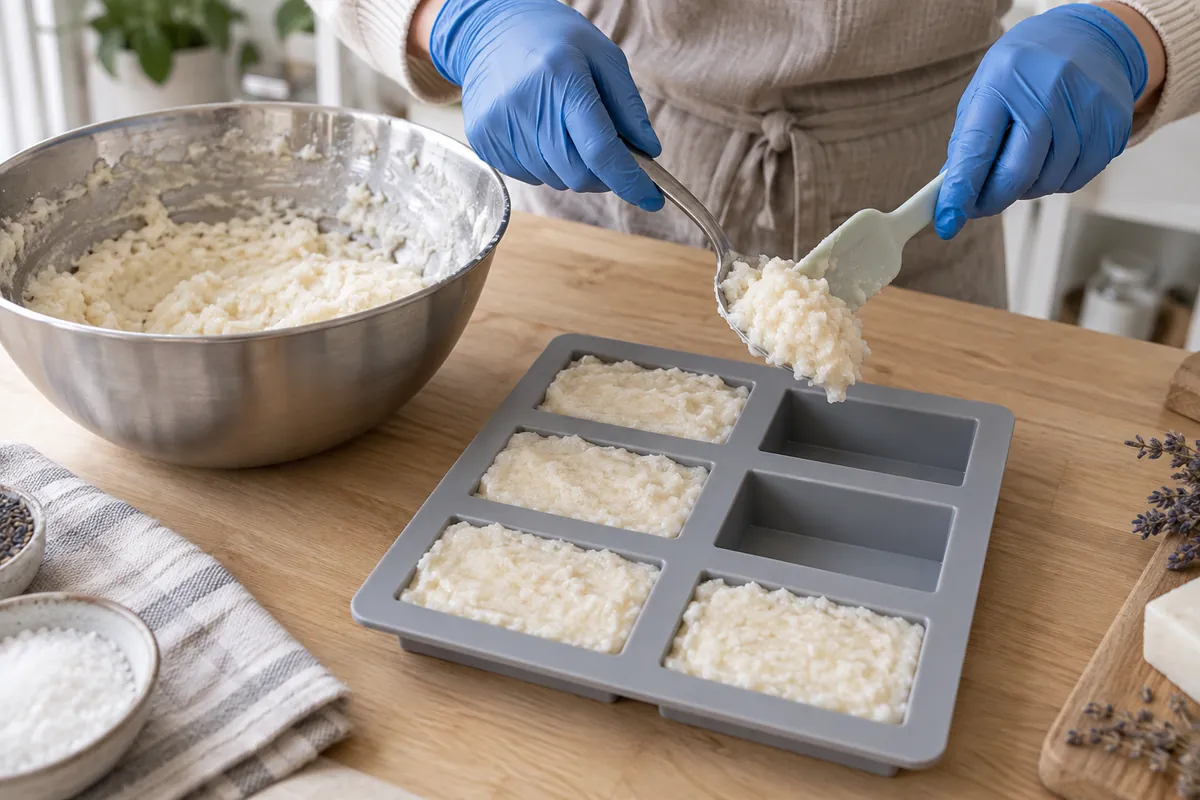 Salt bar batter is thick the moment the salt goes in. Spoon it into the cavities and press it down rather than trying to pour it.
The recipe: salt bar
This is our salt bar for 500 g of oils, with fine sea salt at half the oil weight. It makes about 970 g of soap, eight or nine bars of 110 to 120 g.
| Ingredient | Grams | Ounces |
|---|---|---|
| Coconut oil | 400 | 14.11 |
| Shea butter | 50 | 1.76 |
| Castor oil | 25 | 0.88 |
| Olive oil | 25 | 0.88 |
| Sodium hydroxide (100 %) | 71.6 | 2.53 |
| Water | 145.3 | 5.13 |
| Fine sea salt | 250 | 8.82 |
17 % superfat, a 33 % lye concentration. Across the published saponification ranges of these oils the superfat stays between 14.3 and 19.6 %. Hardness 69, cleansing 54, conditioning 22: a craft convention for comparing recipes, and blind to the superfat, as above.
Try the salt in the calculator. 500 g of oils at a 17 % superfat take 71.6 g of sodium hydroxide; change the salt and watch the batch weight follow.
Open it in the calculatorThe method is ordinary cold process, from the first batch guide, with four differences:
- Get the salt and the mould ready first. Weigh the salt into its own bowl and set out the cavity mould before you make the lye solution. Once the salt is in, the batter will not wait.
- Soap warm, stop early. Coconut oil melts at 23 to 26 °C (73 to 79 °F), so combine the oils and lye while they are still warm; Corley Barto soaps her salt bar at 43 °C (110 °F). Stick blend only to light trace, then add any fragrance.
- Stir the salt in by hand. Fold it in with a spatula rather than the stick blender. The batter thickens at once, like stiff porridge.
- Spoon, press, and unmould early. Spoon the batter into the cavities, press it down and tap the mould to settle it. Leave it uncovered and uninsulated, and turn the bars out as soon as they are firm: hours, not days.
Cure them at least the usual four to six weeks. Salt bars keep getting harder for months, and many makers leave them longer.
No coconut oil? Babassu oil at the same 80 % needs 70.2 g of lye and gives almost the same numbers. For the simplest salt bar of all, our hundred percent coconut bar at a 20 % superfat takes 73.1 g of lye for 500 g of coconut oil.
Brine bars: salt dissolved first
A brine bar, sometimes sold under the German name soleseife, dissolves its salt in the water before the lye goes in. The salt then ends up spread through the bar in very fine crystals instead of grains, so a brine bar is smooth and dense rather than grainy, and it hardens without losing as much lather. That leaves room for more oils that are not coconut: our brine bar is 60 % coconut oil at a 15 % superfat.
The catch is how little salt a lye solution will hold. Plain water at 20 °C dissolves 35.9 g of salt per 100 g. Sodium hydroxide brings its own sodium, which pushes the salt back out, and the stronger the lye solution, the less salt stays dissolved:
| Lye concentration | Water for the brine bar (500 g of oils) | Salt that stays dissolved |
|---|---|---|
| 25 % | 207.8 g | 24.7 g |
| 28 % | 178.1 g | 16.3 g |
| 30 % | 161.6 g | 11.6 g |
| 33 % | 140.6 g | 7.3 g |
| 35 % | 128.7 g | 5.1 g |
| 40 % | 103.9 g | 3.5 g |
From our calculator, which checks every salt added to the lye water against Winteler’s measurements of salt in sodium hydroxide solutions at 20 °C, tabulated by Seidell (1919) and converted to grams per 100 g of water. The lye here is 69.3 g in every row.
So a brine made with a quarter of the water’s weight in salt, a common instruction, is far more than a 33 % lye solution can keep dissolved. When the lye goes in, the excess comes back out as fine crystals and the solution turns milky white, which some books describe without explaining. It is not dangerous. Stir until the lye has fully dissolved and pour in all of it, cloudy part included, or the salt stays behind in the jug. The calculator warns you when it happens and suggests the alternative: dissolve only what the solution can hold, and stir any more salt into the batter at trace.
At a 33 % solution our brine bar would keep only 7.3 g of salt dissolved. Its recipe page raises the water to 38 % of the oils, a 26.7 % solution, which holds up to 19.6 g, and dissolves 19 g:
A brine bar with the salt fully dissolved. 19 g of salt in 190 g of water, then 69.3 g of sodium hydroxide: the calculator raises no warning.
Open it in the calculatorFaiola’s castile brine in Pure Soapmaking stays inside the limit and shows that a brine bar need not be a coconut bar at all: a tablespoon of sea salt, about 16 g, dissolved in 309 g (10.9 oz) of water for 936 g (33 oz) of olive oil. With her 119 g (4.2 oz) of lye that is a 27.8 % solution, which holds about 29 g of salt, so all of it dissolves.
A brine bar sets more slowly than a salt bar. Fisher turns hers out of cavity moulds after 8 to 10 hours; one made with this much water may need a day.
Using a salt bar
A salt bar lasts a long time, but even plain salt starts to draw water from the air above about 75 % relative humidity, which a steamy bathroom passes easily, so a salt bar can weep in a humid climate. Keep it on a dish that drains, out of the stream of the shower, and it will stay hard. Expect a lower, creamier lather than an ordinary bar’s. What the minerals in tap water do to soap, salt bars included, is in the hard water guide.
Recipes to try
All recipesSources
- Pure Soapmaking . Anne-Marie Faiola, Storey Publishing , 2016. Salt bars at 80 to 100 % coconut oil and a high superfat; salt cuts lather; half a teaspoon per pound of oils for hardness; salt-hardened soap in cavity moulds; the castile brine, a tablespoon of sea salt in the water for 33 oz of olive oil.
- The Complete Photo Guide to Soap Making . David Fisher, Creative Publishing International , 2018. Salt at 50 to 100 % of the oils; no Dead Sea or Epsom salt; soleseife.
- The Natural Soap Chef . Heidi Corley Barto, Ulysses Press , 2012.
- The Natural Soap Making Book for Beginners . Kelly Cable, Althea Press , 2017.
- The Everything Soapmaking Book, 3rd edition . Alicia Grosso, Adams Media , 2013. Coarse sea salt at the weight of the oils, scrubby at first and then smooth; no insulation; cut while still warm.
- Formulating salt bars . Lovin Soap, supplier guide . Craft practice only: salt at 50 to 100 % of the oils, a 15 to 20 % superfat, cutting 4 to 8 hours after pouring.
- Solubilities of Inorganic and Organic Compounds, 2nd edition . Atherton Seidell, D. Van Nostrand , 1919. p. 644: sodium chloride in sodium hydroxide solutions at 20 °C (Winteler, 1900), the data behind the calculator's salt check.
- IUPAC-NIST Solubility Data Series 47: Alkali Metal and Ammonium Chlorides in Water and Heavy Water . Cohen-Adad R. and Lorimer J.W. (eds), Pergamon , 1991. Sodium chloride: 26.41 % by mass in saturated solution at 20 °C, which is 35.9 g per 100 g of water.
- The Handbook of Soap Manufacture . W. H. Simmons and H. A. Appleton, Scott, Greenwood and Son , 1908. Salting out; sodium stearate insoluble in 5 % salt solution, sodium laurate needing 17 %; coconut soaps grained with lye rather than salt and taking up salt solution without separating; marine soap with up to 80 % water.
- Modern Soaps, Candles, and Glycerin, 3rd edition . Leebert Lloyd Lamborn, D. Van Nostrand , 1918. p. 320: the US Navy specification for salt-water soap of pure coconut oil.
- Humidity fixed points of binary saturated aqueous solutions . Lewis Greenspan, Journal of Research of the National Bureau of Standards 81A , 1977. Relative humidity over saturated magnesium chloride (about 33 %) and sodium chloride (about 75 %).
- International Critical Tables, volume 1 . National Research Council, McGraw-Hill , 1926. p. 67: humidity over saturated calcium chloride, about 31 to 32 %.
- Microbial and chemical characterization of underwater fresh water springs in the Dead Sea . Ionescu D. et al., PLoS ONE 7(6) e38319 , 2012. Dead Sea water composition: magnesium the dominant cation.