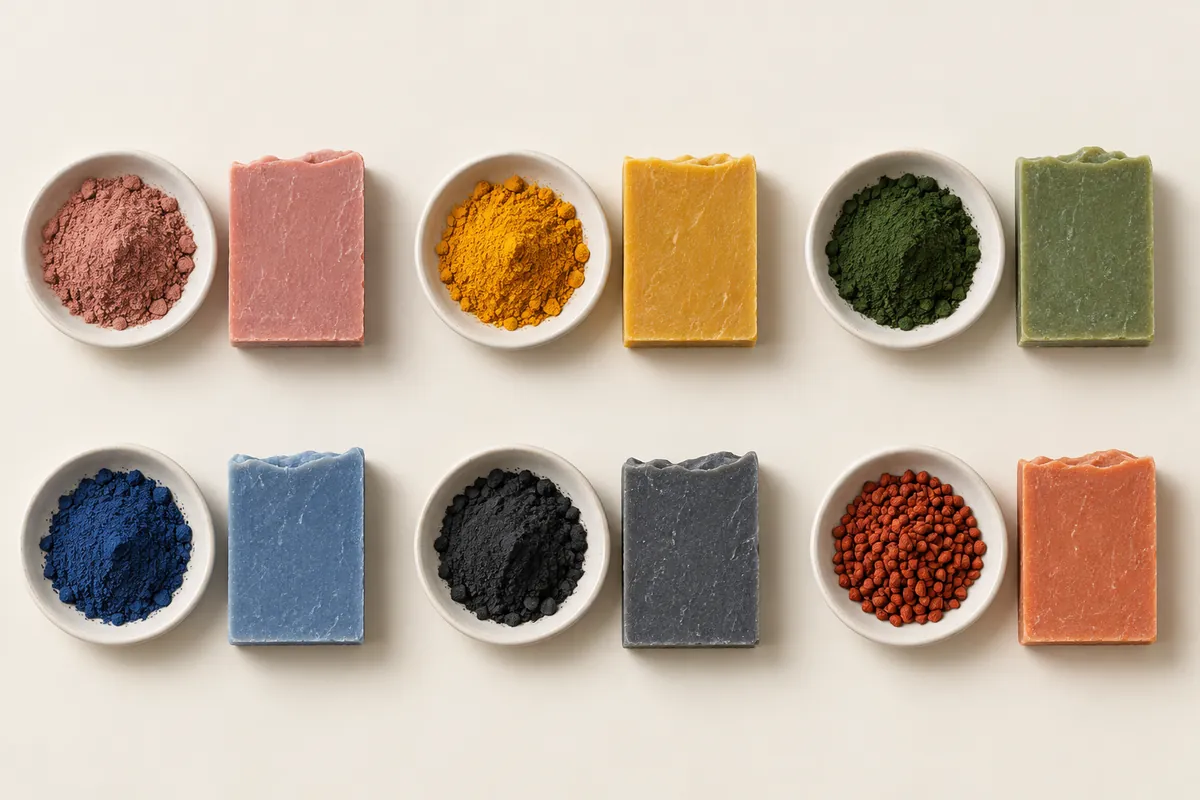
In short
- Soap's alkali changes plant colours: alkanet goes blue-grey before settling to purple, madder is red only if the soap gels, turmeric mellows within a day, beetroot fades to tan.
- Clays and charcoal hold their colour. Spirulina, turmeric and most plant colours fade with time and light.
- Powder at trace speckles; an infused oil gives smooth colour; clays, indigo and madder go deeper stirred into the warm lye solution.
- Start from the doses in the table, all per 500 g of oils, and test: natural material varies from lot to lot.
- Madder, paprika, indigo and rhassoul clay carry safety notes. Beetroot, supermarket food colouring and most flower petals are not worth the trouble.
On this page
- Why the colour changes
- Four ways to get colour in
- Powder at trace
- Infused oil
- In the lye solution
- As the liquid
- The palette
- Clays
- Charcoal
- Yellows and oranges
- Reds and purples
- Blues and greens
- Browns
- Fading, speckles and scratchiness
- What to avoid, and what to use with care
- Natural does not mean unregulated
Natural colour in soap is part colourant and part chemistry experiment. The clays and charcoal behave like the mineral pigments in the colouring guide: what goes in is roughly what you see. The plant colours do not. Several of them are pH indicators, and fresh soap is more alkaline than almost anything else they will ever meet.
Why the colour changes
Alkanet root gives a deep red-purple oil, and its pigment, alkannin, turns blue at pH 11 to 12. That is why an alkanet soap often looks blue-grey when cut and settles towards purple as it cures; Cable describes bright blue on the first day and deep purple once cured. Madder root’s pigments turn purple in alkali; a gelled madder soap comes out red, an ungelled one mauve. Turmeric’s curcumin turns red-orange in alkali and does not last long once dissolved, which is why a turmeric batter that looks bright orange at trace has mellowed to gold by the next day.
Four ways to get colour in
Powder at trace
The quickest way: disperse the powder (about 1 teaspoon in 1 tablespoon of the recipe’s liquid oil, or clay in about three times its volume of the recipe’s water, a teaspoon to a tablespoon) and whisk it into the batter at light trace. Fine powders give an even colour. Coarser ones, including most spice and herb powders and red clays, leave specks; that is a look some people want and others don’t.
Infused oil
For smooth colour, steep the plant in oil and strain it out, so the colour comes without the particles. Three ways work:
- Warm water bath: put the seeds or root, loose or sealed in a tea bag, in a jar of oil, and stand the jar in hot water, or a slow cooker of water on low, for 1 to 5 hours; longer gives a deeper colour. Watch the oil rather than the water: Faiola holds it at about 49 °C (120 °F) for 4 hours and finds that above 54–60 °C (130–140 °F) the plant burns, which smells bad and turns the oil brown (Pure Soapmaking).
- Cold: leave the jar at room temperature for 5 to 6 weeks, shaking it now and then and checking each week for mould or for condensation under the lid.
- Microwave, for a small amount: 2 tablespoons of oil and 1 tablespoon of seeds, heated for 20 seconds, cooled briefly, heated for 20 seconds again, then left to steep.
Strain through fine cloth. For annatto, Faiola and Fisher use 1 to 1½ tablespoons of seed per 100 g of oil. Heat oil only in a water bath, never over a direct flame, and never leave it unattended.
The infused oil is part of the recipe. Weigh it as the oil it is (infused olive oil is olive oil in the calculator) and take its weight off the recipe’s own amount of that oil; Fisher replaces about a quarter of a recipe’s olive oil with infusion. Added on top, it is superfat you did not plan.
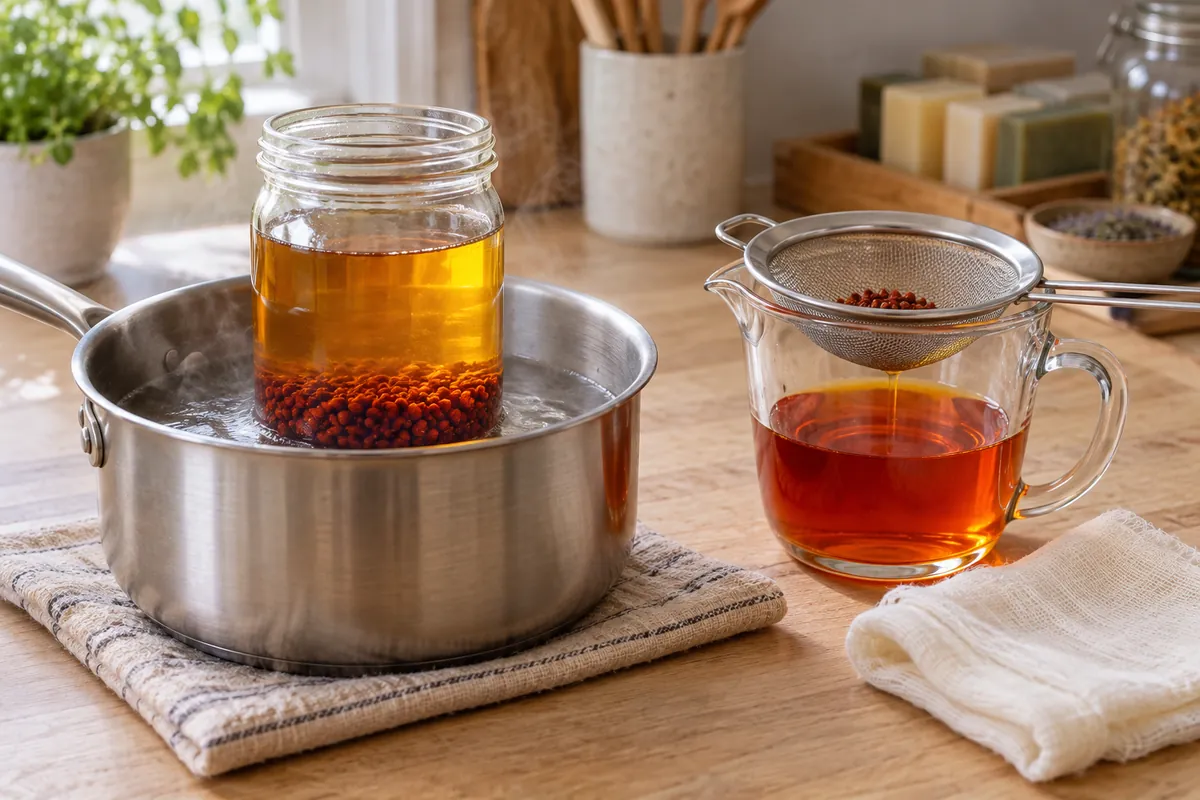 Annatto seeds infusing in a warm water bath, and the strained oil beside them.
In the lye solution
Some colourants come out deeper when stirred into the warm lye solution after the lye has dissolved: rose clay and red clays, indigo and madder among them. Fisher lets indigo or madder steep in the lye for 2 to 3 hours, then strains it, or leaves it unstrained for speckles. Faiola stirs clay into the water before the lye goes in and starts with half the clay she would use at trace, because the heat deepens the colour; she strains the solution through a coffee filter to catch any grit (Pure Soapmaking). This is caustic liquid: stir gently, strain through a stainless steel sieve, and keep your gloves and goggles on throughout. Only add materials that are meant to go in this way; sugars and milk heat up and scorch in lye, which liquids in soap explains.
As the liquid
Brewed coffee or tea can replace part or all of the water. Coffee turns green when the lye goes in and settles to brown in the soap. The liquids guide covers the method.
The palette
Doses are the ones the lye calculator fills in, for 500 g (17.6 oz) of oils in a batch of about 725 g (the palm-free classic at a 33 % lye solution with 3 % fragrance), for colour through the whole batch. A portion coloured for a swirl takes its share.
| Colourant | Start with, per 500 g of oils | How it goes in | What you get |
|---|---|---|---|
| Kaolin clay | 1 tsp (3 g) | in water, at light trace | soft white; lightens other colours |
| Rose clay | ¾ tsp (2.5 g), up to 5 tsp (15 g) | into the warm lye, or in water at trace | dusty pink; deeper from the lye |
| French green clay | 1½ tbsp (20.5 g) | in water, at light trace | soft sage green |
| Rhassoul clay | 1½ tsp (4.4 g), up to 5 tsp (13 g) | in water, at light trace | tan to grey-brown |
| Red clay (illite) | 1 tsp (5.1 g) | into the warm lye, or at trace | brick red, with specks |
| Activated charcoal | ⅜ tsp (0.9 g) | in oil | grey to black |
| Turmeric | ½ tsp (1.7 g) | in oil at trace, or as infused oil | orange at trace, gold a day later; fades |
| Annatto seed | 1 tsp (2.3 g), up to 4 tsp (9 g) | infused in oil and strained | yellow to deep orange |
| Paprika | ¾ tsp (1.8 g) | infused in oil and strained | peach to orange |
| Madder root | 1½ tsp (3.4 g), up to 5 tsp (10 g) | in oil at trace, or in the lye | red if gelled, mauve if not |
| Alkanet root | infused oil; see below | infused in oil and strained | blue-grey at first, then purple |
| Indigo | ¾ tsp (1.3 g) | into the warm lye, or at trace | light to deep blue |
| Woad | 1 tsp (4.4 g) | in a portion at trace | soft blue |
| Spirulina | 1½ tsp (3.6 g) | in oil at trace | bright green, olive within a week |
| Cocoa powder | 1 tbsp (6 g) | stirred into the warm oils | tan to brown |
| Coffee, brewed | half or all of the water | as the lye liquid | tan to brown |
| Beetroot powder | not recommended | no method keeps it | pink that turns tan or brown |
Doses from the suppliers’ and authors’ rates in the calculator’s additive sources. Colours from Cable, Faiola, Fisher and the suppliers. The spoon weights come from published bulk densities; a scale is better.
For alkanet, Faiola steeps 2 tablespoons of root in 115 g (4 oz) of oil and uses 1½ tablespoons of that infusion in a batch of about 650 g of oils, for mauve to blue-grey; for a deep purple swirl, Soap Queen makes alkanet-infused olive oil about 15 % of the recipe’s oils. Used heavily, alkanet goes almost black. In Pure Soapmaking Faiola notes that an alkanet infusion fades over time where the dispersed powder holds its colour, and that a strong orange essential oil (orange 10x) turns alkanet an unattractive green.
Faiola’s colour chart in the same book shows most of these powders at 2 teaspoons per pound of soap, dispersed in three times their volume of oil. For this batch that is about 3 teaspoons: a strong colour, and more than most of the starting doses above, so work up to it with a test batch.
Gel deepens most plant colours. Madder, alkanet and indigo show their best colour only with a hot gel, and comfrey’s green is brighter for one (Faiola). She soaps those batches at 49–54 °C (120–130 °F), insulates the mould and often sets it on a heating pad on medium for 30 minutes to an hour, watching for cracks; the gel phase guide covers the method. She finds spirulina brighter for a gel too, but its blue pigment is damaged by heat, which is why our spirulina layers are made cool: try a small batch each way.
Clays
Clays are the easy naturals: their colour comes from minerals, mostly iron, so it stays much as it went in, as the green, cream and pink of our three-layer clay bar show. Rose clay is often kaolin blended with iron oxide, which the supplier’s ingredient name should say. Clays thicken batter, so add them to thin batter and work quickly after they go in; undispersed lumps of clay can leave the bar crumbly or cracked, so always disperse first. Buy cosmetic-grade clay from a supplier who tests for heavy metals: a 2025 study of cosmetic clays found the highest median mercury in rhassoul.
Charcoal
Activated charcoal is the black of natural soap: a little makes grey, a little more makes black. It stays put, but too much turns the lather grey. Paired with rose or orange clay, charcoal gives a blue-grey that Cable uses as a cheaper stand-in for indigo.
Yellows and oranges
Annatto is the dependable one. Infused and strained, it gives an even yellow to deep orange, as in the swirl of our patchouli and orange bar, and more infusion in place of plain oil gives a deeper shade; too much colours the lather. Turmeric gives the brightest orange at trace, settles to gold in a day and fades further over months. An infusion holds its colour better than the powder (Cable), which is why our turmeric and honey bar infuses it. Paprika infused in oil gives peach to orange; as a powder it speckles.
Reds and purples
Madder root is the natural route to a true red, and only if the soap gels; kept cool, it stays a dusky mauve. Our madder and alkanet swirl is gelled on purpose for that reason. The top of its range, about 5 teaspoons per 500 g of oils, gives the deepest colour. Alkanet gives purples through blue-grey and, used as an infusion, is smooth. It stains washcloths.
Blues and greens
Indigo gives light to navy blue and is richest dispersed in the warm lye solution; our indigo in-the-pot swirl bar disperses it in oil instead, for ribbons of blue. Some powder sold as indigo comes from a different plant (Baphicacanthus cusia rather than Indigofera), and colour strength varies between makes, so test a new supplier. Woad makes the same blue compound as indigo; Cable used 2 teaspoons in a 3 lb batch (about 1 teaspoon per 500 g of oils) for a blue stripe, and notes that it has become expensive. Spirulina is the easy green, bright on day one and olive after a week. Leaf powders such as nettle also colour soap green (Cable used 2 tablespoons in a 3 lb batch); test them, as greens are the least predictable colours.
Browns
Cocoa powder gives tan to chocolate brown; stir it into the warm oils so it disperses. Brewed coffee used as the liquid gives tan, and used coffee grounds give dark specks with a little scrub. Grounds should be dry and already brewed: unbrewed grounds bleed colour, and damp ones can grow mould.
Try rose clay in the lye. This loads the 500 g recipe with ¾ teaspoon of rose clay stirred into the lye solution, the stage that gives the deepest pink.
Open it in the calculatorFading, speckles and scratchiness
Fading. Most plant colours fade, and they fade faster in light and warmth. Clays and charcoal hold. Greens go first: Faiola finds natural greens turn brown or grey within a couple of weeks, with oranges and reds fading more slowly. Spirulina, turmeric and leaf greens all drift within weeks, which is why our spirulina and turmeric layers are made cool and cured in the dark. Cure and store naturally coloured bars out of direct sun, and photograph them for a shop at the colour they will have when sold, not on the day you cut them.
Speckles. Any powder that is not finely milled shows as specks. That can be lovely in a rustic bar. For an even colour, use the finest powder you can buy, infuse and strain, or add it to the lye solution and strain.
Scratchiness. Roots, seeds and herb powders that are coarsely ground feel scratchy in a bar. Grind them fine, or infuse and strain, unless you want a scrub.
Lather and stains. Heavy doses of annatto, charcoal and most pigments colour the lather. Turmeric can stain skin and alkanet stains washcloths, so keep their doses at the low end in bars for daily use.
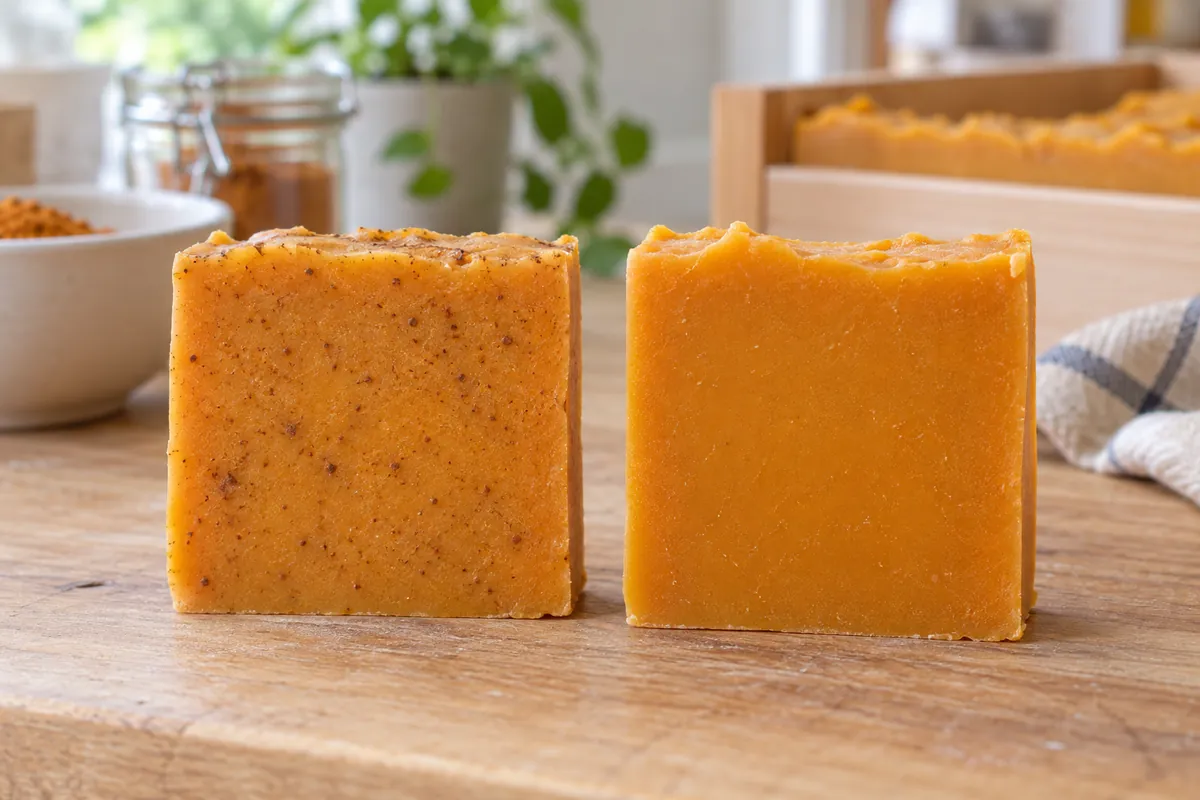 The same turmeric colour, added as powder at trace (left) and as a strained infused oil (right).
What to avoid, and what to use with care
- Beetroot and berry juices. Beetroot’s pink breaks down in soap’s alkali and turns tan or brown within days. Cavitch found beet, cherry and blueberry juice all made “a dull, gray mess”.
- Most flower petals. They turn brown or black in fresh soap. Calendula is one of the few that keeps its colour, a warm yellow.
- Supermarket food colouring. These are dyes: they bleed, many fade or change in soap, and they are not approved for cosmetics in every market.
- Chilli and cayenne. Capsaicin, the heat in chilli, is an irritant. Paprika is the mild relative, and even paprika has produced a weak allergic reaction in patch testing.
- Ground cinnamon. It carries cinnamaldehyde, a skin sensitiser listed in the EU as the allergen cinnamal.
- Madder root, with thought. It is the one common natural colourant with a real toxicology question: its lucidin is genotoxic, and alizarin and rubiadin, two of its components, produced kidney tumours in rats fed them. A rinse-off bar is a far smaller exposure than eating it, but if you sell soap, your safety assessor needs to know it is there.
- Indigo, knowingly. The EU’s scientific committee could not exclude a weak potential for skin sensitisation from Indigofera tinctoria.
Natural does not mean unregulated
Under EU and UK rules, a substance used mainly to colour a cosmetic must be on the Annex IV list of colourants. The list includes curcumin, annatto, paprika extract and beetroot red to food-colour purity standards, not the raw spice or root powders. If you sell in those markets, ask your safety assessor how they want a colouring herb or clay handled. In the US, a true soap sold only as soap is outside the cosmetic colour rules; turmeric and spirulina extract, for example, are listed as colour additives for food only, so they cannot be used as colourants in a soap that makes cosmetic claims. The colouring guide has the detail.
Recipes to try
All recipesSources
- The Natural Soap Making Book for Beginners . Kelly Cable, Althea Press , 2017. Natural colourant doses and how each colour changes over the first day and week of cure.
- The Complete Photo Guide to Soap Making . David Fisher, Creative Publishing International , 2018. Colour infused in oil or in the lye solution; which botanicals blacken.
- Soap Crafting: Step-by-Step Techniques for Making 31 Unique Cold-Process Soaps . Anne-Marie Faiola, Storey Publishing , 2013. Water-bath infusion of alkanet, annatto and paprika; spirulina as a powder.
- Natural Soap Making . Elizabeth Letcavage and Melissa Harden, Stackpole Books , 2013. Quick microwave infusion; which flowers keep their colour.
- Pure Soapmaking . Anne-Marie Faiola, Storey Publishing , 2016. Natural colour chart at 2 teaspoons per pound of soap, powders dispersed 1 to 3 in oil; oil infusions kept near 49 °C and below 54–60 °C; cold infusions checked weekly; clay in the water before the lye at half the dose; hot gel for madder, alkanet and indigo; alkanet fading as an infusion and turning green with orange 10x; greens fading fastest.
- The Natural Soap Book . Susan Miller Cavitch, Storey Publishing , 1995. Beet, cherry and blueberry juices turning soap grey.
- Stability of curcumin in buffer solutions and characterization of its degradation products . Wang Y. J. et al., Journal of Pharmaceutical and Biomedical Analysis 15(12) , 1997.
- pH-dependent stability of major betalains in the encapsulated beetroot extracts (Beta vulgaris L.) . Lukitasari D. M. et al., Journal of Food Science 89(5) , 2024.
- Natural plant-derived compounds in food and cosmetics: a paradigm of shikonin and its derivatives . Malik S. et al., Materials 16 , 2023. Alkannin turns blue at pH 11-12.
- Carcinogenic potential of alizarin and rubiadin, components of madder color, in a rat medium-term multi-organ bioassay . Inoue K. et al., Cancer Science 100 , 2009.
- Opinion on Indigofera tinctoria (SCCS/1615/20) . Scientific Committee on Consumer Safety, European Commission , 2020.
- Analysis of mercury concentration in cosmetic clays . Fischer A. et al., Toxics 13 , 2025.
- Final report on the safety assessment of Capsicum annuum ingredients . Cosmetic Ingredient Review, International Journal of Toxicology 26 Suppl. 1 , 2007.