In short
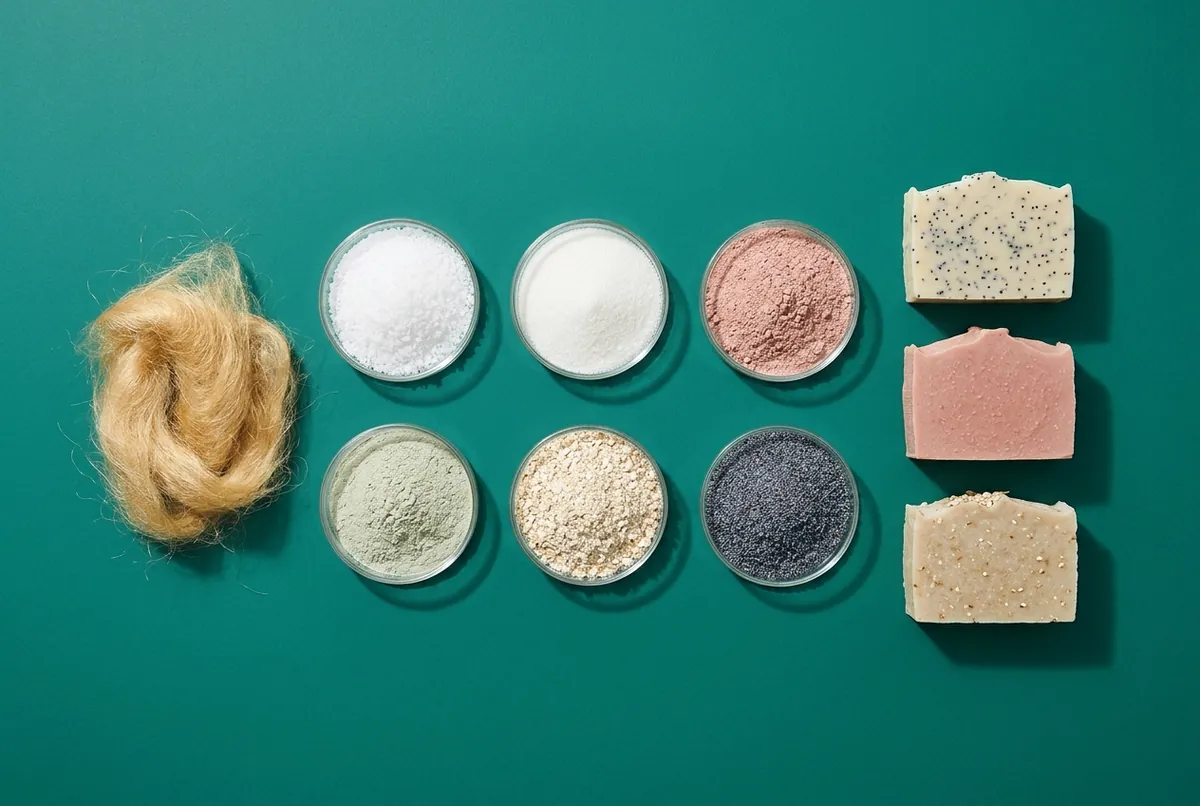
- Sodium lactate and salt harden a bar, and sugar speeds its lather. Clays, oats, silk and scrubs change how it looks and feels; few skin claims survive rinsing.
- Doses come per pound of oils, per pound of soap or as a percent. The calculator turns spoons into grams with weighed spoonfuls: a teaspoon of table salt is 6.0 g, of flaked kosher salt 2.8 g.
- Citric acid uses up 0.62 g of sodium hydroxide per gram. The calculator adds that lye; leave it out and a 5 % superfat drifts to about 9 %.
- Sugar and honey heat the batch. Keep honey out of the lye water, soap sugary batches cool and don't insulate the mould.
On this page
- At a glance
- How additive doses are written
- Sodium lactate and salt: a harder bar
- Sodium lactate
- Salt
- Sugar and honey: more lather, more heat
- Citric acid and the chelators
- Citric acid
- Sodium citrate, EDTA and the rest
- Clays
- Oats and colloidal oatmeal
- Silk
- Scrubs
- Keeping sugary batches cool
- Putting additives into the calculator
- What an additive lets you claim
Soap made from oils, lye and water needs nothing else. Everything on this page is optional, and most of it is there for looks, texture or the story on the label. A few additives do change how a bar sets, lathers or keeps, and one of them changes how much lye the recipe needs. The doses here are the ones in the calculator’s additive database, each with the source it came from, so what you read and what the calculator fills in are the same numbers.
At a glance
| Additive | What it does | Usual dose | Grams for 1000 g of oils | When it goes in |
|---|---|---|---|---|
| Sodium lactate (60 % solution) | Harder bar, cleaner release from the mould | 1 tsp per lb of oils (Faiola); 1–3 % of oils (Classic Bells) | 14.5 g | Into the lye solution once it has cooled |
| Fine salt | Harder bar, less lather | ½–1 tsp per lb of oils (Faiola; Soap Queen) | 6.6 g | Dissolved in the water before the lye |
| Sugar | Faster, bubblier lather | 1 tsp per lb of oils; tested up to 4 % of oils (Wholesale Supplies Plus) | 9.3 g | Dissolved in the water before the lye |
| Honey | Lather and a warmer colour | 1 tsp per lb of soap (Soap Queen) to 1 tbsp per lb of oils (Grosso) | 22–46 g | Light trace, warmed so it pours |
| Citric acid | Chelator: turns into sodium citrate | 1–2 % of oils, range 0.1–3 % (Classic Bells) | 10 g, plus 6.2 g more lye | Dissolved in the water, lye added slowly |
| Tetrasodium EDTA | Chelator; slows rancid spots | 0.1–0.2 % of the bar (Dow) | 1.4 g | Dissolved in the water before the lye |
| Sodium citrate | Chelator; binds metal traces in the bar | 1.3–3.9 % of oils (Classic Bells) | 13 g | In twice its weight of water, into the oils |
| Kaolin clay | Colour, slip | 1 tsp per lb of oils (Lovin Soap) | 6.0 g | In three times its volume of water, at light trace |
| Ground oats | Gentle scrub | 1 tbsp per lb of oils (Lovin Soap) | 12.7 g | Light trace |
| Colloidal oatmeal | Feel, and a story for the label | Up to 5 % of the batch (Bramble Berry) | up to 75 g | Mixed with a little oil, at light trace |
| Tussah silk | Tradition | A pea-sized pinch per lb of oils (Lovin Soap) | a pinch | Into the hot lye |
Doses from our additive database, with their sources. Grams are for 1000 g of oils at a 33 % lye solution, a batch of about 1420 g; a single figure is the dose the calculator fills in, and a dose per pound of soap grows with the batch. Scrubs have their own table further down, and the trace guide shows what light trace looks like.
Three families of additive have guides of their own, because they replace part of the recipe’s water: milks, drinks such as beer, coffee and juice, and fruit and vegetable purées. Colours are covered in natural colourants, herbs and flowers in botanicals, and rosemary extract and vitamin E in antioxidants and chelators.
How additive doses are written
Most soapmaking books are American, so doses come in spoons per pound. Three things decide what such a dose means in grams.
Per pound of what. “Per pound of oils” means per 454 g of the fats in the recipe. “Per pound of soap” means per 454 g of the whole batch: oils, lye, water and everything else, which for a bar made at a 33 % lye solution weighs about 1.42 times the oils. So the same figure gives about 40 % more additive when it is per pound of soap. The calculator keeps each source’s own basis and converts it for your batch.
Which spoon. A US teaspoon is 4.93 mL and a tablespoon is three of them (NIST). A metric teaspoon is 5 mL, near enough the same. An Australian tablespoon is 20 mL, a third bigger, and that difference does matter.
What a spoonful weighs. A spoon measures volume, and powders pack differently, so a teaspoon of one thing can weigh twice a teaspoon of another. The calculator uses spoonfuls that someone has weighed, and where a source publishes only a bulk density, it shows the range that density allows:
| Material | One level US teaspoon | Where the figure comes from |
|---|---|---|
| Fine table salt | 6.0 g | USDA FoodData Central |
| Flaked kosher salt | 2.8 g | USDA FoodData Central, branded label |
| Coarse sea salt | 5.4 g | USDA FoodData Central, branded labels |
| Granulated sugar | 4.2 g | USDA FoodData Central |
| Citric acid | 4.0 g | USDA FoodData Central, branded label |
| Sodium lactate, 60 % | 6.6 g | Its density, 1.32–1.34 g/mL (Corbion) |
| Honey | 7.0 g (21 g a tablespoon) | USDA FoodData Central |
| Kaolin clay | 2.3–3.2 g | Bulk density 0.47–0.64 g/mL (Carl Roth; Minerals, 2020) |
Half a teaspoon of table salt is 3.0 g; half a teaspoon of flaked kosher salt is 1.4 g. Where a recipe gives salt in spoons, weigh it.
In the calculator you can enter an additive in grams, as a percent of the oils or in any spoon it has a weight for, and switch between them. The grams are what go into the batch total and the checks.
Sodium lactate and salt: a harder bar
Sodium lactate
Sodium lactate is the sodium salt of lactic acid, usually sold as a 60 % solution. Its maker says that in bar soap it makes bars harder, helps them stamp and release from moulds, and reduces water loss and cracking (Corbion). It is already fully neutralised, so it takes no lye (Jungbunzlauer).
Faiola adds 1 teaspoon per pound of oils to the lye water, and finds it greatly shortens the wait before a loaf can come out of the mould, which matters most in silicone and detailed moulds (Pure Soapmaking); Soap Queen stirs it in once the lye water has cooled, as the loofah soap does. At 6.6 g a teaspoon that is about 1.4 % of the oils, the low end of the 1–3 % Classic Bells gives. Beyond that the sources disagree about how a bar fails: Faiola found that too much makes it brittle and crumbly, Classic Bells that over 3 % makes it softer and rubbery. No cold-process source goes past 3 %. Soap Queen uses 3 % of the oils in hot process, where it helps the cooked soap stay fluid enough to fill the mould (see hot process). The solution is 40 % water, and the calculator counts that water as part of the recipe’s.
Salt
A little salt dissolved in the water hardens a bar and lets it unmould sooner: half a teaspoon per pound of oils in Faiola’s Pure Soapmaking, a teaspoon in Soap Queen’s recipes. The cost is lather, which salt cuts markedly (Faiola), so it is not something to add to every recipe. The supermarket oils bar dissolves 7 g of salt and 10 g of sugar in its water.
The lye water also holds less salt than you might think. Sodium hydroxide brings its own sodium, which pushes salt back out of solution: 100 g of plain water at 20 °C dissolves about 36 g of salt, but in a 33 % lye solution the same water holds only about 5 g (Winteler’s measurements, in Seidell’s tables). For 1000 g of oils that is about 14.7 g, so a teaspoon per pound (13.2 g) just fits and anything more comes back out as grit. The calculator runs that check and warns you. Salt bars, with their own weight in salt stirred in at trace, are a different soap: see salt bars and the pink salt spa bar.
Sugar and honey: more lather, more heat
A soap-chemistry article on the Wholesale Supplies Plus site describes what sugar did in its author’s lab. It speeds trace, saponification and the rise in temperature, so the batch gels sooner; and it helps the finished soap dissolve faster in the basin, so the lather comes up quicker and feels different. Many makers use a teaspoon per pound of oils; that lab tried up to 4 % of the oils. Faiola has used a tablespoon per pound of oils (Soap Crafting) and, later, half a teaspoon per pound of soap (Pure Soapmaking), about a quarter as much.
Most makers dissolve sugar in the recipe’s water before the lye goes in, and that is where the calculator puts it (Fisher; Faiola in Pure Soapmaking). To keep it away from the heat of fresh lye, dissolve it in water held back from the recipe and add that once the lye solution has cooled, as the lab above does, or stir it in at thin trace, as Faiola did in Soap Crafting. Too much sugar makes a sticky bar that sweats in damp air (Cavitch, The Soapmaker’s Companion).
Honey is mostly sugar: 82 % sugars and 17 % water (USDA). Doses run from a teaspoon per pound of soap (Soap Queen) to a tablespoon per pound of oils (Grosso), and about 5 % of the oils is as high as one experienced maker will go (Anne L. Watson). Cavitch capped it at 4 tablespoons in a 12 lb batch, the same teaspoon per pound of soap (The Natural Soap Book). Warm it until it pours, or loosen it in a little of the recipe’s water as the honey and beeswax bar does, and stir it in at light trace. Never put it in the lye water, where its sugar adds to the heat and can make the jug boil over (Lovely Greens). Even at trace, too much honey can overheat a loaf, which Grosso calls the “honey volcano”. Faiola soaps honey batches with the oils and lye both below 38 °C (100 °F) and puts the mould straight into the fridge or freezer; left warm, the loaf can crack, sweat or tunnel a hole through its middle (Pure Soapmaking). How dark it turns the soap depends on how much you use and how hot the batch is when it goes in (McDaniel).
What honey does not carry into soap is its reputation. On a wound, honey fights bacteria through its acidity, its concentrated sugar and hydrogen peroxide made by an enzyme, glucose oxidase (Mandal and Mandal). In soap, the lye neutralises the acid and meets the enzyme head on, while the sugar is diluted to a few percent of the bar. What reaches your skin is soap with a little sugar in it: more lather and a warmer colour.
Sorbitol, a sugar alcohol sold as a 70 % syrup, behaves much like sugar at 1–4 % of the oils. It heats the batch too, but scorches less (Rustic Wise).
Citric acid and the chelators
Tap water carries calcium and magnesium, which turn soap into the grey scum of hard water; the old manuals wanted soapmaking water “free from calcium and magnesium salts” (Simmons and Appleton). Traces of iron and copper, meanwhile, speed up the rancidity behind orange spots. A chelator locks these metals away. Dow’s data for EDTA in bar soap say what that prevents: “softening, brown-spotting, rancidity, cracking and discoloration due to metal ions”.
Against hard water, a chelator in the bar can do little. It dissolves no faster than the soap around it, and the fraction of a gram each wash releases cannot soften the water you rinse with, so the scum forms anyway; soap in hard water has the arithmetic. Its job is in the bar itself: binding the metal traces that speed rancidity.
Citric acid
Citric acid is an acid, and that is what sets it apart from the ready-made chelators. In the pot it is neutralised to sodium citrate, and that uses up sodium hydroxide: 10 g of it for every 16.01 g of acid (Dunn, Scientific Soapmaking), or 0.62 g per gram. Makers use 0.1–3 % of the oils, most often 1–2 % (Classic Bells).
The calculator adds that lye for you. Put 1 % citric acid into 1000 g of the palm-free bar at the end of this guide and the sodium hydroxide goes from 138.5 g to 144.7 g. Leave the citric acid out of the calculator and those 6.2 g of lye are taken from the oils instead: a recipe set at a 5 % superfat comes out near 9 %, softer and more prone to rancid spots.
Dissolve it in the room-temperature water first, then add the lye slowly. Acid and alkali heat up fast where they meet, and a quick addition can bubble over the jug (Classic Bells). Above about 2 % it can leave a layer of tiny white crystals on the bars. Lemon and lime juice are about 5 % citric acid (Penniston et al.), which matters if you use them as the liquid: see liquids in soap.
Watch the lye change. 1 % citric acid on 1000 g of oils raises the sodium hydroxide from 138.5 g to 144.7 g.
Open it in the calculatorSodium citrate, EDTA and the rest
The ready-made chelators need no extra lye, with one exception. Sodium citrate goes in at 1.3–3.9 % of the oils, dissolved in about twice its weight of the recipe’s water and blended into the oils (Classic Bells). Tetrasodium EDTA is dissolved in the water at 0.1–0.2 % of the bar (Dow). The exception is disodium EDTA, the form sold for neutral cosmetics: in lye it turns into the tetrasodium form and uses a little sodium hydroxide doing it, which the calculator counts. Sodium gluconate, which one of its makers says outperforms EDTA in strongly alkaline solutions (Jungbunzlauer), is used at 0.5–1 % of the batch. Don’t keep it as a ready-made solution: in water, bacteria and fungi break it down within days, so Classic Bells dissolves only what the day’s soap needs.
On rancidity the evidence is thin but real. In Dunn’s test of additives at 0.1 % of the oils, EDTA and rosemary extract each kept olive oil soap at 60 °C from starting to turn orange for more than 300 hours, the length of the test. Sodium citrate on its own did no better than plain soap, but paired with BHT it did best of all (Dunn, 2005). The antioxidants and chelators guide has the detail.
Clays
Clays change a bar’s colour and feel. Kaolin gives a silky slip; bentonite swells with water into a thick mass (European Pharmacopoeia) and gives shaving soap its glide (Corley Barto); French green, rose and red clays bring their colours. Kaolin is used at a teaspoon per pound of oils (Lovin Soap). The other clays run from half a teaspoon to a tablespoon per pound across the sources, and the calculator lists each one’s.
Clay drinks water. That is why it speeds trace (Soap Queen), and why a dry clump left in the batter can crack or crumble the bar (Lovin Soap). Stir it into about three times its volume of water, a teaspoon of clay to a tablespoon, taken from the recipe’s own water (Bramble Berry), then add the smooth slurry at light trace; the French green clay bar and the kaolin and silk facial bar show the method. Faiola mixes her slurry four hours ahead and warns that clay also masks the scent of essential oils (Pure Soapmaking). Rose and red clays give a deeper colour if you stir them into the hot lye solution instead (The Nerdy Farm Wife); Faiola puts clay in the water before the lye and starts with half as much.
Buy cosmetic-grade clay, not craft or pottery clay (Faiola). A 2025 survey of 111 samples of cosmetic clay found the highest median mercury in rhassoul, at 39 micrograms per kilo: a tiny amount, but one more reason to buy from a supplier who can show an analysis (Fischer et al.). The rhassoul clay bar uses 2 tablespoons for 1000 g of oils.
The claims are where clay gets oversold. A clay mask sits on the face for minutes; a bar is rinsed off in seconds, and the cleaning is done by the soap. What clay adds to a bar is colour, slip and a faint drag on the skin. “Detoxifying” is a word for the label, not something the bar does.
Oats and colloidal oatmeal
Rolled oats, ground, make a gentle scrub: a tablespoon per pound of oils (Lovin Soap), added at light trace. Grind them fine for a face bar, because coarse pieces scratch, and expect the batter to thicken as soon as they go in (Letcavage and Harden).
Colloidal oatmeal is oats milled to a fine powder. Bramble Berry uses up to 5 % of the batch, mixed first with a little oil so it doesn’t clump; Faiola suggests premixing it with water instead, because it can speed trace, and notes that it looks slightly grey in the bar; the goat milk, oat and honey bar uses 2 tablespoons. In the US it is also an over-the-counter skin-protectant drug ingredient, which is where its soothing reputation comes from, and where the limits are. The FDA accepted it in barrier products such as creams and bath soaks, “except for ‘cleanser type’ topical dosage forms, for which the agency has no data to support use as a skin protectant” (FDA, 2003). An oatmeal soap is a pleasant soap; one sold as protecting or soothing the skin is, in the US, a drug. Oats can also sensitise: the Cosmetic Ingredient Review records several cases of atopic dermatitis.
Silk
Tussah silk, a golden raw silk fibre, goes in at a pea-sized pinch per pound of oils (Lovin Soap), stirred into the lye straight after the sodium hydroxide dissolves, while the solution is still at 77–88 °C (170–190 °F) (Soap Queen). Faiola pulls the pinch into strands, floats them on the water and adds the lye over them, then pours the solution into the oils through a sifter to catch what did not dissolve (Pure Soapmaking). Most of it disappears, and a few tiny undissolved bits are normal.
Makers say silk gives a silkier lather. No one has measured that. Dunn put silk products in lye and found the silk peptides and amino acids stayed dissolved, while silk powder showed no visible change over months (Dunn, 2014); Faiola writes in Soap Crafting that she doesn’t personally notice a difference. At a pinch per pound it costs little, so treat it as a tradition you enjoy rather than a treatment. It is an animal product, which matters if you sell vegan soap.
Scrubs
| Scrub | Dose | Grams for 1000 g of oils | What to know |
|---|---|---|---|
| Poppy seeds | 1 tsp per lb of soap (Bramble Berry); 0.25–0.5 % (Wholesale Supplies Plus) | 8.8 g | Light scrub, dark specks |
| Used coffee grounds | 1 tsp per lb of soap (Soap Queen) | 6.6 g | Dry them well: damp grounds grow microbes. Unbrewed grounds bleed brown |
| Pumice | 1–10 % (Wholesale Supplies Plus); 5 tbsp per 32 oz of oils in Soap Queen’s mechanic’s bar | from 14 g | For hands, not faces; mix it with a little oil first |
| Ground loofah | 0.25–0.5 % (Wholesale Supplies Plus) | from 3.6 g | Sinks in thin batter |
| Jojoba beads | 0.5–3 % of the bar (Floratech) | from 7.1 g | A wax that melts at 66–71 °C: keep the soap out of gel |
Ground oats are covered above. Scrubs sink in thin batter, so stir them in at light to medium trace, when the batter can hold them up.
The gardener’s pumice scrub bar mixes its pumice and cornmeal into some of the olive oil and adds them at thick trace; the lemon poppy seed bar and the coffee kitchen scrub bar show the gentler scrubs.
Plastic microbeads are banned from rinse-off products in the US (Microbead-Free Waters Act, 2015) and in the EU (Regulation 2023/2055). Jojoba wax beads are not plastic, and neither law covers them.
Keeping sugary batches cool
Sugar speeds saponification and the heat that comes with it, and honey, milk, fruit and beer all carry sugar. An insulated loaf of such soap can overheat, crack or rise out of the mould (Soap Queen). Every fix takes heat away: soap at a cooler temperature, leave off the towel and the box, and put the mould in the fridge if the top starts to dome. Cable soaps her milk, juice and beer recipes at 27–38 °C (80–100 °F) and insulates them lightly or not at all.
Gel itself is harmless, and some makers want it for brighter colours (see gel phase). It is the overshoot that cracks bars and darkens milk and honey; the cracks and glycerin rivers guide shows what that looks like.
Putting additives into the calculator
Take a palm-free everyday bar: 40 % olive oil, 25 % coconut oil, 20 % shea butter, 10 % high-oleic sunflower oil and 5 % castor oil, 1000 g of oils at a 5 % superfat and a 33 % lye solution. On its own it needs 138.5 g of sodium hydroxide and 281.2 g of water.
Now add a teaspoon per pound of sodium lactate (2.2 teaspoons, 14.4 g) to the cooled lye, and a teaspoon per pound of sugar (9.2 g) with half a teaspoon per pound of salt (6.6 g) to the water. The lye stays at 138.5 g, because none of the three takes any. The plain water drops to 275.4 g, because the sodium lactate brings 5.8 g of water of its own. The batch now weighs 1444.1 g, and the salt check passes: with that little less water, this lye solution holds about 13.6 g of salt.
Try the everyday three. Sodium lactate, sugar and salt leave the lye at 138.5 g and take the plain water to 275.4 g.
Open it in the calculatorThe calculator also warns you when an additive goes past the highest dose any of its sources uses, past the highest use reported in rinse-off products or past a legal limit, and when it is set to go in at a stage its sources advise against, such as honey in the lye water.
What an additive lets you claim
In the US, a true soap is one made mainly of the alkali salts of fatty acids, cleaning by those alone, and sold only as soap; it is regulated by the Consumer Product Safety Commission, not the FDA. Say it moisturises or deodorises and it becomes a cosmetic. Say it treats or prevents disease, kills germs or helps acne or eczema, and it is a drug (FDA). In the EU and the UK, soap is a cosmetic in any case, and the law forbids labels that “imply that these products have characteristics or functions which they do not have” (Regulation 1223/2009, Article 20).
So “made with colloidal oatmeal and honey” describes the bar, and “soothes eczema” makes a claim you would have to support as a drug. The labelling guide has the rules for each market.
Recipes to try
All recipesSources
- Soap Crafting . Anne-Marie Faiola, Storey , 2013. Sodium lactate at 1 teaspoon per pound of oils in the lye water; sugar at 1 tablespoon per pound; cosmetic-grade clays; silk.
- Pure Soapmaking . Anne-Marie Faiola, Storey , 2016. Salt at half a teaspoon per pound of oils, dissolved before the lye; salt cuts lather; sugar at half a teaspoon per pound of soap; honey soaped below 38 °C and chilled; clay slurry made four hours ahead, clay masking scent, and half the clay when it goes in the water; colloidal oatmeal premixed with water; silk floated on the water under the lye; sodium lactate shortening the time to unmould.
- Milk Soaps . Anne-Marie Faiola, Storey , 2019. Too much sodium lactate makes a brittle, crumbly bar.
- The Natural Soap Making Book for Beginners . Kelly Cable, Althea Press , 2017. Soaping temperatures and insulation for sugary batches.
- The Natural Soap Chef . Heidi Corley Barto, Ulysses Press , 2012. Lye solutions passing 93 °C (200 °F); bentonite for slip.
- Natural Soap Making . Elizabeth Letcavage and Melissa Harden, Stackpole Books , 2013.
- The Complete Photo Guide to Soap Making . David Fisher, Creative Publishing International , 2018. Sugar dissolved in the water before the lye, or in reserved water at trace.
- Scientific Soapmaking: The Chemistry of the Cold Process . Kevin M. Dunn, Clavicula Press , 2010. 10 g of sodium hydroxide neutralise 16.01 g of citric acid (pp. 354–355).
- The Dreaded Orange Spot . Kevin M. Dunn, The Handcrafted Soapmaker , 2005. Additives at 0.1 % of the oils in olive oil soap held at 60 °C.
- Protein in Handcrafted Soap . Kevin M. Dunn, Handcrafted Soap and Cosmetic Guild , 2014. Silk products in lye.
- Alcohols, Sugars and Cold Process Soap . Wholesale Supplies Plus . Unsigned lab article: sugar speeds trace, saponification and heat, and changes the lather; doses up to 4 % of the oils.
- PURASAL S/HQ60 for bar soap . Corbion .
- Personal Care product folder (sodium lactate, sodium citrate, sodium gluconate) . Jungbunzlauer , 2025.
- VERSENE Chelating Agents . The Dow Chemical Company , 2007. Tetrasodium EDTA at 0.1–0.2 % in bar soap.
- Solubilities of Inorganic and Organic Compounds (Winteler's measurements of salt in sodium hydroxide solution, p. 644) . A. Seidell, Van Nostrand , 1919.
- Sodium hydroxide solution: reactivity profile . NOAA CAMEO Chemicals .
- Honey: its medicinal property and antibacterial activity . M. D. Mandal and S. Mandal, Asian Pacific Journal of Tropical Biomedicine 1(2) , 2011.
- Quantitative assessment of citric acid in lemon juice, lime juice, and commercially-available fruit juice products . K. L. Penniston et al., Journal of Endourology 22(3) , 2008.
- Skin Protectant Drug Products for Over-the-Counter Human Use; Final Monograph (68 FR 33362), comment 15 . US Food and Drug Administration , 2003.
- Safety Assessment of Avena sativa (Oat)-Derived Ingredients as Used in Cosmetics . Cosmetic Ingredient Review , 2014.
- Analysis of Mercury Concentration in Cosmetic Clays . A. Fischer et al., Toxics 13(6) , 2025.
- Frequently Asked Questions on Soap . US Food and Drug Administration .
- Regulation (EC) No 1223/2009 on cosmetic products, recital 7 and Article 20 . European Parliament and Council , 2009.
- NIST Guide to the SI, Appendix B.8 (teaspoon, tablespoon, cup) . National Institute of Standards and Technology, SP 811 , 2008.
- The Handbook of Soap Manufacture . W. H. Simmons and H. A. Appleton, Scott, Greenwood and Son , 1908. Soapmaking water to be soft, 'free from calcium and magnesium salts'.
- The Soapmaker's Companion . Susan Miller Cavitch, Storey , 1997.
- The Natural Soap Book . Susan Miller Cavitch, Storey Publishing , 1995. Honey capped at 4 tablespoons for a 12 lb batch.
- The Everything Soapmaking Book, 3rd edition . Alicia Grosso, Adams Media , 2013. Honey from 1 tablespoon per pound of oils; the 'honey volcano'.
- Florabeads Jojoba product information . Floratech .
- Microbead-Free Waters Act of 2015 (Public Law 114-114); Commission Regulation (EU) 2023/2055 . US Congress; European Commission .
- Soapmaking additive chart . Lovin Soap .
- Sodium lactate, salt, honey, clay, tussah silk and insulation articles . Soap Queen (Bramble Berry) .
- Sodium lactate, citric acid, sodium citrate, EDTA and sodium gluconate . Classic Bells (soapmaking reference) . Soap doses for acids and chelators, where no primary source gives one.