French green clay facial bar
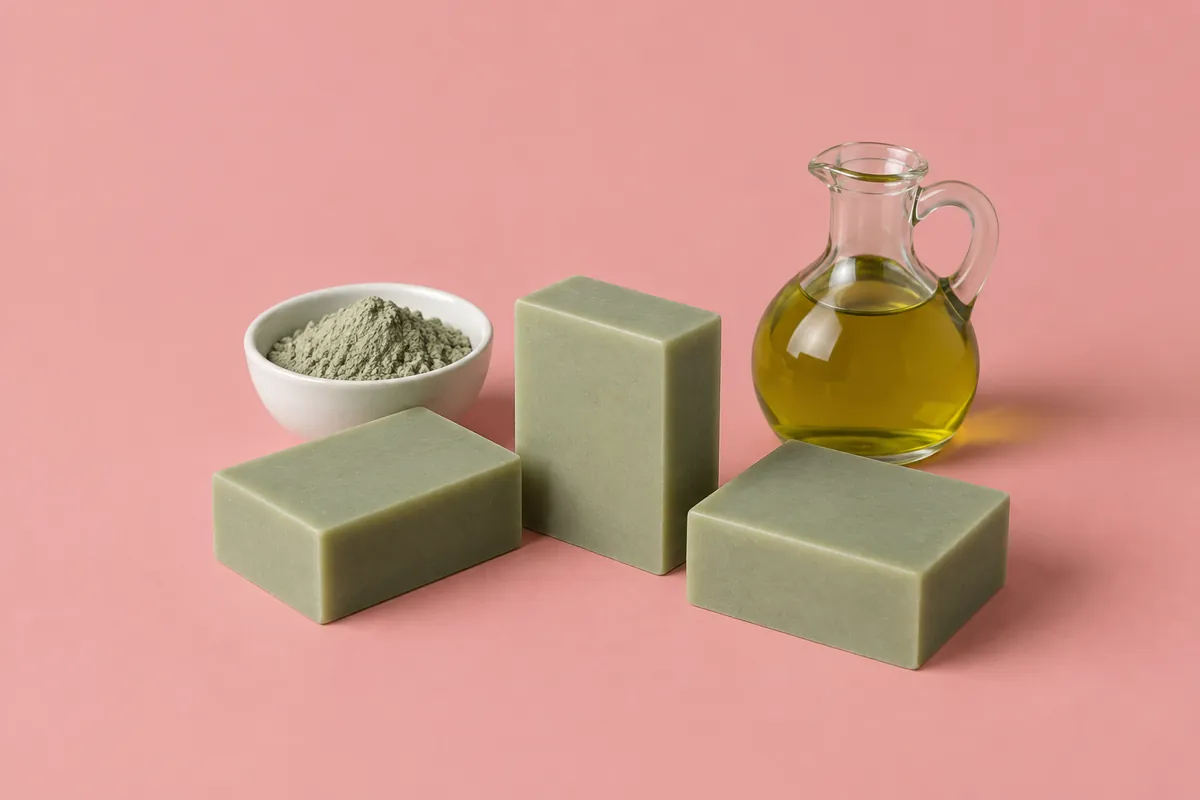
A palm-free face bar coloured a soft sage green with French green clay, with avocado oil and shea butter for a creamy lather. It is unscented, and coconut is held to a fifth of the oils, so it suits faces and anyone who prefers soap without fragrance.
- Skill
- Beginner
- Method
- Cold process
- Batch
- 1000 g of oils about 1473 g of batter
- Hands-on
- 1 h 10 min
- Cure
- 6 weeks
- Gel phase
- Either way gel or not, both work
What you need
For 1000 g of oils, which fills a 1.5 litre loaf mould. Weigh everything, liquids included.
| Olive Oil · 35.0 % | 350 g | 12.35 oz |
| Coconut Oil · 20.0 % | 200 g | 7.05 oz |
| Avocado Oil · 20.0 % | 200 g | 7.05 oz |
| Shea Butter · 20.0 % | 200 g | 7.05 oz |
| Castor Oil · 5.0 % | 50 g | 1.76 oz |
| Sodium hydroxide (NaOH) · the lye, 100 % pure | 134.4 g | 4.74 oz |
| Distilled water · 239 g for a 36 % lye solution, 75 g set aside | 313.6 g | 11.06 oz |
| French green clay · 2 tbsp, whisked into 75 g of water held back from the recipe's water | 25 g | 0.88 oz |
- Superfat
- 6 %
- Temperatures
- Oils and lye solution each at 32 to 38 °C (90 to 100 °F)
Method
-
Get ready
Open a window, put on splash goggles, nitrile gloves and long sleeves, and line or set out a 1.5 litre loaf mould. Wear a dust mask while you measure the clay. -
Weigh everything
Weigh 200 g coconut oil and 200 g shea butter into the pot, and 350 g olive oil, 200 g avocado oil and 50 g castor oil into a jug. Weigh 313.6 g distilled water into the lye jug and pour 75 g of it into a bowl for the clay, then weigh 134.4 g sodium hydroxide last, into a dry container. -
Make the lye solution
At an open window or under the extractor fan, pour the sodium hydroxide slowly into the water left in the lye jug, never the water onto the lye, and stir until clear. With less water it runs hotter than usual, so keep your face away and leave it to cool, labelled and out of reach. -
Mix the clay slurry
Whisk 25 g (about 2 tbsp) French green clay into the 75 g of held-back water until smooth, with no dry lumps. Leave it to soak while the lye cools, and whisk it again just before you use it. -
Melt the fats
Melt the coconut oil and shea butter on the lowest heat, then pour in the olive, avocado and castor oils. Let the oils and the lye solution each come to 32 to 38 °C (90 to 100 °F); keep the oils clear, with no cloudy specks of shea. -
Blend to light trace
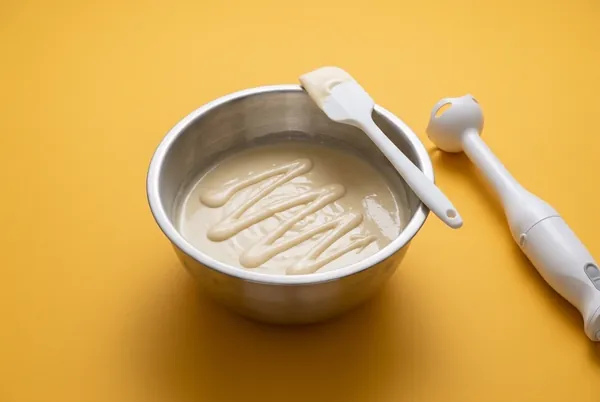
Pour the lye solution into the oils down the shaft of the stick blender, then pulse for a few seconds at a time, stirring between pulses, until the batter reaches light trace: thin custard that holds a faint drizzled line for a moment. -
Add the clay
Pour in the clay slurry and whisk it through by hand, then give two or three short pulses until the colour is even. Clay drinks water and thickens the batter, so pour straight away. -
Pour and cover
Pour into the mould, scraping the pot clean, and tap the mould on the worktop to release air bubbles. Cover it with its lid or a board; gel phase deepens the green a little, and the bar is just as good either way. -
Clean up
With your gloves still on, wipe the batter off the pot and tools with paper towels into the bin, then wash everything in hot soapy water. -
Unmould and cut
After about two days, when the loaf is firm to a pressed finger and has pulled away from the sides, put your gloves back on, unmould it and cut it into bars about 2.5 cm (1 in) thick. -
Cure
Stand the bars on edge on a rack, a finger's width apart, somewhere dry and out of the sun, for six weeks, turning them every few days.
Tips
- For a body bar, 20 g peppermint essential oil (2 % of the oils), stirred in at light trace before the clay, suits the green. Leave it out of a bar meant for the face, where menthol can sting the eyes.
- Mix the clay slurry on the day you soap. Wet clay can grow mould, so don't make it ahead and store it.
- Buy cosmetic-grade clay, not craft or pottery clay. Its colour comes from iron-bearing minerals, so the sage green holds through the cure where plant greens such as spirulina fade.
The oils
| Oil | Share |
|---|---|
| Olive Oil (virgin / refined / olive oil) | 35.0 % |
| Coconut Oil | 20.0 % |
| Avocado Oil | 20.0 % |
| Shea Butter | 20.0 % |
| Castor Oil | 5.0 % |
How it is made
| Process | Cold process |
| Alkali | NaOH |
| Superfat | 6 % |
| Water | lye water at 30 % |
| Iodine value | 63 |
| INS | 138 |
Why make it
A face bar for people who would rather use a soap than a cleanser from a tube. Coconut is held to a fifth of the oils, so it cleanses gently, 14 on our scale, with avocado oil and shea butter for a creamy lather, and it is unscented, in line with the dermatologists' advice to wash the face with a gentle cleanser. French green clay gives the soft sage colour. Tradition and the spa trade credit green clay with suiting oily skin; cosmetic safety reviewers class clays as absorbents and bulking agents, and there is no good evidence that a spoonful in a rinse-off soap does more than colour it and, makers find, give the lather some slip. Any soap is alkaline, so if your face feels tight afterwards, use it less often.
Sources
- Face washing 101 · American Academy of Dermatology
- Amended safety assessment of naturally-sourced clays as used in cosmetics · Cosmetic Ingredient Review, 2023
What tradition, makers' experience and research say about soaps like this, each labelled for what it is. It is not medical advice, and no soap treats a skin condition: if you have one, ask a doctor or pharmacist.
What the numbers say
- Lauric acid 9.8 %
- Myristic acid 3.8 %
- Palmitic acid 10.4 %
- Stearic acid 10.6 %
- Ricinoleic acid 4.4 %
- Oleic acid 47.7 %
- Linoleic acid 8.7 %
- Other 5.3 %
Saturated : unsaturated 37 : 63
Computed from the fatty acids of the fats above. The bands are what the craft has settled on, not chemistry — a bar outside one is not wrong.
From the guides
All guides
Natural colourants: what herbs, clays and spices really do in soap
Clays, charcoal and plant colours in cold-process soap: doses per 500 g of oils, infused oil, powder or lye, and the colour each one actually turns.

Soap additives: salt, sugar, sodium lactate, clays, oats, silk and more
What common soap additives do, how much to use and when they go in: sourced doses for sodium lactate, salt, sugar, honey, citric acid, clays, oats and silk.
Trace: how to tell when soap batter is ready
What trace is, how to read emulsion, light, medium and thick trace, how to spot false trace, and what makes soap batter thicken faster or slower.
Where these proportions come from
Our own formulation: a palm-free face bar with a fifth each of coconut oil, avocado oil and shea butter, olive oil for mildness and a little castor oil for lather, at a 6 % superfat. The water is raised to a 30 % lye solution so that the clay's slurry can come out of it without leaving the lye solution too strong.