In short
- Trace is a stable emulsion thickening as soap forms: batter dripped on the surface leaves a trail instead of vanishing.
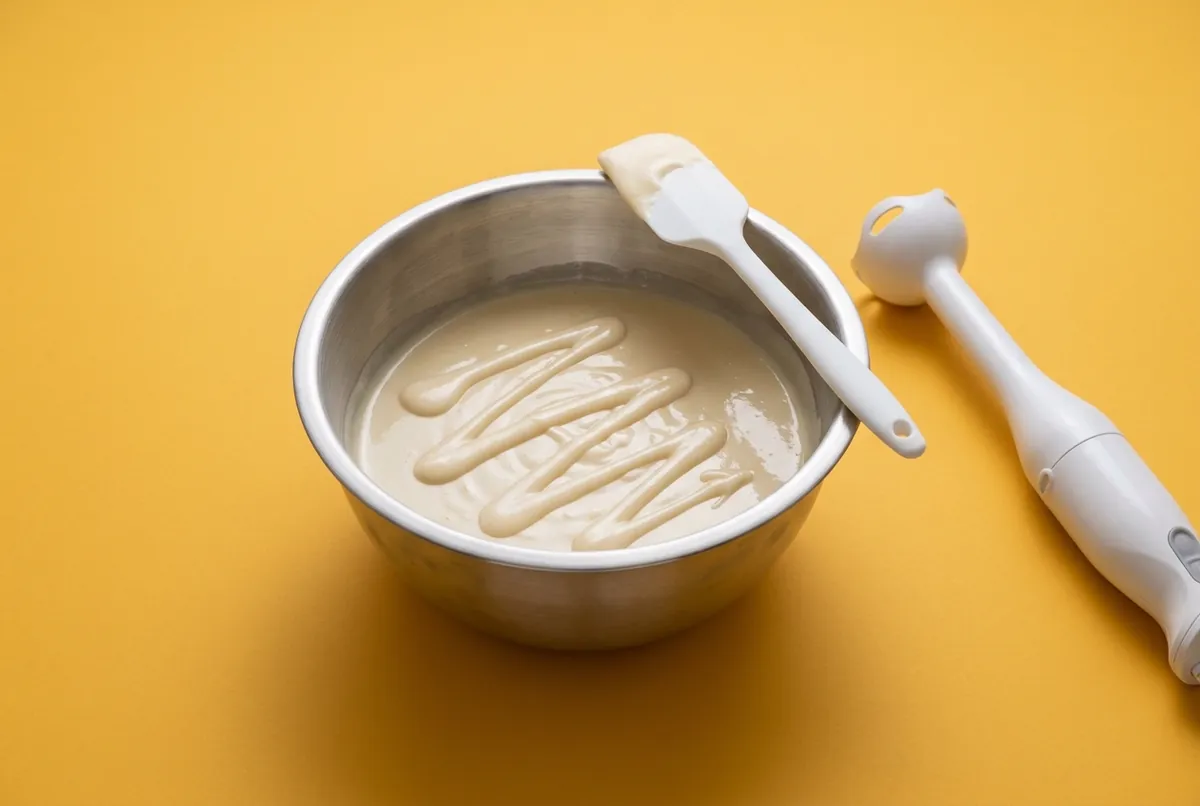
- Most single-colour loaves pour at light trace, like thin custard. Swirls want thinner batter; layers, textured tops and heavy additives want it thicker.
- False trace is hard fat setting in batter that has gone too cool. It looks like trace, but almost no soap has formed.
- A stick blender, warmth, a lot of hard fat, castor oil, less water and some fragrances speed trace; olive oil, more water and cooler batter slow it.
- Watching for a small temperature rise is Anne Watson's own method: a useful cross-check, not an established standard.
On this page
Trace is the point where soap batter has thickened enough to leave a trail on its own surface. Every cold process method asks you to recognise it: pour too soon and the batter can separate in the mould, wait too long and it will not pour at all. This guide explains what is happening in the pot, how to read the stages, how to tell real trace from false, and how to bring trace sooner or later when a design needs it.
What is happening in the pot
Oil and lye solution don’t mix. Poured together they lie in layers, and they can only react where they touch. Blending breaks the oil into droplets, which multiplies the surface where the two meet, and the first soap forms right there. Soap is an emulsifier, so that first soap coats the droplets and stops them running back together, and the blender can break them smaller still. More surface means a faster reaction, which makes more soap, which holds a finer emulsion. That feedback is why a stick blender reaches trace in minutes where a spoon can take an hour or more.
As soap builds up in the water, its molecules crowd together into ordered structures, and those structures are thick. Trace is the moment that thickening becomes something you can see. It does not mean the reaction is finished, or anywhere near it: most of it happens in the mould over the next day, which is why a loaf keeps getting warmer after you pour it.
The stages of trace
| Stage | What the batter looks like | What a drizzle does | Good for |
|---|---|---|---|
| Emulsion | Opaque and even, no oily streaks, thin as single cream | Vanishes at once | Stirring in colour and scent; the most fluid swirls |
| Light trace | Thin custard | Leaves a faint line that sinks back within seconds | Most single-colour loaves and most swirls |
| Medium trace | Pudding | Sits on top for a while | Layers poured over a spatula; keeping small additives suspended |
| Thick trace | Mashed potato | Holds peaks; the batter has to be spooned | Textured and piped tops; heavy additives |
The names are the craft’s own, and books draw the lines in slightly different places. What matters is what the batter does for the job in hand.
To test, switch the blender off, lift it out with the blade stopped and let batter drip back onto the surface, or do the same with a spatula. Look at the surface under a strong light, as Kelly Cable advises, and from a low angle: a faint trail at light trace is much easier to see that way. Watch the edge of the pot too. Anne Watson’s signs that the batter has come together are that it turns from oily and see-through to creamy and opaque, the shine on the surface dulls, and the oily ring where batter meets pot shrinks away. Some blenders tell you by ear, the motor’s note dropping as the batter thickens. Stop and look whenever you are unsure: as Faiola puts it, “you can always thicken it, but you cannot make it thinner!”
How long it takes depends on the recipe and the blender. Watson finds a powerful blender changes the batter almost at once and thickens it within a few minutes, while a weak one may show little change for five or ten minutes. Faiola’s Pure Soapmaking prints the blending time each recipe needed in testing, most of them soaped at 43 to 49 °C (110 to 120 °F): most reached thin trace in about 30 seconds, and even her 100 % olive oil castile took only a minute. By hand the scale changes. Stirring her all-vegetable bars briskly at 27 °C (80 °F), Susan Miller Cavitch expected trace in 7 to 40 minutes, depending on the grade of olive oil.
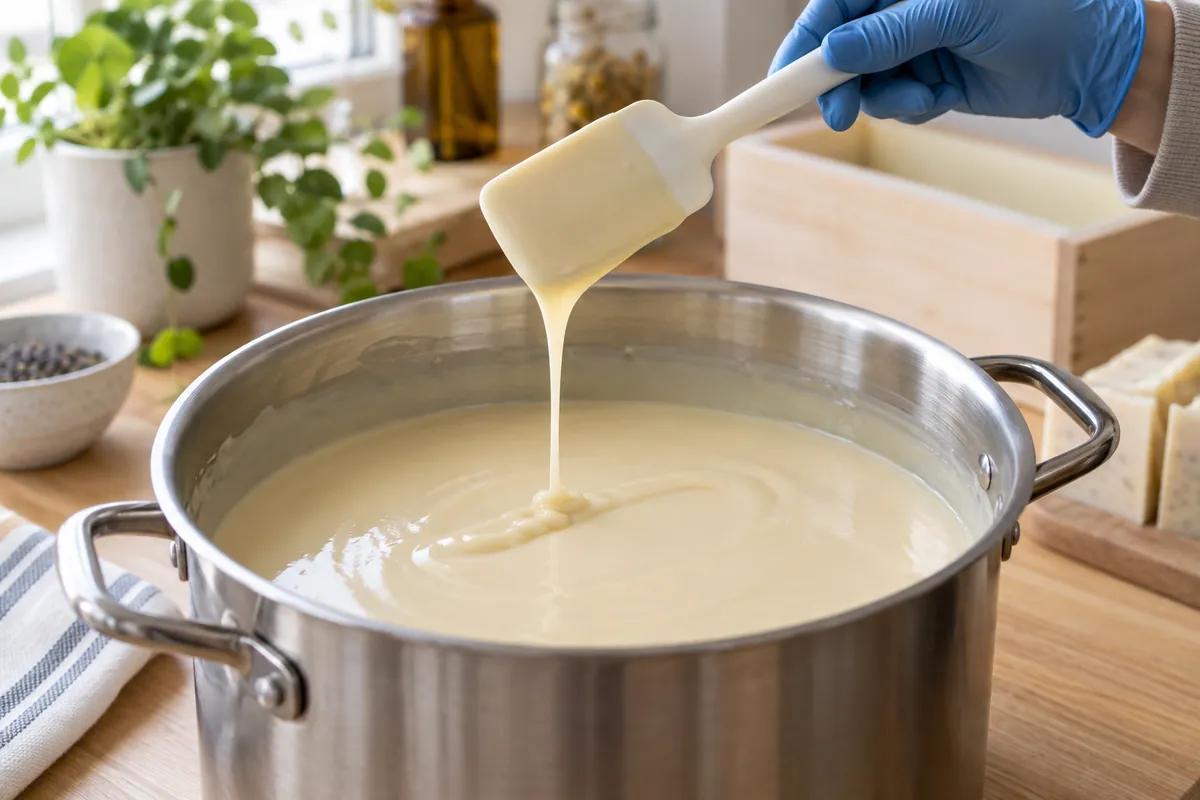 Light trace: the drizzle leaves a faint raised line that sinks back within a few seconds.
Is emulsion enough?
With a stick blender, many recipes can be poured as soon as they are fully emulsified, with no streaks left. David Fisher calls that very light trace, and Watson stops at what she calls the point of no return, when the batter is creamy and just starting to thicken. What you cannot do is pour batter that is still separating. In one of Kevin Dunn’s experiments, pure olive oil soaps made with 33 % and 25 % lye solutions, and mixed only briefly by shaking and swirling, never reached trace and separated in the mould: chalky, lye-heavy soap sank to the bottom and unreacted oil rose to the top. His four-oil blend at 33 % set without trouble. Until you know a recipe, aim for light trace, as our first-batch palm-free bar does.
False trace
False trace is batter that has thickened because it cooled, not because soap has formed. Solid fats melt and set over a range of temperatures: coconut oil around 23 to 26 °C, shea butter 33 to 40.5 °C, lard 36 to 42 °C (our oil pages give the sources). That coconut figure is for the ordinary oil; Cavitch notes harder grades sold to soapmakers that melt at about 33, 38 and 43 °C (92, 101 and 110 °F), and with one of those the risk starts that much higher. If the lye solution is cold, or the batter stands too long, the hard fat starts to crystallise and the batter goes thick, sometimes grainy, with little reaction behind it. Poured like that, it can separate later.
The signs are that it thickens almost as soon as the lye goes in, before much blending; that it looks waxy or grainy rather than smooth and creamy; and, if you are watching a thermometer, that its temperature has not risen. Heidi Corley Barto’s fix is to stand the pot in hot water until the fat melts again, then blend on to real trace. Watson finds that with a stick blender it usually clears within a minute of blending anyway. To prevent it, keep the oils fully melted and clear, and both liquids inside your recipe’s temperature window.
What speeds trace and what slows it
| Speeds trace | Slows trace | |
|---|---|---|
| Mixing | A stick blender run continuously | Short pulses with stirring between; a whisk or spoon |
| Temperature | Warmer batter | Cooler batter, as long as the hard fats stay melted |
| Oils | A high share of hard oils such as palm and tallow; stearic acid; castor oil | Olive oil and other liquid oils; 100 % olive oil (castile) most of all |
| Water | Less water: a stronger lye solution | More water: a weaker lye solution |
| Fragrance | Many florals, and spice oils such as clove and cinnamon | Unscented batter, or a scent you have tested |
| Additives | Honey, sugar and milk, which add heat |
From the books above and Kevin Dunn’s tests. Every recipe is its own case, so try a new fragrance in a small batch first.
Lard is the one the books disagree on. Kelly Cable finds it brings trace on faster; David Fisher builds a slow-tracing swirl recipe on lard and canola, leaving out palm and castor, because lard “is known to slow trace”. Try it yourself before you plan a swirl around it.
Water deserves a word, because the direction is easy to get backwards. Less water means a stronger lye solution, and a stronger solution traces sooner and runs hotter. Dunn tested it directly: with the same brief mixing, olive oil soap made with a 50 % lye solution reached trace within a few minutes, while the same oil at 33 % and 25 % did not. So if you want slow, fluid batter for a swirl, use a little more water, not less. Water discounting has its own uses, such as quicker unmoulding and a shorter cure, and the water guide weighs them up.
The grade of olive oil matters as well. Olive-pomace oil traces faster than ordinary olive oil; Fisher puts that down to its extra unsaponifiable matter, which the Codex standard allows at up to 3 % against 1.5 % for olive oil. Cavitch, who blamed the same unsaponifiables, ranks all the grades: pomace fastest, and darkest, and quickest to overreact to fragrance oils and to cassia or clove; refined grades in the middle, and her choice for high-olive recipes; extra virgin and virgin oils slowest. Faiola turns the difference to use, choosing pomace where a recipe must set sooner, for layers and textured tops.
Which trace for which job
Match the thickness to what the batter has to do. Swirls need batter fluid enough to move, so they are poured at emulsion or light trace from a slow-moving recipe (swirl techniques). Layers need batter thick enough to sit on the one below without sinking, which means medium trace poured gently over a spatula (layered soap). Peaks, piping and textured tops need thick trace, like the frosting on our piped soap cupcakes (embeds and tops). Solid additives such as ground oats or poppy seeds sink through thin batter, so stir them in at medium trace, as the oatmeal and honey scrub bar does; the three-layer clay bar pours each of its layers at medium trace. Colour and scent go in early, at emulsion or light trace: the batter keeps thickening while you stir them in, and some fragrances speed it up.
Watching the thermometer: Anne Watson’s method
In Smart Soapmaking, Anne Watson adds a measurement to the eye test. Saponification gives off heat, so she notes the batter’s temperature right after the lye solution goes in and checks it again as the batter thickens. By the point she pours, it has risen about 1 °C (2 °F). She stops before it has risen 3 °C (5 °F), because a little past that the batter can suddenly get too thick to pour; in her tests a rise of 5 to 6 °C (10 °F) meant heavy trace and batter close to setting in the pot.
It is a good cross-check, and it is especially good at catching false trace, which thickens without the temperature rising. But it is one author’s method, worked out for her own recipes and her batch size of 850 g of oils, as she says herself, and we know of no one who has tested it more widely. Several things blur it. The blender’s own work warms the batter a little. Batter that starts warmer than the room loses heat to the pot while it reacts, and batter that starts cooler gains it. A small batch changes temperature faster than a large one. And the signal is small, so you need a digital thermometer that responds quickly and shows tenths of a degree. Watson herself doubts it would work with hand stirring, where heat is made slowly and lost about as fast. Use it alongside your eyes, not instead of them.
When trace won’t come, or comes too soon
Slow trace is usually the recipe. High-olive batter, and castile above all, can take many minutes of pulsing, and warm, patient blending gets there. If nothing changes at all after a long time, go through the things that stop soap forming, which Faiola and Cable list: the lye went in, it was sodium hydroxide and not potassium hydroxide, it was fresh (lye that has drawn water from the air weighs heavy and delivers less), and the weights were right.
Fast trace is usually heat, hard fat or fragrance; our creamy tallow and olive bar warns that its tallow brings trace on quickly. If the batter thickens faster than you can work it, stop blending, stir in any colour or scent by hand and get the batter into the mould, spooning it if you have to. It is still soap. The seizing and ricing guide covers the extreme cases.
Recipes to try
All recipesSources
- Smart Soapmaking . Anne L. Watson, Shepard Publications , 2013. The visual signs of the point of no return, the temperature-rise method and its limits in the author's own words, and false trace.
- Soap Crafting . Anne-Marie Faiola, Storey Publishing , 2013. Thin, medium and thick trace; too many hard oils, stearic acid, water discounting and many fragrances accelerate; why soap won't trace; a gelling loaf 40 to 60 °F above its pouring temperature.
- Pure Soapmaking . Anne-Marie Faiola, Storey Publishing , 2016. Blending times printed for every recipe: most reached thin trace in about 30 seconds, the castile in a minute; stop and check, since batter can be thickened but never thinned; pomace olive oil used where layers and textured tops must set sooner.
- The Natural Soap Book . Susan Miller Cavitch, Storey Publishing , 1995. Hand-stirred bars ready for scent in 7 to 40 minutes at 80 °F depending on the olive oil; pomace fastest and darkest and most reactive to fragrance, refined grades preferred, extra virgin slowest; coconut oil sold in grades melting at 76, 92, 101 and 110 °F.
- The Complete Photo Guide to Soap Making . David Fisher, Creative Publishing International , 2018. Very light trace as full emulsification; floral and spice oils bring trace almost at once; castor oil and pomace olive oil speed trace; lard is known to slow it.
- Natural Soap Making . Elizabeth Letcavage and Melissa Harden, Stackpole Books , 2013. Light and heavy trace; heavy trace to keep light additives suspended.
- The Natural Soap Making Book for Beginners . Kelly Cable, Althea Press , 2017. Named stages of trace; checking light trace under a strong light; lard and tallow bring trace faster; sugars from milk, honey and juice speed saponification and heat.
- The Natural Soap Chef . Heidi Corley Barto, Ulysses Press , 2012. False trace below a solid oil's melting point, and rewarming in a hot-water bath; honey accelerates trace.
- Trace Analysis . Kevin M. Dunn, lecture to the Handcrafted Soapmakers Guild , 2010. Batter thickened faster when it was warmer, when it had less water and when eugenol (the main part of clove oil) was added.
- The Water Discount . Kevin M. Dunn, Handcrafted Soap and Cosmetic Guild , 2008. Olive oil soap at a 50 % lye solution traced within a few minutes; at 33 % and 25 % it did not, and separated in the mould. Low-water soap generally traces faster and resists separation.
- Superfatting and the Lye Discount . Kevin M. Dunn, The Handcrafted Soapmaker (Journal of the Handcrafted Soapmakers Guild), 2007-2 , 2007. Unsaponified oil in finished soap is richer in oleic and linoleic acid and poorer in ricinoleic acid than the oils that went in.
- Beyond Clean: Unraveling Phase Behavior and Rheology of Soaps . Joshi Y. M., Moaddel T., Raut J. S., Annual Review of Chemical and Biomolecular Engineering 17 , 2026. Soap and water form micellar to liquid-crystalline structures, each with its own flow behaviour.
- Standard for Olive Oils and Olive Pomace Oils (CXS 33-1981) . Codex Alimentarius Commission (FAO/WHO) . Unsaponifiable matter: up to 15 g/kg for olive oil, up to 30 g/kg for olive-pomace oil.