Kukui and almond shampoo bar
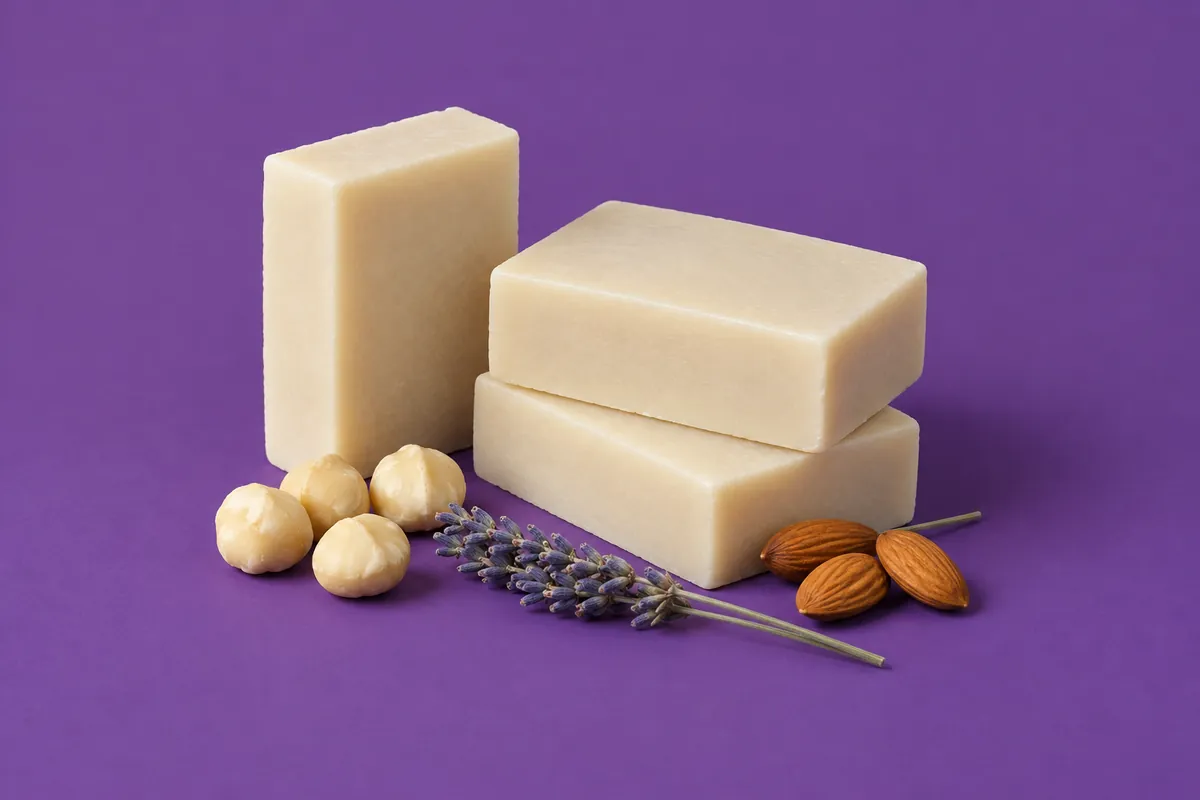
A milder soap shampoo bar for normal to dry hair, with sweet almond and kukui nut oils, cocoa butter and shea butter on an olive, coconut and castor base, scented with lavender and palmarosa. It partners our shampoo bar for normal to oily hair, and like it wants an acid rinse.
- Skill
- Intermediate
- Method
- Cold process
- Batch
- 1000 g of oils about 1445 g of batter
- Hands-on
- 1 h 15 min
- Cure
- 6 weeks
- Gel phase
- Either way gel or not, both work
What you need
For 1000 g of oils, which fills a 1.5 litre loaf mould. Weigh everything, liquids included.
| Olive Oil · 25.0 % | 250 g | 8.82 oz |
| Coconut Oil · 25.0 % | 250 g | 8.82 oz |
| Castor Oil · 19.0 % | 190 g | 6.70 oz |
| Cocoa Butter · 12.0 % | 120 g | 4.23 oz |
| Shea Butter · 7.0 % | 70 g | 2.47 oz |
| Almond Oil · 6.0 % | 60 g | 2.12 oz |
| Jojoba Oil · 3.0 % | 30 g | 1.06 oz |
| Kukui Nut Oil · 3.0 % | 30 g | 1.06 oz |
| Sodium hydroxide (NaOH) · the lye, 100 % pure | 136.7 g | 4.82 oz |
| Distilled water · for a 33 % lye solution | 277.5 g | 9.79 oz |
| Rosemary extract (ROE) · stirred into the liquid oils, to help the kukui and almond oils keep | 1 g | 0.04 oz |
| Vinegar (5 % acidity), for the acid rinse · per wash, in a mug (250 ml) of water; or ¼ tsp citric acid if you would rather have no smell | 1 tbsp | |
| Lavender essential oil · 2.0 % of the oils, at trace | 20 g | 0.71 oz |
| Palmarosa essential oil · 1.0 % of the oils, at trace | 10 g | 0.35 oz |
- Superfat
- 5 %
- Temperatures
- Oils and lye solution at 35 to 38 °C (95 to 100 °F), warm enough to keep the cocoa butter liquid
Method
-
Get ready
Put on splash goggles, nitrile gloves and long sleeves, open a window or run the extractor fan, and clear children and pets from the room. Line a 1.5 litre loaf mould. -
Weigh the oils
Weigh 250 g coconut oil, 120 g cocoa butter and 70 g shea butter into the pot. Into a jug, weigh 250 g olive oil, 190 g castor oil, 60 g sweet almond oil, 30 g jojoba oil, 30 g kukui nut oil and 1 g rosemary extract, and stir. -
Make the lye solution
Weigh 277.5 g distilled water into a heat-safe jug and 136.7 g sodium hydroxide into a dry container. With the window open, pour the lye into the water, never the water onto the lye, stir until clear and leave it to cool to 35 to 38 °C (95 to 100 °F) where it cannot be knocked. If it cools too far, stand the jug in a bowl of hot tap water; never warm lye on the hob. -
Melt the butters
Melt the coconut oil, cocoa butter and shea butter together on the lowest heat until clear, then stir in the jug of liquid oils. Hold them at 35 to 38 °C (95 to 100 °F): any cooler and the cocoa butter starts to set. -
Mix the essential oils
Weigh 20 g lavender and 10 g palmarosa essential oil into a small glass and stir them together. -
Blend to light trace
Pour the lye solution into the oils down the shaft of the stick blender and blend in short pulses, stirring between them. Castor oil and cocoa butter both hurry trace along, so stop as soon as a drizzle leaves a faint trail on the surface. -
Scent it
Stir in the essential oils by hand, then give a couple of short pulses to mix them through. -
Pour and cover
Pour into the mould, tap it firmly on the worktop and smooth the top. Lay a board over it, and add a towel only if the room is cold: a butter-rich loaf that runs hot can crack along the top. -
Unmould and cut
After 24 to 48 hours, or a day or two longer if the loaf still dents under a fingertip, unmould it with gloves on and cut bars about 2.5 cm (1 in) thick. -
Cure for six weeks
Cure the bars on a rack, not touching, in a dry and airy room for six weeks, turning them every week or so. -
Wash your hair
Glide the bar over soaked hair a few times, or work up a lather between wet hands, and massage it into your scalp. Rinse well: the less soap left behind, the less there is for hard water to turn into scum. -
Rinse with acid
Mix a mug (250 ml) of water with 1 tablespoon (15 ml) of 5 % vinegar, or with a quarter teaspoon of citric acid if you would rather have no smell. Pour it through your hair, work it in with your fingers, keep it out of your eyes, and finish with a plain rinse if you like. -
Let it dry between washes
Keep the bar on a draining dish of its own, away from standing water, so it stays firm.
Tips
- Sweet almond and kukui nut oils are tree-nut oils, and shea butter is pressed from a nut too: name them on the label and keep this bar from anyone with a nut allergy.
- In hard water, calcium and magnesium turn part of any soap lather into a dull film that clings to hair. A thorough rinse and the acid rinse clear it; where the water is very hard, a syndet bar may be the better choice.
- Kukui nut oil is rich in linoleic acid and goes rancid sooner than olive oil. Buy it in a small bottle, keep it in the fridge and smell it before you weigh it; the rosemary extract helps the finished bars keep, but use them within a year.
- Its partner, the shampoo bar for normal to oily hair, has a little more coconut oil and castor oil and no cocoa butter. The difference is modest, so if this bar leaves your hair heavy, try that one.
The oils
| Oil | Share |
|---|---|
| Olive Oil (virgin / refined / olive oil) | 25.0 % |
| Coconut Oil | 25.0 % |
| Castor Oil | 19.0 % |
| Cocoa Butter (Theobroma Oil) | 12.0 % |
| Shea Butter | 7.0 % |
| Almond Oil (Sweet Almond Oil) | 6.0 % |
| Jojoba Oil | 3.0 % |
| Kukui Nut Oil | 3.0 % |
How it is made
| Process | Cold process |
| Alkali | NaOH |
| Superfat | 5 % |
| Water | lye water at 33 % |
| Iodine value | 61 |
| INS | 141 |
Why make it
For anyone curious about washing hair with real soap, especially hair on the dry side. Castor, coconut and cocoa butter give a big, creamy lather, 34 bubbly and 36 creamy on our scale, while sweet almond and kukui nut oils keep the cleansing moderate at 17. Soap shampoo bars are an old idea revived by people cutting down on plastic bottles. The honest part: soap is alkaline, and a review of shampoo pH found that an alkaline wash raises the negative charge on hair and the friction between strands (Gavazzoni Dias and colleagues), while in hard water soap leaves a film (USGS). That is why an acid rinse follows every wash. Some people love the result and some go back to shampoo; a few washes will tell you which you are.
Sources
- The shampoo pH can affect the hair: myth or reality? · International Journal of Trichology, 2014
- Hardness of water · U.S. Geological Survey
What tradition, makers' experience and research say about soaps like this, each labelled for what it is. It is not medical advice, and no soap treats a skin condition: if you have one, ask a doctor or pharmacist.
What the numbers say
- Lauric acid 12.3 %
- Myristic acid 4.7 %
- Palmitic acid 10.0 %
- Stearic acid 9.2 %
- Ricinoleic acid 16.8 %
- Oleic acid 32.3 %
- Linoleic acid 8.6 %
- Other 7.2 %
Saturated : unsaturated 39 : 61
Computed from the fatty acids of the fats above. The bands are what the craft has settled on, not chemistry — a bar outside one is not wrong.
From the guides
All guides
Shampoo bars: what true soap does to hair
Soap shampoo bars, honestly: what alkaline soap and hard water do to hair, why an acid rinse helps, when a syndet bar is the better choice, and a recipe.
Soap in hard water: scum, chelators and rinse
Why soap turns to scum in hard water, how much soap each litre wastes, what a chelator in the bar can and cannot do, and why coconut soap copes best.
Antioxidants and chelators: keeping soap from going off
What rosemary extract, vitamin E, BHT, EDTA and sodium citrate do in soap, the doses in our database, and how much evidence stands behind each one.
Where these proportions come from
Adapted from the Tropical Shampoo Bar in Susan Miller Cavitch's The Natural Soap Book, her favourite of her two shampoo bars and the one for normal to dry hair: her olive, coconut, castor, sweet almond, jojoba and kukui nut oils in close to her proportions, with the palm oil replaced by cocoa butter and shea butter, at our 5 % superfat and a 33 % lye solution, and rosemary extract in place of her grapefruit seed extract.
Formulation adapted from The Natural Soap Book by Susan Miller Cavitch (Storey Publishing, 1995). The method and notes are ours.