In short
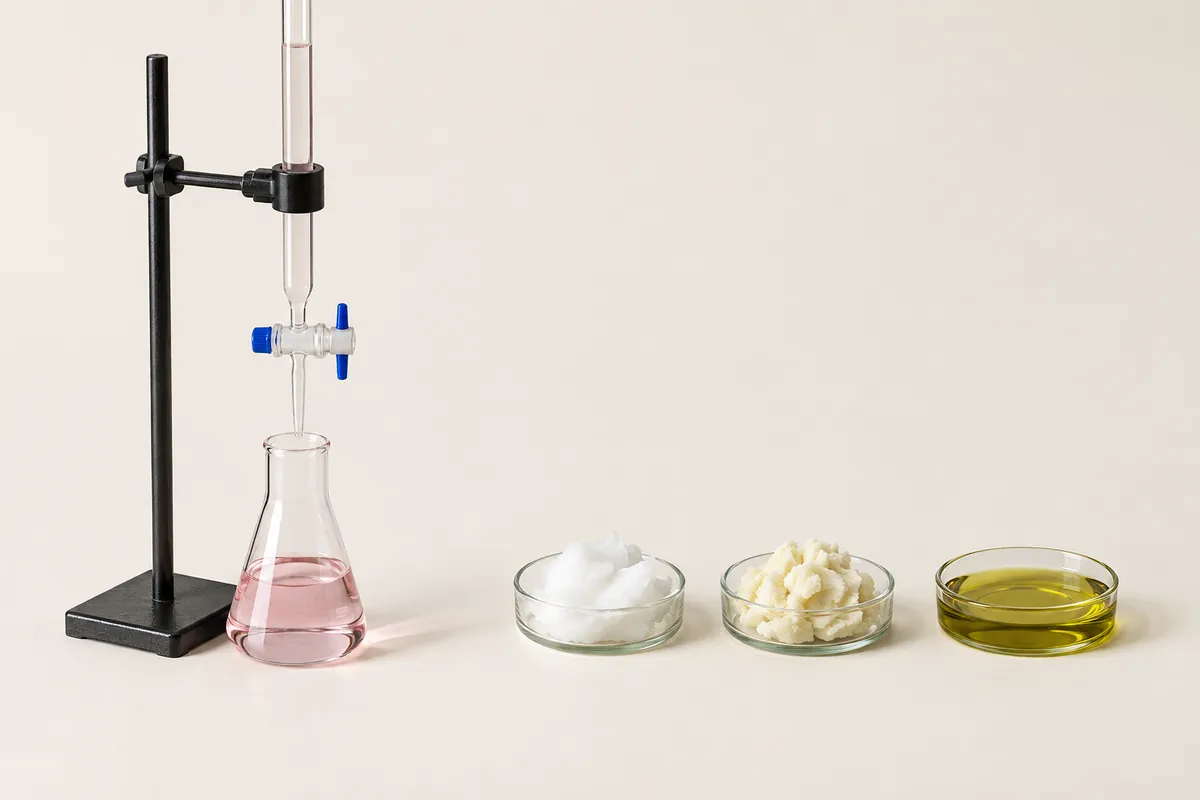
- A SAP value is the milligrams of potassium hydroxide that saponify one gram of fat, measured by boiling the fat with alcoholic KOH and titrating what is left.
- Hobby tables print it per gram of oil, as NaOH or as KOH: 0.135 and 0.190 are both olive oil, and reading the wrong column is a 40 % lye error.
- One oil has a range because the fat itself varies: chain lengths, unsaponifiable matter, grade and refining, and which oil is being sold under the name.
- Priced both ways, 533 recipes from soapmaking books come within 1 % of the books' own figures nineteen times in twenty. The one figure to watch is palm kernel oil, which six books print too low.
- An error of ±3 % in the SAP turns a 5 % superfat into anything from about 2 % to 8 %, which is where the 5 % habit comes from.
- A certificate of analysis for your lot replaces the range with a measurement, and the calculator accepts it.
On this page
- What the number means
- How a laboratory measures it
- NaOH, KOH and the decimal point
- Why one oil has a range
- Why books, calculators and laboratories disagree
- How our figures compare with soapmaking books
- Figures that cannot be true
- Checking a value against the oil’s own composition
- Measuring your own lot
- What ±3 % does to your superfat
A saponification value, SAP for short, is the one number per oil that a lye calculation cannot do without. This guide covers what it measures, how a laboratory gets it, why no oil has a single true figure, why books and calculators print different ones, and how much margin all that leaves you.
What the number means
The saponification value is the number of milligrams of potassium hydroxide needed to saponify one gram of a fat. It counts every fatty acid in the fat, whether bound to glycerol or free; ISO 3657 calls it a measure of “the free and esterified acids”. Olive oil’s is about 190: a gram of olive oil takes 190 mg of KOH.
Every chain needs one hydroxide, so the value is really a count of chains per gram, and shorter chains mean more of them in each gram. That is why coconut oil, rich in 12- and 14-carbon lauric and myristic acid, is published at 248–265, while olive oil, mostly 18-carbon oleic acid, is published at 184–196. The chemistry guide works the figures out from the molecules themselves: pure trilaurin 263.4, pure triolein 190.1.
How a laboratory measures it
ISO 3657 and AOCS Cd 3-25, the two methods the Codex oil standards name, work the same way. About 2 g of fat is boiled under a reflux condenser with 25 ml of 0.5 mol/l potassium hydroxide in ethanol, far more alkali than it can use, for an hour, or two for high-melting fats. Hot alcohol dissolves fat and alkali together, so an ordinary fat is fully saponified in that time. The alkali left over is titrated with 0.5 mol/l hydrochloric acid, with a blank flask run alongside, and the difference between the two titrations is the KOH the fat used:
SAP = (acid used by the blank − acid used by the sample) × c × 56.1 ÷ m
with the acid in millilitres, c its concentration in mol/l and m the grams of fat.
Even a measured value carries some error. In the collaborative trial behind ISO 3657, 22 laboratories analysed the same samples. Two results from one laboratory agreed to about 2 mg KOH/g. Between laboratories the scatter was wider: the reproducibility limit, the difference that two laboratories’ results exceed only one time in twenty, was 5.0 mg KOH/g for rapeseed oil (mean 190.2), 5.7 for palm oil (199.5) and 11.7 for coconut oil (256.8).
NaOH, KOH and the decimal point
Soapmakers’ tables rarely print the laboratory figure. They print grams of lye per gram of oil, which works in any unit because it is a ratio, and they print it for sodium hydroxide, for potassium hydroxide, or for both. A mole of either does the same work, so the NaOH figure is the KOH figure times the ratio of their molar masses, 39.997 ÷ 56.106 = 0.7129, divided by 1000.
| Oil | SAP (mg KOH/g) | KOH per g of oil | NaOH per g of oil |
|---|---|---|---|
| Olive | 190 | 0.190 | 0.135 |
| Coconut | 256.5 | 0.257 | 0.183 |
| Castor | 179 | 0.179 | 0.128 |
The figures the calculator uses: the middle of each oil’s published range.
The two columns look alike, and mixing them up is the most dangerous mistake in the subject. A KOH figure used for a sodium hydroxide recipe asks for 40 % more lye than the oils need (0.190 where 0.135 was meant), which makes a caustic bar. An NaOH figure used for a potassium hydroxide recipe gives 29 % too little, which makes a soft, greasy paste. Soap books have printed a KOH-only table beside recipes made with sodium hydroxide, so read the heading of any table before you trust a number in it.
Two smaller traps. Some older charts carry a second column with a lye discount already taken off, and a calculator’s own superfat then discounts it again. And KOH figures assume pure potassium hydroxide, while the flakes are sold at around 90 %, which the calculator corrects for; the NaOH and KOH guide explains the purity setting.
Why one oil has a range
Codex publishes saponification values as advisory ranges alongside its mandatory fatty-acid ranges, and across the oils in this site’s database the typical published range is about ±3 % of its middle. The reasons are physical, and knowing them tells you when your bottle is likely to sit at one end.
Chain lengths vary. The olive oil standard allows 7.5–20 % palmitic acid (16 carbons) and 55–83 % oleic (18). More of the shorter chain means more molecules per gram and a higher value. Breeding can move an oil far enough to earn it a separate name: Codex lists high-oleic sunflower oil at 182–194 beside ordinary sunflower at 188–194, and rapeseed oil at 168–181 beside low-erucic rapeseed, canola, at 182–193, because erucic acid is a 22-carbon chain. In Britain and the EU, vegetable oil sold as food may hold no more than 2 % erucic acid, so supermarket rapeseed oil is the oil the calculator calls canola, and the high-erucic rapeseed oil is an industrial product.
Some of the oil is not fat. Unsaponifiable matter, such as sterols, squalene and waxes, takes no lye, so it dilutes the value. It is a percent or two in most oils and 2 to 12 % in shea butter, which is why shea and avocado oil take a little less lye than their fatty acids alone suggest.
Grade and refining change the product. Crude rice bran oil, heavy in wax, sits at the floor of the Codex range of 180–199. Pure stearic acid takes 197 mg KOH/g, but the triple-pressed stearic acid soapmakers buy is about half palmitic acid and takes 206–212.
Why books, calculators and laboratories disagree
Look an oil up in two books or two calculators and the lye can differ, usually by a percent or two. Neither need be wrong. The difference nearly always comes from one of four places.
- Different starting figures. Most tables that circulate among soapmakers print one number per oil, to three decimals, with no source, and many repeat one another’s figures. This calculator starts from the range in a primary document (a Codex or national standard, a pharmacopoeia monograph, a producer’s specification or a paper), names that document on the oil’s page, and uses the typical value where one is printed, otherwise the middle of the range.
- Measured oil against pure fat, and which grade. A laboratory measures the oil in front of it, unsaponifiable matter and all, while a figure worked out from fatty acids assumes pure fat. Sunflower, rapeseed, rice bran, stearic acid and shea are each sold in grades whose values differ, and an old table rarely says which it meant.
- Conversion and rounding. Laboratories report mg KOH per gram. A book converts that to grams of NaOH and rounds to three decimals, and the rounding alone can move a figure by 0.4 %.
- Errors that travelled. A wrong figure copied into one table tends to turn up in the next.
A published range is wider than most of these differences: olive oil’s spans 12 mg KOH/g, over 6 % of its value. That is why a sensible superfat covers them, and why the calculator shows the range itself as well as the figure it uses.
How our figures compare with soapmaking books
Fourteen of the soapmaking books we studied print SAP figures: 539 rows covering about 105 oils. Two authors reprint their own tables, so that is twelve independent sources, one of them a 1908 soap-works handbook whose authors measured the fats they bought. We priced 533 of the books’ own recipes twice, once with our figures and once with the books’ (each oil’s median, one figure per source, misprints removed). The two came out a median 0.2 % apart, ours a shade lower. Nineteen recipes in twenty were within 1 %, about 1.5 g of sodium hydroxide on a 1 kg batch of oils, 99 in 100 within 2 %, and none was more than 3 % out. A plain bar of olive, coconut, palm, castor and shea takes 148.4 g of sodium hydroxide per kilogram of oils by our figures and 148.8 g by the books’.
The one figure to watch is palm kernel oil. Six of the ten books that list it print about 0.155 g NaOH per gram, a figure that would suit a fat with far less lauric acid; the earliest printing we have is from 1995, and later books copied it. Palm kernel is nearly half lauric. Malaysia’s palm oil research institute surveyed its palm kernel oil at 243–249 mg KOH/g, 245 on average, which its own fatty acids confirm, and Codex puts the oil at 230–254 (0.164–0.181); we use 245 (0.175). A bar with 40 % palm kernel made to those books at “5 % superfat” is really at about 10 %, and softer than intended.
For five oils the books and the standards agree, and the calculator uses the standards:
| Oil | Books print (g NaOH/g) | Range (mg KOH/g) | We use | Basis |
|---|---|---|---|---|
| Black cumin | 0.137 | 185–205 | 195 (0.139) | A producer’s specification; measured oils 197–198 |
| Mango butter | 0.134–0.145 | 185–198 | 191.5 (0.137) | IS 9231:1979, India’s standard for mango kernel fat |
| Neem | 0.134–0.139 | 175–205 | 190 (0.135) | IS 4765:1975 |
| Avocado | 0.132–0.134 | 170–202 | 186 (0.133) | Codex CXS 210, avocado added 2024 |
| Kukui | 0.135–0.136 | 191.3–198.8 | 191.3 (0.136) | Measured on Hawaiian oil, and its composition agrees |
A few book rows are plain slips: NaOH and KOH columns swapped, one oil’s row repeated under the next, a coconut-type figure printed for a nut oil, the old high-erucic rapeseed figure printed under canola, and coconut oil printed as 0.118 in a table whose own book gives 0.178 a chapter earlier. The composition check below catches most of them.
The 1908 handbook turned out to be the most useful book for this. Its authors were works chemists who tested each lot of fat they bought by the same boiling and titration used today, and for most oils a standard now covers, their figures fall inside its range. They also caught one of ours. We had cohune oil at 241, from a single modern entry for a more oleic sample. The handbook prints cohune at 253.9–255.3 under the heading for a different quantity, a slip that goes back to the Imperial Institute’s bulletin of 1903 and was corrected in print in 1909. Read as saponification values, the figures match five more samples from Belize the Institute measured in 1913, at 252–257, and the oil’s fatty acids agree. We now use 254.6 (0.182).
So if your supplier’s certificate gives a saponification value for your lot, use it. Otherwise the gap between a careful book and this calculator is smaller than the margin a 5 % superfat leaves, which is what the superfat is for.
Figures that cannot be true
The worst errors are in the primary literature, because a number in a journal looks authoritative and gets copied. Building this dataset turned up several that had to be rejected.
- A 2018 paper on andiroba oil printed a saponification value of 59.5 and an iodine value of 196.6. Its own composition says about 190 and 60: the two labels had changed places. A calculator that took 59.5 would ask for a third of the lye the oil needs.
- Papers have reported black cumin oil at 211 to 244 mg KOH/g. An oil that is 55–60 % linoleic acid cannot take more than about 200 even as free acid, and measured commercial oils came in at 197–198.
- A 2021 analysis put one murumuru butter at 573.6 mg KOH/g, twice what any lauric fat can take; its authors noted it was out of line with the 200–300 their pharmacopoeia expects.
The defence is a check that needs no laboratory.
Checking a value against the oil’s own composition
Because the saponification value counts chains per gram, it follows from the fatty-acid profile. From each acid’s share and molar mass, work out how many moles of fatty acid a gram of fat holds, allow for the glycerol backbone, and multiply by 56.106 mg of KOH per millimole. Counting moles matters: an average molar mass taken by weight instead runs about 3 % low for coconut-type oils, whose chains vary most in length. ISO 3657 sets out the same calculation in its Annex B. The two numbers are usually measured separately, often by different people, so when they disagree, one of them is wrong.
On 36 Codex oils, where both numbers come from the same standard, the calculation lands within 0.84 % of the published value for the median oil and within 2.44 % for nine in ten. It runs about 0.55 % high on average, because it assumes pure fat and a crude oil carries a little unsaponifiable matter. The database behind this calculator runs the check on every record and flags any oil whose published value sits more than 12 % from what its own profile implies. Four do: tucumã, murumuru and ucuúba butters, published at 182–205 beside profiles of lauric and myristic fats that must saponify at about 235–250, and pomegranate seed oil, whose typical figure is the bottom of a wide range. The calculator uses the published figure, because that is what the source says, and each oil’s page states that the pair disagrees.
The same arithmetic fills gaps. Where no primary document publishes a value at all, as for hemp seed oil and pecan oil, the figure is derived from the oil’s composition and carries a ±3 % band, the width the method’s accuracy on the Codex oils supports. The formula page shows the working and the validation.
Measuring your own lot
A published range describes an oil in general; the oil in your bottle has one value, and the only way to know it is to have it measured. Some suppliers issue a certificate of analysis for each lot, giving its measured saponification value alongside figures such as free acidity. That is different from a specification sheet, which gives the range the supplier promises for every lot.
Enter a measured value under “Measured values from a certificate of analysis” in the calculator, and it replaces the published figure for that oil and removes that oil from the uncertainty. For 1000 g of olive oil at a 5 % superfat, the published range gives 128.7 g of sodium hydroxide, anywhere from 124.6 to 132.7 g.
Use your own lot's figure. With a measured SAP of 188, 1000 g of olive oil at 5 % superfat takes 127.3 g of sodium hydroxide instead of 128.7 g, and the range for it disappears.
Open it in the calculatorA certificate still carries its laboratory’s error: in the ISO trial, results from different laboratories scattered by about 1 % (0.9 % for rapeseed oil, 1.6 % for coconut oil). That is better than most published ranges and still not exact, so keep a superfat that covers it.
What ±3 % does to your superfat
Superfat is the margin between the lye you weigh and the lye the oils could take, and an error in the saponification value lands directly on it, roughly one point of superfat for every percent. If you weigh lye for a value of 190 and your oil is really 184, it needs less lye than you gave it, and the surplus has nothing to react with. The low end of a range is the dangerous end, which is the opposite of what most people guess.
The superfat you actually get = 1 − (1 − superfat set) × SAP used ÷ true SAP
| Superfat you set | Oils 3 % lower than the figure used | Oils 3 % higher |
|---|---|---|
| 0 % | −3.1 % | 2.9 % |
| 3 % | 0.0 % | 5.8 % |
| 5 % | 2.1 % | 7.8 % |
| 8 % | 5.2 % | 10.7 % |
Every oil at the same end of a ±3 % band.
This is the arithmetic behind the craft’s habit of a 5 % superfat, whether or not anyone worked it out that way: 3 % is the least that survives a 3 % error, and the other 2 % covers the scale, the lye’s purity and a spill. The calculator does this arithmetic with each oil’s own published range, under “How well is this pinned down?”. For olive oil alone, whose range is ±3.2 %, a 5 % superfat could really be anything from 1.9 % to 7.9 %.
Which range you read matters as much as its width. Taken as the band for one lot, shea’s Codex range of 160–195 would put a soap of shea alone at a nominal 5 % anywhere from −8.7 % to 10.8 %. The measured band of 179–190 puts it at 3.0 % to 8.5 %. With an oil whose standard is that broad, a certificate for your lot is worth asking for in a way it is not with sunflower oil at 188–194.
Taking every oil at the same end of its range at once is a worst case, but it is the right question to ask of a margin whose failure is a caustic bar. The superfat guide covers the other reasons for choosing one.
Sources
- ISO 3657:2023 Animal and vegetable fats and oils: Determination of saponification value . International Organization for Standardization , 2023. Definition, reflux and titration method, interlaboratory precision (Annex A) and calculation from fatty-acid composition (Annex B).
- AOCS Official Method Cd 3-25, Saponification Value of Fats and Oils . American Oil Chemists' Society .
- Standard for Named Vegetable Oils (CXS 210-1999) . Codex Alimentarius Commission (FAO/WHO) . Saponification ranges (advisory) and fatty-acid ranges: sunflower, high-oleic sunflower, rapeseed, low-erucic rapeseed, rice bran, palm kernel (230–254), and avocado oil (170–202, added in 2024).
- Standard for Olive Oils and Olive Pomace Oils (CXS 33-1981) . Codex Alimentarius Commission (FAO/WHO) .
- Regional Standard for Unrefined Shea Butter (CXS 325R-2017, amended 2022) . Codex Alimentarius Commission (FAO/WHO) , 2022. Saponification value 160–195 mg KOH/g and unsaponifiable matter 1–19 %; the limits are broad because they cover shea from all production areas.
- Palm Kernel Oil Extraction: The Malaysian Experience . Tang T. S., Teoh P. K., Journal of the American Oil Chemists' Society 62(2) , 1985. Table VII reproduces the Palm Oil Research Institute of Malaysia's survey of Malaysian palm kernel oil: saponification value 243–249, mean 245.
- Cohune Nuts from British Honduras . Imperial Institute, Bulletin of the Imperial Institute 11 , 1913. Five kernel fats from the Belize River, saponification values 252.4–256.5 (table, p. 229).
- Chemical Technology and Analysis of Oils, Fats and Waxes, 4th edition, volume II . Lewkowitsch J., Macmillan , 1909. Cohune oil, p. 497: the 1903 figures are saponification values, printed in the original as equivalents.
- The Handbook of Soap Manufacture . Simmons W. H., Appleton H. A., Scott, Greenwood & Son , 1908. Chapter III: the authors' analyses of the fats a soap works bought, printed as saponification equivalents.
- IS 9231:1979 Specification for Mango Kernel Fat . Indian Standards Institution (now Bureau of Indian Standards) , 1979. Saponification value 185–198 for refined and raw grades.
- IS 4765:1975 Specification for Neem Kernel Oil and Depulped Neem Seed Oil . Indian Standards Institution (now Bureau of Indian Standards) , 1975. Saponification value 180–205 (kernel oil) and 175–200 (depulped seed oil).
- Product Specification: Black cumin seed oil cold pressed (Sp322020c) . Gustav Heess GmbH , 2026. Saponification value 185.0–205.0 mg KOH/g (Ph. Eur. 2.5.6).
- The Chemical Composition of the Fatty Oil from Kukui Nuts . Riebsomer J. L., Foote N., Proceedings of the Indiana Academy of Science . Hawaiian kukui oil: saponification value 191.3.
- Atomic weights of the elements 2013 . IUPAC, Pure and Applied Chemistry 88(3) , 2016.
- Commission Regulation (EU) 2019/1870 on maximum levels of erucic acid . legislation.gov.uk (retained in UK law) , 2019. No more than 20 g/kg erucic acid in vegetable oils sold as food.
- Antioxidant activity and genotoxic assessment of crabwood (andiroba, Carapa guianensis Aublet) seed oils . Araujo-Lima C. F. et al., Oxidative Medicine and Cellular Longevity , 2018. Table 1: the saponification and iodine values discussed here.
- Evaluation of the quality of Amazonian butters as sustainable raw materials for applications in bioproducts . Feitosa J. M. et al., Revista de Ciências Farmacêuticas Básica e Aplicada , 2021.