In short
- One molecule of either hydroxide does the same work, so 56.1 g of KOH does what 40.0 g of NaOH does: multiply by 1.4028 one way and 0.7129 the other.
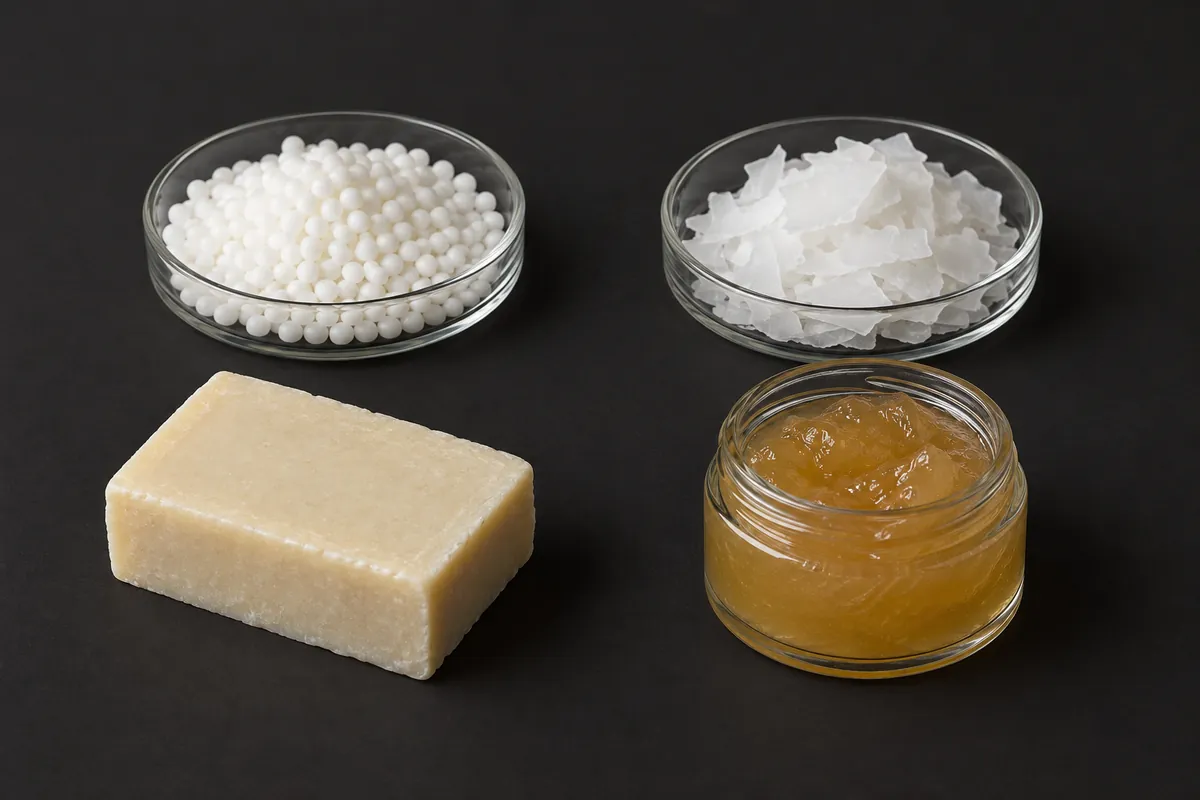
- Sodium soaps of the saturated fatty acids crystallise out of water at room temperature and make bars. Their potassium versions stay dissolved, which is why KOH makes liquid and soft soap.
- Potassium hydroxide is sold at about 90 %, the rest mostly water; sodium hydroxide at close to 100 %. Both absorb water and carbon dioxide once opened.
- In a dual-lye recipe the KOH share is a share of the saponification, not of the weight: in our shaving soap, 40 % of the work is 51 % of the lye you weigh.
- Weigh sodium hydroxide from a potassium hydroxide figure and a bar gets about half as much lye again as its oils can use.
On this page
Sodium hydroxide (NaOH, caustic soda) and potassium hydroxide (KOH, caustic potash) do the same job in soapmaking: each supplies the hydroxide that splits a fat into soap and glycerin. What differs is the soap each one leaves behind, how many grams a recipe needs, and what the flakes on your shelf actually contain. This guide covers all three, then dual-lye recipes that use both, and the one mix-up between them that can make a bar caustic.
The same reaction, different weights
A fat molecule takes three hydroxides whichever alkali supplies them, so the two are interchangeable molecule for molecule, not gram for gram. A potassium atom is heavier than a sodium atom, and with IUPAC’s atomic weights a mole of KOH weighs 56.106 g against 39.997 g for NaOH. So 1 g of KOH does the work of 0.7129 g of NaOH, and 1 g of NaOH the work of 1.4028 g of KOH.
Saponification values are defined in potassium hydroxide, as milligrams of KOH per gram of fat (AOCS Cd 3-25), so a calculator converts them with that 0.7129 whenever you choose sodium hydroxide. A table that prints olive oil’s value as 0.190 is giving you the KOH figure; the NaOH figure is 0.135.
| 1000 g of oil, 5 % superfat | Sodium hydroxide | Potassium hydroxide, pure | Potassium hydroxide at 90 % |
|---|---|---|---|
| Olive oil | 128.7 g | 180.5 g | 200.6 g |
| Coconut oil | 173.7 g | 243.7 g | 270.8 g |
From our calculator, using the representative saponification values of 190 and 256.5 mg KOH/g.
That gives a quick sense check. For bar soap at a 5 % superfat, sodium hydroxide comes to roughly 13 % (olive oil) to 17 % (coconut oil) of the oil weight. Potassium hydroxide at 90 % purity comes to roughly 20 to 27 %. A lye figure outside the range for the alkali you are holding is worth a second look.
Why sodium makes bars and potassium makes liquid soap
A bar of soap is a mass of soap crystals holding some water. Whether the soap crystallises or stays dissolved at room temperature is what separates the two alkalis, and the classic measurements, made by McBain and Sierichs in 1948, show the pattern clearly. In their tests only a handful of pure soaps dissolved to any real extent at room temperature: potassium laurate, potassium myristate, potassium oleate, the potassium soap of coconut oil’s mixed acids, and sodium oleate. Every other sodium or potassium soap of the saturated fatty acids, sodium laurate and sodium stearate among them, needed heat to go into solution.
So a sodium soap of coconut, palm or tallow sets into a firm, crystalline bar. Made with potassium hydroxide, the lauric and oleic soaps of coconut and olive oil stay in solution as a translucent paste, which is exactly what a maker wants for liquid soap: the paste dilutes with water into something pourable, and our dilution calculator works out how much water. The soft soaps of history, such as savon noir made from olive oil and potash, are the same chemistry stopped short of dilution.
Sodium oleate is the exception on the sodium side, and it explains castile. A bar of pure olive oil soap is mostly sodium oleate, which is soluble enough that the young bar stays soft for weeks and turns slippery in use.
Purity: what the flakes on your shelf contain
Sodium hydroxide leaves the factory close to pure. A manufacturer’s certificate for a bag of caustic soda pearls that Dunn showed to soapmakers reads 99.9 % NaOH, and the calculator assumes 100 % unless you change it; its hint gives 98 to 100 % for food and technical grades.
Potassium hydroxide does not. The OECD’s assessment gives the industrial solid as about 91 % KOH and about 8 % water, and reagent-grade pellets are guaranteed only to 85 % KOH, with up to 2 % potassium carbonate. The calculator assumes 90 % and warns you if you set it to 99.5 % or more.
Getting the purity wrong matters most when the superfat is small, and liquid soap is made at 0 to 3 %. KOH that is really 95 % pure but entered as 90 % gives you 5.6 % more KOH than the recipe needs, enough to push a liquid soap made at 0 to 3 % past zero. Enter 90 % flake as 100 % and you are 10 % short, which leaves a cloudy, greasy paste. Use the purity on your supplier’s label or certificate of analysis, and measure it if you have neither (below).
Dual lye
A dual-lye recipe does part of its saponification with potassium hydroxide and the rest with sodium hydroxide. Choose Dual in the calculator and a KOH share box appears. It is the share of the saponification done by potassium, not a share of the weight, and because KOH is the heavier molecule, and sold less pure, its share of the weight is always bigger. The results say both.
Take our shaving soap recipe: 40 % stearic acid, 25 % coconut oil, 20 % olive oil, 10 % castor oil and 5 % shea butter, at a 4 % superfat, with 40 % of the saponification done by potassium. For 500 g of oils that is 43.7 g of sodium hydroxide and 45.4 g of potassium hydroxide at 90 %. Potassium does two-fifths of the work and makes up 51 % of the lye you weigh.
See both shares. The shaving soap at a 40 % KOH share asks for 43.7 g of NaOH and 45.4 g of KOH, 51 % of the lye by weight.
Open it in the calculatorHow much potassium to use depends on what you want from it:
- Bars, around 5 %. A little potassium makes a bar dissolve and lather more readily, especially soaps rich in stearic and palmitic acid. Classic Bells passes on Watson’s suggestion of 5 % for castile, to cut the stringy slime pure olive soap is known for. For 1000 g of olive oil at 5 % superfat, a 5 % share is 122.2 g of sodium hydroxide and 10.0 g of potassium hydroxide.
- Shaving soap, more. The same solubility and lather matter more in a stearic-rich puck. Thomssen’s 1922 shaving soaps run from about 25 % to 45 %; ours uses 40 %, and our stearic shaving soap goes to 50 % so that a damp brush loads quickly. The shaving soap guide goes into the ratios.
- Cream soap, mostly potassium. Fisher’s basic cream soap works out at about three-quarters potassium by saponification, at around a 5 % superfat, and published shaving creams sit in the same region. Our cream soap recipe opens at 75 %; the KOH share is what sets how soft a cream stays, so raise it for a softer one or lower it for a firmer one, and the cream soap guide goes further.
With a master batch, the calculator keeps the two apart: the stock solution holds the sodium hydroxide, and the potassium hydroxide is weighed dry.
The mix-up that makes a bar caustic
The calculator remembers your last choice of lye, in its saved state and in any link you copy. Make liquid soap one evening, type in a bar recipe the next without switching back to sodium hydroxide, and the figure on screen is a potassium hydroxide figure. Weigh sodium hydroxide to it and the bar is badly lye-heavy.
For 1000 g of olive oil at a 5 % superfat, the calculator in KOH mode asks for 200.6 g. Weighed as sodium hydroxide instead of the 128.7 g the bar needs, that is about half as much lye again as the oils can use: a superfat of −48 %. The same mistake happens with a KOH saponification table read as if it were NaOH, and with two unlabelled tubs of white flakes; Faiola warns specifically against buying one when you meant the other.
The reverse mistake is only wasteful. Weigh 128.7 g of 90 % potassium hydroxide from a sodium hydroxide figure for a liquid soap and the superfat is about 39 %: a greasy paste that will not dilute clear, but not a caustic one.
Lye takes up water and carbon dioxide
Both hydroxides pull water from the air. The chemical safety card describes sodium hydroxide as hygroscopic, and the OECD’s assessments call both it and potassium hydroxide deliquescent, able to absorb enough water to dissolve in it; for potassium hydroxide the OECD adds that it readily absorbs carbon dioxide as well.
Water pick-up makes every gram you weigh weaker. Dunn simulated caustic soda that had drifted to 95, 90, 85 and 80 % purity and found the soaps came out softer: lye-light and harmless, but not the bar you designed. Carbon dioxide is worse, because it turns hydroxide into carbonate, and there is no easy way to get it out again. Dunn’s check for sodium hydroxide is to make a 50 % solution: sodium carbonate does not dissolve in strong lye, so a contaminated batch shows white specks floating on the surface. A few are unavoidable; a lot means the lye is unfit for soap.
Keep both alkalis in airtight containers and close them straight after weighing. If a container has been left open or the contents have clumped, measure the purity or replace it.
Measuring purity at home
Dunn’s method needs a scale that reads to 0.01 g, anhydrous citric acid and phenolphthalein, and the same goggles and gloves as any other work with lye. Dissolve about 10 g of citric acid, weighed exactly, in 500 mL of distilled water with three drops of 1 % phenolphthalein. Add the lye a little at a time, stirring until each addition dissolves; the solution flashes pink and clears as the acid neutralises it. When a faint pink lasts for a minute, you have added just enough lye to neutralise the acid. Then:
- % NaOH = 62.46 × citric acid (g) ÷ caustic soda added (g)
- % KOH = 87.61 × citric acid (g) ÷ caustic potash added (g)
Enter the result as the purity in the calculator, which divides the pure requirement by it, as Dunn recommends.
Heat and handling
Potassium hydroxide gives off more heat as it dissolves: 57.61 kJ per mole for the pure solid against 44.51 kJ for sodium hydroxide (CRC Handbook), so the same saponifying power in KOH releases roughly 30 % more heat. Fisher notes that a KOH solution reacts more vigorously and can sound as though it is boiling in the jug. Both alkalis are corrosive to skin and eyes, and everything in the lye safety guide applies to each. The water side of the solution, including how strong you can make it, is in the water guide.
Recipes to try
All recipesSources
- Atomic weights of the elements 2013 . IUPAC, Pure and Applied Chemistry 88(3) , 2016. NaOH 39.997 g/mol, KOH 56.106 g/mol.
- AOCS Official Method Cd 3-25, Saponification Value of Fats and Oils . American Oil Chemists' Society .
- The solubility of sodium and potassium soaps and the phase diagrams of aqueous potassium soaps . McBain J. W., Sierichs W. C., Journal of the American Oil Chemists' Society 25(6):221–225 , 1948.
- OECD SIDS Initial Assessment Report: Potassium hydroxide (SIAM 13) . OECD / UNEP , 2001. Industrial grade about 91 % KOH and 8 % water; absorbs moisture and carbon dioxide from air; enthalpy of solution.
- Potassium hydroxide, ACS reagent, ≥85 %, pellets (product 221473) . Sigma-Aldrich . Assay at least 85 % KOH, carbonate at most 2 %.
- OECD SIDS Initial Assessment Report: Sodium hydroxide (SIAM 14) . OECD / UNEP , 2002. A white, deliquescent solid, neutralised in air by carbon dioxide.
- International Chemical Safety Card 0360: Sodium hydroxide . ILO / WHO , 2010.
- Enthalpy of Solution of Electrolytes . CRC Handbook of Chemistry and Physics (after Parker, NSRDS-NBS 2, 1965) . NaOH −44.51 kJ/mol and KOH −57.61 kJ/mol at infinite dilution, 25 °C.
- Little White Lyes (Handcrafted Soap and Cosmetic Guild conference) . Kevin M. Dunn , 2015. Moisture and carbon dioxide in caustic soda, their effect on soap, and a citric acid titration for purity.
- Scientific Soapmaking: The Chemistry of the Cold Process . Kevin M. Dunn, Clavicula Press , 2010.
- Dual Lye (Soapy Stuff) . Classic Bells . Secondary source for craft practice: Watson's 5 % KOH share (by molecules) in castile; KOH's effect on solubility and lather.
- The Soap-Maker's Manual . E. G. Thomssen, D. Van Nostrand (Project Gutenberg edition) , 1922. Shaving soap formulas with both alkalis, about 25 to 45 % potash counted by molecules (see the shaving soap guide).
- The Complete Photo Guide to Soap Making . David Fisher, Creative Publishing International , 2018. Cream soap made with both alkalis; potassium hydroxide dissolving more vigorously than sodium hydroxide.
- Soap Crafting . Anne-Marie Faiola, Storey Publishing , 2013.