Cornmeal and juniper scrub bar
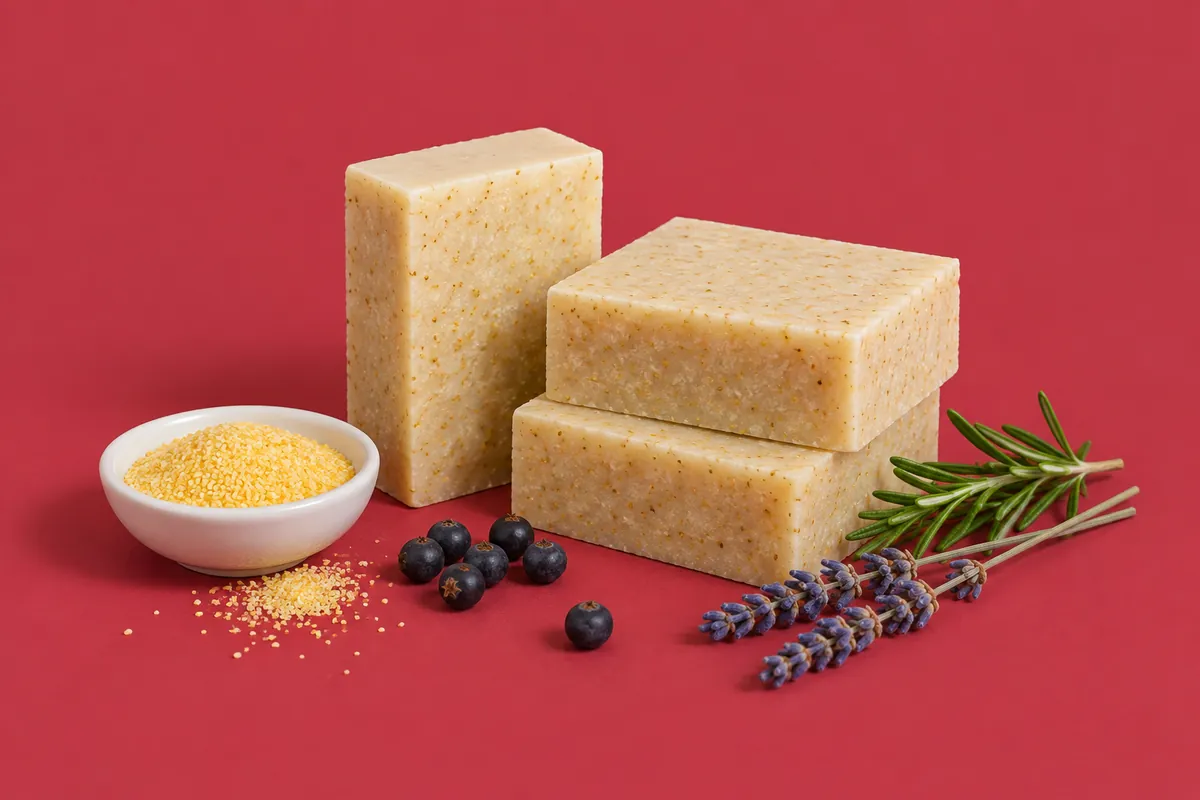
A lightly scrubby everyday bar flecked with golden cornmeal and scented with juniper berry, lavender and rosemary, on a palm-free base that is half olive oil. Gentler than a pumice hand bar, it suits hands and body; keep it away from the face.
- Skill
- Beginner
- Method
- Cold process
- Batch
- 1000 g of oils about 1466 g of batter
- Hands-on
- 1 hour
- Cure
- 6 weeks
- Gel phase
- Yes insulate the mould
What you need
For 1000 g of oils, which fills a 1.5 litre loaf mould. Weigh everything, liquids included.
| Olive Oil · 50.0 % | 500 g | 17.64 oz |
| Coconut Oil · 28.0 % | 280 g | 9.88 oz |
| Shea Butter · 15.0 % | 150 g | 5.29 oz |
| Castor Oil · 5.0 % | 50 g | 1.76 oz |
| Jojoba Oil · 2.0 % | 20 g | 0.71 oz |
| Sodium hydroxide (NaOH) · the lye, 100 % pure | 137.4 g | 4.85 oz |
| Distilled water · for a 33 % lye solution | 279.0 g | 9.84 oz |
| Cornmeal, fine · about 2 rounded tablespoons, wetted with the jojoba oil and 20 g of the olive oil | 20 g | 0.71 oz |
| Juniper berry essential oil · 1.5 % of the oils, at trace | 15 g | 0.53 oz |
| Lavender essential oil · 1.0 % of the oils, at trace | 10 g | 0.35 oz |
| Rosemary essential oil · 0.5 % of the oils, at trace | 5 g | 0.18 oz |
- Superfat
- 6 %
- Temperatures
- Oils and lye solution each at 35 to 40 °C (95 to 104 °F)
Method
-
Get ready
Put on splash goggles, nitrile gloves and long sleeves, open a window or run the extractor fan, and keep children and pets out of the room. Line a 1.5 litre loaf mould. -
Weigh the oils
Weigh 280 g coconut oil and 150 g shea butter into the pot, and 480 g olive oil and 50 g castor oil into a jug. Weigh 20 g jojoba oil and the last 20 g of olive oil into a small bowl for the scrub. -
Wet the cornmeal
Stir 20 g fine cornmeal into the bowl of jojoba and olive oil until it is an even, damp paste with no dry pockets. -
Make the lye solution
Weigh 279.0 g distilled water into a heat-safe jug and 137.4 g sodium hydroxide into a dry container. At the open window, pour the lye into the water, never the water onto the lye, stir until clear with your face turned away, and leave it to cool, labelled and out of reach. -
Melt the fats
Melt the coconut oil and shea butter on the lowest heat, then pour in the olive and castor oils from the jug. Let the oils and the lye solution each come to 35 to 40 °C (95 to 104 °F). -
Mix the essential oils
Weigh 15 g juniper berry, 10 g lavender and 5 g rosemary essential oil into a small glass and stir them together. -
Blend to light trace
Pour the lye solution into the oils down the shaft of the stick blender and pulse for a few seconds at a time, stirring between pulses, until a drizzle leaves a faint line that sinks back within seconds. -
Scent it
Stir the essential oils in with the spatula until no streaks remain. -
Thicken and add the cornmeal
Pulse a little more, to a medium trace like soft pudding, then stir in the cornmeal paste by hand until the golden specks are spread evenly. In thinner batter the cornmeal sinks to the bottom of the bars. -
Pour and insulate
Pour into the mould, tap it on the worktop to release air and smooth the top. Cover it with a board and a folded towel for a day; the trapped heat takes it through gel, and a gelled loaf is ready to cut sooner. -
Unmould and cut
After 24 to 48 hours, when the loaf is firm, unmould it with gloves on and cut bars about 2.5 cm (1 in) thick. -
Cure for six weeks
Stand the bars on edge on a rack with air around them, out of the sun, for six weeks, turning them every few days. A bar that is half olive oil needs the time to become hard and mild.
Tips
- Fine cornmeal gives a light, even scrub. For more grip, use up to 35 g or a coarser grind; for garden and garage grime, the gardener's pumice scrub bar does the job better. Keep both off the face.
- Buy juniper berry oil, distilled from the berries. Oils from juniper twigs and wood, and cade oil, a smoky juniper tar, smell quite different and are no substitute.
- If you cannot find fine cornmeal, pulse polenta or corn grits in a spice grinder and sieve out the coarsest pieces.
The oils
| Oil | Share |
|---|---|
| Olive Oil (virgin / refined / olive oil) | 50.0 % |
| Coconut Oil | 28.0 % |
| Shea Butter | 15.0 % |
| Castor Oil | 5.0 % |
| Jojoba Oil | 2.0 % |
How it is made
| Process | Cold process |
| Alkali | NaOH |
| Superfat | 6 % |
| Water | lye water at 33 % |
| Iodine value | 59 |
| INS | 147 |
Why make it
A lightly scrubby bar for hands and body. Fine cornmeal gives a gentle, even texture, softer than pumice or coffee grounds, on a base that is half olive oil with just over a quarter coconut, cleansing 19 and conditioning 57 on our scale, mild enough for daily use. Cornmeal is an old kitchen-cupboard scrub, long used by cooks and gardeners to work grime off their hands. Juniper berry, lavender and rosemary give a fresh, woody smell with a hint of gin; they are there for pleasure, and no soap scent does more than smell good. The caveats: keep scrub bars off the face and off broken skin, and expect the cornmeal to soften a little where the bar stays wet.
What tradition, makers' experience and research say about soaps like this, each labelled for what it is. It is not medical advice, and no soap treats a skin condition: if you have one, ask a doctor or pharmacist.
What the numbers say
- Lauric acid 13.8 %
- Myristic acid 5.3 %
- Palmitic acid 10.0 %
- Stearic acid 8.6 %
- Ricinoleic acid 4.4 %
- Oleic acid 44.1 %
- Linoleic acid 7.8 %
- Other 7.2 %
Saturated : unsaturated 41 : 59
Computed from the fatty acids of the fats above. The bands are what the craft has settled on, not chemistry — a bar outside one is not wrong.
From the guides
All guides
Soap additives: salt, sugar, sodium lactate, clays, oats, silk and more
What common soap additives do, how much to use and when they go in: sourced doses for sodium lactate, salt, sugar, honey, citric acid, clays, oats and silk.

Scenting soap: essential oils and fragrance oils
How much essential or fragrance oil to use in soap, what ounces per pound mean in percent, the IFRA limits for common essential oils, and EU allergen labelling.
Where these proportions come from
Adapted from Susan Miller Cavitch's Southwest Soap in The Natural Soap Book, an add-on of cornmeal, jojoba and a juniper-led essential oil blend for any of her base bars, here on her Soap Essentials Bar (half olive oil, with coconut and palm) made palm-free with shea butter and castor oil, the jojoba weighed in with the oils, at a 6 % superfat, and with the red thyme, a harsh phenolic oil, left out of her blend.
Formulation adapted from The Natural Soap Book by Susan Miller Cavitch (Storey Publishing, 1995). The method and notes are ours.