Lemongrass and cedar camp soap
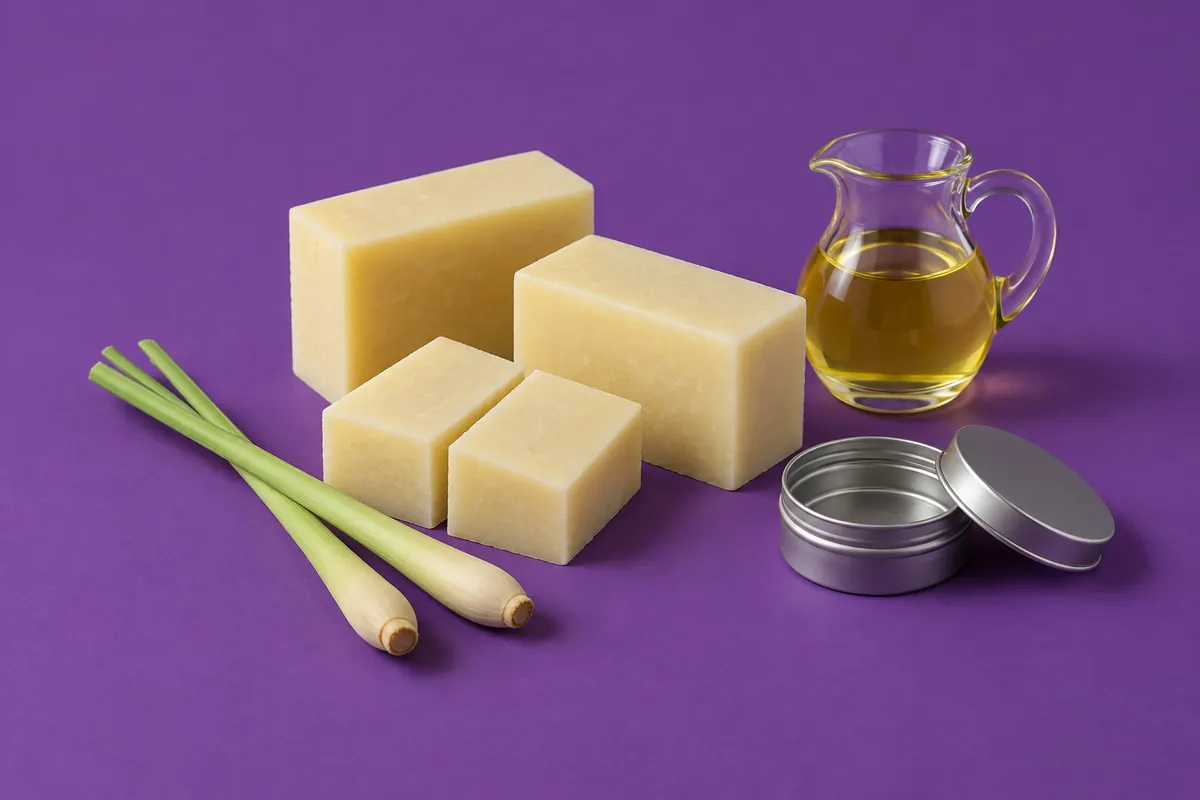
A hard, well-lathering bar for camping and outdoor work, made from tallow, coconut oil, almond oil and mango butter and scented with lemongrass and cedarwood. It is cleansing enough for grimy hands and firm enough to last a trip in a soap tin.
- Skill
- Beginner
- Method
- Cold process
- Batch
- 1000 g of oils about 1466 g of batter
- Hands-on
- 1 hour
- Cure
- 6 weeks
- Gel phase
- Either way gel or not, both work
What you need
For 1000 g of oils, which fills a 1.5 litre loaf mould. Weigh everything, liquids included.
| Edible Tallow · 35.0 % | 350 g | 12.35 oz |
| Coconut Oil · 30.0 % | 300 g | 10.58 oz |
| Almond Oil · 20.0 % | 200 g | 7.05 oz |
| Mango Butter · 10.0 % | 100 g | 3.53 oz |
| Castor Oil · 5.0 % | 50 g | 1.76 oz |
| Sodium hydroxide (NaOH) · the lye, 100 % pure | 144.0 g | 5.08 oz |
| Distilled water · for a 33 % lye solution | 292.4 g | 10.31 oz |
| Lemongrass essential oil · 1.5 % of the oils, at trace | 15 g | 0.53 oz |
| Virginian cedarwood essential oil · 1.5 % of the oils, at trace | 15 g | 0.53 oz |
- Superfat
- 5 %
- Temperatures
- Oils and lye solution each between 32 and 43 °C (90 and 110 °F)
Method
-
Get ready
Put on goggles, gloves and long sleeves, open a window and line a 1.5 litre loaf mould. Weigh 350 g tallow, 300 g coconut oil and 100 g mango butter into the pot, 200 g sweet almond oil and 50 g castor oil into a jug, 292.4 g distilled water into the lye jug and 144.0 g sodium hydroxide into a dry container. -
Make the lye solution
Pour the sodium hydroxide into the water, never the water onto the lye, and stir until it runs clear, keeping your face away from the vapour. Let it cool to between 32 and 43 °C (90 and 110 °F). -
Melt and combine the oils
Melt the tallow, coconut oil and mango butter on a low heat until just clear, then stir in the almond and castor oils and let the oils settle in the same range. -
Mix the essential oils
Weigh 15 g of lemongrass oil and 15 g of Virginian cedarwood oil into a small glass and stir them together. -
Blend to light trace
Pour the lye solution into the oils and stick blend in short pulses, stirring between them, until a drizzle leaves a faint line on the surface. Add the essential oils and blend for a few seconds more. -
Pour and cover
Pour into the mould, tap it on the worktop to let air out, and cover it with a lid or board and a folded towel. It may gel into a darker, glossy centre, which is fine either way. -
Unmould and cut
After 24 to 48 hours, when the loaf is firm, unmould it with gloves on and cut it into bars, or into half bars that fit a travel tin and dry faster between washes. -
Cure for six weeks
Stand the bars on a rack with air around them for six weeks. A harder, drier bar lasts longer on a trip. -
Pack it to breathe
Carry it in a tin with holes, a mesh bag or a cloth rather than a sealed box, and let it dry between washes so it doesn't turn soft. -
Wash well away from water
Wash at least 60 metres (200 feet) from lakes and streams and scatter the soapy water on the ground, where the soil breaks it down; even plain soap harms the life in fresh water.
Tips
- It is a soap and nothing more. Lemongrass and cedarwood are here for their outdoor smell, and the bar makes no claim to keep insects away.
- Lemongrass oil is mostly citral, which IFRA limits in soap. At 1.5 % of the oils this bar sits well inside the limit; don't take the lemongrass past 2 %.
- No tallow? Lard works, for a slightly softer bar. Each fat takes its own lye, so run the swap through the calculator before you weigh.
The oils
| Oil | Share |
|---|---|
| Edible Tallow (beef/mutton dripping) | 35.0 % |
| Coconut Oil | 30.0 % |
| Almond Oil (Sweet Almond Oil) | 20.0 % |
| Mango Butter | 10.0 % |
| Castor Oil | 5.0 % |
How it is made
| Process | Cold process |
| Alkali | NaOH |
| Superfat | 5 % |
| Water | lye water at 33 % |
| Iodine value | 47 |
| INS | 166 |
Why make it
A bar for the rucksack. Tallow and mango butter make it hard, 49 on our scale, so it survives a soap tin and a damp week, and 30 % coconut oil lathers readily even in cold or hard water and shifts grime, cleansing 22, while the 5 % superfat keeps it comfortable on hands. That makes it a good work and garden soap at home too. Lemongrass and Virginian cedarwood are here for their outdoor smell; the bar makes no claim to keep insects away. However mild it is, soap does not belong in streams: Leave No Trace advises carrying water about 60 metres (200 feet) from lakes and streams to wash, and using only a little soap. Tallow means it is not vegetarian, though lard works as well.
Sources
- Principle 3: Dispose of Waste Properly · Leave No Trace Center for Outdoor Ethics
What tradition, makers' experience and research say about soaps like this, each labelled for what it is. It is not medical advice, and no soap treats a skin condition: if you have one, ask a doctor or pharmacist.
What the numbers say
- Lauric acid 14.7 %
- Myristic acid 7.1 %
- Palmitic acid 13.4 %
- Stearic acid 13.5 %
- Ricinoleic acid 4.4 %
- Oleic acid 33.6 %
- Linoleic acid 7.3 %
- Other 6.4 %
Saturated : unsaturated 53 : 47
Computed from the fatty acids of the fats above. The bands are what the craft has settled on, not chemistry — a bar outside one is not wrong.
From the guides
All guides
Lard and tallow: soaping with animal fats
Why lard and tallow make hard, mild, creamy soap, how to render and store them at home, how beef, mutton and pork fat differ, and classic recipes.

Scenting soap: essential oils and fragrance oils
How much essential or fragrance oil to use in soap, what ounces per pound mean in percent, the IFRA limits for common essential oils, and EU allergen labelling.

Curing and storing handmade soap
What curing does to cold process soap and what it doesn't, how long it takes, how to set bars up to cure, how to tell when they're done, and how to store them.
Where these proportions come from
Adapted from the camping soap in Kelly Cable's Natural Soap Making Book for Beginners: her tallow, coconut oil, sweet almond oil and mango butter, with the coconut oil raised for cleansing and a little castor oil added for lather, at a 5 % superfat in place of her 15 % lye discount, and with lemongrass and cedarwood in place of her citronella blend and none of its insect claims.
Formulation adapted from The Natural Soap Making Book for Beginners by Kelly Cable (Althea Press, 2017). The method and notes are ours.