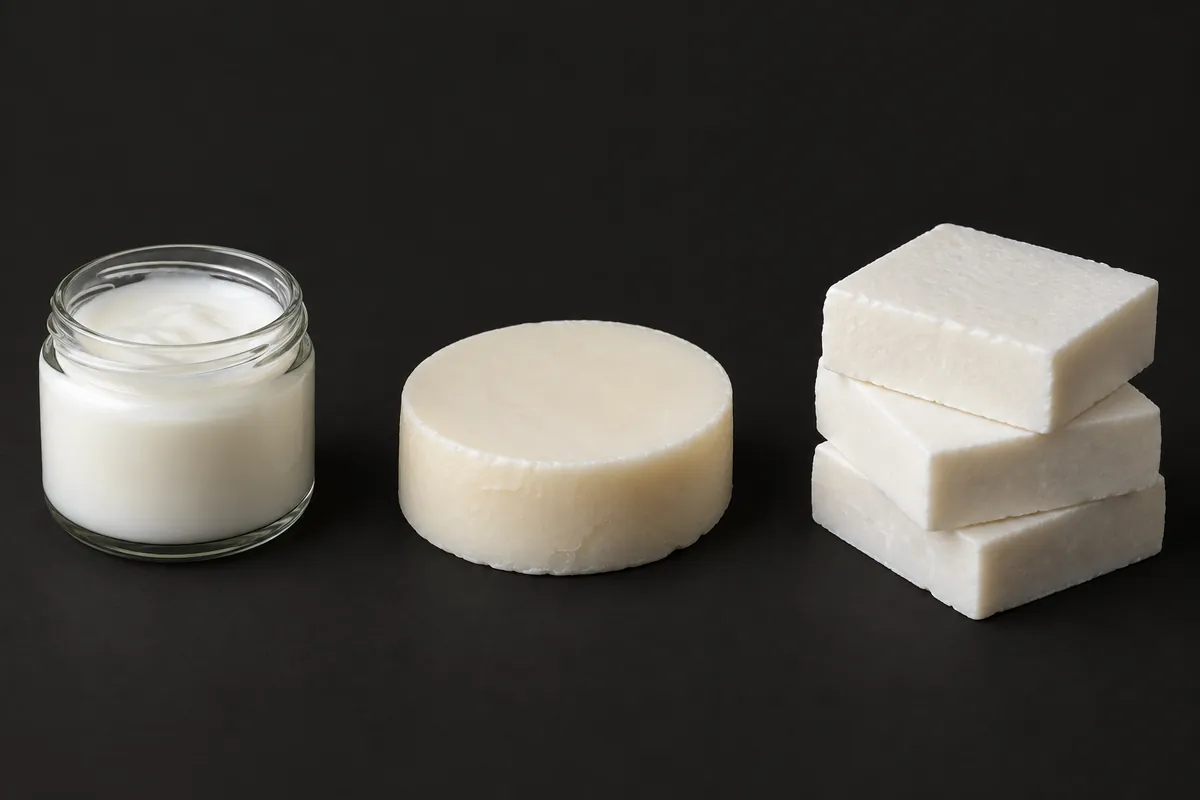
In short
- Tallow is about half saturated fat and lard about two-fifths, mostly palmitic and stearic acid, with little linoleic: a hard, mild, slow-wearing bar that keeps well.
- Tallow makes the harder bar and mutton tallow a harder one still; lard is softer and more conditioning.
- Render in water for the cleanest fat: the water holds the pot at boiling point, so nothing scorches, and the dirt settles out as a grey layer under the set fat.
- Neither lathers much on its own. A quarter of coconut oil, as in the classic kitchen tallow bar, brings the bubbles.
- On a label, tallow is Tallow or Adeps Bovis and lard is Lard or Adeps Suillus; once saponified they are Sodium Tallowate and Sodium Lardate.
On this page
Before vegetable oils were cheap, soap was made from whatever fat the kitchen and the butcher threw off, and that meant tallow and lard. They are still two of the best soap fats there are. They make a hard, white, mild bar with a dense lather, they cost little, and a maker can render them at home from butcher’s fat. This guide explains why they work, how to render and keep them, how beef, mutton and pork fat differ, and the classic recipes with the lye worked out.
Why they make good soap
A fat’s behaviour in soap comes from its fatty acids, and here are the animal fats beside palm oil, the vegetable fat they are most often compared with:
| Lard | Tallow | Mutton tallow | Palm oil | |
|---|---|---|---|---|
| Palmitic acid, % | 20–30 | 20–30 | 20.3–24.6 | 39.3–47.5 |
| Stearic acid, % | 8–22 | 15–30 | 24.3–41.7 | 3.5–6 |
| Oleic acid, % | 35–55 | 30–45 | 31.4–44.8 | 36–44 |
| Linoleic acid, % | 4–12 | 1–6 | 1.6–2.4 | 9–12 |
| Iodine value | 55–65 | 40–53 | 33.8–43.9 | 50–55 |
| Melting point | 36–42 °C | 42–50 °C (beef) | 43.1–51.1 °C | not published |
| A bar of it alone: hardness | 42 | 52 | 58 | 50 |
| creamy lather | 40 | 48 | 55 | 48 |
| conditioning | 55 | 43 | 41 | 51 |
| cleansing | 2 | 4 | 3 | 2 |
Fatty acids and iodine values from the Codex standards for animal fats and vegetable oils, and for mutton tallow from Grasas y Aceites (2003); melting points from the Japanese Pharmacopoeia. The four quality rows are what the calculator gives a bar of that fat alone; they are a community convention.
Three things follow from the table. The palmitic and stearic acid, long straight saturated chains, pack into a hard bar that wears away slowly and gives a small, dense, stable lather: that is the creamy lather tallow soap is known for. The oleic acid keeps the bar mild. And there is almost no lauric acid: Codex allows less than 0.5 % of all the short chains together. That is why both fats score close to zero for cleansing and bubbly lather, why their soap is gentle, and why they are usually paired with some coconut oil.
The low linoleic acid matters too. Each extra double bond in a fatty acid is a place for oxygen to attack, and a chain with two double bonds oxidises roughly 10 to 40 times faster than one with a single double bond (Gharby et al., 2025). Tallow, at 1–6 % linoleic, is one of the most stable soap fats there is; lard, at 4–12 %, is a little less so. Both keep far better than the seed oils.
Tallow is the harder of the two because it carries more stearic acid and less oleic; its lower iodine value (40–53 against 55–65), a measure of how many double bonds a fat has, says the same thing in one number. Failor finds lard soap slightly softer than tallow soap, and a lard bar is the more conditioning of the two.
Beef, mutton and pork
Tallow in the Codex standard is fat rendered from the fatty tissues, muscles and bones of cattle, sheep or both, which helps explain why the tallow ranges above are wide. The fat around the kidneys, called suet, makes the best soap tallow (Fisher), though any clean butcher’s fat will render. A premium grade, premier jus, is rendered at low heat from fresh fat taken at slaughter from the heart, kidneys, caul and mesentery (Codex); it has an iodine value of 36–47.
Mutton tallow is harder again: a third of it is stearic acid (24.3–41.7 %) and it melts at 43.1–51.1 °C, which makes a very hard bar (58 for hardness on its own). Its published data give no SAP value, so the calculator works one out from its fatty acids.
Lard in the Codex standard is fat rendered from pigs’ fatty tissue alone, with bones, skin, organs and scraps excluded. Fat rendered with those included is sold as rendered pork fat, which is a little softer (iodine value 60–72). Like beef fat, pork fat varies with where on the animal it comes from (Fisher), and leaf fat, from around the pig’s kidneys, is the fat traditionally rendered into lard (Sharma et al., 2013).
Codex describes lard as white to cream and tallow as off-white to pale yellow. The same database has records for other animal fats makers ask about, among them chicken fat (17.5–22.8 % linoleic acid) and duck fat (12.7–17.1 %), both softer and quicker to spoil than tallow, and deer tallow.
Rendering at home
Raw fat is fat held in cells, with water, protein and connective tissue around it. Rendering melts the fat out and leaves the rest behind. What it leaves behind matters: bits of protein and water carried into the fat are what make it smell and spoil, since water is where the bacteria and enzymes that split fats do their work (Sharma et al., 2013).
There are two ways to do it. Dry rendering heats the chopped fat on its own, gently, until the fat has run out and the solid pieces (the cracklings) are crisp, then strains it. It is quick, but the fat sits against the hot pan, so it needs low heat and stirring to keep it from scorching. Wet rendering simmers the fat in water. The water cannot rise much above 100 °C, so nothing scorches, and when the pot is chilled the fat sets in a clean disc on top, with the dirt settled out below it. For soap, wet rendering is the easier way to a clean fat, and the method below follows Failor’s.
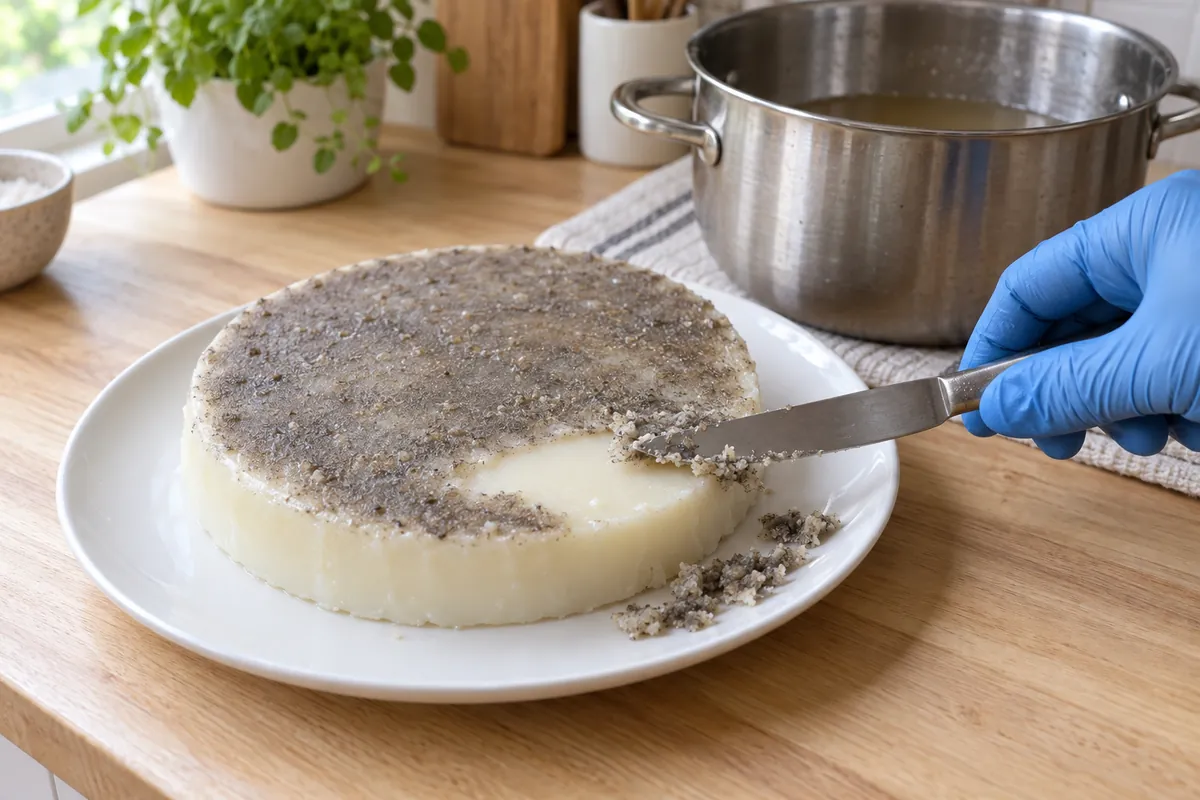 After chilling, the rendered fat lifts out as a disc. Everything grey on its underside is scraped off and thrown away.
- Buy extra and cut it small. Buy about half as much fat again as the recipe needs, since some is lost (Failor buys 1.4 kg (3 lb) of fat for every 0.9 kg (2 lb) of tallow a recipe calls for). Trim off any meat and blood spots and cut the fat into small cubes, or ask the butcher to mince it: the smaller the pieces, the faster they render.
- Simmer it in water. Bring a few cups of water to the boil in a large stainless steel pot, add the fat carefully, bring it back to the boil, then cover, turn the heat down low and simmer, stirring now and then, until all the fat has melted out. A large pot can take a few hours.
- Strain. Pour everything through a sieve lined with cloth into a second pot or heatproof bowl, and discard what stays in the sieve.
- Chill overnight. Let it cool, then refrigerate. By morning there are three layers: white fat on top, a thin grey granular layer under it, and water or jelly at the bottom (Failor).
- Scrape it clean. Lift out the disc of fat, turn it over and scrape off every bit of the grey layer. Pour away the water. If the fat still smells of meat, simmer it again in fresh water and repeat from step 2.
- Dry it and store it. Pat the disc dry. Keep it airtight and cold: in the fridge if you will use it soon, in the freezer for longer (Failor keeps it frozen).
Some makers add salt to the rendering water, and Failor notes that books on opaque soap often call for it; she leaves it out because salt clouds transparent soap.
Keeping it fresh
Rancid fat makes rancid soap, so render fresh fat and use it soon unless it is frozen. Codex lists quality characteristics for commercial fat, and they are a good picture of what matters: almost no water (volatile matter at 105 °C no more than 0.3 %), low free fatty acids, a peroxide value of 10 milliequivalents per kilogram or less, and traces of iron and copper held to 1.5 and 0.4 mg/kg, because metals speed oxidation (Gharby et al., 2025). At home that means straining well, drying the fat, and rendering in stainless steel rather than a copper or cast-iron pan. Fresh fat smells mild; rancid fat smells sharp and stale, and the smell carries into the soap.
If you buy lard rather than render it, read the label. Fisher notes that supermarket lard is usually partially hydrogenated to keep longer, which changes its fatty acids, and Codex allows antioxidants such as BHT in lard.
Classic recipes and ratios
These are worked for 1000 g of fat at a 5 % superfat, with water at a 33 % lye concentration.
| Recipe | Fats | NaOH | Water | Hardness | Cleansing | Conditioning | Bubbly | Creamy | Iodine |
|---|---|---|---|---|---|---|---|---|---|
| 100 % lard | lard 100 | 133.8 g | 271.6 g | 42 | 2 | 55 | 2 | 40 | 60 |
| 100 % tallow | tallow 100 | 132.7 g | 269.5 g | 52 | 4 | 43 | 4 | 48 | 47 |
| Old-fashioned lard bar | lard 80, coconut 20 | 141.7 g | 287.8 g | 49 | 15 | 45 | 15 | 34 | 50 |
| Kitchen tallow bar | tallow 75, coconut 25 | 143.0 g | 290.3 g | 59 | 20 | 34 | 20 | 39 | 37 |
| Lard, olive and coconut | lard 50, olive 30, coconut 20 | 140.2 g | 284.7 g | 42 | 14 | 54 | 14 | 27 | 57 |
| Creamy tallow and olive bar | tallow 50, olive 30, coconut 15, castor 5 | 137.1 g | 278.3 g | 43 | 12 | 52 | 17 | 35 | 54 |
From the calculator. Single-fat bars are reference points more than recipes, though lard soap on its own is an old recipe in its own right: Watt printed a cold process lard soap in 1884.
The kitchen tallow bar is the farmhouse standard: three parts tallow to one of coconut, hard enough to last, with enough lauric acid to lather, and the old-fashioned lard bar is its lard counterpart. The two olive bars are the everyday middle ground, and the creamy tallow bar adds castor oil for a steadier lather. Tallow also carries the goat milk powder bar and the charcoal and tea tree facial bar, at 35 % each. Cable, who builds many of her recipes on tallow or lard, uses them at 17–44 %.
Two variations are worth knowing. For a laundry bar, the same tallow and coconut go in at zero superfat, since free fat is what leaves a residue on fabric; the laundry soap guide covers it, and Cable notes that tallow soap without its superfat makes a good one. Our zero-superfat laundry bar uses coconut oil alone. For a smaller first batch, 500 g of lard needs 66.9 g of sodium hydroxide and 135.8 g of water at the same settings.
Make the kitchen tallow bar. 750 g of tallow and 250 g of coconut oil need 143.0 g of sodium hydroxide and 290.3 g of water at a 5 % superfat. Change the batch size or swap in lard and the calculator redoes the lye.
Open it in the calculatorTallow-rich bars set firm and usually pop straight out of the mould (Failor); like any cold process soap they still want four to six weeks of curing.
What to call them on a label
Soap labels can list ingredients two ways: as they went into the pot, or as they come out of the reaction. The label maker drafts both, and which one your label uses is a question for your safety assessor or the rules where you sell.
As they went in. CosIng, the European Commission’s ingredient database, carries two active names for each fat, with the same CAS number: Tallow or its older Latin name Adeps Bovis (61789-97-7), and Lard or Adeps Suillus (61789-99-9). CosIng’s Tallow is fat from sheep or cattle, so mutton tallow is Tallow too, and Faiola uses the name whatever the animal. Canada’s Cosmetic Regulations list a few dozen ingredients that may be named either by their European name or by the INCI name with the French beside it, and tallow and lard are among them, as Adeps Bovis and Adeps Suillus.
As they come out. Saponified, tallow becomes Sodium Tallowate and lard Sodium Lardate, both CosIng names. The superfat is still fat, so a label written this way usually names the fat as well.
In the United States, a bar made mostly of these soaps, which cleans because of them and is sold and labelled only as soap, is not a cosmetic and needs no ingredient list (21 CFR 701.20); claim that it moisturises and it becomes one. Wherever you sell, say which animal the fat came from. Vegetarians and vegans will pass it by, and some customers avoid pork or beef for religious reasons, so they need to be able to tell. The labelling guide covers the rest.
Recipes to try
All recipesSources
- Standard for Named Animal Fats (CXS 211-1999), 2015 print . Codex Alimentarius Commission (FAO/WHO) , 2015. Definitions of lard, rendered pork fat, premier jus and edible tallow; fatty acids, SAP and iodine ranges, titre, colour and quality limits.
- The Japanese Pharmacopoeia, 18th edition: Lard; Beef Tallow . Ministry of Health, Labour and Welfare, Japan , 2021. Melting points: lard 36–42 °C, beef tallow 42–50 °C.
- Physical properties of mutton tallow . Grasas y Aceites 54(2) , 2003.
- Animal fat: processing and its quality control . Sharma H., Giriprasad R., Goswami M., Journal of Food Processing & Technology 4(8):252 , 2013. Dry and wet rendering; water in fat and spattering above 100 °C.
- Vegetable oil oxidation: mechanisms, impacts on quality, and approaches to enhance shelf life . Gharby S. et al., Food Chemistry: X 28:102541 , 2025.
- CosIng, the European Commission's cosmetic ingredient database: Tallow, Adeps Bovis, Lard, Adeps Suillus, Sodium Tallowate, Sodium Lardate . European Commission .
- Cosmetic Regulations, C.R.C., c. 869, Schedule (EU technical names) . Government of Canada .
- 21 CFR 701.20: Soap . US Food and Drug Administration, Code of Federal Regulations .
- Making Transparent Soap . Catherine Failor, Storey Publishing , 2000. Wet rendering of tallow; lard as a slightly softer substitute for palm and tallow.
- The Complete Photo Guide to Soap Making . David Fisher, Creative Publishing International , 2018.
- Soap Crafting . Anne-Marie Faiola, Storey Publishing , 2013.
- The Natural Soap Making Book for Beginners . Kelly Cable, Althea Press , 2017.