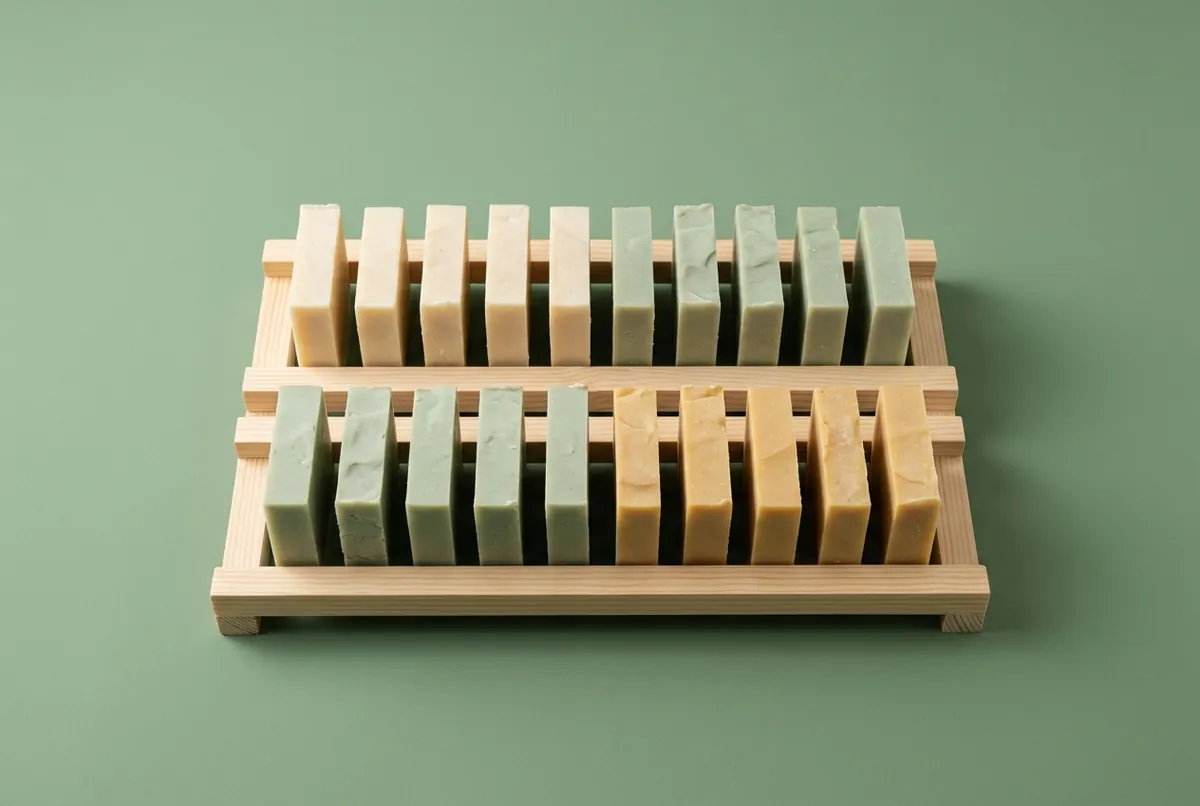
In short
- The lye is used up within a day or two. Curing is water leaving the bar and the soap settling, over weeks.
- Four to six weeks for most cold process bars; olive-rich soap and castile for months. Hot process is safe once cooled and set, but still needs four to six weeks to harden.
- Cure bars on edge, a finger's width apart, with air all round and out of the sun, and turn them now and then.
- Weigh the same few bars every few days. When the weight stops falling, the cure is done.
- Keep cured soap cool, dark and dry, in something that breathes, and wrap it only once it has cured.
On this page
A cold process bar is soap within a day or two of making it. It is not yet a good bar: it is soft, it wears away fast in the shower and it lathers poorly. Over the next few weeks water leaves it and the soap inside settles, and it comes out harder, longer-lasting and milder. That is curing. This guide explains what is and isn’t happening, how to set bars up to cure, how to tell when they are done, and how to keep them afterwards.
What curing does, and what it doesn’t
It is not the lye still reacting. Saponification in cold process soap is essentially over within a day or so: a 2018 study of cold process soaps puts it at 18 to 24 hours, and Anne-Marie Faiola leaves only the last 3 % of the reaction for the weeks of cure. Anne Watson, testing with pH strips, found most of her soaps fine on the hands straight out of the mould and milder on the face within two weeks. The idea that fresh soap stays caustic for a month doesn’t hold for a well-made bar. A lye-heavy bar is another matter, and waiting is no reliable cure for it (see soap pH and testing).
It is water leaving. A bar made at our calculator’s default, a 33 % lye solution, is about a fifth water when it is cut; the first-batch recipe is 19.9 % water. Much of that evaporates. Classic Bells estimates that after four to eight weeks a bar holds 50 to 70 % of the water it started with, which for that recipe means losing about 6 to 10 % of its weight and ending at about 11 to 15 % water. That is close to the 11 to 14 % to which factories dried their soap before milling it, in Simmons and Appleton’s 1908 handbook. As the water goes the bar hardens: in Kevin Dunn’s measurements, hardness rose steadily as moisture fell.
It is the soap settling. Classic Bells describes a slower change too. The less soluble soaps, made from stearic and palmitic acid, gradually gather into the crystals, while the more soluble ones stay in the softer phase around them, and that can take months to settle. Classic Bells counts it among the reasons an older bar lathers better and lasts longer than a young one.
How long
| Soap | Cure | Why |
|---|---|---|
| Most cold process bars, like our first-batch palm-free bar | 4 to 6 weeks | Usable at four weeks, harder at six |
| Bars made with less water | Sooner | Less water to lose |
| Olive-rich soap and castile | Months | Soft and slow to dry; our high-olive bastile bar takes eight weeks, our Aleppo-style laurel bar six months, and castile can take up to six months to harden fully. Faiola counts castile at its best after 10 months to a year |
| Hot process | 4 to 6 weeks | Safe once cooled and set, but usually made with more water, which the weeks take out |
| Melt and pour | None | It is finished soap; it only has to set |
Faiola, Fisher and Classic Bells. Humid air slows every one of these; a warm, dry, airy room speeds them up.
Water decides a lot of it. Kevin Dunn made the same soaps with 50 %, 33 % and 25 % lye solutions and followed them for weeks. His four-oil soap made with a 33 % solution took 36 days to dry to the moisture the 50 % version started at, and 12 days to catch up with its hardness; made with a 25 % solution, it took 57 days and 36 days. (His single bars were held at 60 °C for four hours after mixing, so read the day counts as a guide rather than a timetable for a loaf left at room temperature.)
Hot process confuses people. It is safe to use once it has cooled and set, because the cook used the lye up, but it still has its water to lose, and it is usually made with extra water to keep it workable. Give it four to six weeks, as our goat milk and shea hot process bar does: it hardens and lasts longer for it. Classic Bells cures hot process at least six weeks, Fisher only one to two. The bars will tell you if you weigh them.
Setting up a cure
- Stand the bars on edge, a finger’s width apart, so air reaches every face.
- Use a rack, or a tray lined with baking paper. Avoid bare metal that can rust: rust stains soap, and Faiola lists a rusty curing surface among the causes of orange spots. Avoid printed paper and newspaper too: Susan Miller Cavitch cures on plain brown paper because young bars, still alkaline, pick up the ink.
- Choose a room at ordinary temperature, with moving air and no direct sun. Not a steamy bathroom or a damp cellar. A fan helps in still air. If droplets of water form on the bars, Letcavage and Buck warn, the room is too humid.
- Turn the bars every few days so they dry evenly. Faiola turns hers every few days, Kelly Cable weekly, and Cavitch just once over the whole cure.
- Cover them loosely against dust with a cloth or paper, never plastic.
- Keep differently scented soaps apart. Heidi Corley Barto doesn’t let them share a box for more than a short time.
- Label each batch with its recipe and the date you made it.
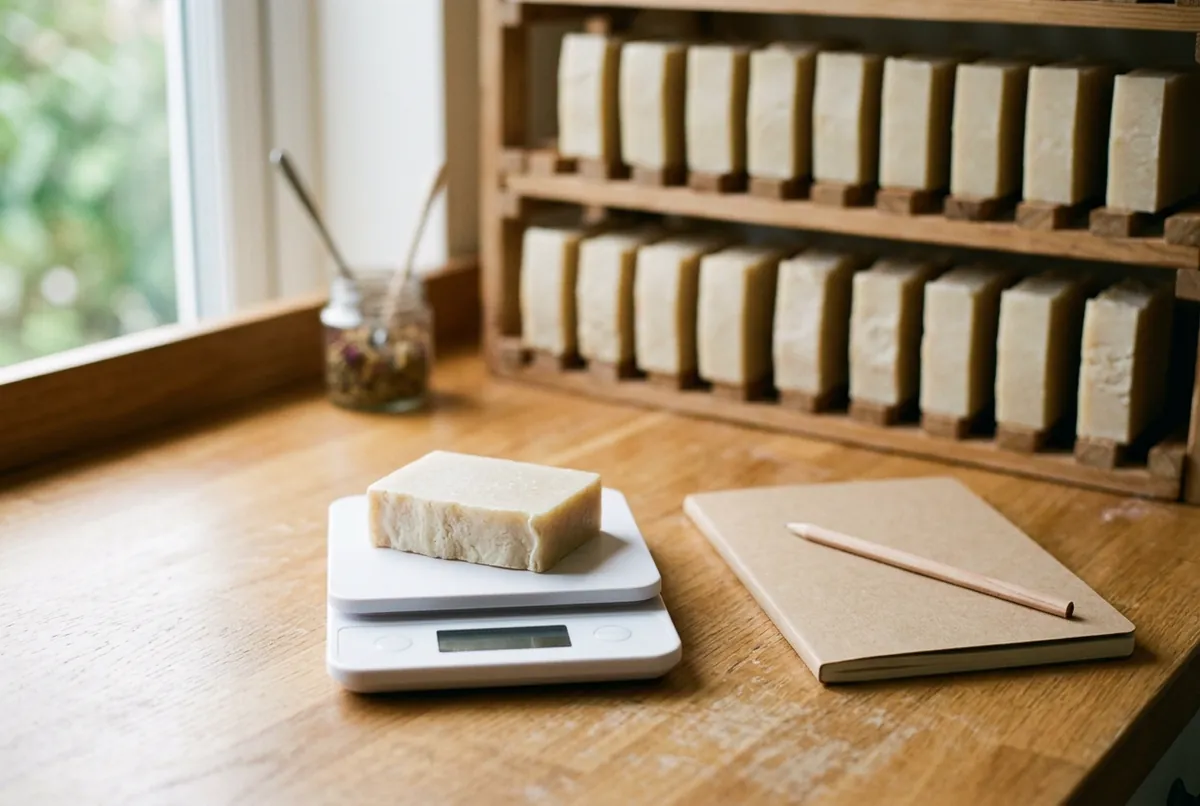 A simple cure: bars on edge with air all round, and the same bar weighed every few days.
Weighing: how to tell the cure is done
A calendar is a guess; a scale is a measurement. Touch is no better: Simmons and Appleton warned analysts that soap “very rapidly loses its moisture on the surface, while the interior of the bar or cake may be comparatively moist”. Classic Bells suggests weighing a bar as soon as it is cut and then every few days for six to eight weeks. After four to eight weeks the loss slows to a crawl, and once it has, the bar is about as dry as your room will make it.
To do it well, weigh the same two or three bars every time, marked so you know which, on the same scale, and write down the date and the grams. Work out the loss against the first weighing: loss = (first − now) ÷ first × 100. Then watch how fast it is still falling. When a week makes almost no difference, the cure is done.
For example, a bar that weighed 110 g when cut and 101 g five weeks later has lost 8.2 %. If it weighs 100.6 g a week after that, it is losing about 0.4 % of its first weight a week, and it is nearly done.
Our batch log does the sums for you. Enter each weigh-in and it draws the curve, shows the loss since the first weighing and the rate over the most recent stretch of at least five days, and calls the cure steady once the bars are losing less than 0.5 % of their first weight a week. That threshold is our own rule of thumb for reading the curve, not a standard, and the curve is always shown beside it. Cure weigh-ins come with the Maker plan (see pricing); a kitchen scale and a notebook do the same job.
Storing cured soap
Once the weight has settled, keep the bars somewhere cool, dark and dry, in something that lets a little air through: a cardboard box, a drawer, paper or cloth. Letcavage and Harden store theirs unstacked in a covered box; Cable uses a plastic box with the lid left ajar. Heat and light speed up the slow oxidation that eventually turns soap rancid, and light fades many natural colours. Don’t seal soap in plastic before it has cured: Faiola lists wrapping too early among the causes of orange spots, and Corley Barto keeps her soap out of plastic altogether.
How long does it keep? Letcavage and Harden reckon a bar at 5 % superfat keeps at least six months, and usually longer; Cavitch expected a year from hers, and “longer than a year is more than we should expect from a natural product”. What ends a bar’s life is rancidity, which shows as a stale smell and orange spots. Oils rich in linoleic and linolenic acid, traces of iron or copper, old oils, heat, light and damp all bring it on sooner. The superfat is not the main culprit: in Kevin Dunn’s tests, soap with no superfat at all turned orange about as soon as soap with 10 %. EDTA or rosemary extract delays it (in Dunn’s test sodium citrate and vitamin E on their own did not), and the guide to orange spots goes through what the evidence supports. Scent fades as well, citrus oils fastest.
Wrap bars only once they have cured; wrap them sooner and, as Alicia Grosso found, the band goes loose as the bar keeps shrinking. Something that breathes suits handmade soap best: a paper band around the middle, a card box or a cloth. Plastic and shrink wrap slow any drying that is left and trap moisture, so keep them for fully cured bars. Melt and pour soap is the opposite case: its extra glycerin draws water from the air, so it needs wrapping as soon as it has set. If you sell your soap, the label rules are in labelling soap.
Recipes to try
All recipesSources
- The Water Discount . Kevin M. Dunn, Handcrafted Soap and Cosmetic Guild , 2008. Moisture and hardness of soaps made at 50, 33 and 25 % lye solutions, measured over weeks of cure.
- Curing soap . Classic Bells, Soapy Stuff . Weighing bars through the cure; 50 to 70 % of the original water left after four to eight weeks; soap crystals settling over months; hot process cured at least six weeks.
- The Effects of Cold Saponification on the Unsaponified Fatty Acid Composition and Sensory Perception of Commercial Natural Herbal Soaps . Prieto Vidal N. et al., Molecules 23(9), 2356 , 2018. Cold saponification takes 18 to 24 hours to complete, followed by weeks of cure.
- Soap Crafting . Anne-Marie Faiola, Storey Publishing , 2013. The last 3 % of saponification left for the cure, most of the reaction done in the first 24 hours; usable at four weeks, harder at six; turning bars; humidity; wrapping early and rusty surfaces among the causes of orange spots.
- Pure Soapmaking . Anne-Marie Faiola, Storey Publishing , 2016. Castile at its prime after 10 months to a year.
- The Natural Soap Book . Susan Miller Cavitch, Storey Publishing , 1995. Curing four to six weeks in a single layer on plain brown paper, never ink-printed bags, turned over once; a natural bar good for about a year.
- Basic Soap Making . Elizabeth Letcavage and Patsy Buck, Stackpole Books , 2009. Water droplets forming on drying bars as the sign of a room too humid.
- The Everything Soapmaking Book, 3rd edition . Alicia Grosso, Adams Media , 2013. Wrapping put on before most of the water has gone works loose as the bar shrinks.
- The Handbook of Soap Manufacture . W. H. Simmons and H. A. Appleton, Scott, Greenwood & Son (Project Gutenberg edition) , 1908. Soap from the frames at 28 to 30 % water, dried to 11 to 14 % before milling; the surface of a bar dries much faster than its interior.
- Smart Soapmaking . Anne L. Watson, Shepard Publications , 2013. pH-tested soaps usable on the hands out of the mould and milder on the face within two weeks; citrus scents fade; a paper band rather than plastic.
- The Complete Photo Guide to Soap Making . David Fisher, Creative Publishing International , 2018. Castile up to six months to harden fully; storing bars on end under a light cloth; one to two weeks for hot process.
- Natural Soap Making . Elizabeth Letcavage and Melissa Harden, Stackpole Books , 2013. Curing on edge in a cool, dry place out of the sun; storing unstacked in a covered box; a 5 % superfat bar keeps at least six months.
- The Natural Soap Chef . Heidi Corley Barto, Ulysses Press , 2012. No plastic for storing soap; differently scented soaps kept apart.
- The Natural Soap Making Book for Beginners . Kelly Cable, Althea Press , 2017. Turning curing bars weekly; storing cured soap in a box with the lid ajar.
- The Dreaded Orange Spot . Kevin M. Dunn, The Handcrafted Soapmaker (Handcrafted Soapmakers Guild), Winter 2005/2006 , 2005. Soap made at a 0 % lye discount turned orange in about the same time as soap at 10 %; rosemary extract and EDTA each delayed it, and BHT with sodium citrate did best.