Rhassoul clay and argan facial bar
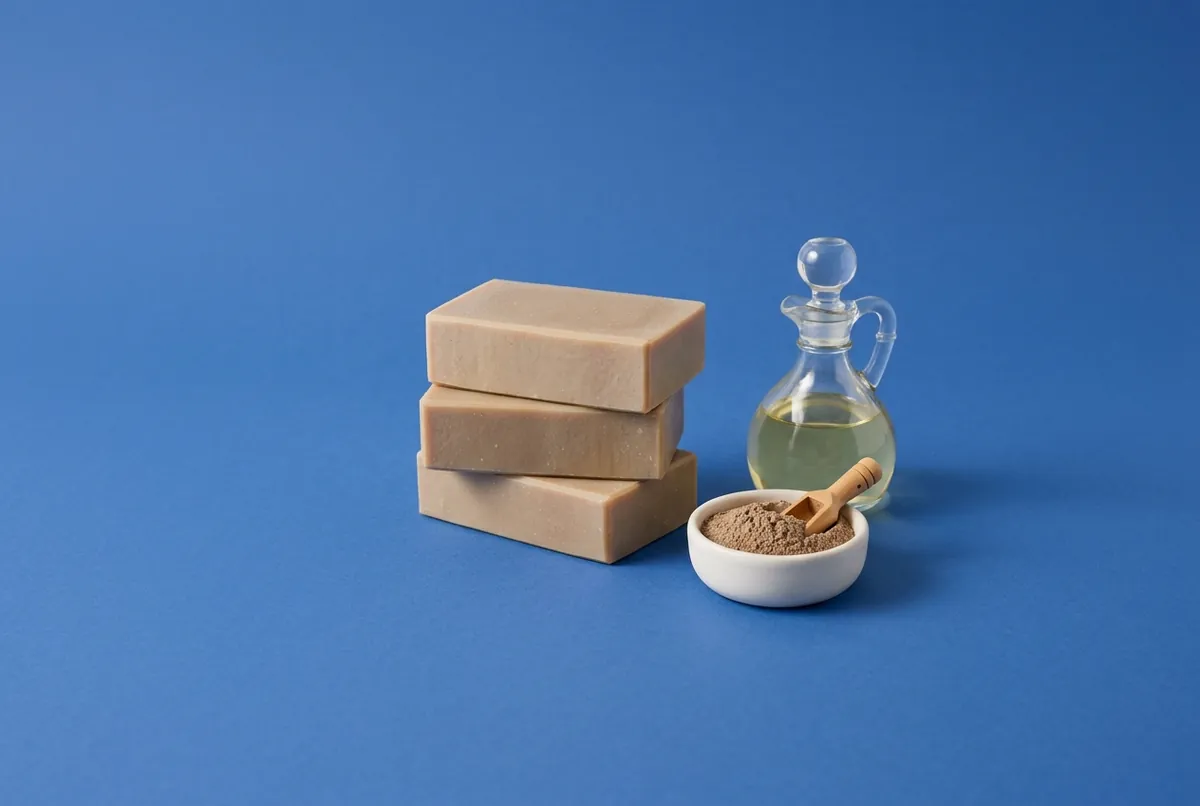
A mild face bar with rhassoul, the soft brown washing clay of Morocco, and a tenth argan oil. Olive oil, shea butter and a 7 % superfat keep it gentle, and a light scent of lavender and Atlas cedarwood sits over the earthy smell of the clay.
- Skill
- Beginner
- Method
- Cold process
- Batch
- 1000 g of oils about 1468 g of batter
- Hands-on
- 1 h 10 min
- Cure
- 6 weeks
- Gel phase
- Either way gel or not, both work
What you need
For 1000 g of oils, which fills a 1.5 litre loaf mould. Weigh everything, liquids included.
| Olive Oil · 45.0 % | 450 g | 15.87 oz |
| Coconut Oil · 20.0 % | 200 g | 7.05 oz |
| Shea Butter · 20.0 % | 200 g | 7.05 oz |
| Argan Oil · 10.0 % | 100 g | 3.53 oz |
| Castor Oil · 5.0 % | 50 g | 1.76 oz |
| Sodium hydroxide (NaOH) · the lye, 100 % pure | 133.7 g | 4.72 oz |
| Distilled water · 248 g for a 35 % lye solution, 50 g set aside | 297.6 g | 10.50 oz |
| Rhassoul clay · 2 tbsp, whisked into 50 g of water held back from the recipe's water | 16.3 g | 0.57 oz |
| Lavender essential oil · 1.0 % of the oils, at trace | 10 g | 0.35 oz |
| Atlas cedarwood essential oil · 1.0 % of the oils, at trace | 10 g | 0.35 oz |
- Superfat
- 7 %
- Temperatures
- Oils and lye solution each at 32 to 38 °C (90 to 100 °F)
Method
-
Get ready
Open a window, put on splash goggles, nitrile gloves and long sleeves, and line or set out a 1.5 litre loaf mould. Wear a dust mask while you measure the clay. -
Weigh everything
Weigh 200 g coconut oil and 200 g shea butter into the pot, and 450 g olive oil, 100 g argan oil and 50 g castor oil into a jug. Weigh 297.6 g distilled water into the lye jug and pour 50 g of it into a bowl for the clay, then weigh 133.7 g sodium hydroxide last, into a dry container. -
Make the lye solution
At an open window or under the extractor fan, pour the sodium hydroxide slowly into the 247.6 g of water left in the lye jug, never the water onto the lye, and stir until clear. Keep your face out of the vapour and leave it to cool, labelled and out of reach. -
Mix the clay slurry
Whisk 16 g (2 tbsp) rhassoul clay into the 50 g of held-back water until smooth and free of lumps. Leave it to soak while the lye cools, and whisk it again just before you use it. -
Melt the fats
Melt the coconut oil and shea butter on the lowest heat, then pour in the olive, argan and castor oils. Let the oils and the lye solution each come to 32 to 38 °C (90 to 100 °F), with the oils clear and free of cloudy specks. -
Blend to light trace
Pour the lye solution into the oils down the shaft of the stick blender, then pulse for a few seconds at a time, stirring between pulses. Stop at light trace, when the batter looks like thin custard and a drizzle leaves a faint line that sinks back within seconds. -
Add the scent and clay
Stir in 10 g lavender and 10 g Atlas cedarwood essential oil, then whisk in the clay slurry and give two or three short pulses until the colour is even. The clay thickens the batter, so pour straight away. -
Pour and cover
Pour into the mould, scraping the pot clean, and tap the mould on the worktop to release air bubbles. Cover it with its lid or a board; the loaf may gel or not, and either is fine. -
Clean up
With your gloves still on, wipe the batter off the pot and tools with paper towels into the bin, then wash everything in hot soapy water. -
Unmould and cut
After 36 to 48 hours, when the loaf is firm to a pressed finger and has pulled away from the sides, put your gloves back on, unmould it and cut it into bars about 2.5 cm (1 in) thick. -
Cure
Stand the bars on edge on a rack, a finger's width apart, somewhere dry and out of the sun, for six weeks, turning them every few days.
Tips
- Buy rhassoul from a supplier who can show a heavy-metals analysis: a 2025 survey of cosmetic clays found the highest median mercury in rhassoul.
- Rhassoul comes as fine powder and as small dried pieces. Use the powder, or grind the pieces fine before you weigh them, or they leave gritty specks.
- Argan oil sold for cooking is pressed from roasted kernels and is darker and nutty; use the cosmetic kind, pressed from raw kernels.
The oils
| Oil | Share |
|---|---|
| Olive Oil (virgin / refined / olive oil) | 45.0 % |
| Coconut Oil | 20.0 % |
| Shea Butter | 20.0 % |
| Argan Oil | 10.0 % |
| Castor Oil | 5.0 % |
How it is made
| Process | Cold process |
| Alkali | NaOH |
| Superfat | 7 % |
| Water | lye water at 31 % |
| Iodine value | 65 |
| INS | 137 |
Why make it
A gentle bar for the face and for dry skin: cleansing 14 and conditioning 62 on our scale, at a 7 % superfat, with olive oil and shea butter doing most of the work. Rhassoul, or ghassoul, is a magnesium-rich stevensite clay from the Jbel Ghassoul in Morocco (Moussout et al.), and by tradition it has been the washing clay of the hammam, used on skin and hair for centuries. In soap it adds slip and a soft brown colour; it does not change the soap's chemistry. Argan oil makes it a Moroccan pairing: the traditional know-how of making argan oil is on UNESCO's list of intangible cultural heritage. Buy clay that comes with a heavy-metals analysis, because a 2025 survey of cosmetic clays found the highest median mercury in rhassoul (Fischer et al.).
Sources
- Interfacial electrochemical properties of natural Moroccan Ghassoul (stevensite) clay in aqueous suspension · Moussout H. et al., Heliyon 6(3):e03634, 2020
- Argan, practices and know-how concerning the argan tree · UNESCO Intangible Cultural Heritage, 2014
- Analysis of Mercury Concentration in Cosmetic Clays · A. Fischer et al., Toxics 13(6), 2025
What tradition, makers' experience and research say about soaps like this, each labelled for what it is. It is not medical advice, and no soap treats a skin condition: if you have one, ask a doctor or pharmacist.
What the numbers say
- Lauric acid 9.8 %
- Myristic acid 3.8 %
- Palmitic acid 10.1 %
- Stearic acid 10.9 %
- Ricinoleic acid 4.4 %
- Oleic acid 46.8 %
- Linoleic acid 10.4 %
- Other 4.4 %
Saturated : unsaturated 38 : 62
Computed from the fatty acids of the fats above. The bands are what the craft has settled on, not chemistry — a bar outside one is not wrong.
From the guides
All guides
Natural colourants: what herbs, clays and spices really do in soap
Clays, charcoal and plant colours in cold-process soap: doses per 500 g of oils, infused oil, powder or lye, and the colour each one actually turns.

Soap additives: salt, sugar, sodium lactate, clays, oats, silk and more
What common soap additives do, how much to use and when they go in: sourced doses for sodium lactate, salt, sugar, honey, citric acid, clays, oats and silk.

Scenting soap: essential oils and fragrance oils
How much essential or fragrance oil to use in soap, what ounces per pound mean in percent, the IFRA limits for common essential oils, and EU allergen labelling.
Where these proportions come from
Our own formulation: olive oil with a fifth each of coconut oil and shea butter, a tenth argan oil and a little castor, at a 7 % superfat, for a mild face bar. The water is set at a 31 % lye solution so that the clay's slurry can come out of it and the lye solution stays near its usual strength.