Tea tree and lemongrass bar
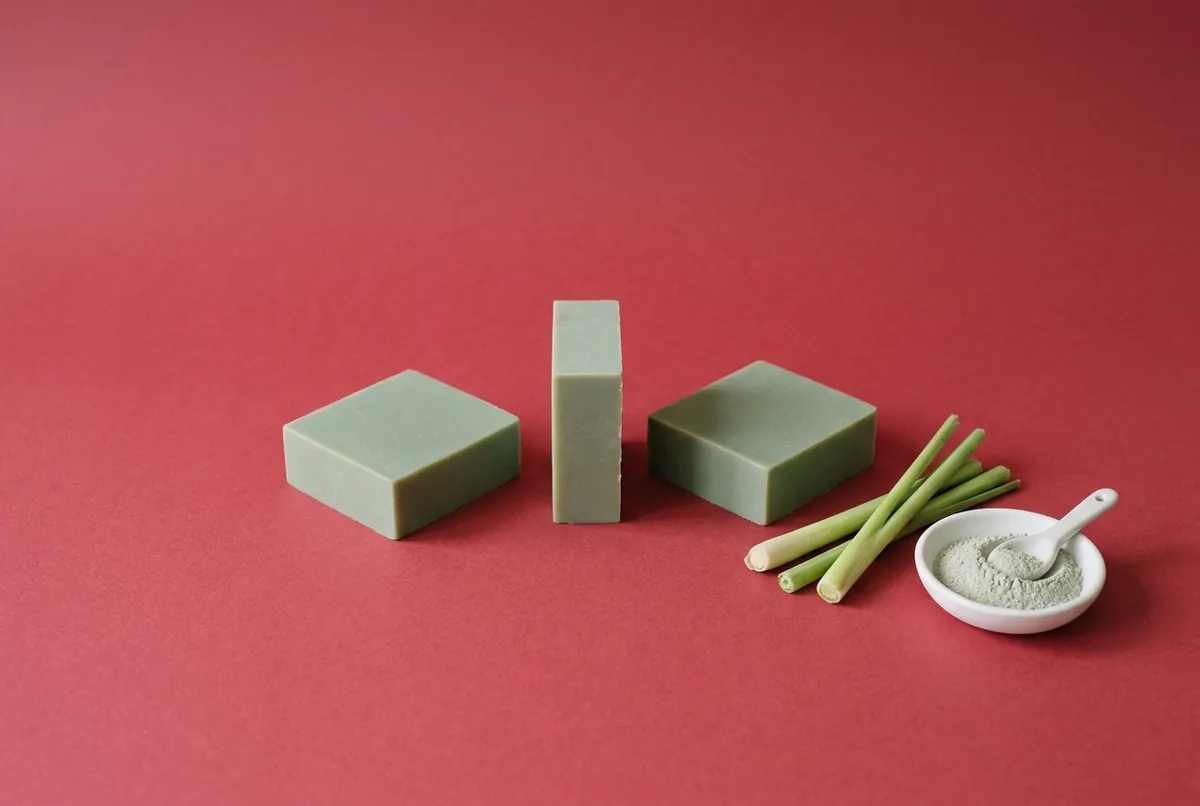
A fresh, herbal everyday bar scented with tea tree and lemongrass essential oils and coloured a soft sage green with French green clay. Both oils are kept well inside their IFRA limits for soap, and the clay's colour holds through the cure.
- Skill
- Beginner
- Method
- Cold process
- Batch
- 1000 g of oils about 1493 g of batter
- Hands-on
- 1 h 10 min
- Cure
- 6 weeks
- Gel phase
- Either way gel or not, both work
What you need
For 1000 g of oils, which fills a 1.5 litre loaf mould. Weigh everything, liquids included.
| Olive Oil · 45.0 % | 450 g | 15.87 oz |
| Coconut Oil · 25.0 % | 250 g | 8.82 oz |
| Cocoa Butter · 12.0 % | 120 g | 4.23 oz |
| Shea Butter · 8.0 % | 80 g | 2.82 oz |
| Avocado Oil · 5.0 % | 50 g | 1.76 oz |
| Castor Oil · 5.0 % | 50 g | 1.76 oz |
| Sodium hydroxide (NaOH) · the lye, 100 % pure | 139.3 g | 4.91 oz |
| Distilled water · 255 g for a 35 % lye solution, 55 g set aside | 310.0 g | 10.94 oz |
| French green clay · 1.5 tbsp, whisked into 55 g of water held back from the recipe's water | 18.7 g | 0.66 oz |
| Tea tree essential oil · 1.5 % of the oils, at trace | 15 g | 0.53 oz |
| Lemongrass essential oil · 1.0 % of the oils, at trace | 10 g | 0.35 oz |
- Superfat
- 5 %
- Temperatures
- Oils and lye solution each between 35 and 43 °C (95 and 110 °F)
Method
-
Get ready
Open a window or turn on the extractor fan, send children and pets out, and put on splash goggles, nitrile gloves and long sleeves. Set out a 1.5 litre loaf mould, and wear a dust mask while you measure the clay. -
Weigh everything
Weigh 250 g coconut oil, 120 g cocoa butter and 80 g shea butter into the pot, and 450 g olive oil, 50 g avocado oil and 50 g castor oil into a jug. Weigh 310.0 g of distilled water into the lye jug and pour 55 g of it into a small bowl for the clay, weigh 15 g of tea tree and 10 g of lemongrass essential oil into a small cup, and weigh the 139.3 g of sodium hydroxide last, into a dry container. -
Make the lye solution
Where air moves, pour the sodium hydroxide slowly into the 255.0 g of water left in the jug, never the water onto the lye, and stir until it turns clear. With less water it runs hotter than usual, so keep your face away, and leave it to cool, labelled and out of reach. -
Mix the clay
Whisk 1½ tablespoons (about 19 g) of French green clay into the 55 g of held-back water until it is smooth, with no dry lumps, and leave it to soak. -
Melt the fats
Melt the coconut oil, cocoa butter and shea butter on the lowest heat until just clear, then pour in the olive, avocado and castor oils. -
Check the temperatures
Go on when the oils are clear and both they and the lye solution are between 35 and 43 °C (95 and 110 °F); cooler than that, the cocoa butter can start to set and thicken the batter before it has traced. -
Blend to light trace
Pour the lye solution into the oils down the shaft of the stick blender, tap out the trapped air, and pulse and stir until the batter looks like thin custard and a drizzle leaves a faint line. -
Add the scent
Stir in the tea tree and lemongrass oils by hand. -
Add the clay
Whisk the clay slurry again, pour it in and whisk until the colour is even, with two or three short pulses if streaks remain. Clay drinks water and thickens batter, so pour straight away. -
Pour
Pour into the mould, scraping the pot clean, tap the mould on the worktop to release air, and smooth the top. -
Cover and leave
Cover the mould with its lid or a board and lay a towel over it for a day. Gel deepens the green a little; the bar is as good either way. -
Unmould and cut
After 24 to 48 hours, when the loaf is firm and has pulled away from the sides, unmould it with gloves on and cut it into bars about 2.5 cm (1 in) thick. -
Cure
Stand the bars on edge in a dry, airy place for six weeks, a finger's width apart, turning them every few days.
Tips
- Keep both oils at these amounts. Lemongrass is limited by its citral, and at 1 % of the oils it already uses about two-fifths of what IFRA allows in soap; the tea tree uses just under a third of its own limit.
- Mix the clay slurry on the day you soap. Wet clay can grow mould, so don't make it ahead and store it.
- Buy cosmetic-grade clay. French green clay owes its colour to iron-bearing minerals, so its sage green holds through the cure where plant greens fade.
The oils
| Oil | Share |
|---|---|
| Olive Oil (virgin / refined / olive oil) | 45.0 % |
| Coconut Oil | 25.0 % |
| Cocoa Butter (Theobroma Oil) | 12.0 % |
| Shea Butter | 8.0 % |
| Avocado Oil | 5.0 % |
| Castor Oil | 5.0 % |
How it is made
| Process | Cold process |
| Alkali | NaOH |
| Superfat | 5 % |
| Water | lye water at 31 % |
| Iodine value | 57 |
| INS | 148 |
Why make it
A fresh, sharp-smelling everyday bar, cleansing 17 and conditioning 57 on our scale, palm-free, with French green clay for a sage colour that holds because it comes from minerals. People choose tea tree soap for its clean, camphor-like scent and for tea tree's reputation, which has roots in Aboriginal Australian use of the leaves and in much laboratory study of the oil as a leave-on ingredient (Carson, Hammer and Riley 2006). A bar rinsed off after a minute is not a medicine, though, and nothing here should be read as one. Tea tree can also sensitise skin, and oxidised oil does so about three times more strongly than fresh (SCCP 2008), which is why this recipe keeps it well inside its limit. Buy fresh oil and store the bars cool and dark.
Sources
- Melaleuca alternifolia (Tea Tree) Oil: a Review of Antimicrobial and Other Medicinal Properties · Clinical Microbiology Reviews, 2006
- Opinion on tea tree oil (SCCP/1155/08) · European Commission, Scientific Committee on Consumer Products, 2008
What tradition, makers' experience and research say about soaps like this, each labelled for what it is. It is not medical advice, and no soap treats a skin condition: if you have one, ask a doctor or pharmacist.
What the numbers say
- Lauric acid 12.3 %
- Myristic acid 4.7 %
- Palmitic acid 12.7 %
- Stearic acid 9.7 %
- Ricinoleic acid 4.4 %
- Oleic acid 44.2 %
- Linoleic acid 7.7 %
- Other 5.3 %
Saturated : unsaturated 43 : 57
Computed from the fatty acids of the fats above. The bands are what the craft has settled on, not chemistry — a bar outside one is not wrong.
From the guides
All guides
Scenting soap: essential oils and fragrance oils
How much essential or fragrance oil to use in soap, what ounces per pound mean in percent, the IFRA limits for common essential oils, and EU allergen labelling.

Natural colourants: what herbs, clays and spices really do in soap
Clays, charcoal and plant colours in cold-process soap: doses per 500 g of oils, infused oil, powder or lye, and the colour each one actually turns.

Soap additives: salt, sugar, sodium lactate, clays, oats, silk and more
What common soap additives do, how much to use and when they go in: sourced doses for sodium lactate, salt, sugar, honey, citric acid, clays, oats and silk.
Where these proportions come from
Our own palm-free formulation at a 5 % superfat and a 31 % lye solution, so that the clay's water can come out of the recipe's own. The essential oils are set by IFRA's category 9 limits: lemongrass by its citral and tea tree by its methyl eugenol.