In short
- The soap has to be legal where it is sold: the right label everywhere, a safety assessment and a notification before the first sale in the EU and the UK, and a notification within 10 days of it in Canada.
- Fairs and markets pay the full retail price for a day of your time and a pitch fee. A shop buying wholesale pays less but pays whether or not the bars sell; consignment pays only when they do.
- Online marketplaces take fees on every sale, and the seller stays responsible for the product's labels and warnings.
- In the UK the law requires no insurance of a maker working alone, but markets and shops may ask for cover, and a producer is liable for harm a defective product causes.
- Track stock, curing batches, finished bars and sales by channel, and name the shop on every wholesale order so a recall can reach it.
On this page
- Before the first sale
- The soap has to be legal where it is sold
- Know how the soap keeps
- Registering the business and tax
- Insurance
- Where to sell
- Fairs and markets
- Consignment
- Wholesale
- Online marketplaces
- Your own website
- Packaging and presentation
- Photographs that sell soap
- Stock, finished goods and sales
A bar of soap reaches a customer in one of five ways: across your own table at a fair or market, through a shop that buys it from you, through a shop that sells it for you on commission, through an online marketplace, or through your own website. Each takes a different share of the price and asks something different of you. This guide goes through them, then covers what has to be in place before the first sale, how to present the soap, and how to keep track of it once it starts to move.
Before the first sale
The soap has to be legal where it is sold
The label comes first everywhere, and what it needs depends on where the soap is sold; the labelling guide works through the US, the EU, Great Britain and Canada. In the EU and Great Britain every soap also needs a safety assessment by a qualified person, a responsible person and a notification before it goes on sale, which the safety assessment guide covers. In Canada, a maker notifies Health Canada of each cosmetic within 10 days of first selling it.
Know how the soap keeps
A buyer will ask how long a bar lasts, and a recipe new to you can’t answer yet. Grosso keeps back a bar of every new recipe for at least six months and notes how it ages before selling it. A card with each sale saying how long it keeps, and that it should dry between uses, answers the question before it is asked.
Registering the business and tax
United Kingdom. The trading allowance covers up to £1,000 a year of gross trading income, meaning before any expenses are taken off. Above that you must register for Self Assessment by 5 October after the end of the tax year. VAT registration becomes compulsory once your taxable turnover for the last 12 months passes £90,000, or you expect it to in the next 30 days.
United States. Licences and permits come from the state, the county and the city, and “will depend on your business activities and business location”, in the Small Business Administration’s words; zoning rules can apply “even to home-based businesses”. Sales tax is set state by state, so ask your state’s revenue department what applies to you.
European Union. VAT registration rules are national. Once your online sales to consumers in other EU countries pass the EU-wide threshold of 10 000 euros, VAT is due at each customer’s country’s rate, and the One Stop Shop lets you declare it all in one country instead of registering in each.
Canada. You must register for the GST/HST once your taxable sales pass 30 000 Canadian dollars in a single calendar quarter or over four consecutive quarters, and you may register earlier if you choose.
Insurance
In the UK the law requires a small business to carry employers’ liability insurance as soon as it employs someone, with at least £5 million of cover, though employing only a family member is an exception. Public liability insurance, for claims by customers and the public, is voluntary. Product liability insurance covers a claim that something you sold caused harm, and under the Consumer Protection Act 1987, where damage is caused by a defect in a product, its producer is liable for it. Markets, fairs and shops may make cover a condition of taking you on, so read their terms before you book. Trade guilds for soap makers in the US and the UK point members to insurance written for small makers.
Where to sell
| Channel | What you receive | What it costs you | Who takes the risk of unsold bars |
|---|---|---|---|
| Fairs and markets | The full retail price, on the day | A pitch fee, a share of the takings or both; the day itself, travel, a display, card fees | You |
| Consignment | The retail price less the shop’s commission, when a bar sells | Stock tied up on someone else’s shelf | You |
| Wholesale | Your wholesale price, on the order | A lower price per bar, minimum orders, invoicing | The shop |
| Online marketplace | The price less the platform’s fees | Fees on every sale, postage and packing, photographs, messages | You |
| Your own website | The price less payment fees | The platform, the payments, and bringing the visitors yourself | You |
What each channel pays for a bar is worked out against its cost in the costing guide.
Fairs and markets
A stall pays the full price in your hand and tells you, face to face, which bars people pick up and put down. It is also a day of your time that earns nothing if it rains, which is why the pitch fee belongs in overhead: spread it over the bars you expect to sell there, and a fair that sells twenty bars carries its fee very differently from one that sells two hundred. Many events take a percentage of your sales as well, or instead, as Alicia Grosso found: office and church bazaars often charge no table fee but ask for a share for a charity, and craft fairs want an application and a deposit, and some are juried. A percentage comes off every bar, like a card fee, so it belongs in the price rather than the overhead. Keep a tester bar of each scent out for sniffing, so the stock stays unhandled.
Grosso sets a new stall up at home a few days before the event, draws the layout and practises packing it away, and keeps the stock indoors until she leaves. She takes an inventory sheet to every event, with columns for each product’s price, starting count, trades, charity, damages, shrinkage (whatever went missing), ending count, number sold and takings, and at the end checks the cash, less the float, against it.
Unwrapped bars need their label somewhere. In Great Britain, for cosmetics that are not pre-packaged, the particulars “must appear on the container in which the product is exposed for supply or on a notice in immediate proximity to that container” (Cosmetic Products Enforcement Regulations 2013, regulation 5(1)), so a crate of bare bars can carry its whole label on a card beside it. In the EU the ingredient list of soap may go on a notice by the container in which it is displayed (Article 19(3) of Regulation 1223/2009), and each country sets the rest for products that are not pre-packaged.
Consignment
The shop puts your soap on its shelf and pays you when a bar sells, keeping a commission. The bars stay yours until then, and so does the risk: slow sellers, damage, theft, and bars that come back shop-worn. Agree it in writing before you hand anything over: the commission, the retail price, how often the shop reports sales and pays, who bears loss or damage, and when unsold stock comes back. Record which batches are in which shop, so that a recall can reach them.
Wholesale
The shop buys the bars outright at your wholesale price and sets its own retail price. You are paid for the order whether or not it sells, which is the attraction; the price is lower, which is the catch. Work out whether your cost allows it before you quote, because a wholesale price that covers the oils but not your time loses money on every bar you ship. Set a minimum order and your payment terms, and put them on a wholesale price list.
Every wholesale invoice should name the shop and the batch codes it received. FDA’s draft guidance on cosmetic good manufacturing practice asks for distribution records “identifying the consignee, the product, and the lot or control number”, and those are the records that let a recall reach every shelf your soap is on. The batch records guide covers the rest.
Online marketplaces
A marketplace brings buyers you would never meet at a market, for a fee on every sale. Etsy, for example, requires that “everything listed for sale on Etsy must be made, designed, handpicked, or sourced by a seller”, and it charges a listing fee of 0.20 US dollars for each item listed, a transaction fee of 6.5 % of the price plus any shipping and gift wrap you charge, and a payment processing fee that varies by country. Its seller policy also puts the law on you: by listing, you are “responsible for complying with all applicable laws and regulations in connection with the products you list for sale, including any required labels and warnings”.
The listing is part of the label as far as claims go. In the US, FDA reads a product’s intended use from “claims stated on the product labeling, in advertising, on the Internet, or in other promotional materials”, so a product description that says a bar clears acne or kills germs makes it a drug just as surely as the wrapper would. Put the ingredient list and the net weight in the listing, down to the oil a colour was dispersed in: Anne-Marie Faiola lists every carrier oil for the sake of buyers with nut allergies. Describe the soap the way its label does.
Selling at a distance to consumers in the UK or the EU brings a right to cancel: 14 days from the day the goods arrive. There is an exception for “sealed goods which are not suitable for return due to health protection or hygiene reasons” once they are unsealed after delivery. If you mean to rely on it for wrapped soap, say so plainly in your terms before the sale; an unwrapped bar is not sealed by anyone’s reading.
Soap is heavy for its size. Weigh a packed parcel before you set a shipping charge, and remember that on Etsy the transaction fee applies to shipping as well.
Your own website
Your own shop keeps more of each sale and gives you your own customer list, at the price of bringing every visitor yourself. The same rules follow the soap there: the listing’s claims, the ingredient list, the right to cancel. On the Business plan, the products page, which works out each product’s cost and margin from its recipe, downloads your catalogue in the format Shopify imports.
Packaging and presentation
Choose the packaging after the label, because the pack has to carry it. A paper band round the middle shows the soap and carries the particulars on the back; a box has room for everything, and costs more per bar. Whatever you choose, cost it per bar: in the costing guide’s example the packaging is 13.5 % of what a bar costs.
Wrap bars only once they have cured, and weigh them then. The net weight on the label must hold for the bar as packed, and a bar weighed at cutting still has water to lose; the curing guide covers how long that takes. Cut bars to a consistent size, which the cutting guide helps with, so the same weight fits every bar.
Order printed packaging in modest runs. A label changes when a recipe changes, when a supplier’s fragrance changes its allergen declaration, and when the law does: every EU label for a scented soap first supplied from 1 August 2026 had to account for 57 more fragrance allergens.
Photographs that sell soap
Online, the photograph does the work the stall does at a market: it is the only look at the soap a buyer gets before paying. A good one needs daylight more than equipment.
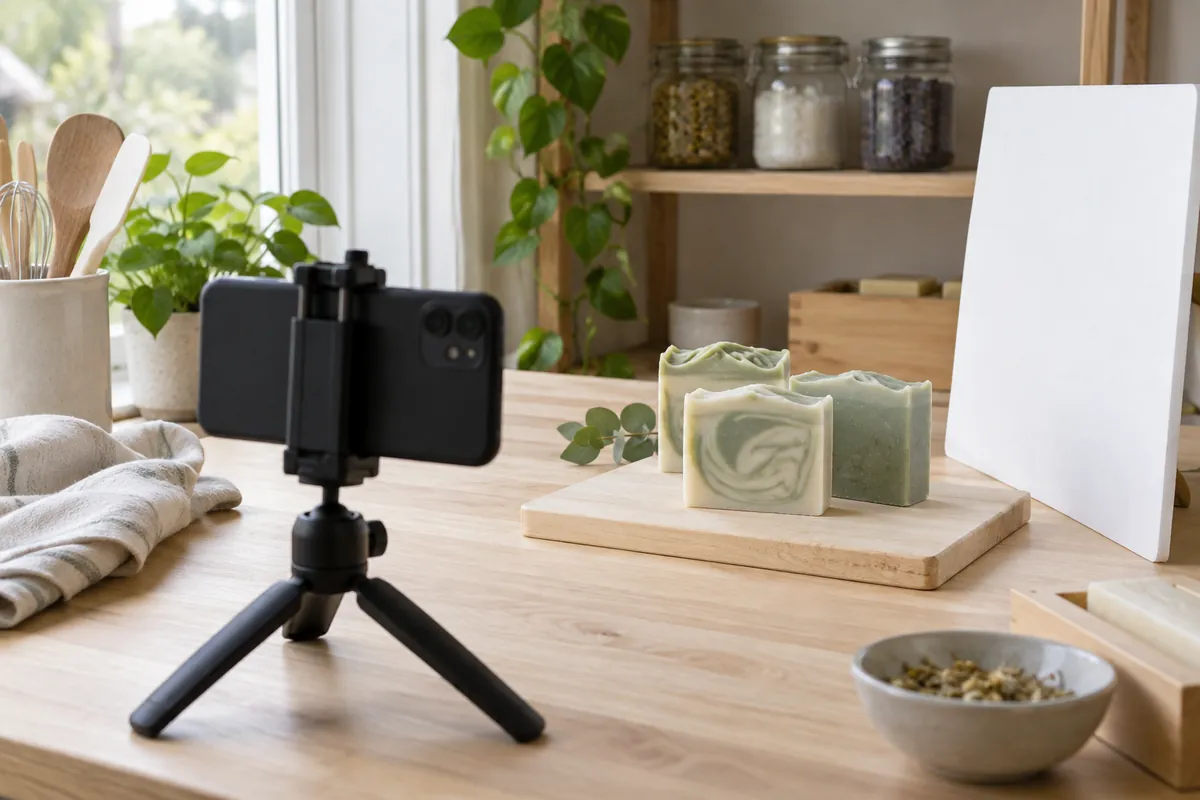 Window light from one side and a white card on the other: all the studio a soap photograph needs.
- Light. A window out of direct sun, to one side of the soap, and a sheet of white card on the other to lift the shadows.
- The shot. One whole bar, and one showing the cut face, where a swirl or a layer lives. A second bar or a spoon in the frame tells the buyer the size.
- Colour. Set the white balance so a white card looks white, and leave the colour where it is. The bar that arrives has to look like the one in the picture.
- Consistency. The same background and angle for the whole range makes a shop page look like one maker’s work.
- The label. One photo of the label, legible, so buyers can read the ingredients before they buy.
Photograph every batch, too. Some colourants shift or fade in soap, and fragrances that contain vanillin turn a bar brown over the weeks after it is poured, so a photo in the batch log is the record of what a batch looked like when it was released. The Maker plan keeps photos with each batch.
Stock, finished goods and sales
Selling adds three things to keep track of: raw materials, bars curing, and bars ready or sold. The questions are simple, and a notebook can answer them for a while. What will run out before the next market? What is ready on which day? Which channel sold what last month? Which shops have bars from which batch?
Record every sale with its channel, and keep gifts, samples and losses apart from sales, so the figures show which channels earn. Sell the oldest ready bars first. And name the shop or customer on every wholesale order and posted parcel, because those are the sales a recall has to find.
On the site, the Business plan joins these up. Stock, which starts on the Maker plan, warns when an ingredient or a box runs low, and a batch logged from the lye calculator or the batch log takes what it used, its packaging too; on Business each delivery keeps its supplier lot. Finished goods follows the bars each batch cut, from curing to ready to sold, with every sale by channel. Products works out what one of each costs and the margin on your retail and wholesale prices, and writes the Shopify catalogue and the wholesale price list. Reports add it up by month, and a printable market card for your stall carries a QR code that opens your page on the site. The pricing page lists what each plan includes; the cost calculator and the label maker are free.
Sources
- Tax-free allowances on property and trading income . HM Revenue & Customs, GOV.UK , 2019.
- VAT registration: when to register . HM Revenue & Customs, GOV.UK .
- Apply for licenses and permits . US Small Business Administration .
- Cross-border VAT: selling to consumers in other EU countries . European Union, Your Europe , 2026.
- When to register for and start charging the GST/HST . Canada Revenue Agency .
- Employers' liability insurance . GOV.UK .
- Employers' liability compulsory insurance . Royal Borough of Kensington and Chelsea . Public liability insurance is voluntary; employers' liability is compulsory once you employ anyone.
- Consumer Protection Act 1987, section 2 . legislation.gov.uk , 1987.
- The Consumer Contracts (Information, Cancellation and Additional Charges) Regulations 2013, regulations 28 and 30 . legislation.gov.uk , 2013.
- Directive 2011/83/EU on consumer rights, Article 16 . legislation.gov.uk (EU text) .
- Fees & Payments Policy; Seller Policy . Etsy , 2026.
- Membership benefits . Handcrafted Soap and Cosmetic Guild .
- Insurance for crafters . Guild of Craft Soap & Toiletry Makers .
- Soap Crafting . Anne-Marie Faiola, Storey Publishing , 2013. Colourants that shift or fade in soap; vanillin browning.
- The Everything Soapmaking Book, 3rd edition . Alicia Grosso, Adams Media , 2013. Events that take a percentage of sales, a table fee or both; bazaars, juried craft fairs and deposits; a dry run of the stall; the event inventory sheet; keeping a bar of each recipe six months to learn its shelf life; care notes for buyers.
- Pure Soapmaking . Anne-Marie Faiola, Storey Publishing , 2016. Listing every ingredient on soap for sale, carrier oils and colour-dispersing oils included, for customers with nut allergies.
- Notification of cosmetics: guide for cosmetic notifications . Health Canada , 2026.
- Draft Guidance for Industry: Cosmetic Good Manufacturing Practices (Records) . US Food and Drug Administration , 2013.