In short
- Most loaves are ready in 24 to 48 hours: firm to a pressed finger and pulled away from the sides. Olive-rich soap and cavity moulds take longer.
- Put gloves on to unmould and cut. Fresh soap can still hold a little unreacted lye for its first day or two.
- Silicone lets go with patience, a night in the freezer, or sodium lactate in the next batch; lined moulds lift straight out.
- Cut at room temperature with a long, straight, unserrated blade or a wire, pushing straight down in one movement.
- Bevel the edges and plane off soda ash whenever you like; stamp when the bar is firm but not yet hard, anywhere from a few days to a few weeks.
On this page
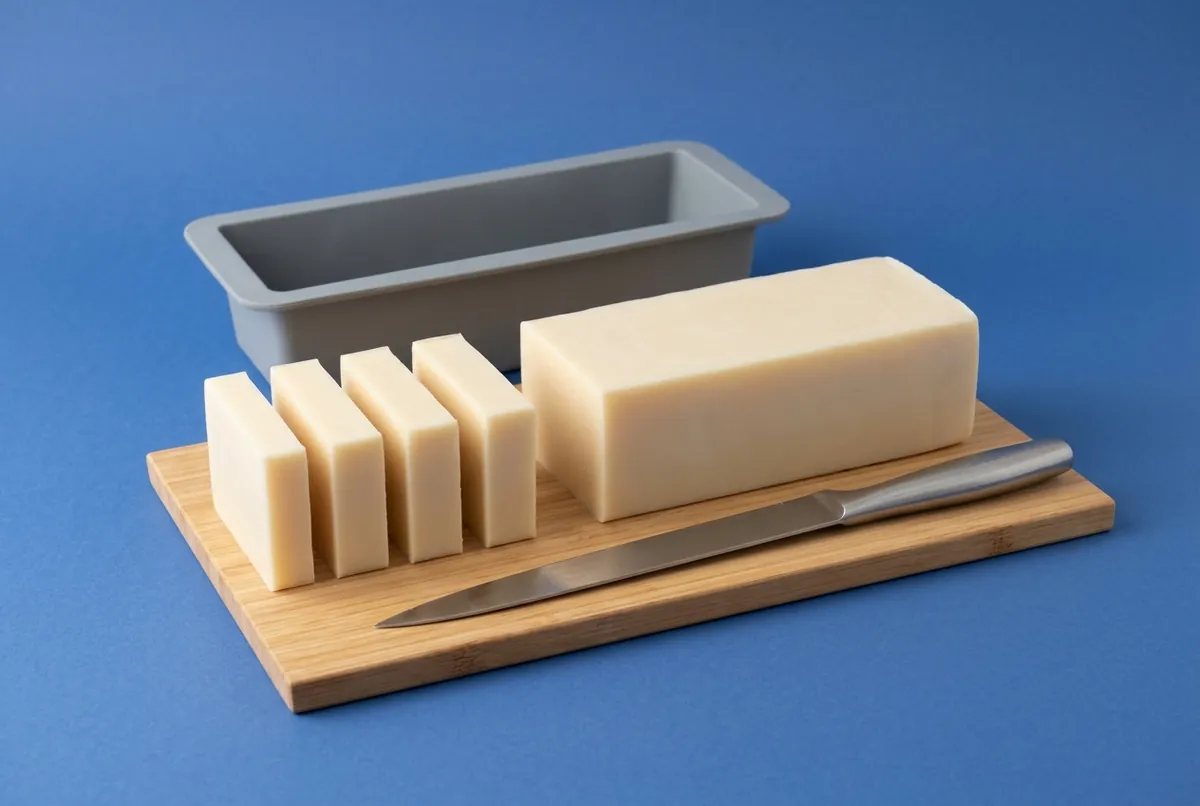
Unmoulding and cutting are the first time you get your hands on the soap you made, and the timing is most of the skill. Too early and the loaf tears or smears on the knife; too late and it can be hard to cut cleanly. This guide covers how to tell when a loaf is ready, how to get it out of each kind of mould, and how to cut, finish and stamp the bars.
When is it ready?
Most cold process loaves can come out of the mould 24 to 48 hours after pouring; Anne-Marie Faiola waits at least 48, and 48 more if the soap tears. Three checks tell you:
- Press the top with a gloved finger. It should feel firm, like a hard cheese, and take no more than a faint print. A sticky surface or wet batter underneath means it needs longer. This is Kelly Cable’s fingerprint test.
- Look at the sides. A loaf that is ready has usually pulled away from the mould a little, as Heidi Corley Barto points out.
- When unsure, cut a thin slice off one end. If it smears or drags on the knife, give the loaf another day.
Some soaps take longer. Recipes with a lot of liquid oil, castile above all, can need two days or more: Corley Barto waits at least 48 hours for pure olive oil soap, and our high-olive bastile bar stays two or three days. Soap kept cool to avoid gel, or made in a cold or humid room, sets more slowly, and Susan Miller Cavitch finds that bars carrying a lot of citrus oil take longer to harden too. Silicone forms an airlock around the soap, and Anne-Marie Faiola notes that a silicone mould can take up to a week to let go; individual cavity moulds hold on hardest of all. Gelled soap, soap made with less water and soap with sodium lactate in it are usually quicker.
Salt bars are the exception to all of this: they make enough heat to need no insulation, and have to be cut within hours, while still warm, before they get too hard. Our pink salt spa bar comes out of its cavities after 4 to 8 hours, and as a loaf it must be cut 2 to 4 hours after pouring (see salt bars).
Gloves on
Put your gloves back on before you touch the loaf. After a day or two the reaction is mostly done (a study of cold process soaps puts saponification at 18 to 24 hours), but not quite all the lye has met its oil, and a loaf that stayed cool is further behind. The books differ here. Letcavage and Harden reckon no protection is needed by the time you unmould, though Letcavage’s earlier book with Patsy Buck advises gloves for cutting; Anne Watson puts her gloves back on and David Fisher keeps them on until the soap has finished saponifying. Gloves cost nothing: wear them until the bars are cut and on the rack.
Getting it out of the mould
Silicone loaf moulds
Pull the sides gently away from the soap all the way round to break the seal, turn the mould over and press the base down with your palm, which is Faiola’s method. Don’t pull on the soap itself. If it tears or won’t come, wait a few more days, or freeze it.
Lined wooden moulds and boxes
Lift the loaf out by its liner and peel the paper off. If the mould comes apart, take it apart rather than pushing the soap out: Corley Barto removes the long sides first, then the ends, twisting them away from the soap instead of pulling.
Cavity moulds
Give them extra days, or freeze them. Then turn the mould over close to the worktop, so nothing falls far, and press each cavity out from the back.
Freezing
Frozen soap doesn’t flex, so it lets go of the mould. Faiola freezes a stubborn loaf for at least 12 hours, unmoulds it frozen, then lets it thaw for several hours before cutting, because cold soap is brittle and breaks rather than cuts. As it warms it collects condensation, so let it dry fully at room temperature before you stack or store the bars. Our loofah soap comes out of its pipe mould the same way. For a small decorative mould, Letcavage and Harden find 10 to 15 minutes in the freezer is often enough.
Sodium lactate, for next time
If a recipe is always slow to release, sodium lactate helps. It is a salt that gives a harder bar that leaves the mould sooner, and Corbion, which makes it, lists harder bars, easier release from moulds and easier stamping among its uses in soap. Faiola adds 1 teaspoon of the usual 60 % solution per pound of oils, about 6.6 g per 454 g, to the cooled lye solution. Our additive database gives 1 to 3 % of the oil weight; above 3 % it can make bars softer and rubbery. The additives guide has more.
Cutting bars
Cut when the soap is at room temperature: too cold and it breaks, too warm and it smears. Use a long, straight blade with no serrations, which leave drag marks, or a wire soap cutter; a crinkle cutter gives a rippled face if you want one. Push straight down in one steady movement rather than sawing, and keep the blade upright. Turn a layered loaf, or one with a topping, onto its side first, as Faiola does, so the cuts run with the layers and the knife can’t drag one colour into the next.
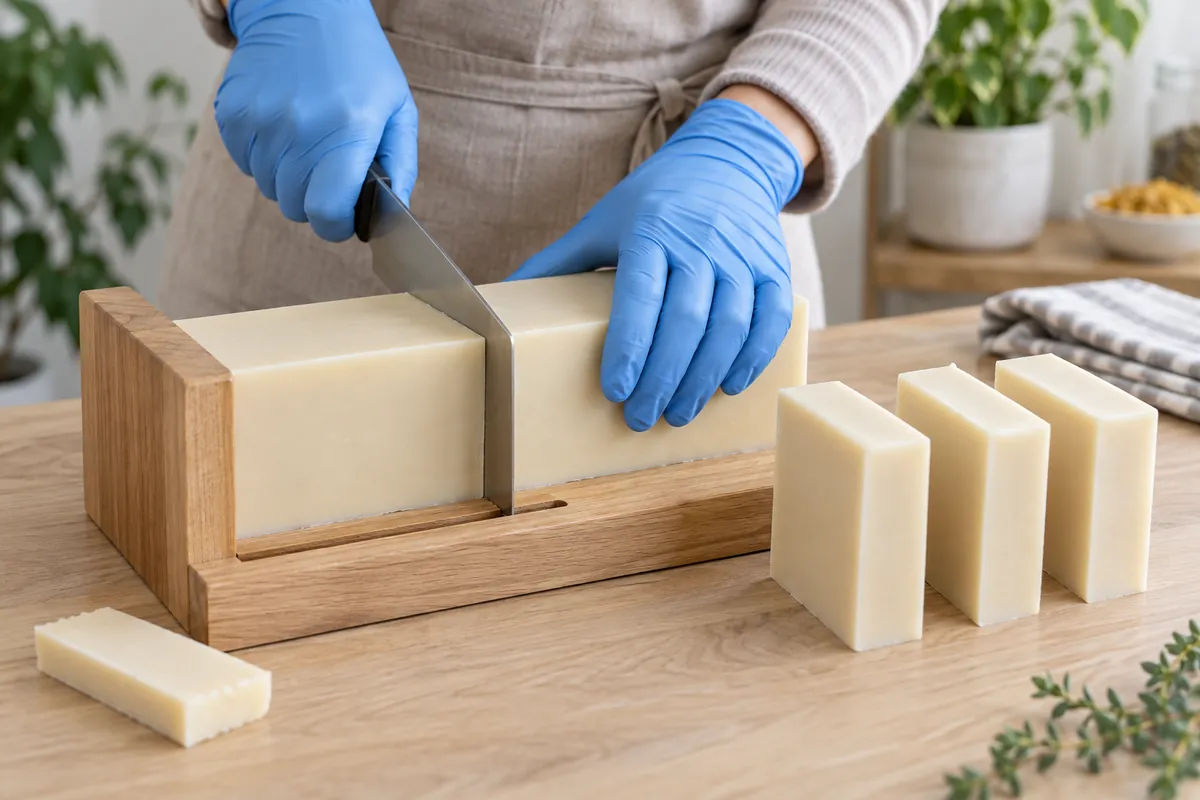 A simple guide with a stop makes every bar the same thickness. The rough end has already been trimmed off.
For even bars, measure before the first cut. Mark each cut line on the top of the loaf with a ruler and a light nick of the knife, or use a mitre box or a wooden guide with a stop set at the thickness you want. Trim the rough ends first and keep the offcuts.
A slab is cut like a tray of brownies, which Cavitch prefers because it takes fewer cuts than slicing a tall block. She marks the edges of the tray every 7.6 cm (3 in) one way and every 6 cm (2⅜ in) the other, scores every line lightly along a ruler, checks them all, and only then cuts through: 40 bars from one tray.
Choose the thickness from the weight you want. Fresh soap weighs about a gram per millilitre, so a slice’s weight in grams is close to its volume in millilitres: a loaf 7 cm wide and 6 cm tall gives about 105 g per 2.5 cm (1 in) slice. The bars lose some of that weight as they cure (see curing and storing soap).
If the knife drags or the soap sticks to it, the loaf is still too soft: leave it a day or two. If it crumbles or cracks, it may be cold, or it waited too long; Letcavage and Harden unmould and cut within a week, because a loaf only gets harder to slice after that, and tallow-rich soap such as our creamy tallow and olive bar is best cut the day it comes out. A bar that is chalky and crumbly at room temperature may be lye-heavy, and should be tested before anyone uses it (see soap pH and testing).
Finishing the bars
Bevelling. A vegetable peeler drawn along each edge takes off the sharp corners; a bevel tool does the same job more evenly. Save the shavings for rebatching.
Planing off soda ash. A white, powdery film on the top is soda ash, harmless sodium carbonate. Shave it off with a peeler or a soap plane, or steam it off. Wait a few days after cutting and any ash will have shown itself first.
Stamping. A stamp needs soap soft enough to take the impression and firm enough to hold it. Too fresh and the edges smear; too hard and the soap cracks around the stamp. Soap factories dried their bars until the surface formed a skin, which, Simmons and Appleton wrote in 1908, “allows of an impression being given by the stamp without the soap adhering to the dies”. Books disagree on when that is: Cable stamps 4 to 7 days after unmoulding, while Letcavage and Harden find 2 to 4 weeks of cure best for most recipes. It depends on the recipe, so try an offcut first. Tap a wooden-backed stamp with a rubber mallet, centre first and then each corner; press an acrylic stamp firmly by hand and never hit it; and roll a rubber stamp slightly as you press. A double impression is almost impossible to fix, which is one more reason to practise on the ends.
Recipes to try
All recipesSources
- Soap Crafting . Anne-Marie Faiola, Storey Publishing , 2013. Releasing silicone moulds, which can take up to a week; freezing at least 12 hours and thawing before cutting; unserrated blades; sodium lactate at 1 teaspoon per pound of oils; bevelling tools.
- Natural Soap Making . Elizabeth Letcavage and Melissa Harden, Stackpole Books , 2013. Lifting a loaf by its liner; unmoulding within a week; a vegetable peeler for edges; 10 to 15 minutes in the freezer for decorative moulds; stamping semi-cured soap.
- The Natural Soap Making Book for Beginners . Kelly Cable, Althea Press , 2017. The fingerprint test at 24 hours; stamping 4 to 7 days after unmoulding; rolling a rubber stamp as you press.
- The Natural Soap Chef . Heidi Corley Barto, Ulysses Press , 2012. Soap pulling away from the sides; 48 hours for pure olive oil soap; taking wooden moulds apart; cutting only at room temperature, with a test cut first.
- Smart Soapmaking . Anne L. Watson, Shepard Publications , 2013. Gloves back on to unmould; trimming or bevelling with a vegetable peeler.
- The Complete Photo Guide to Soap Making . David Fisher, Creative Publishing International , 2018. Gloves and eye protection until the soap has finished saponifying; steaming off soda ash.
- The Natural Soap Book . Susan Miller Cavitch, Storey Publishing , 1995. Soap ready to slice in one to seven days, later with a lot of citrus oil or unsaturated oils; slab cutting on a 3 by 2⅜ inch grid, scored along a ruler before cutting through.
- Pure Soapmaking . Anne-Marie Faiola, Storey Publishing , 2016. At least 48 hours in the mould, 48 more if the soap tears; layered and topped loaves turned on their side to cut.
- Basic Soap Making . Elizabeth Letcavage and Patsy Buck, Stackpole Books , 2009. Gloves advised for cutting the new log, though the soap is safe to handle after 24 hours.
- The Everything Soapmaking Book, 3rd edition . Alicia Grosso, Adams Media , 2013. Salt soap left uninsulated, as it makes its own heat, and sliced when hard even if still warm.
- The Handbook of Soap Manufacture . W. H. Simmons and H. A. Appleton, Scott, Greenwood & Son (Project Gutenberg edition) , 1908. Bars dried to a skin before stamping so the soap does not stick to the dies.
- The Effects of Cold Saponification on the Unsaponified Fatty Acid Composition and Sensory Perception of Commercial Natural Herbal Soaps . Prieto Vidal N. et al., Molecules 23(9), 2356 , 2018. Cold saponification takes 18 to 24 hours to complete, followed by weeks of cure.
- PURASAL S/HQ60 sodium lactate for bar soap . Corbion . The maker's own list of uses in bar soap: hardness, release from moulds, stamping.
- Sodium lactate . Classic Bells, Soapy Stuff . 10 to 30 g of 60 % solution per 1000 g of fats; over 3 % can make bars softer and rubbery.