Gardener's pumice scrub bar
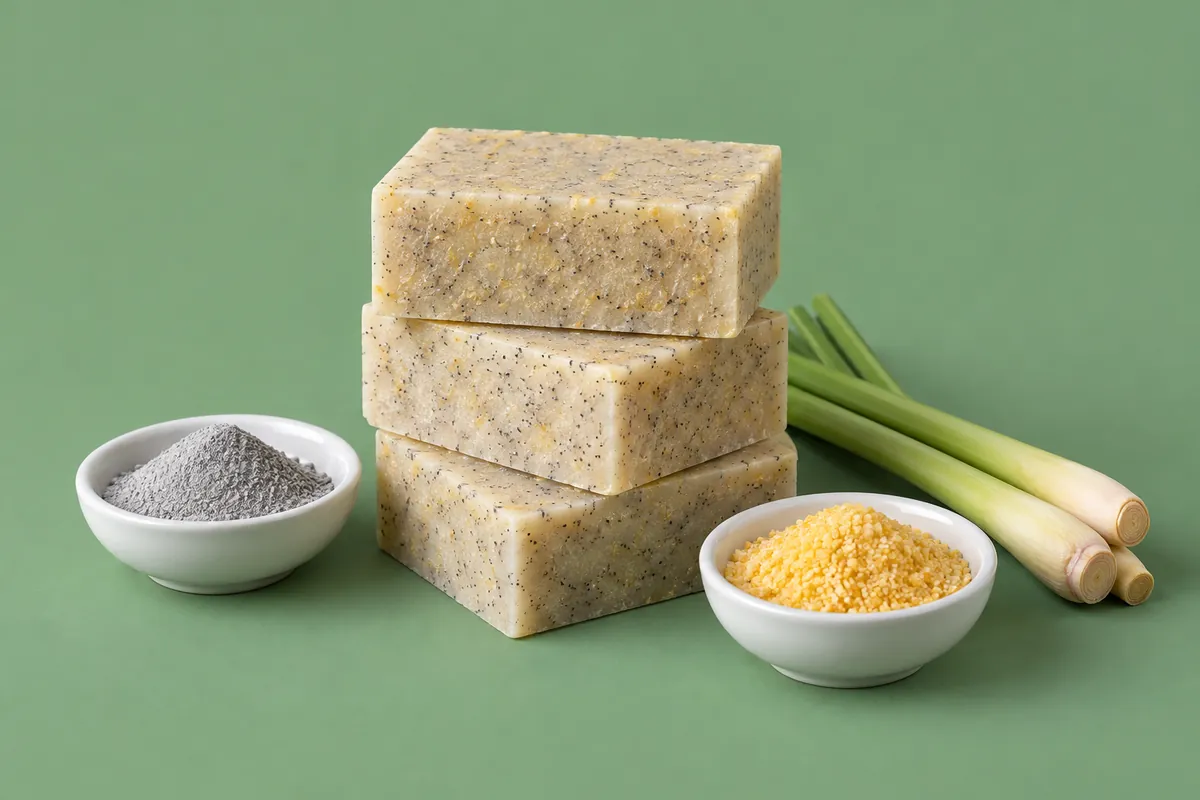
A hard-working hand bar for the potting shed and the garage: a coconut-rich, bubbly base with fine pumice and cornmeal for grip on grime, scented with lemongrass and Atlas cedarwood. Pumice is too rough for faces, so keep this one by the back door.
- Skill
- Beginner
- Method
- Cold process
- Batch
- 1000 g of oils about 1511 g of batter
- Hands-on
- 1 h 10 min
- Cure
- 4 weeks
- Gel phase
- Yes insulate the mould
What you need
For 1000 g of oils, which fills a 1.5 litre loaf mould. Weigh everything, liquids included.
| Coconut Oil · 30.0 % | 300 g | 10.58 oz |
| Palm Oil · 25.0 % | 250 g | 8.82 oz |
| Olive Oil · 25.0 % | 250 g | 8.82 oz |
| Shea Butter · 10.0 % | 100 g | 3.53 oz |
| Jojoba Oil · 5.0 % | 50 g | 1.76 oz |
| Castor Oil · 5.0 % | 50 g | 1.76 oz |
| Sodium hydroxide (NaOH) · the lye, 100 % pure | 138.2 g | 4.87 oz |
| Distilled water · for a 33 % lye solution | 280.6 g | 9.90 oz |
| Pumice powder, fine · 4 tbsp, mixed with 30 g of the recipe's olive oil | 46 g | 1.61 oz |
| Cornmeal, fine · about 2 tbsp, mixed in with the pumice | 17 g | 0.60 oz |
| Lemongrass essential oil (East Indian) · 2.0 % of the oils, at trace | 20 g | 0.71 oz |
| Atlas cedarwood essential oil · 1.0 % of the oils, at trace | 10 g | 0.35 oz |
- Superfat
- 6 %
- Temperatures
- Oils and lye solution each at 38 to 43 °C (100 to 110 °F)
Method
-
Get ready
Open a window, put on splash goggles, nitrile gloves and long sleeves, and line or set out a 1.5 litre loaf mould. Wear a dust mask while you measure the pumice, which is fine rock dust. -
Weigh everything
Stir the tub of palm oil right through, since its hard and soft parts separate, then weigh 300 g coconut oil, 250 g palm oil and 100 g shea butter into the pot. Weigh 250 g olive oil, 50 g jojoba oil and 50 g castor oil into a jug, and pour 30 g of the olive oil into a small bowl for the scrub. -
Make the lye solution
Weigh 280.6 g distilled water into the lye jug and 138.2 g sodium hydroxide into a dry container. At an open window or under the extractor fan, pour the lye slowly into the water, never the reverse, stir until clear and leave it to cool, labelled and out of reach. -
Wet the scrub
Stir 4 tbsp (45.5 g) pumice powder and 17 g (about 2 tbsp) fine cornmeal into the 30 g of olive oil to a gritty paste with no dry pockets. -
Melt the fats
Melt the coconut oil, palm oil and shea butter on the lowest heat, then pour in the rest of the olive oil and the jojoba and castor oils. Let the oils and the lye solution each come to 38 to 43 °C (100 to 110 °F), warm enough to keep the palm oil fully melted. -
Blend to light trace
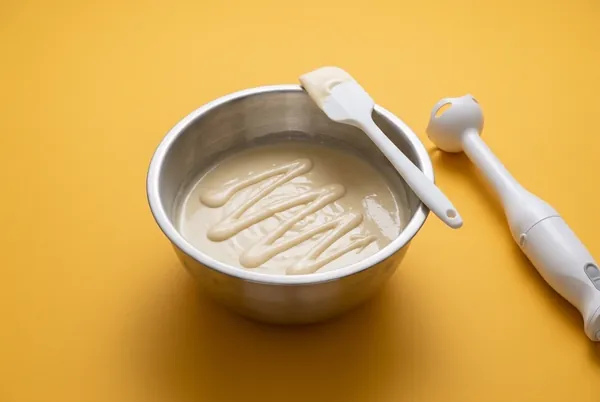
Pour the lye solution into the oils down the shaft of the stick blender, then pulse for a few seconds at a time, stirring between pulses, until light trace, when a drizzle leaves a faint line that sinks back within seconds. -
Add the scent
Stir in 20 g lemongrass and 10 g Atlas cedarwood essential oil with a spatula. -
Thicken and add the scrub
Pulse a little more, until the batter reaches a pudding-like trace that holds a drizzle on its surface: thinner batter lets the pumice sink to the bottom of the bars. Stir in the pumice paste by hand until the specks are even. -
Pour and insulate
Spoon or pour the batter into the mould, tap it firmly on the worktop and smooth the top. Cover it and wrap it in a towel; this recipe gels readily, which is fine. -
Clean up
With your gloves still on, wipe the batter off the pot and tools with paper towels into the bin, then wash everything in hot soapy water. -
Unmould and cut
After 24 to 48 hours, when the loaf is firm, put your gloves back on, unmould it and cut it into bars about 2.5 cm (1 in) thick with an old straight knife or a wire cutter, since pumice blunts a good blade. -
Cure
Stand the bars on edge on a rack with air around them, out of the sun, for four to six weeks, turning them every few days.
Tips
- Pumice is for hands and feet only. For a gentler hand bar, halve it and leave the cornmeal as it is.
- Buy RSPO-certified palm oil. Swapping it for another fat changes the lye, so run the recipe through the calculator again rather than substituting by weight.
- Lemongrass can speed trace a little. Have the pumice paste ready before you combine, so you are never waiting on it with thickening batter.
The oils
| Oil | Share |
|---|---|
| Coconut Oil | 30.0 % |
| Palm Oil | 25.0 % |
| Olive Oil (virgin / refined / olive oil) | 25.0 % |
| Shea Butter | 10.0 % |
| Jojoba Oil | 5.0 % |
| Castor Oil | 5.0 % |
How it is made
| Process | Cold process |
| Alkali | NaOH |
| Superfat | 6 % |
| Water | lye water at 33 % |
| Iodine value | 51 |
| INS | 156 |
Why make it
A bar for hands that have been in soil, grease or paint. Pumice is volcanic glass ground to a powder and a long-standing ingredient of heavy-duty hand cleaners (US Geological Survey); fine cornmeal adds a softer grit. The base is firmer and more cleansing than a bath bar, 21 on our scale with a lively lather, so it stands up to life by an outdoor tap, and gardeners like the lemongrass and cedarwood scent. It is too rough for the face or for broken skin, and repeated scrubbing dries hands out. Dermatologists advise gloves for gardening and a hand cream after washing, and those will do more for working hands than any soap.
Sources
- 2019 Minerals Yearbook: Pumice and pumicite · U.S. Geological Survey, 2024
- Dermatologists' top tips for relieving dry skin · American Academy of Dermatology
What tradition, makers' experience and research say about soaps like this, each labelled for what it is. It is not medical advice, and no soap treats a skin condition: if you have one, ask a doctor or pharmacist.
What the numbers say
- Lauric acid 14.8 %
- Myristic acid 6.0 %
- Palmitic acid 17.5 %
- Stearic acid 7.1 %
- Ricinoleic acid 4.4 %
- Oleic acid 35.0 %
- Linoleic acid 7.1 %
- Other 9.7 %
Saturated : unsaturated 49 : 51
Computed from the fatty acids of the fats above. The bands are what the craft has settled on, not chemistry — a bar outside one is not wrong.
From the guides
All guides
Soap additives: salt, sugar, sodium lactate, clays, oats, silk and more
What common soap additives do, how much to use and when they go in: sourced doses for sodium lactate, salt, sugar, honey, citric acid, clays, oats and silk.
Trace: how to tell when soap batter is ready
What trace is, how to read emulsion, light, medium and thick trace, how to spot false trace, and what makes soap batter thicken faster or slower.

Scenting soap: essential oils and fragrance oils
How much essential or fragrance oil to use in soap, what ounces per pound mean in percent, the IFRA limits for common essential oils, and EU allergen labelling.
Where these proportions come from
Adapted from Elizabeth Letcavage and Melissa Harden's gardener's hand soap: coconut, palm and olive oils with shea butter and jojoba, the jojoba halved to 5 % and castor oil added for a thicker lather, with pumice and cornmeal as the scrub in place of their oats and herbs. The superfat is 6 %, so that some oil is left over even if every oil sits at the bottom of its published saponification range.
Formulation adapted from Natural Soap Making by Elizabeth Letcavage and Melissa Harden (Stackpole Books, 2013). The method and notes are ours.