Kaolin and silk facial bar
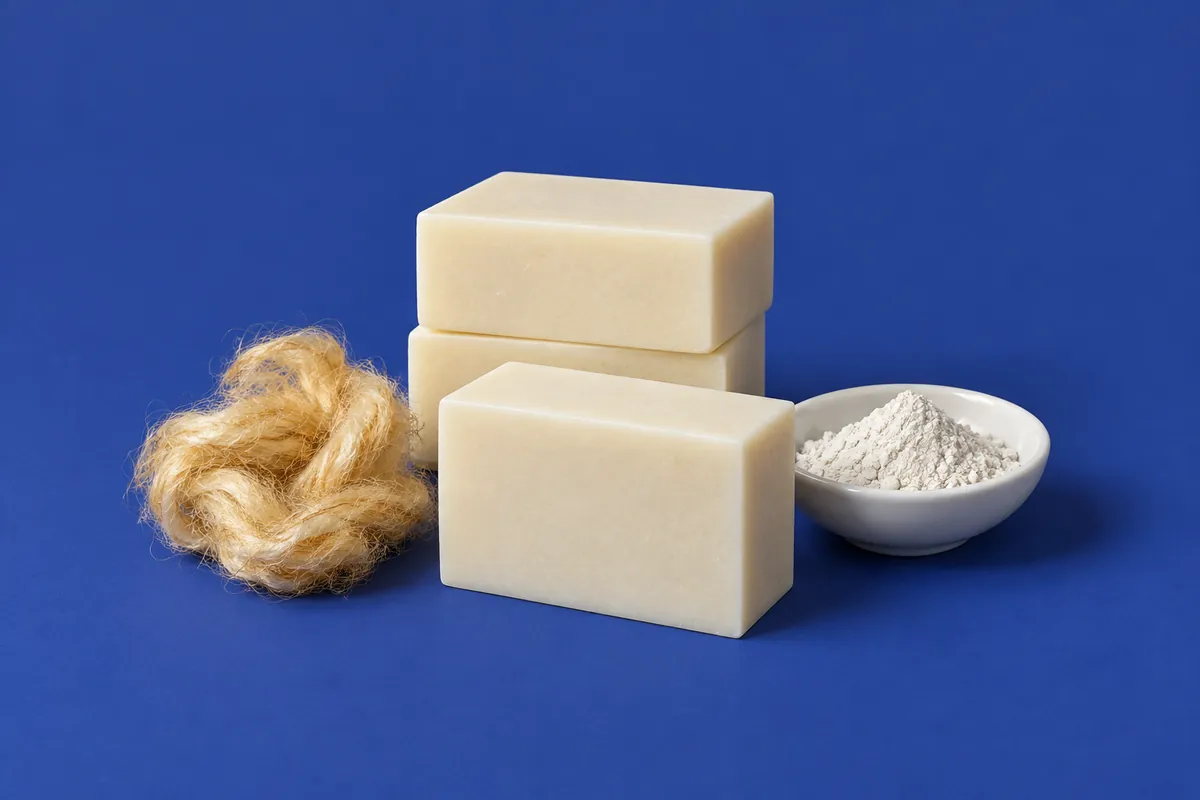
A very mild, unscented face bar: mostly olive oil, with rice bran oil, shea and cocoa butter, a little kaolin clay for slip and a pinch of tussah silk dissolved in the lye. It cures to a pale ivory bar with a fine, creamy lather.
- Skill
- Intermediate
- Method
- Cold process
- Batch
- 1000 g of oils about 1412 g of batter
- Hands-on
- 1 h 15 min
- Cure
- 6 weeks
- Gel phase
- Either way gel or not, both work
What you need
For 1000 g of oils, which fills a 1.5 litre loaf mould. Weigh everything, liquids included.
| Olive Oil · 45.0 % | 450 g | 15.87 oz |
| Coconut Oil · 20.0 % | 200 g | 7.05 oz |
| Rice Bran Oil · 10.0 % | 100 g | 3.53 oz |
| Shea Butter · 10.0 % | 100 g | 3.53 oz |
| Cocoa Butter · 10.0 % | 100 g | 3.53 oz |
| Castor Oil · 5.0 % | 50 g | 1.76 oz |
| Sodium hydroxide (NaOH) · the lye, 100 % pure | 134.1 g | 4.73 oz |
| Distilled water · 256 g for a 34 % lye solution, 16 g set aside | 272.3 g | 9.61 oz |
| Tussah silk fibre · two small pinches, each about the size of a large pea, stirred into the hot lye solution | 0.2 g | 0.01 oz |
| Kaolin clay · 2 tsp, stirred into 16 g of water held back from the recipe's water | 5.5 g | 0.19 oz |
- Superfat
- 7 %
- Temperatures
- Silk into the lye solution while it is still at 77 to 88 °C (170 to 190 °F); oils and lye solution then each at 35 to 40 °C (95 to 104 °F)
Method
-
Get ready
Open a window, put on splash goggles, nitrile gloves and long sleeves, and line or set out a 1.5 litre loaf mould. Pull the silk into two small tufts, each about the size of a large pea, and have a stainless steel spoon and a fine stainless steel sieve to hand. -
Weigh everything
Weigh 200 g coconut oil, 100 g shea butter and 100 g cocoa butter into the pot, and 450 g olive oil, 100 g rice bran oil and 50 g castor oil into a jug. Weigh 272.3 g distilled water into the lye jug and pour 16 g of it into a small cup for the clay, then weigh 134.1 g sodium hydroxide last, into a dry container. -
Make the lye solution
At an open window or under the extractor fan, pour the sodium hydroxide slowly into the water left in the lye jug, never the water onto the lye, and stir until clear. Keep your face out of the vapour: the solution is now at about 77 to 88 °C (170 to 190 °F), which is the heat the silk needs. -
Dissolve the silk
Straight away, drop the silk tufts into the hot lye solution and stir slowly with the steel spoon, keeping your face back, until the fibres dissolve, usually within a few minutes. A few fine threads left over are normal; leave the jug to cool, labelled and out of reach. -
Mix the clay slurry
Stir 2 tsp (5.5 g) kaolin clay into the 16 g of held-back water until smooth and free of lumps. -
Melt the fats
Melt the coconut oil, shea butter and cocoa butter on the lowest heat, then pour in the olive, rice bran and castor oils. Let the oils and the lye solution each come to 35 to 40 °C (95 to 104 °F), with the oils fully clear. -
Blend to light trace
Pour the lye solution into the oils through the sieve, to catch any silk threads, then pulse the stick blender for a few seconds at a time, stirring between pulses. This olive-rich batter traces slowly; stop at light trace, when a drizzle leaves a faint line that sinks back within seconds. -
Add the clay
Whisk in the kaolin slurry by hand, then give two or three short pulses until no streaks remain. -
Pour and cover
Pour into the mould, scraping the pot clean, and tap the mould on the worktop to release air bubbles. Cover it with its lid or a board and leave it for two days; gel or no gel, the bar is the same, though ungelled soap cures a shade paler. -
Clean up
With your gloves still on, wipe the batter off the pot and tools with paper towels into the bin, then wash everything, sieve included, in hot soapy water. -
Unmould and cut
After 48 hours, when the loaf is firm to a pressed finger, put your gloves back on, unmould it and cut it into bars about 2.5 cm (1 in) thick. Olive-rich soap can need a third day; if it smears on the knife, wait. -
Cure
Stand the bars on edge on a rack, a finger's width apart, somewhere dry and out of the sun, for six weeks, turning them every few days.
Tips
- Silk is an animal fibre. Leave it out for a vegan bar and change nothing else: at a pinch it takes no lye and no water.
- Two teaspoons of kaolin follows Lovin Soap's rate of a teaspoon per pound of oils. Here it gives slip rather than colour, and Kelly Cable finds that much more makes a bar feel slimy.
- If silk threads catch on the blender blade, lift the blender out with the motor off and wipe them into the bin; they do the soap no harm.
The oils
| Oil | Share |
|---|---|
| Olive Oil (virgin / refined / olive oil) | 45.0 % |
| Coconut Oil | 20.0 % |
| Rice Bran Oil | 10.0 % |
| Shea Butter | 10.0 % |
| Cocoa Butter (Theobroma Oil) | 10.0 % |
| Castor Oil | 5.0 % |
How it is made
| Process | Cold process |
| Alkali | NaOH |
| Superfat | 7 % |
| Water | lye water at 33 % |
| Iodine value | 63 |
| INS | 139 |
Why make it
A face bar for anyone who wants the mildest soap they can make. With coconut at a fifth of the oils and a 7 % superfat it cleanses at 14 on our scale with a fine, creamy lather, and it is unscented, following the dermatologists' advice to wash the face with a gentle cleanser. Kaolin, the white clay makers reach for in face bars, is used here at a teaspoon per pound of oils for slip rather than colour. Silk dissolved in the lye is an old maker's luxury said to give the lather a silky feel; cosmetic safety reviewers class silk proteins as skin and hair conditioning agents, though no one has measured what a pinch does in soap. It is not a vegan bar, and like any soap it is alkaline, so if your face feels tight, use it less often.
Sources
- Face washing 101 · American Academy of Dermatology
- Safety assessment of silk protein ingredients as used in cosmetics · International Journal of Toxicology, 2020
What tradition, makers' experience and research say about soaps like this, each labelled for what it is. It is not medical advice, and no soap treats a skin condition: if you have one, ask a doctor or pharmacist.
What the numbers say
- Lauric acid 9.8 %
- Myristic acid 3.8 %
- Palmitic acid 12.9 %
- Stearic acid 9.8 %
- Ricinoleic acid 4.4 %
- Oleic acid 45.2 %
- Linoleic acid 10.2 %
- Other 4.5 %
Saturated : unsaturated 39 : 61
Computed from the fatty acids of the fats above. The bands are what the craft has settled on, not chemistry — a bar outside one is not wrong.
From the guides
All guides
Soap additives: salt, sugar, sodium lactate, clays, oats, silk and more
What common soap additives do, how much to use and when they go in: sourced doses for sodium lactate, salt, sugar, honey, citric acid, clays, oats and silk.

Natural colourants: what herbs, clays and spices really do in soap
Clays, charcoal and plant colours in cold-process soap: doses per 500 g of oils, infused oil, powder or lye, and the colour each one actually turns.
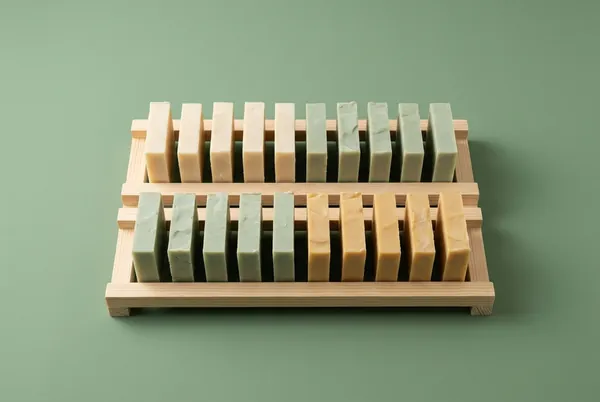
Curing and storing handmade soap
What curing does to cold process soap and what it doesn't, how long it takes, how to set bars up to cure, how to tell when they're done, and how to store them.
Guides with this recipe
Where these proportions come from
Adapted from David Fisher's palm-free base: the same olive oil, coconut oil, rice bran oil, shea butter and cocoa butter, with coconut cut from 30 to 20 %, olive oil in place of his sunflower oil, cocoa butter raised from 5 to 10 % for firmness, a little castor oil added for lather and the superfat set at 7 % for a gentler face bar. The silk goes into the hot lye solution, as Fisher describes.
Formulation adapted from The Complete Photo Guide to Soap Making by David Fisher (Creative Publishing International, 2018). The method and notes are ours.