In short
- Palm oil brings palmitic acid: a hard, slow-wearing bar with a stable, creamy lather. Whatever replaces it has to bring saturated fat of its own.
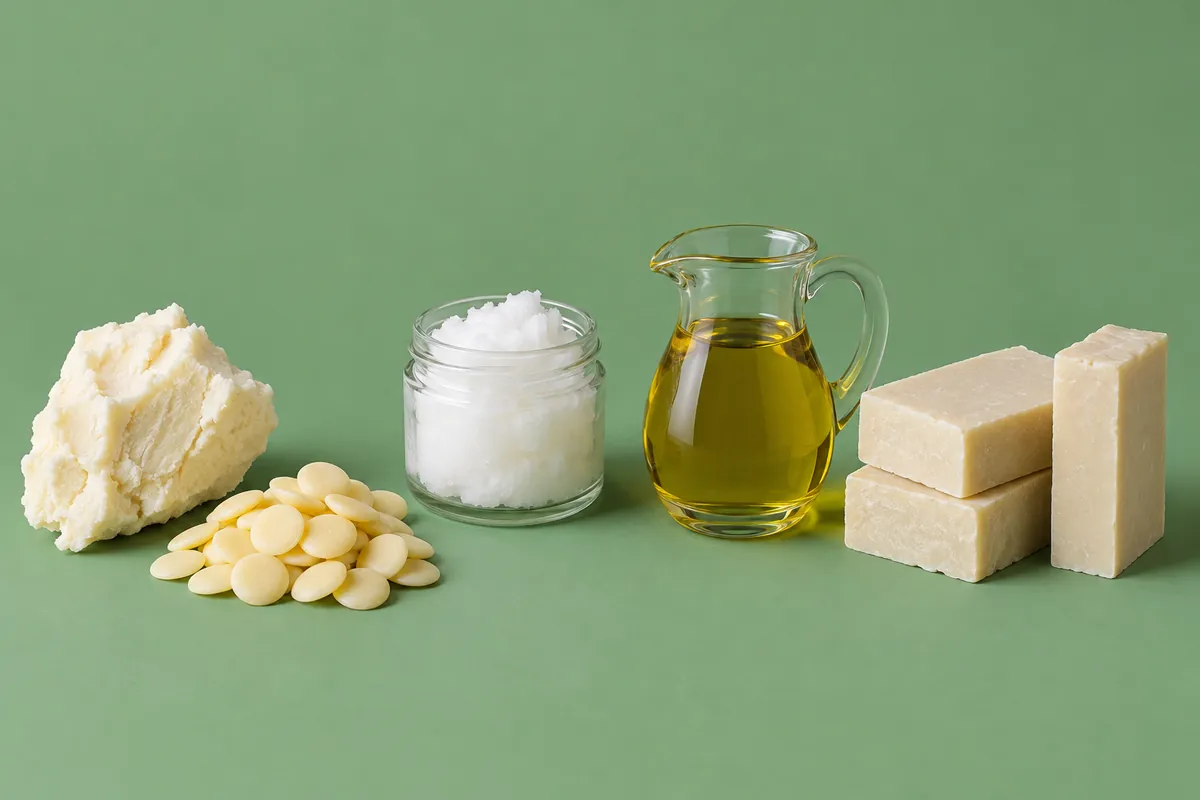
- Lard and tallow are the closest swaps. For a vegan bar, shea, cocoa, kokum and sal butter do the same job, and a little stearic acid firms a soft recipe.
- Leaving palm out and adding nothing still makes good soap: softer out of the mould and slower to cure.
- Unrefined shea can need less lye than the calculator's 183 mg KOH/g, since its standards allow 160–195. At a large share of a crude butter, add a point or two of superfat or use your lot's certificate.
- Palm hides behind other names: Elaeis Guineensis, palmate and palm kernelate all come from the oil palm, and stearic acid often does.
On this page
The most repeated beginner recipe in soapmaking is 40 % olive oil, 30 % coconut and 30 % palm. The palm is the part that makes it firm, mild and slow to wear away. Plenty of makers now leave palm oil out, and leaving it out is easy; the craft is in replacing what it did. This guide shows what palm brings to a bar, what each replacement brings instead, and two palm-free recipes worked through the calculator.
What palm oil does in a bar
Palm oil, pressed from the fruit pulp of the oil palm, is close to half palmitic acid (39.3–47.5 %), two-fifths oleic acid (36–44 %) and about a tenth linoleic (9–12 %). Palmitic acid is a long, straight, saturated chain: its soap packs into a hard bar that dissolves slowly in use and gives a small, dense, stable lather. The oleic acid keeps it mild. On its own, palm scores 50 for hardness and 48 for creamy lather on the soap quality scale, with almost nothing for cleansing.
The easiest way to see its job is to take it out. In the 40/30/30 bar, then in the same bar with the palm replaced by more olive oil:
| 1000 g of oils, 5 % superfat | Hardness | Creamy | Conditioning | Iodine | NaOH |
|---|---|---|---|---|---|
| Olive 40, coconut 30, palm 30 | 45 | 25 | 51 | 52 | 144.1 g |
| Olive 70, coconut 30 | 36 | 15 | 60 | 62 | 142.2 g |
From the calculator, with water at a 33 % lye concentration. The quality numbers are a community convention, a way of adding up fatty acids; they are useful for comparing recipes and blind to texture.
So palm’s contribution to that bar is roughly nine points of hardness and ten of creamy lather, and a lower iodine value, which means fewer double bonds and a bar that keeps better. A replacement has to bring saturated fat, mainly palmitic and stearic acid, and ideally not much linoleic.
Why makers leave it out
Oil palm expansion has been a major driver of tropical deforestation. On Borneo, at least half of all deforestation between 2005 and 2015 was related to oil palm, and the International Union for Conservation of Nature estimates that its expansion could affect more than half of the world’s threatened mammals and birds, the Bornean orangutan among them (IUCN, 2018). The same report makes the awkward counterpoint: oil palm produces about 35 % of the world’s vegetable oil on less than 10 % of the land given to oil crops, up to nine times more oil per hectare than the alternatives, so switching the world to other oils would move the damage rather than end it.
That leaves two reasonable positions. Some makers drop palm; others buy palm certified by the Roundtable on Sustainable Palm Oil (RSPO), a voluntary standard set up in 2004 by WWF, growers, manufacturers and retailers. If you buy certified oil, ask which supply chain it comes through. Under the Identity Preserved and Segregated models, the oil in your tub is certified oil, kept apart from ordinary palm; Mass Balance oil is certified oil mixed with ordinary oil along the chain; and credits pay certified growers without the oil itself reaching you (RSPO). The rest of this guide is for makers who leave palm out.
What replaces it
The fair test is to change one thing: keep 40 % olive and 30 % coconut oil and give the last 30 % to each candidate in turn.
| The last 30 % | Hardness | Creamy | Conditioning | Iodine | INS | NaOH |
|---|---|---|---|---|---|---|
| Palm (for comparison) | 45 | 25 | 51 | 52 | 161 | 144.1 g |
| Lard | 43 | 22 | 52 | 54 | 158 | 143.7 g |
| Tallow | 46 | 24 | 48 | 50 | 161 | 143.4 g |
| Mutton tallow | 48 | 27 | 48 | 48 | 164 | 143.3 g |
| Shea butter | 44 | 24 | 52 | 52 | 156 | 140.8 g |
| Cocoa butter | 49 | 28 | 47 | 48 | 163 | 142.8 g |
| Kokum butter | 48 | 27 | 48 | 47 | 163 | 142.1 g |
| Sal butter | 46 | 26 | 47 | 48 | 161 | 141.7 g |
| Mango butter | 45 | 25 | 49 | 50 | 161 | 142.5 g |
1000 g of oils, 5 % superfat, 33 % lye concentration, from the calculator. The iodine value measures double bonds, so lower means harder and slower to go rancid; INS is the SAP value minus the iodine value, a one-number hardness guide (see iodine value and INS). NaOH is the sodium hydroxide the recipe needs.
On the numbers, almost any saturated fat puts the bar back where palm had it, and every row needs a different amount of lye. What the table cannot show is what separates them in the pot and in the shower: brittleness, cost, animal origin, and how far each one’s published SAP value can be trusted.
Lard
Lard is the cheapest close swap. It has less saturated fat than palm (palmitic 20–30 %, stearic 8–22 %) and more oleic acid, so the bar is a touch softer (43 against 45), and Failor finds lard soap slightly softer than palm or tallow soap in her recipes. It makes a mild, white bar. See lard and tallow.
Tallow
Tallow is the closest match overall, and Failor treats palm oil and tallow as interchangeable in her recipes. Its linoleic acid is low (1–6 %), so it keeps well. Mutton tallow, with 24.3–41.7 % stearic acid, is harder again.
Shea butter
For a vegan bar, shea is the obvious first choice, and Fisher’s own palm-free recipe leans on shea and cocoa butter for its hardness (our kaolin and silk facial bar is built on it). Its hardness comes from stearic acid rather than palmitic, 27.7–55.7 % of the fat depending on where it grew, which is why two shea butters can make noticeably different bars. It also carries 2.4–11.6 % unsaponifiable matter, which stays in the bar as it is.
Watch its SAP value. The standards for unrefined shea allow 160–195 mg KOH/g (Codex) or 160–200 (India), because they cover butters with up to 19 % unsaponifiable matter. Butters that have been measured fall between 179.3 and 190, and the calculator uses 183. With 30 % shea in the bar above, its uncertainty band runs from a 2.1 % to an 8.1 % superfat, narrower than palm’s. A crude butter heavy in unsaponifiables can sit below the measured band, so at 25 % or more of an unrefined butter, raise the superfat to 6 or 7 % or use the SAP value on your supplier’s certificate. The shea and cocoa butter luxury bar uses 30 % shea at a 7 % superfat.
Cocoa butter
Cocoa butter makes the hardest bar in the table (49) and the creamiest lather, being nearly two-thirds saturated. Faiola finds that above about 15 % it can make a bar crack, so split it with shea: 15 % of each in the same bar scores 46 for hardness and 26 for creamy, needing 141.8 g of sodium hydroxide. Unless it is deodorised, it smells of chocolate. The rice bran and avocado bar gets its firmness from 20 % cocoa butter.
Kokum and sal butter
Two Indian seed fats, both rich in stearic acid: kokum about 52 % stearic and 41.5 % oleic, sal 43.7 % stearic, 36.9 % oleic and 8.6 % arachidic. On the numbers they behave much like cocoa butter, without its scent, and the same caution about brittleness is sensible. Our fatty-acid data for each comes from a single analysis (kokum from 1939, sal from 1978), so treat their quality numbers as approximate.
Mango butter
Mango butter looks like a replacement on paper (45 for hardness) but melts lower than cocoa or shea butter, anywhere from 17.6 to 34.3 °C depending on the variety, and Faiola finds it adds little hardness in practice. Use it for feel, not firmness.
Stearic acid
Stearic acid is not a fat but the fatty acid itself, a triple-pressed mixture of about half stearic and half palmitic acid, so gram for gram it is the most concentrated hardener here. To show its strength: five percent in the olive and coconut bar (olive 65, coconut 30, stearic acid 5) lifts hardness from 36 to 40 and creamy lather from 15 to 19, with 142.8 g of sodium hydroxide.
That is ten times the rate Faiola suggests for a hardener, 0.5 % of the oils, and it has two catches. Being a free fatty acid, it reacts with lye at once, so it brings trace on fast: Failor melts it separately and stirs it in after the other oils have traced, and Faiola adds it melted at thin trace, to batter at 57 °C (135 °F) or above. And it is made from palm oil or animal fat (Faiola; Failor), so for a palm-free bar, ask your supplier which.
Sodium lactate
Sodium lactate is not a replacement for anything in the fatty acids. It is the sodium salt of lactic acid, usually sold as a 60 % solution, and it helps a bar firm up and leave the mould sooner; Faiola stirs about a teaspoon per 454 g (1 lb) of oils into the lye solution. It adds nothing to the fatty acids, though, so it cannot give a soft recipe the slow-wearing hardness palm brought. The additives guide has the doses.
Or leave it out
The olive 70, coconut 30 bar in the first table is a good soap. It scores 36 for hardness, inside the convention’s band, and it will be softer out of the mould and take longer to firm up, but it lathers well and cures into a sound bar. If you do not need a hard bar quickly, it is a fine place to stop. The supermarket oils bar does just that with olive, coconut and canola oil, and a little salt and sugar in the water.
Palm under other names
An ingredient list tells you where palm is hiding. Elaeis Guineensis is the oil palm: Elaeis Guineensis Oil is palm oil and Elaeis Guineensis Kernel Oil is palm kernel oil, from the seed of the same fruit, which Fisher notes carries the same environmental concerns. As soap, they appear as Sodium Palmate and Sodium Palm Kernelate, and hydrogenated palm oil and palm stearin are palm too. Stearic acid often is. Check the ingredient list of anything you buy ready-made, melt and pour bases included.
Two palm-free recipes, worked
Both are our own recipes. The figures are for 1000 g of oils at a 5 % superfat, with water at a 33 % lye concentration. For a first batch with a full method and photographs, the first-batch palm-free bar keeps it simpler: olive 60, coconut 25, shea 10 and castor 5.
Palm-free classic
| Oil | % | Grams |
|---|---|---|
| Olive oil | 40 | 400 |
| Coconut oil | 25 | 250 |
| Shea butter | 20 | 200 |
| High-oleic sunflower oil | 10 | 100 |
| Castor oil | 5 | 50 |
| Sodium hydroxide | 138.5 | |
| Water | 281.2 |
Batch weight 1419.6 g before fragrance or additives.
Shea butter takes palm’s place for hardness, high-oleic sunflower oil stands in for some of the olive and keeps well, and castor steadies the lather. It scores 37 for hardness, 17 for cleansing, 60 for conditioning, 21 for bubbly and 24 for creamy lather, with an iodine value of 59. The calculator’s uncertainty band on this recipe runs from a 2.1 % to an 8.0 % superfat; if your shea is unrefined, a 6 % superfat (137.0 g of sodium hydroxide) adds a margin.
Make the palm-free classic. At 1000 g of oils it needs 138.5 g of sodium hydroxide and 281.2 g of water. Change the batch size, the superfat or the shea and the calculator redoes the lye.
Open it in the calculatorThe recipe page has it ready to open, and the method is the ordinary one in your first cold process soap.
Vegan hard bar
| Oil | % | Grams |
|---|---|---|
| Olive oil | 40 | 400 |
| Coconut oil | 25 | 250 |
| Cocoa butter | 20 | 200 |
| Rice bran oil | 10 | 100 |
| Castor oil | 5 | 50 |
| Sodium hydroxide | 139.9 | |
| Water | 284.1 |
Batch weight 1424.0 g before fragrance or additives.
Cocoa butter does the hardening here, and rice bran oil adds a little palmitic acid of its own. It scores 41 for hardness, 17 for cleansing, 55 for conditioning, 22 for bubbly and 28 for creamy lather, with an iodine value of 58, and cocoa butter’s narrow SAP range keeps the uncertainty band at 1.9–8.0 % superfat. Twenty percent cocoa butter is above the 15 % Faiola suggests; if your bars crack or crumble when you cut them, move 5 % of it to shea butter.
Make the vegan hard bar. At 1000 g of oils it needs 139.9 g of sodium hydroxide and 284.1 g of water at a 5 % superfat.
Open it in the calculatorThe recipe page has it ready to open. Like any cold process bar, both want the usual four to six weeks of cure, and the unmoulding guide covers telling when a softer bar is ready to cut.
To take palm out of a recipe you already make, change only the palm and recalculate. The 25er guide does that for Germany’s four-oil beginner soap, fat by fat.
Recipes to try
All recipesSources
- Palm oil and biodiversity (issues brief), drawing on Oil palm and biodiversity: a situation analysis by the IUCN Oil Palm Task Force . International Union for Conservation of Nature (IUCN) , 2018.
- Who we are . Roundtable on Sustainable Palm Oil (RSPO) .
- RSPO supply chains: certification models . Roundtable on Sustainable Palm Oil (RSPO) .
- Standard for Named Vegetable Oils (CXS 210-1999), 2019 revision . Codex Alimentarius Commission (FAO/WHO) , 2019. Palm oil's fatty acids and SAP range.
- Standard for Named Animal Fats (CXS 211-1999), 2015 print . Codex Alimentarius Commission (FAO/WHO) , 2015.
- Triterpene alcohol and fatty acid composition of shea nuts from seven African countries . Akihisa T. et al., Journal of Oleo Science 59(7) , 2010.
- Regional Standard for Unrefined Shea Butter (CXS 325R-2017), amended 2022 . Codex Alimentarius Commission (FAO/WHO) , 2022. Saponification value 160–195 mg KOH/g and unsaponifiable matter 1–19 %.
- Food Safety and Standards Regulations, Chapter 2.2: Fats, oils and fat emulsions (kokum fat, shea butter) . Food Safety and Standards Authority of India , 2025.
- Nutritional studies on refined sal (Shorea robusta) fat . Sundaravalli O.E. et al., Journal of the Oil Technologists' Association of India 10(4) , 1978.
- Stearic acid 50 % (triple pressed), product specification . Wilmar International .
- Soap Crafting . Anne-Marie Faiola, Storey Publishing , 2013. Usage ranges for shea and cocoa butter; stearic acid and sodium lactate rates and handling.
- The Complete Photo Guide to Soap Making . David Fisher, Creative Publishing International , 2018.
- Making Transparent Soap . Catherine Failor, Storey Publishing , 2000. Palm, tallow and lard as interchangeable hard fats; mixing stearic acid without curdling.