Rose clay and rose petal bar
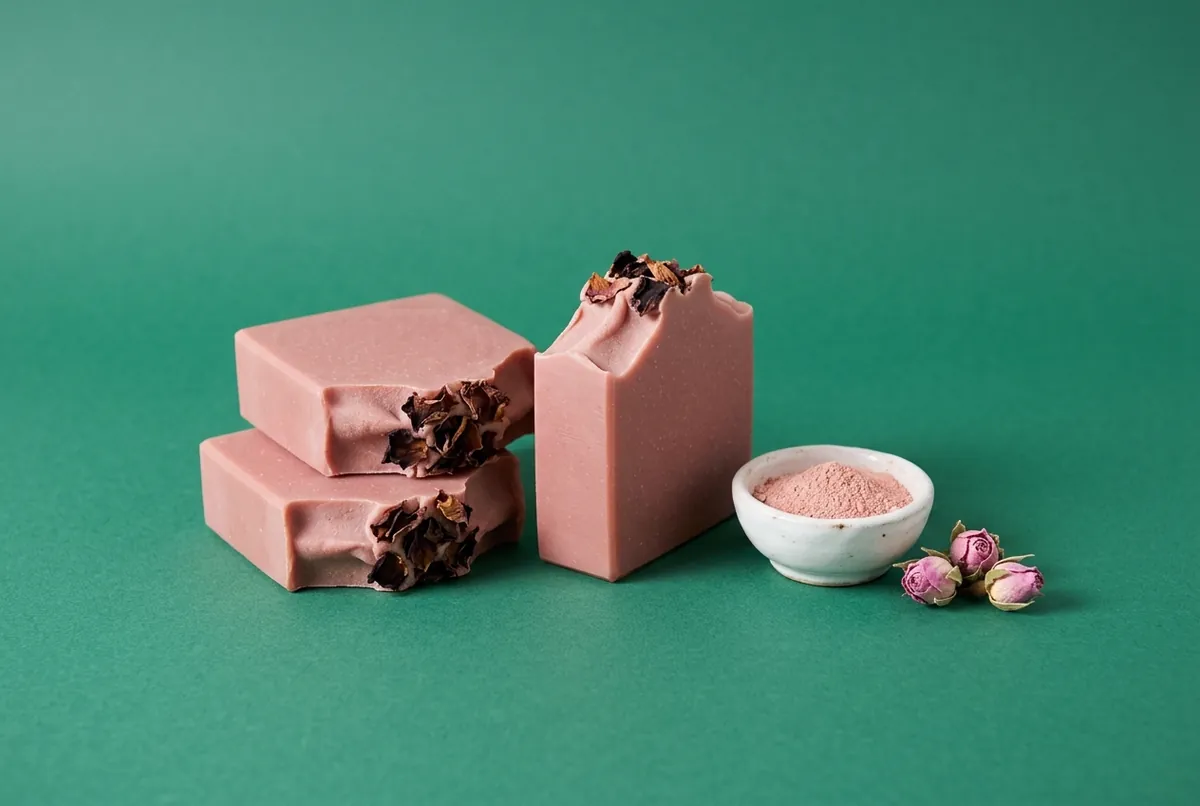
A creamy tallow and olive bar coloured dusty pink with rose clay, scented with rose geranium and finished with a peaked top and dried rose petals. The petals turn dark brown to black in soap, so they are there for texture, not colour.
- Skill
- Beginner
- Method
- Cold process
- Batch
- 1000 g of oils about 1447 g of batter
- Hands-on
- 1 h 10 min
- Cure
- 6 weeks
- Gel phase
- Either way gel or not, both work
What you need
For 1000 g of oils, which fills a 1.5 litre loaf mould. Weigh everything, liquids included.
| Edible Tallow · 30.0 % | 300 g | 10.58 oz |
| Olive Oil · 30.0 % | 300 g | 10.58 oz |
| Coconut Oil · 20.0 % | 200 g | 7.05 oz |
| Avocado Oil · 10.0 % | 100 g | 3.53 oz |
| Shea Butter · 5.0 % | 50 g | 1.76 oz |
| Castor Oil · 5.0 % | 50 g | 1.76 oz |
| Sodium hydroxide (NaOH) · the lye, 100 % pure | 136.6 g | 4.82 oz |
| Distilled water · for a 33 % lye solution | 277.3 g | 9.78 oz |
| Rose clay · 2 tsp, stirred into the warm lye solution | 6.3 g | 0.22 oz |
| Dried rose petals · a small handful, pressed into the peaked top; they turn dark brown to black | 2 g | 0.07 oz |
| Geranium essential oil (rose geranium) · 2.5 % of the oils, at trace | 25 g | 0.88 oz |
- Superfat
- 6 %
- Temperatures
- Oils and lye solution each between 38 and 43 °C (100 and 110 °F)
Method
-
Get ready
Open a window or turn on the extractor fan, send children and pets out, and put on splash goggles, nitrile gloves and long sleeves. Set out a 1.5 litre loaf mould, lined if it is not silicone. -
Weigh everything
Weigh 300 g tallow, 200 g coconut oil and 50 g shea butter into the pot, and 300 g olive oil, 100 g avocado oil and 50 g castor oil into a jug. Weigh 277.3 g of distilled water into the lye jug, 25 g of geranium essential oil into a small cup, and the 136.6 g of sodium hydroxide last, into a dry container. -
Make the lye solution
Where air moves, pour the sodium hydroxide slowly into the water, never the water onto the lye, and stir until it turns clear. Keep your face away from the vapour. -
Stir in the rose clay
While the solution is still warm, stir in 2 teaspoons of rose clay gently until no lumps remain, keeping your goggles and gloves on; it gives a deeper pink this way than added at trace. Leave it to cool, labelled and out of reach. -
Melt the fats
Melt the tallow, coconut oil and shea butter on the lowest heat until just clear, then pour in the olive, avocado and castor oils. -
Check the temperatures
Go on when both the oils and the lye solution are between 38 and 43 °C (100 and 110 °F). Tallow starts to set below that and can thicken the batter before it has traced. -
Blend to light trace
Stir the lye solution so the clay is lifted off the bottom, pour it into the oils down the blender shaft, and pulse and stir until the batter looks like thin custard. -
Add the geranium
Stir in the geranium essential oil by hand, then give it two or three short pulses. -
Pour and texture the top
Pour into the mould and tap it on the worktop to release air. After 10 to 20 minutes, when the top has thickened like soft pudding, pull it up into peaks with the back of a spoon. -
Add the petals
Scatter the dried rose petals over the peaks and press them in lightly with a gloved hand so they stay put. -
Cover and leave
Set an upturned box over the mould so nothing touches the top, and leave it for a day in a warm room. It may gel or not; either is fine. -
Unmould and cut
After 24 to 48 hours, when the loaf is firm, unmould it with gloves on and lay it on its side to cut, so the knife doesn't flatten the peaks or drag petals down the bars. -
Cure
Stand the bars on edge in a dry, airy place for six weeks, turning them every few days.
Tips
- Rose petals darken to brown or black, because lye destroys the pigment that makes them red. On the top they hold their colour a little longer than stirred in, but they still darken; use them for texture, or leave them off for a plain pink top.
- Geranium oil, sold as rose geranium, gives a rosy scent at a fraction of the price of rose oil. Rose oil itself is limited by IFRA to about 0.085 % of a soap, because of its methyl eugenol.
- Rose clay stays pink through the cure. Buy cosmetic-grade clay; some rose clay is kaolin coloured with iron oxide, which the ingredient list should say.
- Tallow is beef fat, so the bar is not vegan. Lard at the same weight works; run it through the calculator again, as the lye changes a little.
The oils
| Oil | Share |
|---|---|
| Edible Tallow (beef/mutton dripping) | 30.0 % |
| Olive Oil (virgin / refined / olive oil) | 30.0 % |
| Coconut Oil | 20.0 % |
| Avocado Oil | 10.0 % |
| Shea Butter | 5.0 % |
| Castor Oil | 5.0 % |
How it is made
| Process | Cold process |
| Alkali | NaOH |
| Superfat | 6 % |
| Water | lye water at 33 % |
| Iodine value | 56 |
| INS | 147 |
Why make it
Tallow and olive oil make a hard, creamy bar, cleansing 15 and conditioning 55 on our scale, with a fifth coconut oil for a steady lather: a good everyday bar for normal to dry skin. People choose it for how it looks and smells. The dusty pink is rose clay, coloured by iron oxides, so it holds through the cure where plant pinks fade, and makers value clay for the slip it gives a bar (Alicia Grosso). Clays have a long place in cosmetics and spa treatments (Carretero 2002), but a bar is rinsed off within a minute, so the clay's part here is colour and feel. The petals are decoration only, since lye turns them dark brown, and the rosy scent is geranium because rose oil itself is limited to a trace in soap. Tallow makes it unsuitable for vegans.
Sources
- Alicia Grosso, The Everything Soapmaking Book, 3rd edition · Adams Media, 2013
- Clay minerals and their beneficial effects upon human health. A review · Applied Clay Science, 2002
What tradition, makers' experience and research say about soaps like this, each labelled for what it is. It is not medical advice, and no soap treats a skin condition: if you have one, ask a doctor or pharmacist.
What the numbers say
- Lauric acid 9.8 %
- Myristic acid 5.0 %
- Palmitic acid 15.2 %
- Stearic acid 10.7 %
- Ricinoleic acid 4.4 %
- Oleic acid 42.2 %
- Linoleic acid 6.9 %
- Other 5.6 %
Saturated : unsaturated 44 : 56
Computed from the fatty acids of the fats above. The bands are what the craft has settled on, not chemistry — a bar outside one is not wrong.
From the guides
All guides
Natural colourants: what herbs, clays and spices really do in soap
Clays, charcoal and plant colours in cold-process soap: doses per 500 g of oils, infused oil, powder or lye, and the colour each one actually turns.
Herbs, flowers and infusions in soap
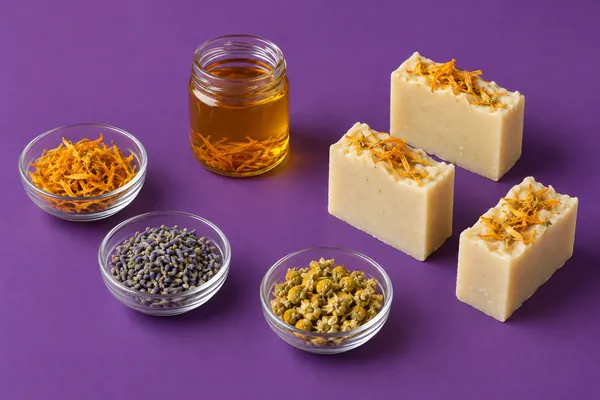
What dried herbs, petals, infused oils and herbal teas really do in soap: which survive lye, how to infuse an oil, and which claims a herbal soap can make.
Lard and tallow: soaping with animal fats
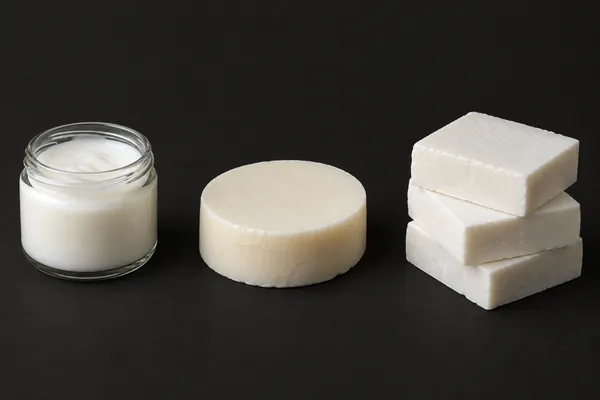
Why lard and tallow make hard, mild, creamy soap, how to render and store them at home, how beef, mutton and pork fat differ, and classic recipes.
Guides with this recipe
Where these proportions come from
Adapted from Kelly Cable's tallow and olive rose soap, with the coconut cut from 28 to 20 % and a little shea and castor added, at a 6 % superfat. The rose clay goes into the warm lye solution, as David Fisher does for a deeper pink, and geranium stands in for rose oil, which IFRA limits to a trace in soap.
Formulation adapted from The Natural Soap Making Book for Beginners by Kelly Cable (Althea Press, 2017); The Complete Photo Guide to Soap Making by David Fisher (Creative Publishing International, 2018). The method and notes are ours.