In short
- Lye turns most petals brown or black. Calendula is the common flower that keeps its yellow: its colour is a carotenoid, not one of the anthocyanins that break down above pH 7.
- Herbs don't scent soap. 10 g of dried lavender flowers holds a tenth to a third of a millilitre of oil; the scent comes from essential oils.
- Use dried herbs, never fresh: fresh plant pieces hold water, brown and can grow mould in the bar.
- An infused oil is still the oil it started as. Weigh it after straining and enter it in the calculator as that oil.
- Claim that a herbal soap heals or treats the skin and, in the US and the EU, it is regulated as a drug or a medicine.
On this page
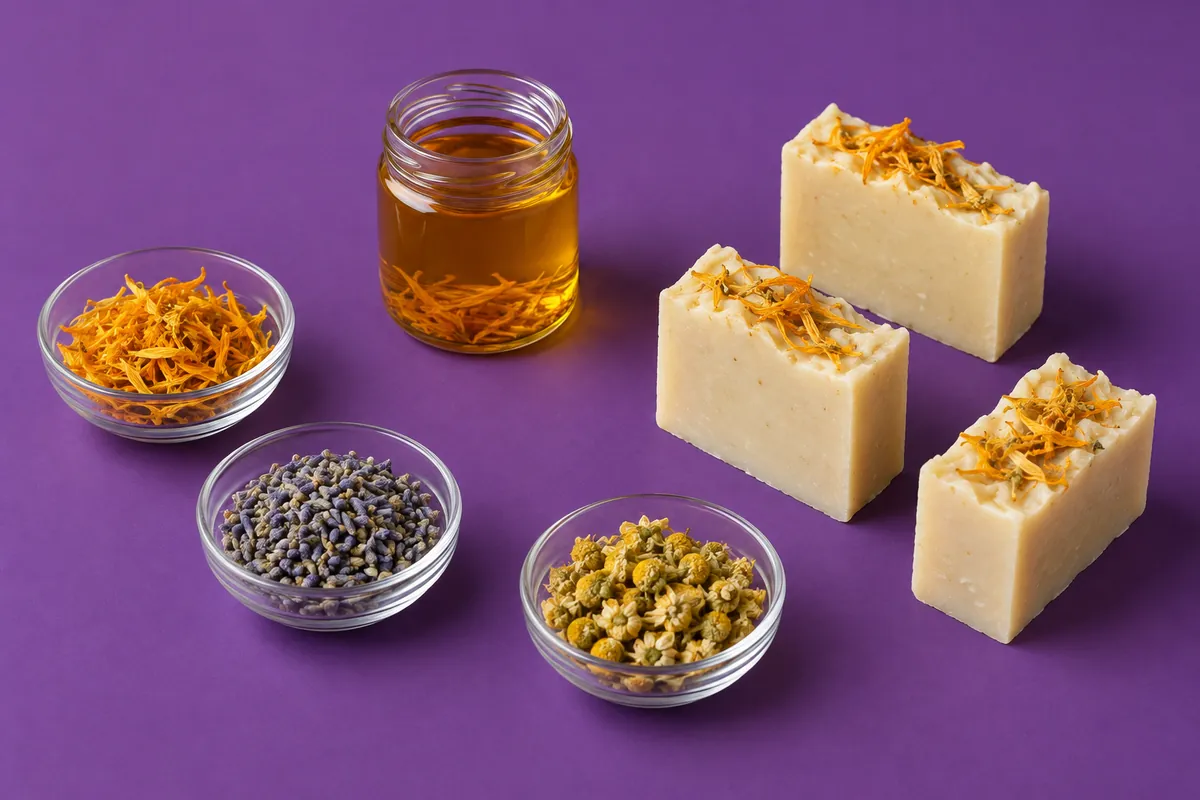
Soap batter is a strong alkali, and most plant material comes out of it changed. Petals darken, and the scent a herb had in the jar is mostly gone by the time the bar is cut. That doesn’t make herbs useless in soap. It means choosing them for what survives: some colour, a scattering of texture, and a bar that looks like what it is made of. This guide covers dried herbs and petals, oils infused with them, and herbal teas used as the liquid. Plants used purely for colour, such as madder and indigo, are in natural colourants.
What lye does to petals and leaves
The reds, pinks, purples and blues of most flowers and berries come from anthocyanins, pigments that change colour with pH and break down above pH 7 (Enaru et al., 2021). Soap is well above that. Rose petals turn black in cold-process soap and lavender buds turn brown; whole lavender buds end up looking, as Fisher puts it, like mouse droppings. Even flowers without those pigments, such as chamomile, brown. Calendula is the exception makers keep reporting: its petals stay yellow to orange (Letcavage and Harden; Fisher). Its colour belongs to a different family of pigments, carotenoids, mostly lutein and zeaxanthin (European Medicines Agency), the same family as the orange in carrots.
| Botanical | In cold-process soap | Where it works better |
|---|---|---|
| Calendula petals | Stay yellow to orange | Stirred in at trace or pressed on top |
| Lavender buds | Turn brown; whole buds look like specks of dirt | Ground fine, or in rebatched and melt-and-pour soap |
| Rose petals | Turn black | Rebatched and melt-and-pour soap |
| Chamomile flowers | Turn brown | As a tea for the liquid |
| Mint and other fresh leaves | Bleed brown into the soap around them | Steeped as a tea first |
| Steeped tea leaves | Brown flecks | Kept back from brewing the tea, stirred in at trace |
From Fisher, Letcavage and Harden, and Watson. Rebatched and melt-and-pour soap is already saponified, so petals added to it meet no fresh lye.
For amounts, Fisher starts at 1–2 teaspoons of dried petals or ground herb per pound of oils, and the herbal recipes in The Natural Soap Chef use half a teaspoon to a teaspoon of dried rosemary, ginger or peel in a batch of 566 g of oils. More is not better: dried plant matter is scratchy in quantity, and every piece is a spot that can brown. Add herbs at light to medium trace, when the batter is thick enough to hold them up, or press a few petals into the top after pouring, as the lavender and calendula bar does with calendula. The rose petal and rose clay bar presses rose petals into its top knowing they will darken. Cut a loaf with petals on top on its side, so the knife does not drag them down through the bar (Faiola).
Anne L. Watson’s advice is plain: some plant materials “don’t come out of a lye bath as pretty as they went in”, so try a small batch before committing a loaf, and keep the fragile ones for rebatching or melt and pour. Grosso finds herbs keep their colour longest in soap balls pressed by hand from moistened shreds, with no melting at all, though even there they brown in the end.
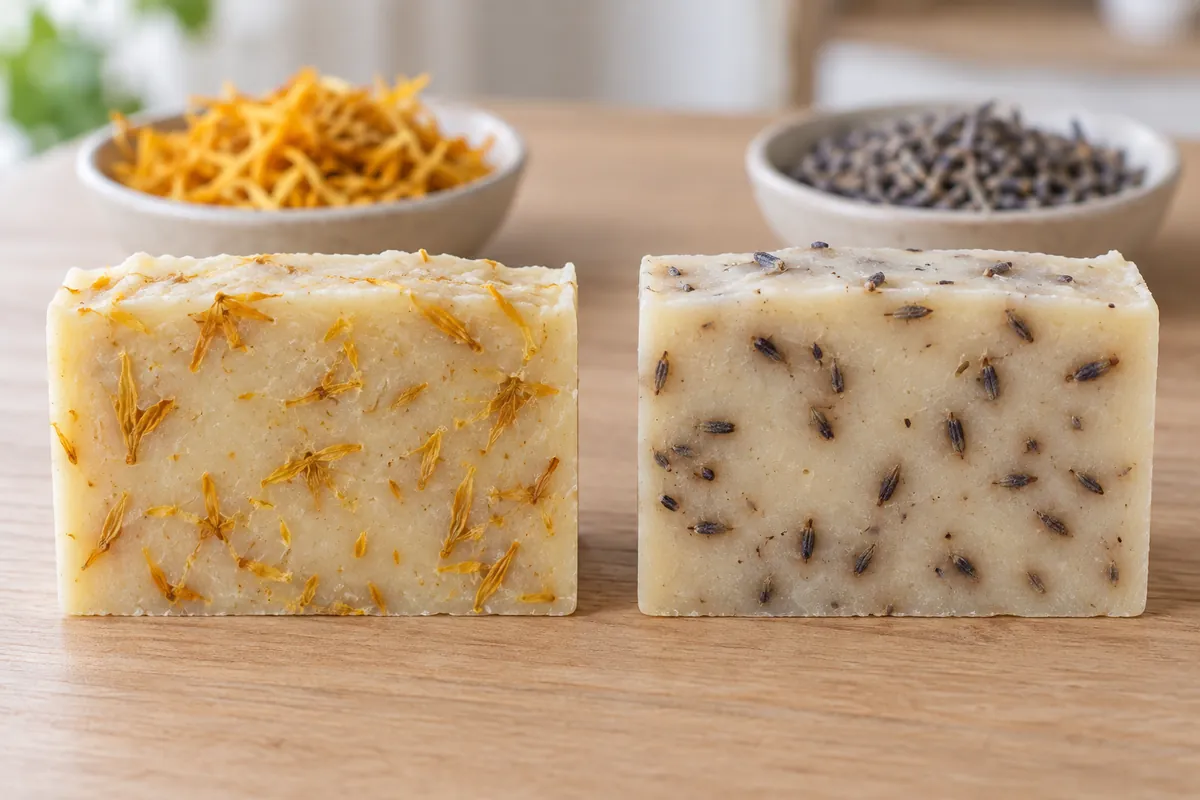 Calendula petals (left) keep their colour in cold-process soap; lavender buds (right) turn brown.
Herbs don’t scent soap
Dried lavender smells strong in the bag, so it is natural to expect a lavender-scented bar. The numbers say otherwise. Lavender flowers of pharmacopoeia quality hold at least 13 mL of essential oil per kilo, and typically 1–3 % (European Medicines Agency). A generous 10 g of buds in a batch therefore brings between a tenth and a third of a millilitre of lavender oil. The calculator’s usual starting point for scent is 3 % of the oils, which for 1000 g of oils is 30 g of essential oil: at least a hundred times more. And what little the buds do carry still has to survive the heat of saponification and weeks of curing.
So scent the soap with essential oil and use the herb for looks. The scenting guide covers how much essential oil a bar can safely carry.
Dried, not fresh
Fresh leaves and petals are mostly water, and water held in a piece of plant is the same problem as a lump of fruit purée or damp coffee grounds in a bar: it browns and can grow mould (Lovely Greens; Scientific Reports, 2021). Use herbs that are fully dry.
To dry your own, Letcavage and Harden cut healthy, unsprayed stems in the morning, rinse them briefly, and dry them on a screen in an airy spot out of the sun for a few days to a week, until the leaves crumble. Strip the leaves, store them airtight and grind them only when you need them. If you buy dried herbs, buy them sold for food or cosmetic use rather than for crafts or potpourri.
Infused oils
An infused oil carries a plant’s colour into the soap without the specks. Steep a dried herb or seed in oil, strain it, and the oil comes out tinted; use it in place of the same weight of plain oil. Lovin Soap’s paprika soap shows the difference: stirred in as a powder, paprika speckles, but “if you infuse your oils and strain, then your soap will be nice and smooth”. Calendula gives a golden oil, annatto a strong orange, and alkanet a purple that shifts towards blue in soap. Our lavender and calendula bar, chamomile bar and sage and citrus bar each infuse 3 to 8 g of dried flowers or leaf in 280 g of their olive oil, and the nettle and rosemary bar 15 g of nettle powder in 500 g.
- Weigh out more oil than you need. The herb soaks some up and keeps it. Faiola infuses 298 g (10.5 oz) of oil and uses 284 g (10 oz) of it; Corley Barto infuses 130 g of olive oil to use 113 g.
- Add the dried herb. Faiola uses 8.5 g (0.3 oz) of dried calendula petals in that 298 g of oil. Cable puts a heaping tablespoon of herb powder or seeds in an 8 oz (240 mL) jar and fills it with oil, and Bramble Berry uses a teaspoon of annatto seed per 454 g (16 oz) of oil.
- Warm it gently, or give it time. Faiola holds the oil on low heat in a double boiler for 1–4 hours; Corley Barto uses a slow cooker on low. Keep it warm, not hot: in Pure Soapmaking Faiola aims for about 49 °C (120 °F) and finds that above 54–60 °C (130–140 °F) the herbs burn and turn the oil brown. Heat oil only over water or in a slow cooker, never over a direct flame, and don’t leave it unattended. Without heat, Cable seals the jar and leaves it on a windowsill for six weeks, shaking it now and then; check it each week for mould or for condensation under the lid. For a fast colour, Letcavage and Harden microwave 2 tablespoons of oil with a tablespoon of annatto seed in two 20-second bursts.
- Strain it well. Pour it through cheesecloth or a coffee filter until no particles are left, because bits of plant in the oil become bits of plant in the bar.
- Weigh what you have. Use that weight in the recipe as the oil it was made from, and top up with plain oil of the same kind if you are short.
Keep infused oil in the fridge and use it within six months. Vitamin E or rosemary extract slows rancidity but does not stop mould (Faiola). Herbal extracts made in oil or water can go in at thin trace; alcohol-based ones, such as tinctures and baking extracts, can react badly in soap and are best left out (Faiola).
In the calculator, enter an infused olive oil as olive oil: the herb is strained out and adds nothing to the lye. The calculator’s colour infusions work the same way. Add annatto, paprika or alkanet set to go in with the oils and it treats them as infused and strained, so they count towards no total.
Infuse for colour. A teaspoon of annatto seed per pound of oils, infused and strained, leaves the lye at 138.5 g and the batch at 1419.6 g.
Open it in the calculatorAn infused oil is still an ingredient of the soap. On an EU or UK label it appears as the oil and the plant extract, for example Calendula Officinalis Flower Extract; the labelling guide has the rules.
Herbal teas as the liquid
A strong tea can replace some or all of the recipe’s water. Corley Barto’s method is simple: steep two tea bags in 250 g of boiling distilled water until the tea is very dark, strain it, chill it and use the 215 g her recipe needs, keeping the strained leaves to stir in at trace for flecks. Steeped leaves are the ones to use: unsteeped leaves bleed colour into the bar (Fisher). Grosso brews loose herbs at 2 tablespoons per cup (237 ml) of the recipe’s water, lets the tea cool completely, strains it and tops it back up with water to make good what evaporated. The chamomile bar uses chamomile tea, strained and chilled, as all of its water.
Expect colour. Lye darkens tea: green tea turns brownish (Faiola) and black tea a very dark brown (Soap Queen). Caffeine-free herbal teas keep a little more of theirs, rooibos going red-brown (Faiola, Pure Soapmaking). The fumes are strong as the lye goes in (Corley Barto), so mix it where air moves. Tea is almost all water, and the calculator counts it as such; the liquids guide covers chilling, adding the lye and the numbers.
The antioxidants that make green tea interesting in a cup do not reach the bar in a useful form: tea catechins degrade as temperature and pH rise (Su et al.), and a fresh lye solution is both hot and far above neutral.
What a herbal soap can claim
Calendula shows where the line is. The European Medicines Agency’s herbal committee recognises calendula flower as a traditional herbal medicine for minor inflammation of the skin, used in ointments and compresses. Put calendula petals in a soap and write “calms eczema” or “heals minor burns” on the label, and in the EU the soap is “presented as having properties for treating or preventing disease”, which makes it a medicinal product (Directive 2001/83/EC). In the US, a soap intended to treat skin conditions such as acne or eczema is a drug (FDA). Even as a cosmetic, a label may not imply that a product does things it does not do (Regulation 1223/2009, Article 20).
There is a plain scientific reason to leave such claims off, too. A bar is on the skin for seconds, and whatever active compounds a herb had have been through lye first. What you can say honestly is what you can see and smell: “made with calendula petals”, “coloured with annatto-infused olive oil”, “scented with lavender essential oil”.
Recipes to try
All recipesSources
- Natural Soap Making . Elizabeth Letcavage and Melissa Harden, Stackpole Books , 2013. Calendula keeps its colour; drying herbs; the microwave infusion.
- The Complete Photo Guide to Soap Making . David Fisher, Creative Publishing International , 2018. Which petals and leaves brown or blacken in cold process; 1–2 teaspoons per pound as a start.
- Soap Crafting . Anne-Marie Faiola, Storey , 2013. Calendula-infused oil in a double boiler for 1–4 hours; green tea as the lye liquid.
- Pure Soapmaking . Anne-Marie Faiola, Storey Publishing , 2016. Oil infusions kept near 49 °C and below 54–60 °C; cold jars checked weekly; infused oils refrigerated and used within six months; antioxidants no preservative; no alcohol-based extracts; herbal tea colours; topped loaves cut on their side.
- The Everything Soapmaking Book, 3rd edition . Alicia Grosso, Adams Media , 2013. Herb teas at 2 tablespoons per cup of water, cooled, strained and topped up; herbs keeping their colour longest in hand-pressed soap balls.
- The Natural Soap Making Book for Beginners . Kelly Cable, Althea Press , 2017. Hot and cold (six-week) oil infusions.
- The Natural Soap Chef . Heidi Corley Barto, Ulysses Press , 2012. Infused olive oils strained and swapped in for plain oil; strong teas brewed, strained and chilled.
- Smart Soapmaking . Anne L. Watson, Shepard Publications , 2013. Lavender buds suggested for rebatching rather than raw lye.
- Assessment report on Lavandula angustifolia Miller, aetheroleum and flos (EMA/HMPC/143183/2010) . European Medicines Agency, Committee on Herbal Medicinal Products , 2012. Lavender flower contains not less than 13 mL/kg of essential oil, typically 1–3 %.
- Assessment report on Calendula officinalis L., flos (EMA/HMPC/603409/2017) . European Medicines Agency, Committee on Herbal Medicinal Products , 2018. Carotenoids up to 4.7 %, mostly lutein and zeaxanthin; traditional use for minor skin inflammation.
- Anthocyanins: Factors Affecting Their Stability and Degradation . B. Enaru et al., Antioxidants 10(12) , 2021.
- Stability of tea catechins and theaflavins . Su et al. .
- Spent coffee grounds and microbial growth . Scientific Reports 11 , 2021.
- Paprika lime cold process soap . Lovin Soap .
- Natural carrot soap . Lovely Greens .
- Annatto seed . Bramble Berry .
- Black tea cold process soap . Soap Queen .
- Frequently Asked Questions on Soap . US Food and Drug Administration .
- Directive 2001/83/EC on medicinal products for human use, Article 1(2) . European Parliament and Council , 2001.
- Regulation (EC) No 1223/2009 on cosmetic products, Article 20 . European Parliament and Council , 2009.