Shaving croap
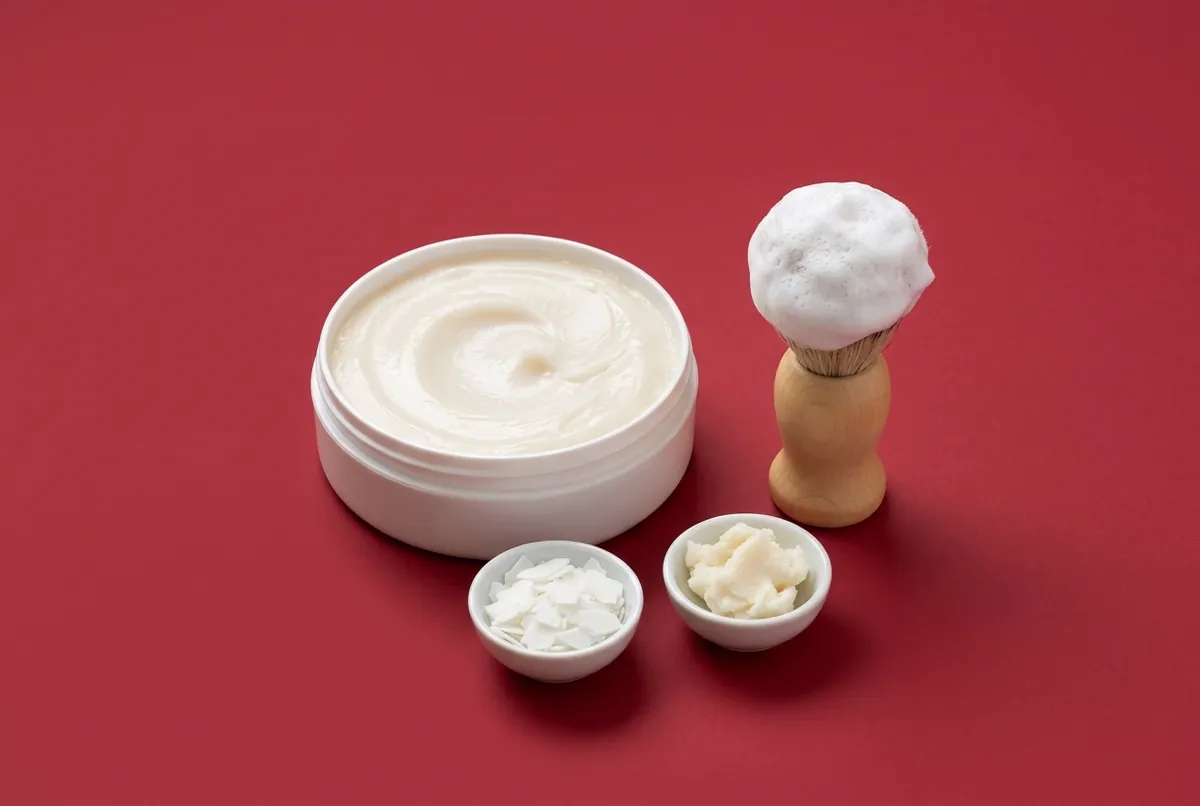
A soft shaving soap for a tub, halfway between a puck and a cream: half the oils are stearic acid for a dense, cushioning lather, and potassium hydroxide does 60 % of the saponification, so a damp brush loads in a few swirls. Unscented, with glycerin stirred in after the cook.
- Skill
- Advanced
- Method
- Hot process
- Batch
- 500 g of oils about 876 g of batter
- Hands-on
- 1 h 30 min
- Cure
- 4 weeks
- Gel phase
- In the pot it gels as it cooks
What you need
For 500 g of oils, which fills four wide shaving tubs holding about 200 g each. Weigh everything, liquids included.
| Stearic Acid · 50.0 % | 250 g | 8.82 oz |
| Coconut Oil · 20.0 % | 100 g | 3.53 oz |
| Shea Butter · 15.0 % | 75 g | 2.65 oz |
| Castor Oil · 10.0 % | 50 g | 1.76 oz |
| Olive Oil · 5.0 % | 25 g | 0.88 oz |
| Sodium hydroxide (NaOH) · the lye, 100 % pure | 28.8 g | 1.02 oz |
| Potassium hydroxide (KOH) · the lye, 90 % pure; if your label says otherwise, weigh 71.4 g at 85 % or 63.9 g at 95 % | 67.4 g | 2.38 oz |
| Distilled water · for a 28 % lye solution | 250.0 g | 8.82 oz |
| Glycerin · stirred into the hot soap after the cook | 30 g | 1.06 oz |
- Superfat
- 4 %
- Temperatures
- Fats held above 60 °C (140 °F) so the stearic acid stays melted, lye solution cooled below 82 °C (180 °F), cooked on low
Method
-
Get ready
Put on splash goggles, gloves and long sleeves, and keep them on until the croap is in its tubs. Weigh 250 g stearic acid, 100 g coconut oil and 75 g shea butter into a slow cooker, 50 g castor oil and 25 g olive oil into a jug, 250 g distilled water into a heat-proof jug, and 28.8 g sodium hydroxide and 67.4 g potassium hydroxide flakes into two dry containers; close the flake tub at once. -
Make the lye solution
At an open window, stir the sodium hydroxide and then the potassium hydroxide into the water a little at a time, always lye into water. Potassium hydroxide fizzes loudly and the solution gets very hot; keep it away from aluminium and let it cool below 82 °C (180 °F) while you melt the fats. -
Melt the fats hot
Melt the stearic acid, coconut oil and shea butter in the slow cooker on high, stir in the castor and olive oils, and turn the cooker to low. Half of this fat is stearic acid, which sets at about 55 °C (131 °F), so hold the blend above 60 °C (140 °F). -
Pour in the lye
Pour the lye solution into the fats in one steady stream, stirring hard with a sturdy spatula. The batter turns milky and thickens to a paste almost at once as the stearic acid becomes soap. -
Work it smooth
Break the paste up with short bursts of the stick blender and the spatula until it is even and no liquid lye pools in the pot. With more water and more potassium than a puck, it stays softer and stickier, like thick, heavy cream cheese. -
Cook it through
Cover and cook on low for about an hour, folding it over every 15 to 20 minutes and scraping the edges back into the middle, and stirring it down if it puffs up. -
Check it is done
It is ready when it is glossy and translucent right through, like petroleum jelly, with no opaque white streaks when you fold it. If you have phenolphthalein, a drop on a smear should turn only a faint, slow pink; a vivid magenta at once means another 20 to 30 minutes. -
Stir in the glycerin
Turn off the cooker and stir the 30 g of glycerin through the hot soap until it disappears. It loosens the croap a little, which makes the tubs easier to fill. -
Fill the tubs
Spoon the hot croap into four wide tubs, pressing each spoonful down to push out air and tapping the tub on the bench, and smooth the tops with the back of a spoon. -
Let it firm
Leave the tubs open somewhere airy for four weeks, then put the lids on. It firms to a dense, soft soap that holds its shape but takes the print of a fingernail, and it loses a little water and weight as it goes. -
Load the brush
To use it, wet the brush, shake it out and swirl it on the croap for ten seconds or so; it loads far faster than a hard puck. Build the lather in a bowl or on your face, adding water a few drops at a time.
Tips
- Potassium hydroxide does 60 % of the saponification, so its purity matters more here than in a puck. The recipe assumes 90 % flakes; with 95 % flakes the same weight takes the superfat from 4 % to about 0.8 %, so enter the figure on your label in the calculator before you weigh.
- Keep the superfat at 4 %. At 2 % the spread of published saponification values for these oils could leave the croap with a trace of free lye, and it goes on freshly shaved skin.
- If it comes out softer than you like, lower the potassium share in the calculator for the next batch, towards the 40 % of our shaving soap puck; for something softer still, to scoop by hand, see the cream soap. Both lyes change when you do.
- To scent it, stir essential oil into the hot soap after the glycerin, once it is below about 82 °C (180 °F), at 2 to 3 % of the oils, and check any oil with an IFRA limit in the calculator first.
The oils
| Oil | Share |
|---|---|
| Stearic Acid (triple-pressed, ~50:50 C16/C18) | 50.0 % |
| Coconut Oil | 20.0 % |
| Shea Butter | 15.0 % |
| Castor Oil | 10.0 % |
| Olive Oil (virgin / refined / olive oil) | 5.0 % |
How it is made
| Process | Hot process |
| Alkali | NaOH + KOH |
| Superfat | 4 % |
| Water | 50 % of the oils |
| Iodine value | 23 |
| INS | 188 |
Why make it
A croap sits between a puck and a cream. Half its oils are stearic acid and potassium hydroxide does 60 % of the saponification, so it stays soft enough to load a damp brush in a few swirls yet holds its shape in a tub. On our scale it scores 69 for creamy lather and 15 for cleansing: a dense, cushioning lather that does not strip. Glycerin goes back in because free stearic acid makes none. Wet shavers who find hard pucks slow to load often choose a croap, a preference that rests on experience rather than trials. It is left unscented, in line with the American Academy of Dermatology's advice to look for fragrance-free products, and shaving creams made for sensitive skin, if your skin is dry or sensitive. The price of softness is that it wears down faster than a puck.
Sources
- Dermatologists' top tips for relieving dry skin · American Academy of Dermatology
- Hair removal: How to shave · American Academy of Dermatology
What tradition, makers' experience and research say about soaps like this, each labelled for what it is. It is not medical advice, and no soap treats a skin condition: if you have one, ask a doctor or pharmacist.
What the numbers say
- Lauric acid 9.8 %
- Myristic acid 4.8 %
- Palmitic acid 26.7 %
- Stearic acid 33.2 %
- Ricinoleic acid 8.9 %
- Oleic acid 12.7 %
- Linoleic acid 3.1 %
- Other 3.2 %
Saturated : unsaturated 76 : 24
Computed from the fatty acids of the fats above. The bands are what the craft has settled on, not chemistry — a bar outside one is not wrong.
Try it differently
6 variationsThe same soap with one thing moved. Each opens in the calculator ready to change again.
From the guides
All guides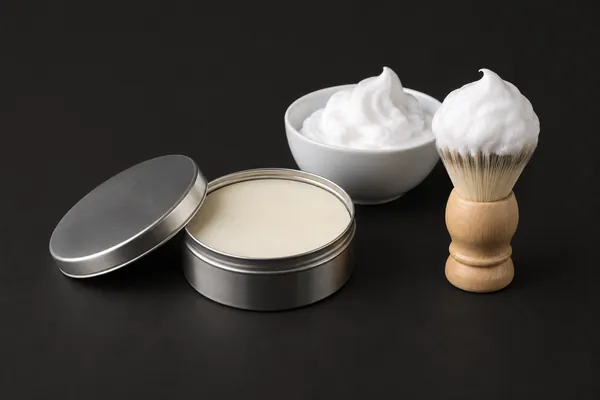
Shaving soap: stearic acid, dual lye and a dense lather
How shaving soap differs from a body bar: stearic acid for a dense, lasting lather, NaOH and KOH for a firm puck that loads fast, and hot process into tins.
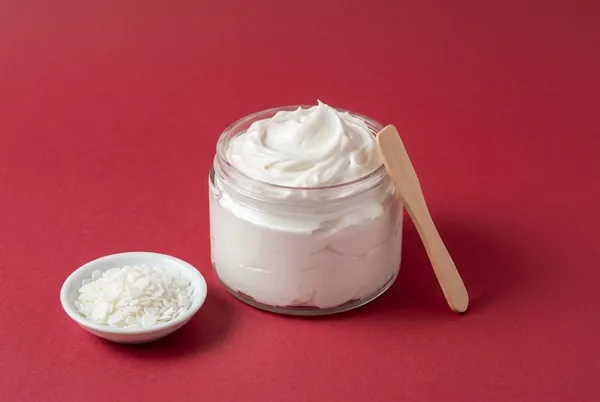
Cream soap and soft soaps
Cream soap explained: stearic acid, mostly potassium lye, a long cook and a whip, and why it turns pearly as it rests. Plus savon noir and the old potash soft soaps.
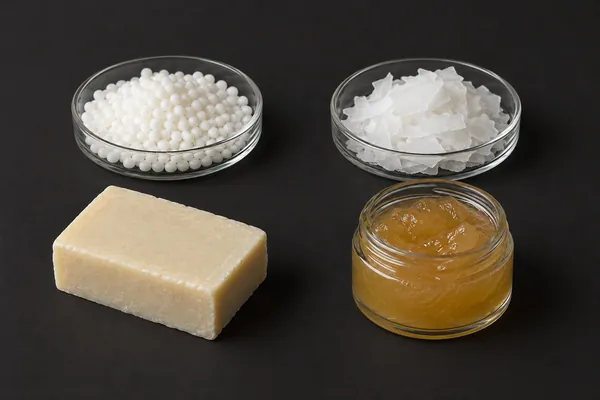
Sodium hydroxide, potassium hydroxide and dual lye explained
Why NaOH makes bars and KOH makes soft soap, converting between them, KOH purity, dual-lye recipes, and the calculator slip that turns a bar caustic.
Where these proportions come from
Craft convention: a softer, higher-stearic shaving soap between a hard puck and a cream, at the top of the usual 30 to 50 % stearic range. Potassium hydroxide does 60 % of the saponification, our choice for a soft puck, between Thomssen's cold-made shaving soap (Soap-Making Manual, 1922, about 45 %) and the 74 to 83 % of published shaving creams (Keithler, 1955; Harry's Cosmeticology). The superfat is 4 % rather than 2 % so that the published saponification ranges of these oils cannot leave it lye-heavy. It is cooked as our shaving soap guide teaches, with glycerin stirred in after the cook because free stearic acid makes none.