In short
- Cream soap is mostly stearic acid soap, made mainly with potassium hydroxide and a little sodium hydroxide, then cooked, rested and whipped.
- Stearic acid is a free fatty acid: lye neutralises it at once and it releases water rather than glycerin, which is why cream soap recipes add glycerin.
- The potassium share of the lye sets how soft it stays. Fisher's cream soap works out at about 75 % potassium and a 5 % superfat in our calculator.
- Its pearly look comes from fatty-acid crystals that form as it rests, so judge the texture after it has settled, not on the day you make it.
- Boric acid, which some recipes whip in, is prohibited in cosmetics in the EU and Great Britain; a little free stearic acid does much the same job.
- Soft soaps such as savon noir are potash soaps of liquid oils: pastes rather than creams.
On this page
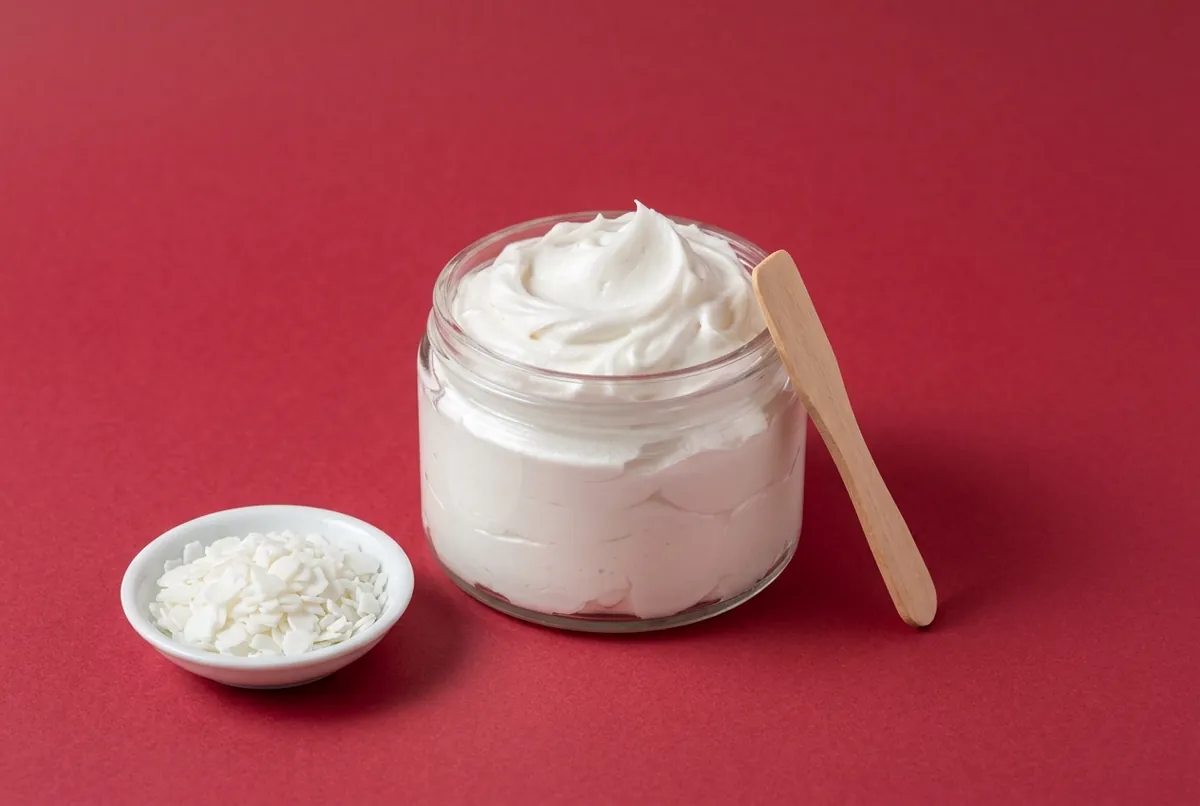
Cream soap sits between liquid soap and a bar. Fisher describes his as firm but scoopable, a little heavier than whipped cream, and good as a body wash or a shaving soap. It is soap through and through, made from three things in unusual proportions: a fat charge dominated by stearic acid, a lye that is mostly potassium hydroxide with a little sodium hydroxide, and a great deal of water and glycerin. It is cooked like hot process soap, left to rest, and whipped.
It belongs to an old family. Simmons and Appleton’s 1908 shaving soaps blended soda and potash soap for a quick, creamy, lasting lather. Thomssen’s 1922 manual gives factory shaving creams made from stearic acid and coconut oil with potash lye and glycerine, and describes the vanishing cream of his day, a stearate skin cream, as simply a soft soap. The shaving soap guide covers the firmer end of the same chemistry, and our shaving croap sits between the two.
The chemistry that makes it work
Stearic acid is already an acid
Most soap fats are triglycerides, three fatty acids held on a glycerol backbone that the lye has to cut free, releasing glycerin as it goes. Commercial stearic acid is different. It is roughly half stearic and half palmitic acid, and its acid value of 205–211 mg KOH/g sits inside a saponification value of 206–212, which means it is practically all free fatty acid. The lye does not saponify it but neutralises it, at once, and the by-product is water rather than glycerin. Thomssen drew the same line in 1922: combining lye with a free fatty acid is neutralisation, not saponification.
Two practical consequences follow. Stearic acid stiffens a batter within moments of the lye going in, so it is melted first and the batch is worked hot. And a soap made half from stearic acid carries only about half the glycerin of an ordinary soap, which is why cream soap recipes add glycerin back: Fisher’s uses 156 g for 538.5 g of fats. His ingredient list includes it, but his steps never say when it goes in. Thomssen put the glycerine in with the oils at the start, which is the simplest place for it; Grosso dissolves hers in the lye water.
Where the pearly look comes from
Freshly cooked cream soap is dense, glossy and translucent. It turns white, fluffy and pearly when it is whipped and as it rests, and the reason is crystals. A Unilever study of a closely related cream, triethanolamine stearate with extra stearic acid, found that the hot mixture forms a liquid crystal, and that as it stands after cooling, part of the soap slowly turns back into stearic acid, which grows as flat, platelet crystals. Those platelets give stearate creams their strong pearly sheen. Thomssen saw a soapmaker’s version of the same crystallising in potash soft soaps: star-shaped crystalline spots he called figging, commoner in winter and brought on deliberately by a little soda in the potash lye.
So cream soap keeps changing after it is made. Judge its texture once it has rested, not on the day you cook it.
Why potassium, and how much
Potassium soaps stay soft and soluble; sodium soaps crystallise and set. Cream soap uses mostly potassium so that it stays soft enough to scoop and whip, with a little sodium for body. The calculator expresses the mix as the KOH share, the fraction of the saponification that the potassium hydroxide does; the NaOH, KOH and dual lye guide explains the idea.
Fisher’s Basic Cream Soap weighs 91 g of potassium hydroxide and 20 g of sodium hydroxide for 538.5 g of fats: 283.5 g of stearic acid, 127.5 g of coconut oil, 85 g of sunflower oil and 42.5 g of castor oil. Run through our calculator with 90 % potassium hydroxide, that is a KOH share of 75 % at a superfat of about 5 %: the calculator asks for 91.7 g and 19.6 g.
Grosso’s cream soap in The Everything Soapmaking Book leans further to potassium: 7 g (0.25 oz) of sodium hydroxide and 85 g (3 oz) of potassium hydroxide for 454 g (16 oz) of stearic acid and oils, with 709 g (25 oz) of water. With 90 % flakes our calculator reads that as a KOH share of about 89 % and an 11 % superfat, or about 2 % superfat if the flakes are pure; her recipe states no purity. The old soft-soap makers show the limit from the other side: Simmons and Appleton let caustic soda replace up to a quarter of the potash lye to keep a soft soap firmer in hot weather, and warned that a slight excess of soda spoilt its look and made it separate.
Our cream soap recipe is 30 % stearic acid, 25 % coconut oil, 25 % olive oil, 10 % castor oil and 10 % shea butter, at a 4 % superfat with water at 60 % of the oils, and it does three-quarters of its saponification with potassium hydroxide, Fisher’s balance. The table shows what other shares would ask for.
| KOH share | Sodium hydroxide | Potassium hydroxide (90 %) | Note |
|---|---|---|---|
| 20 % | 57.6 g | 22.5 g | the calculator’s default for a mixed lye |
| 50 % | 36.0 g | 56.1 g | |
| 75 % | 18.0 g | 84.2 g | our recipe, and the balance of Fisher’s cream soap |
| 100 % | 0 g | 112.3 g | all potassium |
Our cream soap recipe for 500 g of oils at a 4 % superfat, from the calculator. The water stays at 300 g; the higher the potassium share, the softer the soap.
Try it at three-quarters potassium. 500 g of oils for our cream soap at a 75 % KOH share and a 4 % superfat take 18.0 g of sodium hydroxide and 84.2 g of 90 % potassium hydroxide in 300 g of water.
Open it in the calculatorThe calculator’s method notes assume a bar; for cream soap, follow the outline below.
Making it
Fisher’s method, in outline:
- Make the lye solution. Dissolve both lyes in the water.
- Melt the fats. Melt the stearic acid on its own, because it melts well above the other fats (the common grade solidifies at 55–57 °C, 131–135 °F), then melt the coconut oil and any butter into it and add the liquid oils.
- Blend. Pour the hot oils into a slow cooker on high, add the lye and blend. The batter goes from a thin, melted milkshake to lumpy mashed potato to a smooth cream like honey.
- Cook. Cover it and let it cook, checking every 30 minutes and stirring it down if it rises. After about an hour it is too stiff to stir, so chunk it and turn it instead.
- Rest. After 3 to 4 hours it should be golden and translucent all through. Turn off the heat and leave it in the covered pot for 24 hours.
- Whip. Fisher stirs in a boric acid solution and whips the soap with a stick blender, and it lightens and turns fluffy; the next section explains what the boric acid does and what to use instead. Whip in colour and fragrance and let it rest again. If it is firmer than you want, whip in water a tablespoon at a time.
Grosso’s method runs the same course with more patience: 2½ hours in the slow cooker, stirred every 20 minutes and tested before it stops; a night’s rest; then beating in a stand mixer with a paddle, adding water 57 g (2 oz) at a time until it is as fluffy as meringue. She then ages it for at least a week, stirring daily, which old soapmakers called “rotting”.
Wear goggles, gloves and long sleeves as for any lye soap until the cook is finished; stearic acid batter is also hot and sticky, so keep your arms covered while you chunk and turn it.
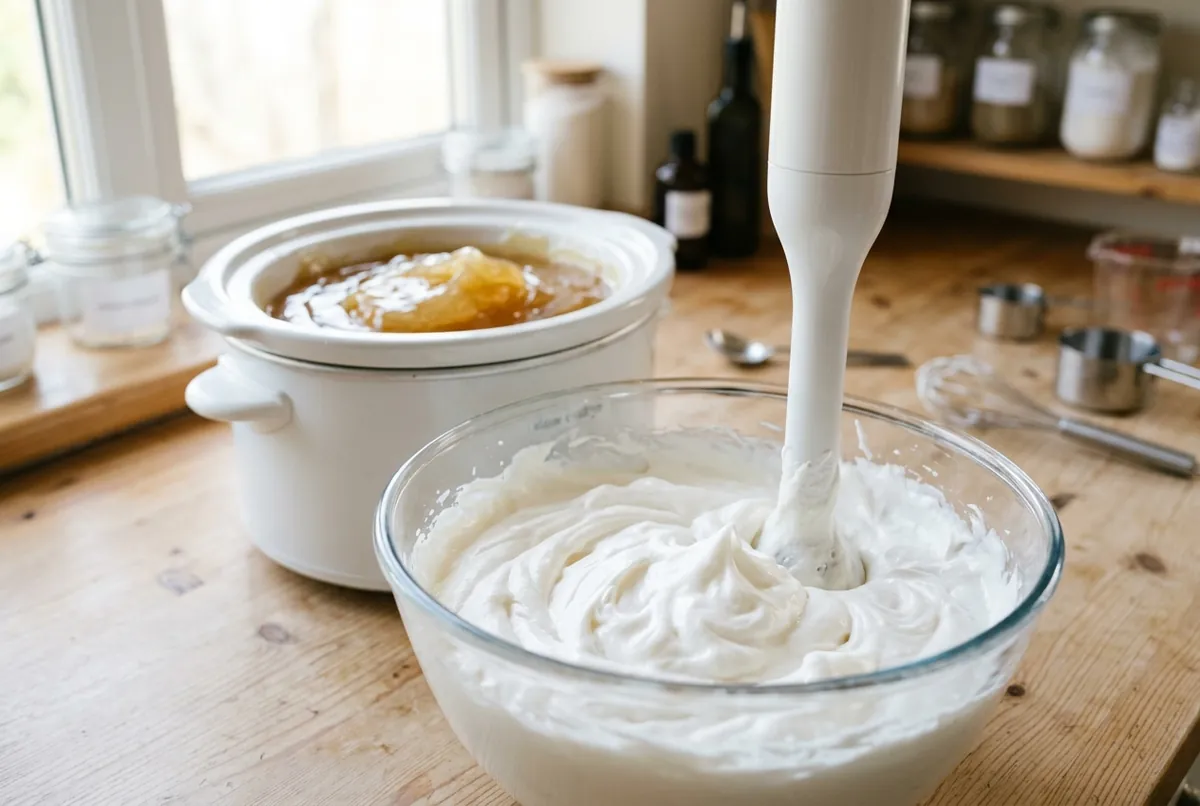 Before and after: the cooked soap after its rest (back), glossy and translucent like petroleum jelly, and the same soap whipped (front).
The boric acid whip, and what to use instead
Fisher whips a solution of 14 g of boric acid in 113 g of hot water into the rested soap, and it suddenly lightens and turns fluffy; if the cream is not firm enough, he adds another 7 g. What the boric acid does is acid-base chemistry. It is a weak acid, the acid half of the borax buffer that NIST certifies at pH 9.2, and at that pH it is acid enough to take potassium from some of the stearate: Kanicky and Shah measured the apparent pKa of stearic acid, the pH at which half of it is soap and half free acid, at 10.15. The stearic acid it frees stays in the cream as free acid, the same kind whose platelet crystals give stearate creams their pearly look. In effect, the boric acid raises the superfat after the cook, as free stearic acid.
Boric acid and the borates are on the list of substances prohibited in cosmetic products in the EU, where Regulation (EU) 2019/1966 put them, and in Great Britain, which kept the same entries, so a cream whipped with boric acid cannot be sold there. Canada allows boric acid up to 5 %, with warnings on the label.
You can get much the same effect without boron by leaving a little stearic acid unneutralised, which is how Thomssen finished his shaving creams: he tasted a cooled sample and added stearic acid until there was a 3 % excess. Tasting soap is not something to copy (the soap pH guide explains why), but the chemistry holds. Stir a few percent of melted stearic acid into the hot soap once the cook is finished, when no lye is left to neutralise it, and it stays in the cream as free acid.
Keeping it
Fisher’s cream soap is close to half water, so the advice for liquid soap applies: a clean jar with a lid, a clean spoon rather than wet fingers, and a preservative that works at the pH of soap if you sell it. Keep the lid on, or the surface dries out. Grosso prefers tubes and airless pumps to jars, which invite fingers. Warmth only thickens cream soap, so pipe it in cold from a piping bag, and fill by volume, since whipped air changes the weight.
Soft soaps: savon noir and the potash pastes
Before liquid soap came in bottles, potash soap was sold as a paste: soft soap. Thomssen’s manual has soft soaps for textile mills and for washing cars, made with potash from liquid oils such as corn, soya, cottonseed and olive-oil foots. A finished soap was judged on cold glass: pressed onto it, a sample that slid instead of sticking was too alkaline. His olive-foots potash soap for silk throwing is on our recipe pages. The paste in the liquid soap guide is the same thing, stopped before it is diluted.
Savon noir, the black soap of North Africa, is a soft soap of this kind: olive oil, often pomace oil or crushed whole olives, saponified with potash into a soft paste. Our savon noir recipe is the plain version, 100 % olive oil with potassium hydroxide at a 3.5 % superfat and water equal to the oil: for 500 g of oil the calculator asks for 101.9 g of 90 % potassium hydroxide in 500 g of water. The superfat is there for the reason the liquid soap guide gives: at 0 %, the range check says the soap could be up to 3.3 % lye-heavy. Olive-pomace oil has its own saponification range, 182 to 193 mg KOH/g against 184 to 196 for olive oil, so switch the oil in the calculator rather than assuming it is the same. Then make it exactly like the liquid soap paste, and simply do not dilute it.
Savon noir is a different thing from West African black soap, which takes both its alkali and its colour from the ash of plantain skins and cocoa pods, with palm kernel oil and shea butter. Our homage to it uses those fats but cannot reproduce the ash.
Recipes to try
All recipesSources
- The Complete Photo Guide to Soap Making . David Fisher, Creative Publishing International , 2018. Basic Cream Soap: its ingredients, the cook and its stages, the 24-hour rest, the boric acid whip and the adjustments.
- Soap-Making Manual . E. G. Thomssen, D. Van Nostrand Company , 1922. Stearic acid shaving creams made with potash lye and glycerine and finished with a 3 % excess of stearic acid; vanishing cream as a soft soap; fatty acid neutralisation as distinct from saponification; potash soft soaps, their glass test and figging.
- The Everything Soapmaking Book, 3rd edition . Alicia Grosso, Adams Media , 2013. Cream Soap in the Slow Cooker: 0.25 oz sodium hydroxide and 3 oz potassium hydroxide for 16 oz of fats, glycerin in the lye water; the cook, overnight rest, paddle whip and week of 'rotting'; filling cold, by volume.
- The Handbook of Soap Manufacture . W. H. Simmons and H. A. Appleton, Scott, Greenwood and Son , 1908. Soft soap with caustic soda for up to a quarter of the potash lye; shaving soaps blended from soda and potash soap.
- Interaction of the acid soap of triethanolamine stearate and stearic acid with water . Zhu S. et al. (Unilever R&D), Journal of Physical Chemistry B 111(5) , 2007. A lamellar liquid crystal forms hot; on storage, hydrolysis deposits platelet crystals of stearic acid that give a strong pearlescent appearance.
- Stearic Acid 50 % (WILFARIN SA-1850) product specification . Wilmar International . Acid value 205–211 and saponification value 206–212 mg KOH/g; titre 55–57 °C; about half palmitic and half stearic acid.
- Effect of degree, type, and position of unsaturation on the pKa of long-chain fatty acids . Kanicky J. R. and Shah D. O., Journal of Colloid and Interface Science 256(1) , 2002. Apparent pKa of stearic acid 10.15.
- Certificate of Analysis, Standard Reference Material 187f: Sodium Tetraborate Decahydrate (Borax), pH Standard . National Institute of Standards and Technology , 2025. A 0.01 mol/kg borax solution has a certified pH of 9.195 at 25 °C.
- Regulation (EC) No 1223/2009 on cosmetic products, Annex II, entries 1395 and 1396 . legislation.gov.uk, as substituted by Commission Regulation (EU) 2019/1966 . Boric acid, and borates and tetraborates including borax, are listed as substances prohibited in cosmetic products.
- Cosmetic Ingredient Hotlist: boric acid and its salts . Health Canada , 2025. Permitted up to 5 % with label warnings.
- Standard for Olive Oils and Olive Pomace Oils (CXS 33-1981) . Codex Alimentarius Commission (FAO/WHO) . Saponification values of olive oil (184–196) and olive-pomace oil (182–193 mg KOH/g).