In short
- Stearic and palmitic soaps make the heavy, creamy, slow-drying lather a shave needs, so shaving soaps are commonly 30 to 50 % stearic acid.
- Stearic acid is a free fatty acid: lye neutralises it at once instead of slowly splitting a fat, so the batter sets almost on contact, which is why many makers hot process shaving soap.
- Sodium hydroxide makes the puck firm; potassium hydroxide makes it soft enough to load a brush quickly. Our recipe does 40 % of the saponification with KOH.
- Keep a real superfat. Uncertain saponification values and uncertain KOH purity both eat into it, and a shaving soap must not sting.
- Free stearic acid makes no glycerin, which is one reason shaving creams have long had glycerin added back.
On this page
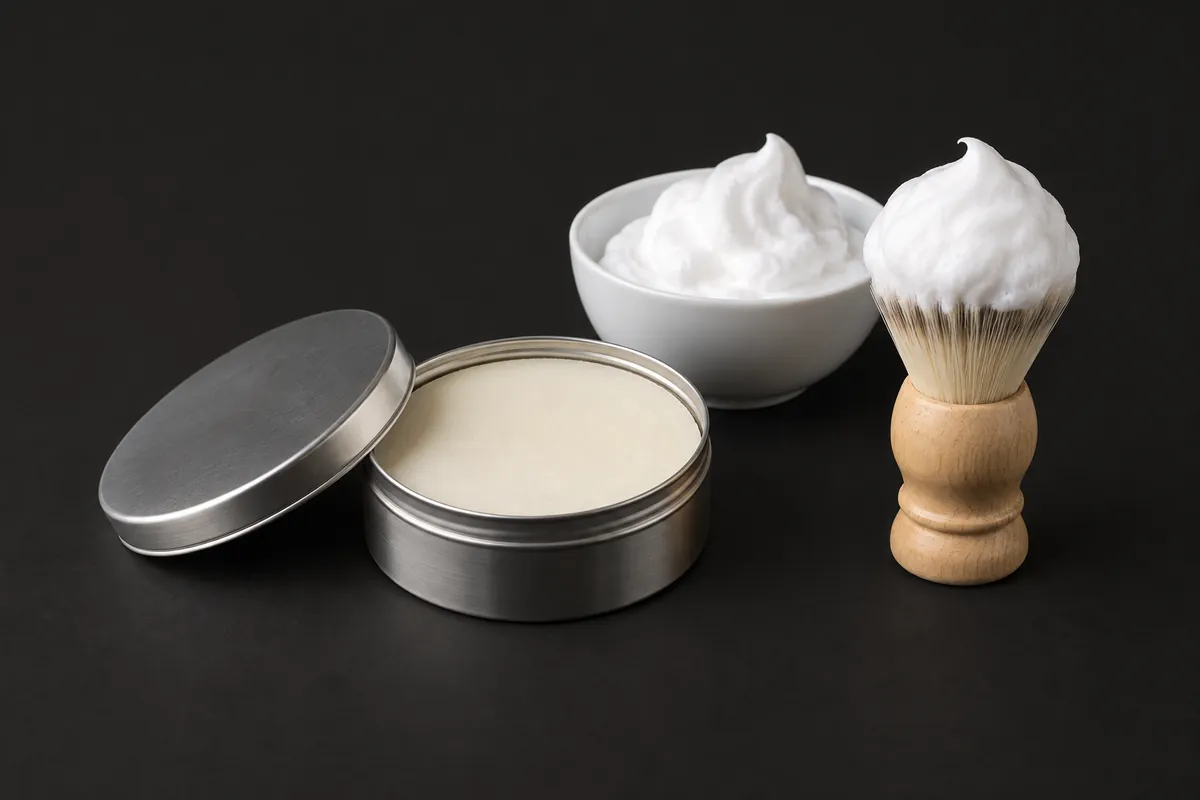
A bar of bath soap and a puck of shaving soap are made the same way, from fats and alkali, but they are built for opposite jobs. Bath soap should lather quickly and rinse away. Shaving soap should build a lather of fine, tightly packed bubbles that holds its shape on the face for the length of a shave, stays wet, and lets the blade slide. Three things make that happen: stearic acid, a mix of two alkalis, and a superfat set with care.
What a shaving lather needs
The old soap manuals put it well. Thomssen, in 1922, wanted a lather “heavy, creamy, but not gummy” that would “remain moist when formed on the face”, from a soap “neutral or nearly so to prevent the alkali from smarting during shaving”. Simmons and Appleton, in 1908, asked for “a profuse creamy lather which is lasting”, and found that lasting quality in potash soap.
The soaps that give that lather are the soaps of the long, straight, saturated acids, palmitic and stearic. They dissolve slowly and hold a small, dense bubble that does not collapse. Thomssen singled out stearic acid for “the non-drying creamy lather so greatly desired”, and potassium stearate as the ideal shaving soap, provided something softer was worked in with it. Stearic soap alone does not make a big enough lather, though, so coconut oil goes in for its quick, larger bubbles: Harry’s Cosmeticology, a long-standing reference on cosmetic chemistry, puts lather creams at about three parts stearic acid to one of coconut fatty acids, and Thomssen, writing again in 1936, wanted 20 to 25 % coconut oil in a shaving soap. Castor oil steadies the lather.
Our calculator’s creamy-lather number is the sum of palmitic, stearic and ricinoleic acid. The shaving soap below scores 57 on it and 66 for hardness, both above the bands drawn for bath bars. Those bands describe a good body bar; a shaving soap is meant to sit outside them.
Stearic acid, and why it sets so fast
Commercial stearic acid is not pure stearic acid. The triple-pressed grade that soapmakers buy is roughly half stearic (C18) and half palmitic (C16) acid, a white, waxy solid with a titre, its setting point, of 55 to 57 °C. The stearic acid page gives the full specification.
What matters in the pot is that stearic acid is a free fatty acid, not a fat. In an oil, the fatty acids are bound to glycerol, and lye has to split them off: a slow reaction that needs the oil and lye stirred into an emulsion first. A free acid needs no splitting. The hydroxide simply neutralises it, a proton transfer that is about as fast as chemistry gets. Dunn puts the difference in two lines: soap from an oil takes one to four hours, and soap from a fatty acid takes seconds. Stearic acid’s soap is solid well above room temperature, so a batter rich in it thickens on contact. Failor, who uses stearic acid in transparent soap, melts it and adds it separately after the rest has traced, because stirred into the oils it can curdle a batch within moments. The saponification chemistry guide covers the reaction in detail.
That is why so much shaving soap is made by hot process. In a slow cooker the batter can set as fast as it likes: you stir it, cook it until the lye is used up, and press it into tins while it is still hot and soft. For a blend this rich in stearic and palmitic acid, 49 % in our recipe, the calculator’s method notes say the same: in cold process, have the mould ready and stir by hand.
There is one more consequence. A fat gives glycerin when it saponifies, because the glycerol it was built on is set free; a free fatty acid gives water instead. In our recipe the 200 g of stearic acid yields no glycerin at all, and the 300 g of oils yield about 35 g, 4 % of the batch. That is one reason shaving creams have long had glycerin added back.
Sodium, potassium and the split between them
Sodium soaps are hard; potassium soaps are soft and dissolve more readily. A shaving soap wants some of each: enough sodium soap for a puck that holds its shape in the tin, and enough potassium soap that a damp brush picks up lather in a few swirls. The mix is stated as the share of the saponification done by potassium hydroxide, not the share of the weight, because a gram of KOH does less work than a gram of NaOH: it takes 56.1 g of KOH to do what 40.0 g of NaOH does.
| KOH share of the saponification | Sodium hydroxide | Potassium hydroxide (90 %) | Lye concentration |
|---|---|---|---|
| 0 % | 72.8 g | none | 24.4 % |
| 20 % | 58.2 g | 22.7 g | 26.5 % |
| 40 % | 43.7 g | 45.4 g | 28.4 % |
| 60 % | 29.1 g | 68.1 g | 30.2 % |
| 80 % | 14.6 g | 90.8 g | 31.9 % |
| 100 % | none | 113.5 g | 33.5 % |
Our shaving soap, 500 g of oils at a 4 % superfat with water at 45 % of the oils, from our calculator. KOH is weighed at the 90 % purity that commercial flakes usually have.
There is no single right share. “In shaving-soap potash is a necessary and essential ingredient,” Lamborn wrote in 1918, but published formulas have used very different amounts of it:
| Source | Product | Potash share of the alkali |
|---|---|---|
| Lamborn, 1918, analysis of a popular brand | Shaving soap | About a fifth |
| Thomssen, 1922, three formulas | Shaving sticks | 27 to 30 % |
| Thomssen, 1922 | Cold-made shaving soap | About 45 % |
| Keithler, 1955; Harry’s Cosmeticology | Lather shaving creams, 4 or 5 parts KOH to 1 of NaOH by weight | 74 to 78 % |
| Fisher | Cream soap for shaving or washing | About three-quarters |
Worked out from each source’s own figures (Thomssen’s from his table of lye strengths), counting molecules of alkali, which is how the calculator’s KOH share counts them. Thomssen’s 1922 shaving creams use potash alone.
Lower shares give a harder, longer-lasting puck that needs more loading; higher shares give a softer soap that loads fast, and at the top of the range a cream rather than a puck. Our recipe uses 40 %, a firm puck that still loads quickly; our stearic shaving soap, written out with a full method, uses 50 % for a puck that loads faster.
Change the split and watch both lyes move. At 40 % KOH our shaving soap takes 43.7 g of sodium hydroxide and 45.4 g of 90 % potassium hydroxide.
Open it in the calculatorThe NaOH, KOH and dual lye guide explains the chemistry of the split and the arithmetic behind it.
A superfat you can trust
A shaving soap is lathered on skin that is about to be scraped, so free alkali matters more here than anywhere. Thomssen’s factories did not trust arithmetic alone: they tested each batch, added melted stearic acid until the test showed neutral, and for shaving cream kept going “until there is a 3% excess” of it. In 1936 he advised superfatting shaving soap “preferably with stearic acid so that 2 or 3 per cent of free fatty acid is contained in the soap”, and Harry’s gives 3 to 5 % for lather creams. At home the margin has to come mostly from the superfat you set, and two uncertainties eat into it.
The first is the oils. Across the published saponification ranges of our recipe’s oils, a 3 % superfat could be as low as 0.7 % in the worst case, which is why its page uses 4 %, where the worst case is 1.7 %. Our shaving croap would fall to −0.1 % at 2 %, a soap that could carry free alkali, and it uses 4 % too, where the worst case is 2.0 %. The second is the potassium hydroxide. Flakes are sold anywhere from about 85 to 95 % pure, and the calculator assumes 90 % unless you tell it otherwise. If yours are really 95 % pure, a 40 % KOH share at a nominal 4 % superfat delivers about 1.9 %.
So read the purity on your KOH’s label or certificate and enter it, and keep the superfat at 4 % or more; at 5 % you give up a little firmness for a comfortable margin. The superfat guide explains the uncertainty band, and the soap pH guide the tests that are worth doing on a finished soap.
Glycerin, lanolin and clay
Glycerin keeps a lather wet on the face. Shaving creams carry a great deal of it: Thomssen’s first cream formula is about a fifth glycerine by weight, Fisher’s cream soap uses 156 g of glycerin to 538.5 g of fats, and Harry’s allows up to 15 % in a cream. For a lather shaving stick Harry’s gives 5 to 10 % glycerol. Our recipe’s own oils already make about 35 g, 4 % of the fresh batch, so a spoonful or two stirred in after the cook is plenty. Too much leaves any soap sticky and sweating in damp air (Failor).
Lanolin is prized in shaving soap for its feel, but it is a wax, not a fat: mostly esters of sterols and long-chain alcohols, and “very difficult to saponify”, as Lamborn put it; the pharmacopoeia measures its saponification value only after four hours’ boiling. Counted in the lye, part of the lye weighed for it may find nothing to react with, which quietly shrinks the superfat. In hot process, add it after the cook and mark it as an after-the-cook oil in the calculator, which then leaves it out of the lye and counts it as superfat: 10 g of lanolin stirred in after the cook takes our recipe’s superfat from 4 to 4.9 %. Use it sparingly. In milled toilet soaps, Simmons and Appleton kept superfatting materials such as lanolin to 6 to 8 ounces per hundredweight, well under 1 %, and a 1955 trade paper on shaving creams warns that too much lanolin spoils the lather.
Clay gives a lather slip, the glide that lets a blade travel. Corley Barto puts 2 teaspoons of bentonite into her shaving soap, a batch of 453 g of oils. Mix it with a little water first so it does not clump, and stir it in after the cook.
The recipe: hot process shaving soap
This is our shaving soap for 500 g of oils, with 40 % of the saponification done by potassium hydroxide. It makes 814.1 g of soap before the cook drives any water off, enough for seven or eight tins of 100 g.
| Ingredient | Grams | Ounces |
|---|---|---|
| Stearic acid, triple pressed | 200 | 7.05 |
| Coconut oil | 125 | 4.41 |
| Olive oil | 100 | 3.53 |
| Castor oil | 50 | 1.76 |
| Shea butter | 25 | 0.88 |
| Sodium hydroxide (100 %) | 43.7 | 1.54 |
| Potassium hydroxide (90 %) | 45.4 | 1.60 |
| Water | 225 | 7.94 |
4 % superfat, water at 45 % of the oils. Hardness 66, cleansing 18, conditioning 32, bubbly 27, creamy 57: outside the bath-bar bands, by design.
The method is the hot process method, with a few points specific to stearic acid:
- Make the lye solution. Wearing splash goggles, gloves and long sleeves, stir both hydroxides into the 225 g of water a little at a time, always lye into water, and let it cool while you melt the fats.
- Melt the fats hot. Melt the stearic acid, coconut oil and shea butter together in the slow cooker, then add the olive and castor oils. Keep the blend well above stearic acid’s 55 °C setting point, or it starts to crystallise before the lye arrives.
- Add the lye and let it seize. Pour the lye solution in steadily, stirring all the while. The batter thickens to a paste almost at once. That is the stearic acid turning to soap, not a failure.
- Cook it through. Cover and cook on low, stirring every so often, until the whole mass is translucent, like petroleum jelly, with no opaque patches left.
- Finish off the heat. Let it cool a little, then stir in any glycerin, clay slurry, lanolin held back for after the cook, and fragrance. Fragrance goes in once the soap is below about 82 °C, or much of it evaporates.
- Press into tins. Spoon the hot soap into tins or jars, pressing it down firmly to push out air pockets, and tap each one on the bench. Smooth the tops and leave them uncovered to cool.
- Let them dry. Leave the tins open for four to six weeks before lidding them: hot process soap still has water to lose, and the soap firms up and shrinks slightly as it goes.
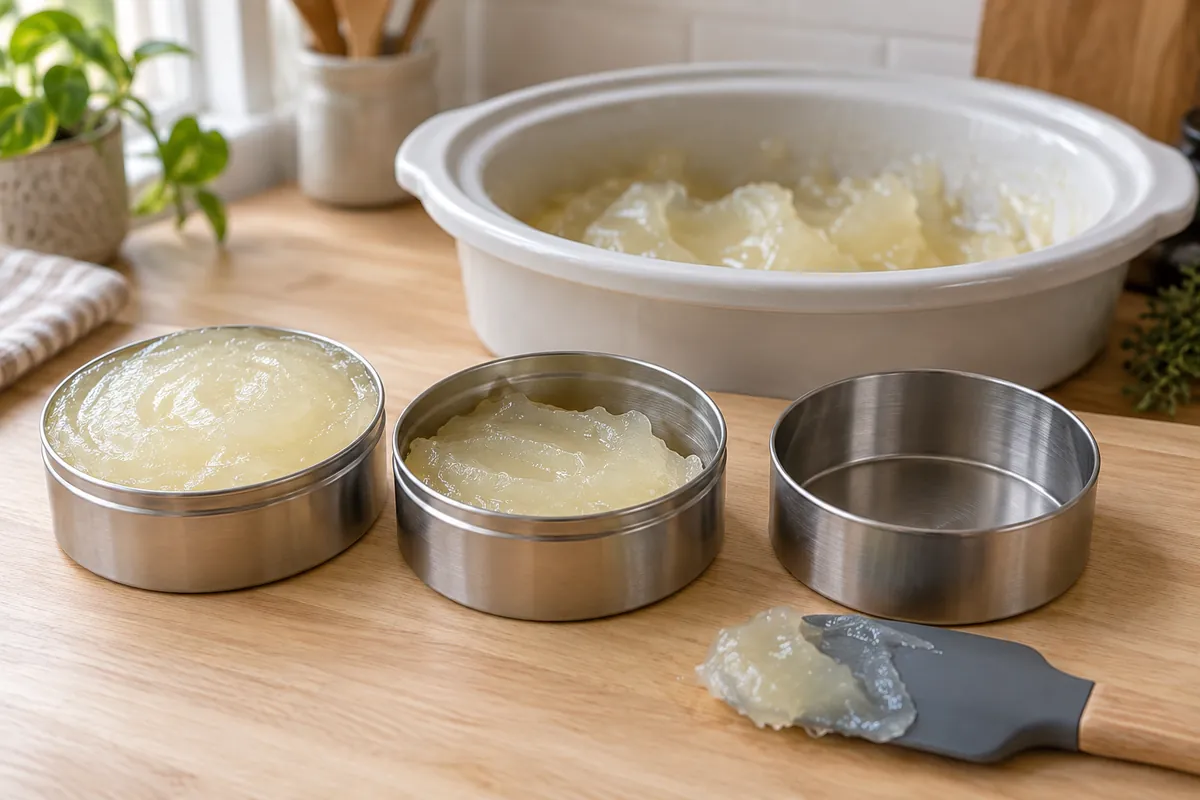 Cooked shaving soap is translucent and stiff, like petroleum jelly. Press it into the tins firmly: air pockets become holes in the puck.
Factories in Thomssen’s day made shaving sticks and mug soap by milling: the soap was dried, rolled into thin ribbons and pressed, which gives a dense, smooth puck. The home version is to grate a cured shaving soap, melt it with a little water and press it into tins; the rebatching guide covers the technique.
Croap: the soft end of the range
Push the potassium share up and the stearic acid higher, add more water, and a shaving soap becomes a croap, part cream and part soap: soft enough to scoop with a brush, still stiff enough to sit in a tub. Our shaving croap is 50 % stearic acid with 60 % of the saponification done by potassium hydroxide, at a 4 % superfat and more water than the puck. Fisher’s cream soap goes further, to about three-quarters potassium, and the cream soap guide covers whipping and curing the softest of these soaps.
Recipes to try
All recipesSources
- Soap-Making Manual . E. G. Thomssen, D. Van Nostrand , 1922. What a shaving lather needs; stearic acid for a non-drying creamy lather; shaving soap and shaving cream formulas; the tongue test and a 3 % excess of stearic acid; lye strength by the Baumé scale.
- The Handbook of Soap Manufacture . W. H. Simmons and H. A. Appleton, Scott, Greenwood and Son , 1908. Shaving soaps as mixtures of soda and potash soaps; potash soap for a lasting lather; superfatting material kept very small; shaving creams with more superfat and water.
- Shaving Preparations . E. G. Thomssen, Soap (journal) 12(3) and 12(4) , 1936. 20 to 25 % coconut oil in shaving soap; superfatting with stearic acid to 2 or 3 % free fatty acid; five parts caustic potash to one of caustic soda in cream; 5 % glycerine.
- Harry's Cosmeticology, 7th edition . J. B. Wilkinson and R. J. Moore (eds), Longman , 1982. Lather shaving creams: about 75 % stearic to 25 % coconut fatty acids, a 5:1 ratio of KOH to NaOH, 3 to 5 % free fatty acid, up to 15 % humectant; shaving sticks with 5 to 10 % glycerol.
- Lather shaving creams . W. R. Keithler, Drug and Cosmetic Industry 76(2) , 1955. Four or five parts KOH to one of NaOH; too much lanolin spoils the lather.
- Modern Soaps, Candles, and Glycerin, 3rd edition . Leebert Lloyd Lamborn, D. Van Nostrand , 1918. Analysis of a popular shaving soap (25 % potassium oxide, 75 % sodium oxide of the combined alkali); potash essential in shaving soap; lanolin very difficult to saponify.
- Transparency and Meltability in Hot-Process Soap (lecture slides) . Kevin M. Dunn, Handcrafted Soap and Cosmetic Guild , 2012. Soap from an oil takes one to four hours; from a fatty acid, seconds.
- Safety Assessment of Lanolin and Lanolin-Derived Ingredients . Cosmetic Ingredient Review , 2023. About 87 % high molecular weight esters: a wax, not a fat; saponified, about half fatty acids and half alcohols.
- Making Transparent Soap . Catherine Failor, Storey Publishing , 2000. Stearic acid combines so fast with lye that it can curdle a batch; melted and added separately.
- The Complete Photo Guide to Soap Making . David Fisher, Creative Publishing International , 2018. A hot process cream soap with potassium and sodium hydroxide, stearic acid and glycerin.
- The Natural Soap Chef . Heidi Corley Barto, Ulysses Press , 2012. Bentonite clay for slip in a shaving soap.
- Stearic Acid 50 % (WILFARIN SA-1850, triple pressed), product specification . Wilmar International . Palmitic 45 to 49 %, stearic 50 to 54 %, acid value 205 to 211, saponification value 206 to 212, titre 55 to 57 °C.
- Wool fat (Adeps lanae), Ph. Eur. 11.0, product specification . Gustav Heess GmbH . Lanolin's saponification value, 90 to 105 mg KOH/g.