In short
- Iodine value is the grams of iodine a fat takes up per 100 g, a count of its double bonds: coconut oil about 8, olive oil 85, linseed oil 190.
- Double bonds make soap softer and give oxygen a place to attack, so a high iodine value warns of a soft bar and a shorter shelf life.
- It weighs every double bond alike, but linoleic and linolenic chains oxidise far faster than oleic ones, so the polyunsaturated share predicts rancidity better.
- INS is the SAP value minus the iodine value, popularised by Robert McDaniel in 2000 with an ideal of 160. It subtracts two unrelated units and cannot tell lauric acid from stearic.
- A 50/50 blend of coconut and soybean oil sits inside the INS band and still makes a harsh bar that is likely to go rancid early.
On this page
Iodine value and INS sit at the bottom of the calculator’s quality panel. The first is a measurement a laboratory makes on a fat; the second is arithmetic a soapmaker made out of two measurements. This guide explains what each one counts, what it is good for, and where it misleads, with the sums done on real oils.
What iodine value measures
The iodine value is the mass of halogen, expressed as iodine, that 100 g of fat takes up under the conditions of the standard method (ISO 3961, AOCS Cd 1-25). Halogen adds across carbon–carbon double bonds, one molecule to each, so the value is a count of double bonds per unit of mass. A fully saturated fat scores close to zero.
The method uses Wijs’s reagent, iodine monochloride in acetic acid, in use since the end of the nineteenth century. The fat is dissolved in a solvent, a measured excess of reagent is added, and the flask stands in the dark for an hour, or two for fats above 150 or with conjugated acids. Potassium iodide then turns whatever reagent is left into iodine, which is titrated with sodium thiosulfate to a starch end point, alongside a blank without fat. The difference is what the double bonds took.
Because each double bond takes one molecule, the value can also be worked out from the fatty-acid profile. A chain in a triglyceride adds a fixed amount of iodine value per percentage point: 0.860 for oleic, 1.732 for linoleic, 2.616 for linolenic, 0.950 for palmitoleic and 0.816 for castor’s ricinoleic acid. Pure triolein would score 86.0, trilinolein 173.2 and trilinolenin 261.6. ISO 3961 gives the same calculation in an annex, taken from AOCS Cd 1c-85.
For olive oil at the middle of its Codex composition, 69 % oleic, 12.3 % linoleic, 0.6 % linolenic and 1.9 % palmitoleic, that comes to 59.3 + 21.2 + 1.6 + 1.8 plus a trace, or 84.1, inside the measured range of 75–94. The same sum for sunflower oil gives 129.6, against a measured 118–141.
| Oil | Iodine value (published range) | Figure the calculator uses | INS (SAP − iodine value) |
|---|---|---|---|
| Coconut | 6.3–10.6 | 8.5 | 248 |
| Palm kernel | 14.1–21 | 17.6 | 224 |
| Cocoa butter | 33–42 | 37.5 | 156 |
| Tallow | 40–53 | 46.5 | 150 |
| Palm | 50–55 | 52.5 | 147 |
| Shea butter | 30–75 | 52.5 | 131 |
| Lard | 55–65 | 60 | 138 |
| Olive | 75–94 | 84.5 | 106 |
| High-oleic sunflower | 78–90 | 84 | 104 |
| Castor | 83–88 | 85.5 | 94 |
| Canola (low-erucic rapeseed) | 105–126 | 115.5 | 72 |
| Sunflower | 118–141 | 129.5 | 62 |
| Soybean | 124–139 | 131.5 | 61 |
| Linseed | 170–211 | 190.5 | 1 |
Ranges from the Codex standards and the other primary documents on each oil’s page. The calculator uses the middle of each range for both values.
Why a high iodine value means a softer bar
A double bond in its natural form bends the chain, and bent chains cannot pack tightly. Their sodium soaps are more soluble and hold water longer, so a bar made from them is softer and takes longer to firm up. Iodine value is in effect a count of those bends, which is why it rises and falls with the conditioning number.
A blend’s iodine value is the average of its oils by weight. For the everyday 40/30/30 bar of olive, coconut and palm oil it is 0.4 × 84.5 + 0.3 × 8.5 + 0.3 × 52.5, or 52. The calculator shades 41–70 as the usual range, a convention inherited from hobby calculators; we know of no study behind it. The classic hard fats sit inside it (tallow 46.5, palm 52.5, lard 60) and olive oil sits above it, which matches the slow firming of a castile. Iodine value is not hardness, though: coconut oil scores 8 and its soap, hard as it is, dissolves fast in water, which is a matter of chain length that the iodine value cannot see.
Why it warns of rancid soap, and where it misleads
Oxidation starts at the double bonds, and above all at a carbon that sits between two of them, whose hydrogens come away easily. Oleic acid has no such carbon; linoleic has one and linolenic two. In a classic measurement each extra double bond at least doubled the rate of oxidation (Holman and Elmer, 1947), and later work found that oxidisability rises in step with the number of those in-between carbons (Cosgrove et al., 1987). The chains in a bar of soap are the chains the oil had, and they oxidise the same way; the rancid smell and orange spots of an old bar are generally put down to that reaction.
Iodine value counts oleic, linoleic and linolenic chains in the ratio 1 : 2 : 3, one for each double bond. The risk does not scale like that. Oleic has none of the vulnerable carbons and linoleic has one, so the step from oleic to linoleic is the big one, and the iodine value understates the difference between an oleic-rich oil and a polyunsaturated one.
A realistic pair shows it. A 70/30 blend of tallow and soybean oil has an iodine value of 72, lower than olive oil’s 85, yet it carries about 22 % linoleic and linolenic acid against olive oil’s 13 %, and about twice the vulnerable carbons. The iodine value ranks the two the wrong way round for shelf life. For how long a bar keeps, read the linoleic and linolenic percentages in the calculator’s fatty-acid profile, and use the iodine value as a second opinion.
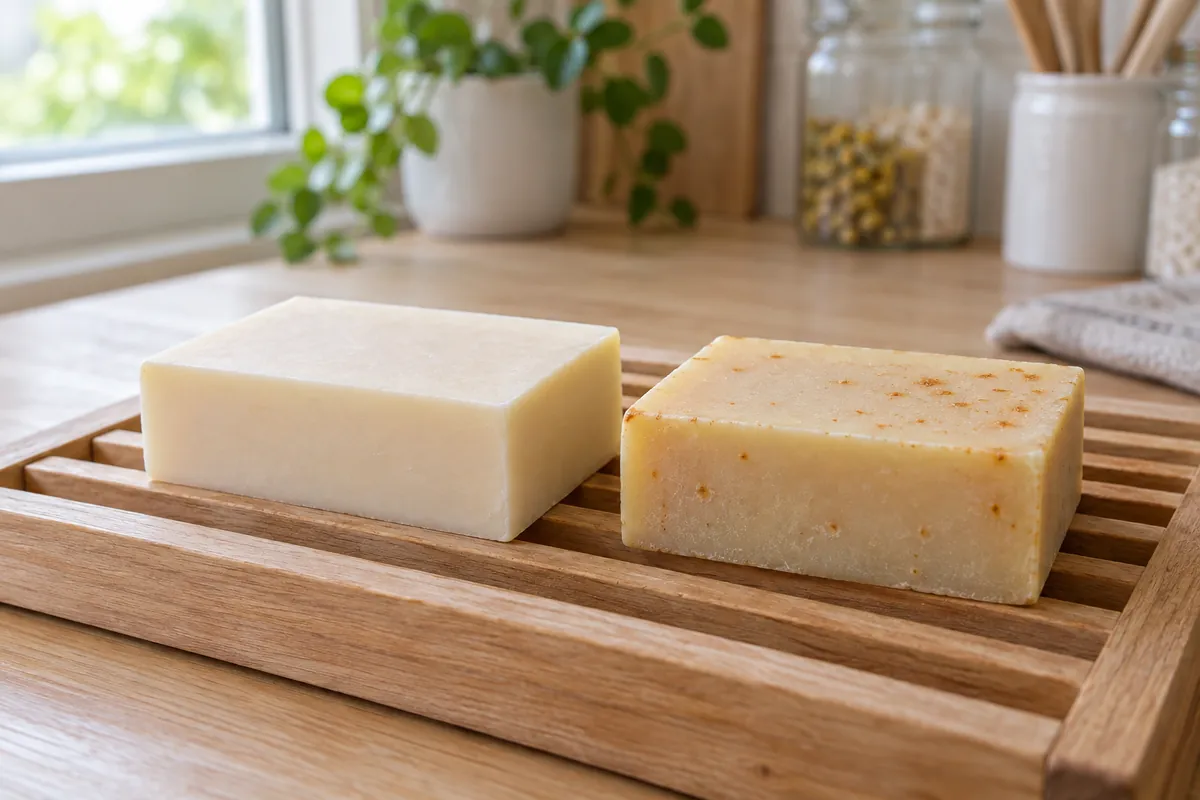 Orange spots on an older bar: oxidation of unsaturated chains, most likely where linoleic and linolenic acid are plentiful.
Neither number sees the other things that decide shelf life: an antioxidant or chelator in the recipe, the freshness of the oils when they went in, how much free oil the superfat leaves, and whether the bars are kept cool, dark and dry. The antioxidants and chelators guide and the curing and storage guide cover those.
INS: SAP value minus iodine value
INS is each oil’s saponification value minus its iodine value, averaged over the blend by weight. Robert McDaniel popularised it among soapmakers in Essentially Soap (2000) as a single figure for a hard, long-lasting bar, with an ideal near 160; the calculator shades 136–165. Anne Watson’s Smart Soapmaking uses a band of about 145–160, together with at least 40 % solid fats, as a quick check on a new blend.
It works up to a point because both terms point the same way. A high saponification value means short chains, lauric and myristic, whose soaps are hard; a low iodine value means saturated chains, whose soaps are hard too. So the hard fats score high (coconut 248, palm kernel 224, cocoa butter 156, tallow 150) and the soft, unsaturated oils score low (olive 106, sunflower 62, linseed 1).
For the everyday 40/30/30 bar, 0.4 × 105.5 + 0.3 × 248 + 0.3 × 147 comes to 161, almost exactly McDaniel’s ideal, for one of the most repeated beginner recipes in the craft.
What INS cannot tell you
Its units do not subtract. A saponification value is milligrams of KOH per gram; an iodine value is grams of iodine per 100 g. Taking one from the other is arithmetic of convenience, and the result has no physical meaning. A fat made only of linolenic chains would score −69.
It cannot tell lauric acid from stearic. Both raise it, for different reasons, and they make very different soap. A 70/30 blend of olive and coconut oil scores 148 and pure tallow 150, nearly the same, but the first lathers fast and cleans hard (cleansing 20, hardness 36) while the second is a hard, creamy bar with little quick lather (cleansing 4, hardness 52).
It calls classic soaps wrong. Pure olive oil scores 106, far outside the band, and castile is one of the oldest soaps there is.
It can pass a poor recipe. A 50/50 blend of coconut and soybean oil scores an INS of 154, with an iodine value of 70 at the top of its band and hardness and conditioning both 47, comfortably inside theirs. It is still a harsh bar, with a cleansing of 34 against the usual 12–22, and a poor keeper, since over 31 % of its fatty acids are linoleic and linolenic.
A recipe INS approves of. 500 g of coconut oil and 500 g of soybean oil at a 5 % superfat take 151.9 g of sodium hydroxide, score an INS of 154, and still show cleansing at 34.
Open it in the calculatorIt cannot see anything but the oils. Like the other quality numbers, INS ignores the superfat, the water, the cure and every additive.
Using the two numbers
Read the iodine value as a measure of softness and a first warning about shelf life, then check the linoleic and linolenic share, which predicts rancidity more directly. Read INS as a rough flag: a very low figure means a soft, slow bar made mostly of unsaturated oils, and a very high one means a lot of lauric oil, so look at cleansing next. Neither is a target in itself. A recipe designed to hit 160 exactly has been designed around a number that cannot tell a coconut bar from a tallow one; the recipe design guide starts from what the bar is for instead.
Sources
- ISO 3961:2018 Animal and vegetable fats and oils: Determination of iodine value . International Organization for Standardization , 2018. The Wijs method; Annex B calculates the value from fatty-acid composition, based on AOCS Cd 1c-85.
- AOCS Official Method Cd 1-25, Iodine Value of Fats and Oils, Wijs Method . American Oil Chemists' Society .
- Atomic weights of the elements 2013 . IUPAC, Pure and Applied Chemistry 88(3) , 2016.
- Standard for Named Vegetable Oils (CXS 210-1999) . Codex Alimentarius Commission (FAO/WHO) .
- Standard for Olive Oils and Olive Pomace Oils (CXS 33-1981) . Codex Alimentarius Commission (FAO/WHO) .
- Standard for Named Animal Fats (CXS 211-1999) . Codex Alimentarius Commission (FAO/WHO) .
- The rates of oxidation of unsaturated fatty acids and esters . R. T. Holman and O. C. Elmer, Journal of the American Oil Chemists' Society 24 , 1947.
- The kinetics of the autoxidation of polyunsaturated fatty acids . Cosgrove J. P., Church D. F., Pryor W. A., Lipids 22 , 1987.
- Essentially Soap . Robert S. McDaniel, Krause Publications , 2000. The INS figure and its ideal of 160.
- Smart Soapmaking: The Simple Guide to Making Traditional Handmade Soap . Anne L. Watson, Shepard Publications , 2013. INS of about 145 to 160, and at least 40 % solid fat, as checks on a new blend.