Unscented chamomile bar
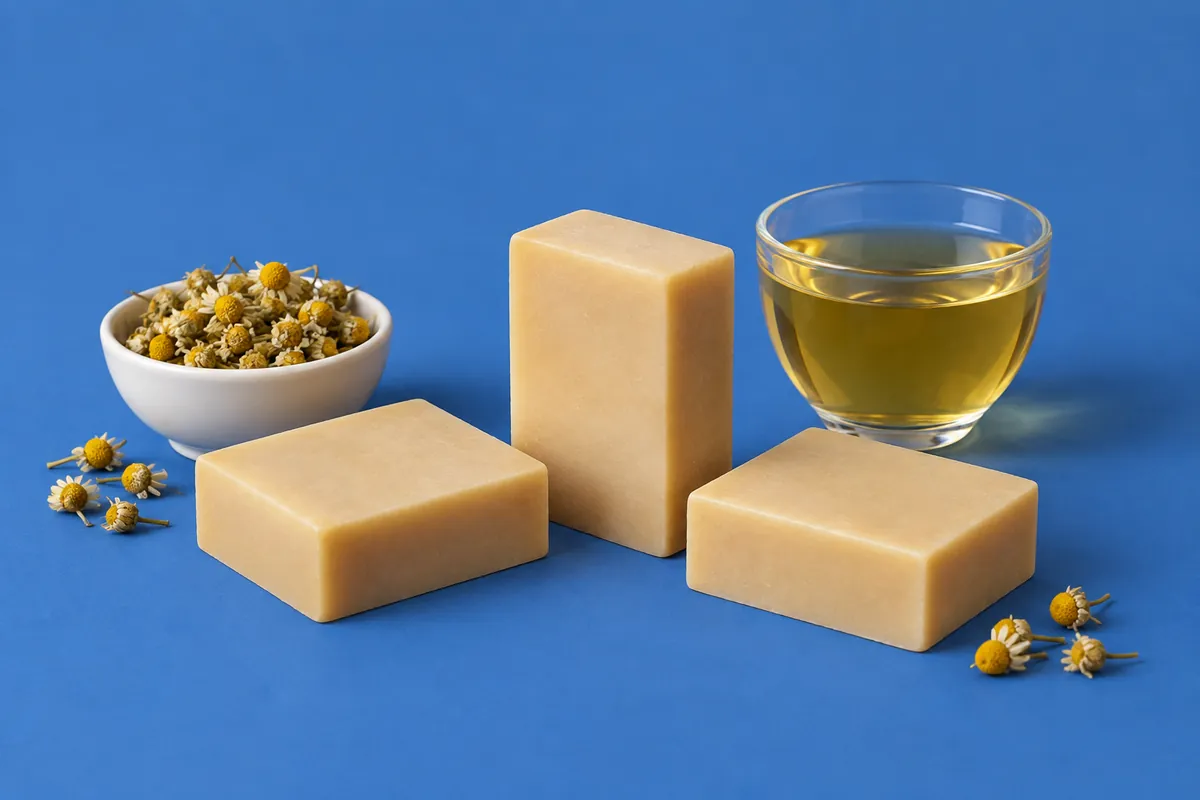
A gentle, unscented bar made with strong chamomile tea as the liquid and chamomile-infused olive oil. The chamomile gives it a warm beige colour rather than a scent, so it suits anyone who wants a soap with nothing added to smell of.
- Skill
- Intermediate
- Method
- Cold process
- Batch
- 1000 g of oils about 1406 g of batter
- Hands-on
- 1 h 20 min
- Cure
- 8 weeks
- Gel phase
- Either way gel or not, both work
What you need
For 1000 g of oils, which fills a 1.5 litre loaf mould. Weigh everything, liquids included.
| Olive Oil · 55.0 % | 550 g | 19.40 oz |
| Cocoa Butter · 17.0 % | 170 g | 6.00 oz |
| Coconut Oil · 15.0 % | 150 g | 5.29 oz |
| Sunflowerseed Oil - High Oleic Acid · 8.0 % | 80 g | 2.82 oz |
| Castor Oil · 5.0 % | 50 g | 1.76 oz |
| Sodium hydroxide (NaOH) · the lye, 100 % pure | 133.9 g | 4.72 oz |
| Distilled water · for a 33 % lye solution | 271.8 g | 9.59 oz |
| Dried chamomile flowers, for the infused oil · infused in 280 g of olive oil and strained out | 8 g | 0.28 oz |
| Dried chamomile flowers, for the tea · steeped in 350 g of boiling distilled water and strained out; the chilled tea is the recipe's water | 6 g | 0.21 oz |
- Superfat
- 6 %
- Temperatures
- Chill the tea before the lye goes in, then soap at 32 to 38 °C (90 to 100 °F)
Method
-
Infuse the chamomile oil
A day or more ahead, put 8 g of dried chamomile flowers and 280 g of olive oil in a clean glass jar and stand it in a pan of hot water, keeping the oil at about 49 °C (120 °F) and below 54 °C (130 °F), for 2 to 4 hours, never over a direct flame. Strain it through fine cloth and weigh out 250 g, topping it up with plain olive oil if you are short. -
Brew and chill the tea
On the day, pour 350 g of boiling distilled water over 6 g of dried chamomile flowers and steep for 20 minutes. Strain it, pressing the flowers, and chill the tea until it is fridge-cold. -
Get ready
Open a window or turn on the extractor fan, send children and pets out, and put on splash goggles, nitrile gloves and long sleeves. Set out a 1.5 litre loaf mould and a bowl of ice and water for the lye jug to stand in. -
Weigh everything
Weigh 170 g cocoa butter and 150 g coconut oil into the pot, and the 250 g of chamomile oil, 300 g of plain olive oil, 80 g high-oleic sunflower oil and 50 g castor oil into a jug. Weigh 271.8 g of the cold tea into the lye jug, in place of water, and the 133.9 g of sodium hydroxide last, into a dry container. -
Add the lye to the tea
With the jug standing in the ice bath where air moves, add the sodium hydroxide a spoonful at a time, stirring until each one dissolves, never pouring the tea onto the lye. The tea darkens to amber and smells strongly for a minute or two; leave it to cool, labelled and out of reach. -
Melt the fats
Melt the cocoa butter and coconut oil on the lowest heat until just clear, then pour in the chamomile oil, the plain olive oil, the sunflower oil and the castor oil. -
Blend to light trace
When the oils and the lye solution are each between 32 and 38 °C (90 and 100 °F), pour the lye solution into the oils through a sieve, down the blender shaft. Pulse and stir until the batter looks like thin custard; with this much olive oil it can take several minutes. -
Pour
Pour into the mould, scraping the pot clean, tap the mould on the worktop to release air, and smooth the top. -
Cover and leave
Cover the mould with its lid or a board and lay a towel over it for a day. A loaf that gels comes out a shade darker; both are fine. -
Clean up
With your gloves still on, wipe the batter off the pot and tools into the bin, not the sink, wash them in hot soapy water, and pour away any leftover tea. -
Unmould and cut
This olive-rich soap sets slowly. Unmould it after two to three days, when it is firm and has pulled away from the sides, and cut it into bars with gloves on. -
Cure
Stand the bars on edge in a dry, airy place for eight weeks, turning them every few days. The long cure gives a harder, longer-lasting bar.
Tips
- Chamomile colours this bar rather than scenting it. Expect warm beige to light tan: lye darkens any tea, and the infused oil adds a faint gold.
- Don't press chamomile flowers onto the top, because they turn brown in soap. If you want flowers there, calendula petals keep their colour.
- Chamomile belongs to the daisy family, so anyone allergic to daisies or ragweed should try the bar on a small patch of skin first.
- Brew the tea on the day you make the soap and throw away what you don't use: like any food, it spoils.
The oils
| Oil | Share |
|---|---|
| Olive Oil (virgin / refined / olive oil) | 55.0 % |
| Cocoa Butter (Theobroma Oil) | 17.0 % |
| Coconut Oil | 15.0 % |
| Sunflowerseed Oil - High Oleic Acid | 8.0 % |
| Castor Oil | 5.0 % |
How it is made
| Process | Cold process |
| Alkali | NaOH |
| Superfat | 6 % |
| Water | lye water at 33 % |
| Iodine value | 65 |
| INS | 135 |
Why make it
A gentle, palm-free bar for sensitive or dry skin: only 15 % coconut and more than half olive oil, so cleansing is 10 and conditioning 65 on our scale, and nothing is added to smell of. Dermatologists advise fragrance-free products for dry, sensitive skin, and people who follow that advice often like a bar like this. Chamomile tea has a long place in European herbal tradition, and makers use it here for its warm beige colour and its story; the flowers are strained out and the bar is rinsed off, so any effect on skin rests on tradition rather than evidence. The caveat: chamomile belongs to the daisy family, and people allergic to daisies, ragweed or their relatives can react to it, so try a small piece first.
Sources
- Dermatologists' top tips for relieving dry skin · American Academy of Dermatology, 2026
- European Union herbal monograph on Matricaria recutita L., flos · European Medicines Agency, Committee on Herbal Medicinal Products, 2015
What tradition, makers' experience and research say about soaps like this, each labelled for what it is. It is not medical advice, and no soap treats a skin condition: if you have one, ask a doctor or pharmacist.
What the numbers say
- Lauric acid 7.4 %
- Myristic acid 2.9 %
- Palmitic acid 13.8 %
- Stearic acid 8.2 %
- Ricinoleic acid 4.4 %
- Oleic acid 51.8 %
- Linoleic acid 8.5 %
- Other 3.9 %
Saturated : unsaturated 34 : 66
Computed from the fatty acids of the fats above. The bands are what the craft has settled on, not chemistry — a bar outside one is not wrong.
From the guides
All guides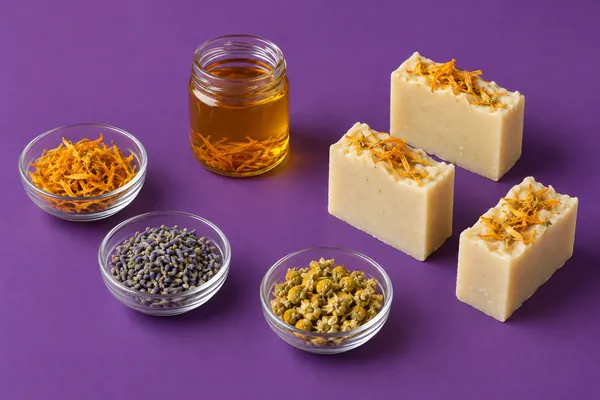
Herbs, flowers and infusions in soap
What dried herbs, petals, infused oils and herbal teas really do in soap: which survive lye, how to infuse an oil, and which claims a herbal soap can make.
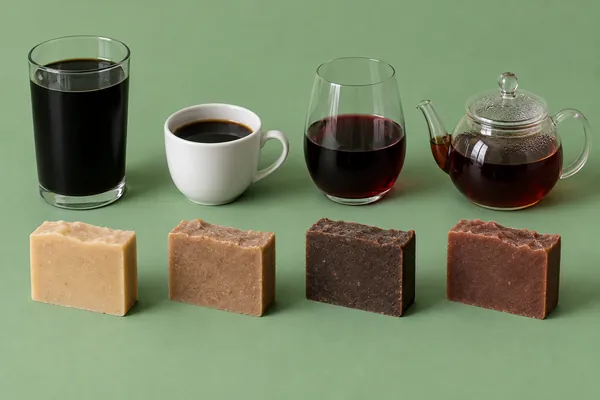
Beer, wine, coffee, tea and juice in soap
Using beer, wine, coffee, tea or juice in place of soap's water: how to prepare each one, add the lye safely, and what the calculator does with the liquid.
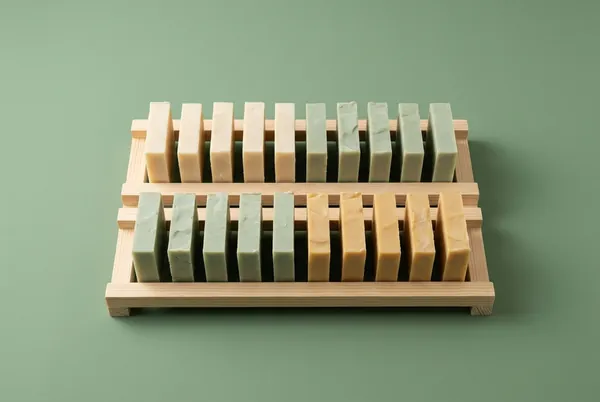
Curing and storing handmade soap
What curing does to cold process soap and what it doesn't, how long it takes, how to set bars up to cure, how to tell when they're done, and how to store them.
Where these proportions come from
Our own formulation: a gentle palm-free bar with only 15 % coconut oil, at a 6 % superfat. The chamomile goes in twice, as a tea for the lye liquid and as an infused oil, the way Kelly Cable uses one herb in both halves of her jewelweed soap.
Formulation adapted from The Natural Soap Making Book for Beginners by Kelly Cable (Althea Press, 2017). The method and notes are ours.