In short
- The calculator counts each liquid by the water it carries: 306 g of beer or 283 g of coffee stands in for 281 g of water.
- Chill or freeze the liquid and add the lye slowly in an ice bath. Sugary liquids scorch, and above 84 °C they can give off carbon monoxide.
- Flatten and boil beer and wine first. Boiling leaves more alcohol than people think: 35 % of it after 30 minutes' simmering.
- Lemon and lime juice are nearly 5 % citric acid, which uses up lye. The calculator's lemon juice counts it; leave it out and a 5 % superfat becomes about 11 %.
- Expect tan to dark brown bars. Vitamins and antioxidants don't survive lye in any useful form.
On this page
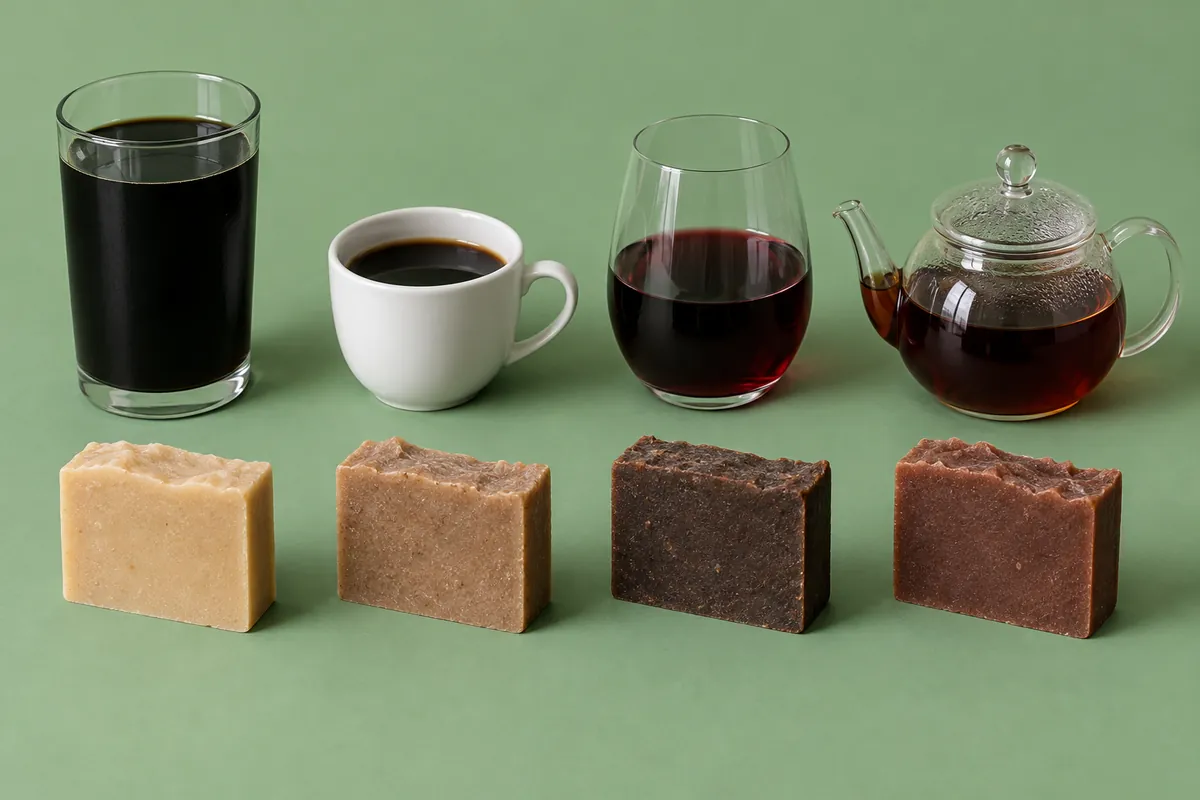
Most of the water in a freshly made bar leaves it during the cure. What stays is everything else a drink brought with it: sugars that heat the batch and help the lather, acids that use up lye, colours that turn brown in alkali, and, while you mix, a strong smell. Any drink that is mostly water can replace some or all of a recipe’s water. This guide covers how to prepare beer, wine, coffee, tea and juice, how to get the lye into them without scorching them, and what the calculator does with each. Milk has its own guide, and so do purées.
What the calculator does with a liquid
The water in a recipe is set by the lye concentration you choose. For the palm-free bar used through this guide, 1000 g of oils at a 5 % superfat and a 33 % lye solution, that is 281.2 g of water for 138.5 g of sodium hydroxide. A drink is not all water, so the calculator counts each liquid by the water it carries, from USDA food composition data, and tops up with plain water. Everything else in the drink, the sugar, the alcohol and the solids, goes into the batch total.
| Liquid | Water | Sugars | Also | To carry all 281.2 g of water |
|---|---|---|---|---|
| Beer | 92.0 % | 3.6 % carbohydrate | 3.9 % alcohol | 305.7 g |
| Red wine | 86.5 % | 0.6 % | 10.6 % alcohol; at least 3.5 g of acid per litre | 325.1 g |
| Coffee, brewed | 99.4 % | none | 282.9 g | |
| Black tea, brewed | 99.7 % | none | 282.0 g | |
| Carrot juice | 88.9 % | 3.9 % | 316.4 g | |
| Orange juice | 88.5 % | 8.1 % | 9–17 g of citric acid per litre | 317.8 g |
| Apple juice | 88.2 % | 9.6 % | not in the calculator | |
| Lemon juice | 92.3 % | 2.5 % | 48 g of citric acid per litre | 304.6 g |
Composition from USDA FoodData Central; citric acid from Penniston et al. (2008); wine’s acid is the EU legal minimum. The last column is what the calculator fills in to replace all the water in the palm-free bar. With wine and the acid juices the lye rises a little, and plain water tops up the difference.
Beer and wine are listed as they come from the bottle. Boiling drives off alcohol and some water, which the calculator cannot know about, so weigh the liquid after boiling and cooling and accept that the figures are a few grams out. For a juice the calculator doesn’t list, weigh it in place of the same weight of water when it replaces part of the water. If it replaces all of it, divide the water by the juice’s water fraction, or the lye comes out stronger than you set: 281 g of apple juice carries only 248 g of water, which turns a 33 % solution into a 35.8 % one.
Half the water as beer. 152.9 g of flat beer carries 140.6 g of water; the calculator makes the plain water 140.5 g and leaves the lye at 138.5 g.
Open it in the calculatorAdding lye to a liquid that isn’t water
Sodium hydroxide heats water as it dissolves, enough to take a room-temperature liquid past 93 °C (200 °F) (Corley Barto). Plain water comes to no harm. The sugars, proteins and colours in a drink do: they scorch, darken and smell. So the method changes in one direction, towards cold and slow.
- Prepare the liquid and weigh it. Flatten and boil beer or wine, brew and strain coffee or tea, and let it cool before you weigh it for the recipe. Boiling shrinks a drink, so Faiola starts with about twice the beer or wine she needs, and Grosso tops a strained herb tea back up with water to the weight the recipe calls for.
- Chill it hard, or freeze it. Coffee and tea only need to be cold. For sugary liquids, Cable freezes the drink together with the recipe’s water to a slush, checking it after an hour and then every 20 minutes. Frozen cubes work too: the lye’s heat goes into melting the ice first.
- Set the jug in an ice bath. Use a heat-safe polypropylene or stainless steel jug in a bowl of ice and water, with goggles and gloves on and a window open or the extractor running.
- Add the lye in small portions. Stir each one until it dissolves before adding the next, as Faiola does with beer and wine.
- Keep it cold as it dissolves. Corley Barto never lets lye mixed into milk or purée pass 60 °C (140 °F), and Letcavage and Harden hold milk below 49 °C (120 °F). With a sugary drink, the cooler you keep it, the less it darkens. Add ice to the bath if it climbs.
- Soap it cool, and don’t insulate. Cable combines her beer and wine batches at 27–32 °C (80–90 °F) and never insulates them, because their sugars heat the loaf.
The solution will change colour and smell, which is normal. Coffee turns green when the lye goes in, then brown (Soap Queen); tea goes very dark; and stout, in Corley Barto’s word, reeks, so open a window.
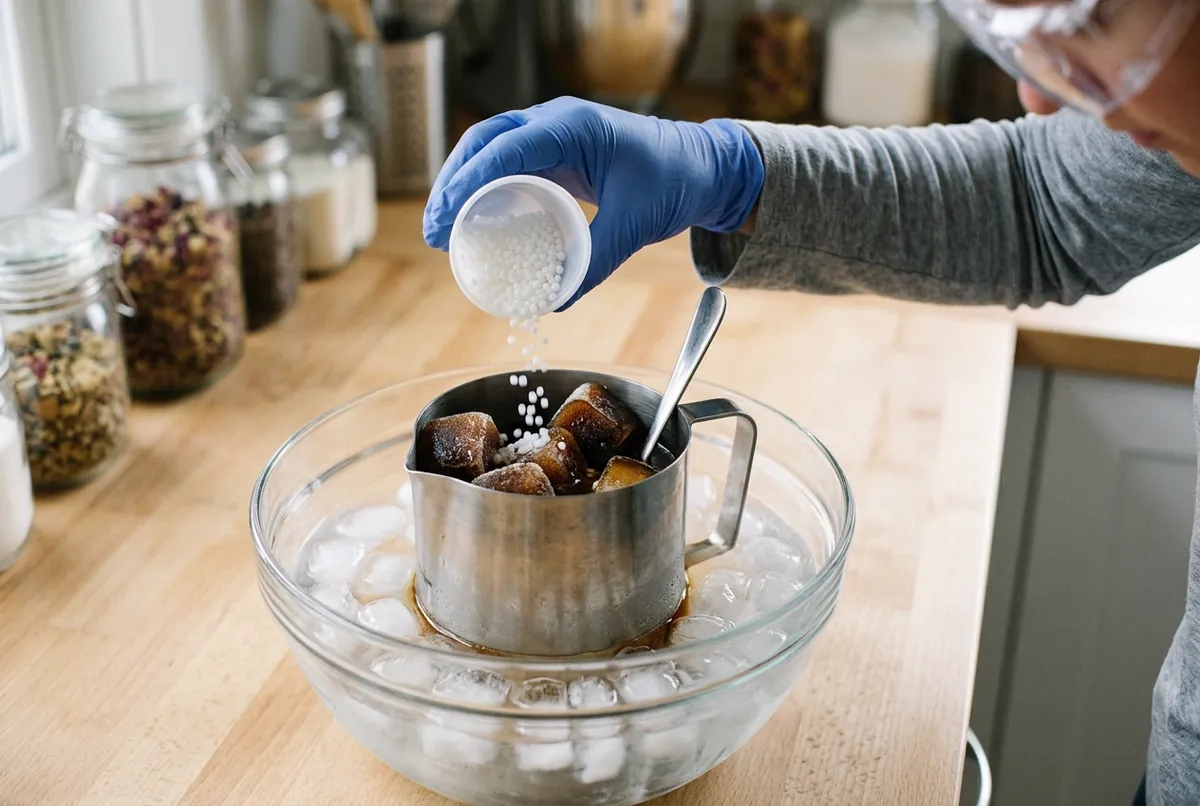 Lye going into frozen coffee cubes in an ice bath. The ice has to melt before the solution can get hot.
Beer
Beer goes flat and gets boiled before it meets lye. Carbonation foams up when the lye hits it, and the beer’s sugars heat the solution and speed trace (Soap Queen). The books agree on the idea but not the time. Cable leaves the beer open for 24 hours, then boils it and simmers it for 30 minutes; Faiola boils it uncovered for about 15 minutes, losing roughly half its volume, and leaves it uncovered in the fridge overnight; Corley Barto boils stout for 5 minutes and chills it until it is flat. Watch the pan, because boiling beer foams over.
Boiling does not remove all the alcohol, though recipes often say it does. USDA’s measurements on cooked foods found 40 % of the alcohol left after 15 minutes of simmering, 35 % after 30 and 25 % after an hour. Boiling is there to get rid of the bubbles and cut the alcohol, not to reach zero. Don’t leave boiled beer standing at room temperature, either: it goes mouldy (Anne L. Watson).
Cable uses flat beer for half the water; Faiola, Corley Barto and Soap Queen use it for all of it, as does our stout beer bar, which keeps its stout lye below 30 °C. Beer darkens the soap: Corley Barto’s stout batter is deep brown and cures to a creamy camel, and Faiola uses a pale beer where she wants a pale layer. Makers often describe beer soap’s lather as creamy. The likeliest reason is its leftover carbohydrate, 3.6 % of the beer (USDA), since sugars speed up and change a lather, as the additives guide explains.
Wine
Wine is prepared the same way. Faiola boils a whole 750 mL bottle uncovered for 10–15 minutes, watching it because it foams; it loses about 30 % of its volume, and she tops it up with distilled water. Cable leaves it open for a day and simmers it for 30 minutes. Unboiled wine can overheat when the lye goes in (Wholesale Supplies Plus), and a sweet wine, with more sugar, speeds gel (Nature’s Garden), so soap it cool. In Pure Soapmaking Faiola freezes boiled wine before the lye goes in but only chills beer, to 4–13 °C (40–55 °F), because she finds wine reacts far hotter; expect the wine and lye solution to stay cloudy. Its acids use a little lye, which the calculator counts at the EU’s legal minimum for wine: about 0.6 g of sodium hydroxide when wine replaces all the water.
Red wine does not make a red soap. Its colour comes from anthocyanins, which break down above pH 7 (Enaru et al., 2021), so the batter turns a dark tan (Soap Queen) and the bars cure brown to reddish-brown (Faiola); a dark merlot still gives a much darker bar than a chardonnay. If you want wine red, add a colourant: see colouring soap. The same goes for the grape’s other polyphenols, the ones behind wine’s antioxidant reputation: phenolic acids such as gallic acid are not stable at high pH (Friedman and Jürgens, 2000). Use half wine and half water (Wholesale Supplies Plus) or all wine (Soap Queen); the red wine bar freezes the wine and water together.
Coffee
Brew it strong and chill it. Corley Barto brews espresso with distilled water and chills it; Grosso and Handcrafted Soap use strong brewed coffee in place of all the water. Soap Queen suggests about half coffee and half water, for a milder smell and colour. The lye turns coffee green, then brown, and the bar comes out tan to deep brown depending on how strong the coffee was. The mocha swirl bar uses cold coffee for all of its water.
Coffee’s phenolic acids, caffeic and chlorogenic acid among them, are among those Friedman and Jürgens found unstable at high pH, so a coffee soap is coffee-coloured rather than a skin treatment. Used grounds make a good scrub in the same bar: dry them well first and use about a teaspoon per pound of soap (see soap additives), as the coffee kitchen scrub bar does with the grounds from its own brew.
Tea
Brew it strong: Corley Barto steeps two tea bags in 250 g of boiling distilled water until very dark, strains it and chills it, and stirs the steeped leaves in at trace for flecks. Soap Queen cools black tea to about 21 °C (70 °F) before the lye goes in, noting that the cooler the mixture, the lighter the colour. The chai spice bar uses strong black tea for all of its water.
In Faiola’s experience tea always ends up brown or olive in soap, black tea darkest, though caffeine-free herbal teas keep a little more colour, rooibos going red-brown. To save what colour she can, she freezes strong tea in cubes and stirs them in after the scent, taking the same weight off the lye water (Pure Soapmaking).
Soap Queen’s black tea soap also came out full of glycerin rivers, the translucent veins some bars show, until the team cut the water. Rivers are cosmetic; the glycerin rivers guide explains them. As for green tea’s antioxidants, tea catechins break down as temperature and pH rise (Su et al.), so the bar keeps the colour and loses the chemistry.
Juice
Juices are the sugary ones: 8.4 % sugar in orange juice and 9.6 % in apple juice, against 3.9 % in carrot juice (USDA). That sugar scorches in hot lye and heats the loaf. Cable finds juice can make up about a quarter of the water without browning or overheating, and that most juices turn soap brown beyond that. Freeze it to a slush with the rest of the water before the lye goes in, as the carrot and honey bar does with half its water as carrot juice. The Nerdy Farm Wife makes soap with all the water as carrot juice; fresh juice keeps only a day or two in the fridge, so freeze what you won’t use at once. Don’t expect a bright colour from juice alone: the strong orange in one of her carrot soaps came from red palm oil, not the carrots.
Forget the vitamin C. Ascorbic acid in solution oxidises quickly in air, and alkali speeds that up (PubChem), so an orange-juice bar holds no useful vitamin C by the time it is cut.
Citrus juices bring something the calculator has to know about: citric acid, which uses up lye. Fresh lemon juice holds 48 g per litre and lime juice 45.8 g, against 9–17 g in orange juice (Penniston et al., 2008). The calculator’s lemon juice counts that acid: 304.6 g of it, enough to carry all the water in the palm-free bar, brings about 14 g of citric acid and uses up 8.9 g of lye, so the calculator raises the sodium hydroxide to match. Leave the acid out and the 5 % superfat you set becomes about 11 %. Its lime juice counts the acid the same way.
Lemon juice for all the water. 304.6 g of lemon juice raises the lye from 138.5 g to 147.3 g.
Open it in the calculatorHolding the liquid back until trace
Some makers avoid scorching altogether by dissolving the lye in part of the water and adding the drink at trace, the way Fisher adds milk to the oils. The calculator allows it, and it shows the catch: the lye now dissolves in less water, so the solution you mix is stronger than the recipe’s.
In the palm-free bar at a 33 % solution, holding back a quarter of the water as beer leaves the lye dissolving at 39.6 %. Hold back a third and it runs at 42.5 %, hot and strong, and the calculator warns you. Hold back all of it and the lye cannot dissolve at all, which leaves caustic lumps in the batter; the calculator flags that as a danger. Keep at least three quarters of the water with the lye, or set a lower lye concentration before you hold any back. The water and lye concentration guide has the arithmetic.
Recipes to try
All recipesSources
- The Natural Soap Chef . Heidi Corley Barto, Ulysses Press , 2012. Stout boiled and chilled flat; teas and espresso brewed strong, strained and chilled; lye solutions with purées and milks held under 60 °C (140 °F) in an ice bath.
- The Natural Soap Making Book for Beginners . Kelly Cable, Althea Press , 2017. Beer and wine left open 24 hours, simmered 30 minutes, frozen to a slush with the water; juice up to a quarter of the water.
- Soap Crafting . Anne-Marie Faiola, Storey , 2013. Beer boiled about 15 minutes and rested overnight; a bottle of wine boiled 10–15 minutes; lye added a little at a time.
- The Complete Photo Guide to Soap Making . David Fisher, Creative Publishing International , 2018. Adding milk to the oils instead of the lye.
- Natural Soap Making . Elizabeth Letcavage and Melissa Harden, Stackpole Books , 2013. Milk and lye kept below 49 °C (120 °F).
- Pure Soapmaking . Anne-Marie Faiola, Storey Publishing , 2016. Beer and wine boiled uncovered, starting with about twice the liquid; wine frozen, beer chilled to 4–13 °C; merlot darker than chardonnay; tea colours, and frozen tea cubes added after the scent.
- The Everything Soapmaking Book, 3rd edition . Alicia Grosso, Adams Media , 2013. Strong brewed coffee in place of the water; herb teas strained, cooled and topped back up to the recipe's weight.
- Handcrafted Soap . Delores Boone, North Light Books , 2002. Cold, strong coffee in place of the distilled water.
- USDA FoodData Central: beer (168746), red table wine (173190), brewed coffee (171890), brewed black tea (173227), orange juice (169098), apple juice (173933), lemon juice (167747), carrot juice (170491) . US Department of Agriculture .
- USDA Table of Nutrient Retention Factors, Release 6 (alcohol) . US Department of Agriculture, Agricultural Research Service , 2007.
- Quantitative assessment of citric acid in lemon juice, lime juice, and commercially-available fruit juice products . K. L. Penniston et al., Journal of Endourology 22(3) , 2008.
- Scientific Soapmaking: The Chemistry of the Cold Process . Kevin M. Dunn, Clavicula Press , 2010. 10 g of sodium hydroxide neutralise 16.01 g of citric acid.
- Sodium hydroxide solution: reactivity profile . NOAA CAMEO Chemicals .
- Ascorbic acid: stability . PubChem (Hazardous Substances Data Bank) .
- Effect of pH on the stability of plant phenolic compounds . M. Friedman and H. S. Jürgens, Journal of Agricultural and Food Chemistry 48 , 2000.
- Anthocyanins: Factors Affecting Their Stability and Degradation . B. Enaru et al., Antioxidants 10(12) , 2021.
- Stability of tea catechins and theaflavins . Su et al. .
- How to use alcoholic beverages in cold process soap . Soap Queen .
- Black tea cold process soap tutorial . Soap Queen .
- How to use tea and coffee in soap . Soap Queen .
- Incorporating wine in soap . Wholesale Supplies Plus .
- Making cold process wine soap . Nature's Garden .
- Baby carrot soap; Carrot honey soap . The Nerdy Farm Wife .
- Soapmaking month by month: October . Anne L. Watson .