Hundred percent coconut bar
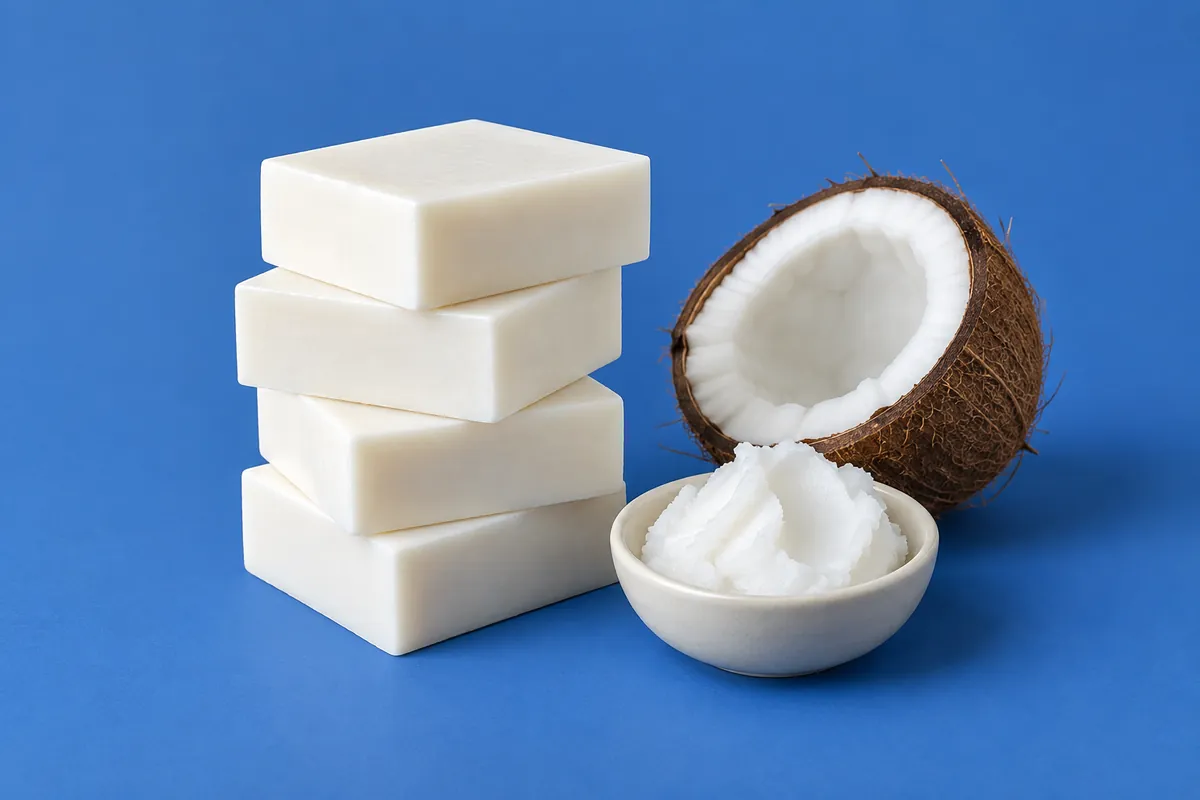
Coconut oil and nothing else, with a fifth of it left as free oil: a hard, bright white bar with a big, fast lather that works in hard water and even sea water. The high superfat is what makes coconut soap kind enough for skin, and a little litsea keeps it smelling fresh.
- Skill
- Beginner
- Method
- Cold process
- Batch
- 1000 g of oils about 1463 g of batter
- Hands-on
- 45 min
- Cure
- 4 weeks
- Gel phase
- Either way gel or not, both work
What you need
For 1000 g of oils, which fills a 1.5 litre loaf mould. Weigh everything, liquids included.
| Coconut Oil · 100.0 % | 1000 g | 35.27 oz |
| Sodium hydroxide (NaOH) · the lye, 100 % pure | 146.3 g | 5.16 oz |
| Distilled water · for a 33 % lye solution | 297.0 g | 10.48 oz |
| Litsea (May Chang) essential oil · 2.0 % of the oils, at trace | 20 g | 0.71 oz |
- Superfat
- 20 %
- Temperatures
- Oil and lye solution at 32 to 38 °C (90 to 100 °F), left uncovered
Method
-
Get ready
Put on splash goggles, nitrile gloves and long sleeves, open a window or turn on the extractor fan, and keep children and pets out of the room. Line the loaf mould and set it somewhere cool and level where it can stay for the day. -
Weigh everything
Weigh 1000 g coconut oil into the soaping pot and 20 g litsea essential oil into a small glass. Weigh 297 g distilled water into a heat-safe jug and 146.3 g sodium hydroxide into a dry container. -
Make the lye solution
At the open window or under the fan, pour the sodium hydroxide slowly into the water, never the water onto the lye, and stir until clear. Leave it to cool to 32 to 38 °C (90 to 100 °F), labelled and out of reach. -
Melt the coconut oil
Warm the coconut oil until it is just clear, then let it cool to the same 32 to 38 °C (90 to 100 °F). Don't let it go much cooler: coconut oil starts to set again below about 24 °C (75 °F). -
Blend to light trace
Pour the lye solution into the oil down the shaft of the stick blender and pulse briefly, stirring between bursts. Coconut oil traces quickly even with this much superfat, so stop as soon as a drizzle leaves a faint line on the surface. -
Add the litsea
Stir the litsea through by hand with the spatula until the batter is even. -
Pour and leave it uncovered
Pour into the mould and tap it on the worktop to let air out. Leave it uncovered in a cool room with no towel over it: coconut soap makes plenty of heat of its own and can crack if it is kept warm. -
Clean up
With your gloves still on, wipe the batter off the pot and tools with paper towels into the bin, then wash them in hot soapy water. -
Cut it the same day
Coconut soap sets hard quickly. Unmould and cut it with gloves on as soon as it holds a clean edge, usually 6 to 12 hours after pouring; left overnight it can chip and crack under the knife. -
Cure
Stand the bars on a rack with air around them for four weeks, turning them now and then. They are hard almost at once, but the cure lets the last of the water go so they last longer in use.
Tips
- Same oil, different soap: at 0 % superfat this is our zero-superfat coconut laundry bar, and folded with salt it becomes our pink salt spa bar. No other oil shows so clearly that the superfat decides what a soap is for, not just how it feels.
- The calculator's range check puts this bar between 17 and 23 % superfat whatever coconut oil you use, so it cannot be lye-heavy. The quality numbers look harsh because they count fatty acids only and cannot see the free oil.
- Use refined coconut oil for a white, neutral bar; virgin coconut oil smells of coconut, and a little of that survives the lye. Fractionated coconut oil is a different material with different saponification figures and will not do here.
- Keep the bar on a dish that drains. Coconut soap lathers so readily that a bar left sitting wet wears away quickly.
The oils
| Oil | Share |
|---|---|
| Coconut Oil | 100.0 % |
How it is made
| Process | Cold process |
| Alkali | NaOH |
| Superfat | 20 % |
| Water | lye water at 33 % |
| Iodine value | 8 |
| INS | 248 |
Why make it
Coconut oil alone lathers faster and bigger than almost any other soap fat, and it keeps lathering in hard water and even sea water, which is why the soap trade made marine soap from it; Simmons and Appleton noted in 1908 that such soap dissolves in brine. On our scale it is cleansing 68 and conditioning 9, so the 20 % superfat is what makes it a skin soap at all: at 0 % the same oil makes our laundry bar. It suits campers, sailors, gardeners and a sink where hands get greasy, and people with oily skin who like a squeaky-clean feel. That strength is also the caveat. A review of soaps and skin reports that laurate soap, the main soap in this bar, swells the skin's outer layer more than a mild synthetic bar does, so dry or sensitive skin will be happier with an olive-rich bar.
Sources
- The Handbook of Soap Manufacture · Scott, Greenwood & Son (W. H. Simmons and H. A. Appleton), 1908
- Skin Cleansing without or with Compromise: Soaps and Syndets · Molecules 27(6):2010 (Mijaljica, Spada and Harrison), 2022
What tradition, makers' experience and research say about soaps like this, each labelled for what it is. It is not medical advice, and no soap treats a skin condition: if you have one, ask a doctor or pharmacist.
What the numbers say
- Lauric acid 49.2 %
- Myristic acid 18.9 %
- Palmitic acid 8.9 %
- Stearic acid 3.0 %
- Oleic acid 7.5 %
- Linoleic acid 1.8 %
- Other 14.3 %
Saturated : unsaturated 91 : 9
Computed from the fatty acids of the fats above. The bands are what the craft has settled on, not chemistry — a bar outside one is not wrong.
Try it differently
10 variationsThe same soap with one thing moved. Each opens in the calculator ready to change again.
- 5 % superfat
- 15 % superfat
- 25 % superfat
- Babassu Oil instead of Coconut Oil
- Palm Kernel Oil instead of Coconut Oil
- 5 % superfat and Babassu Oil instead of Coconut Oil
- 15 % superfat and Babassu Oil instead of Coconut Oil
- 15 % superfat and Palm Kernel Oil instead of Coconut Oil
- 25 % superfat and Babassu Oil instead of Coconut Oil
- 25 % superfat and Palm Kernel Oil instead of Coconut Oil
From the guides
All guides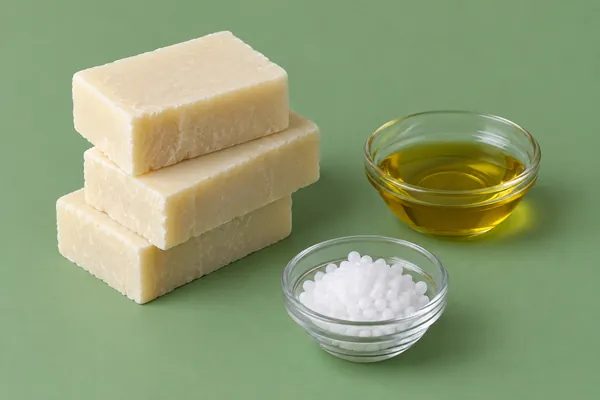
Superfat and lye discount: why recipes leave some oil unsaponified
What superfat and lye discount mean, how the calculator applies them, where makers set them for each soap, and why oil added at trace isn't the oil left over.
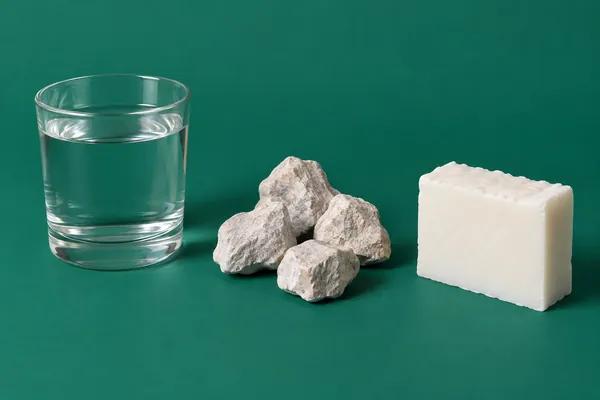
Soap in hard water: scum, chelators and rinse
Why soap turns to scum in hard water, how much soap each litre wastes, what a chelator in the bar can and cannot do, and why coconut soap copes best.
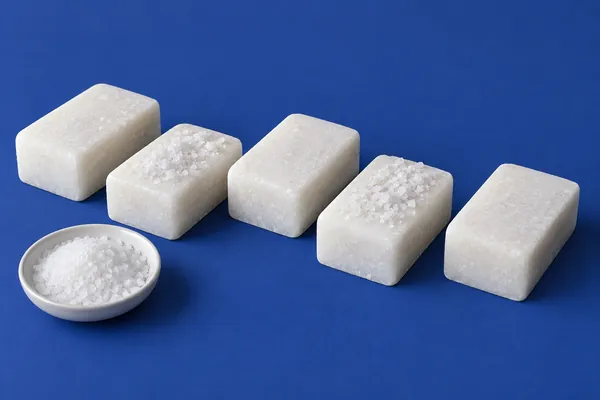
Salt bars: spa soap with sea salt
Why salt bars are mostly coconut oil at a 15 to 20 % superfat, how much salt to use and which to avoid, when to cut them, and how brine bars differ.
Where these proportions come from
Craft convention: a 100 % coconut bar needs a superfat around 20 % to be usable on skin, and is a laundry bar below about 5 %. Coconut and palm kernel oil were the soap trade's fats for marine soap, because their soaps dissolve in brine and lather in sea water, as Simmons and Appleton recorded in 1908.