Three-colour hanger swirl bar
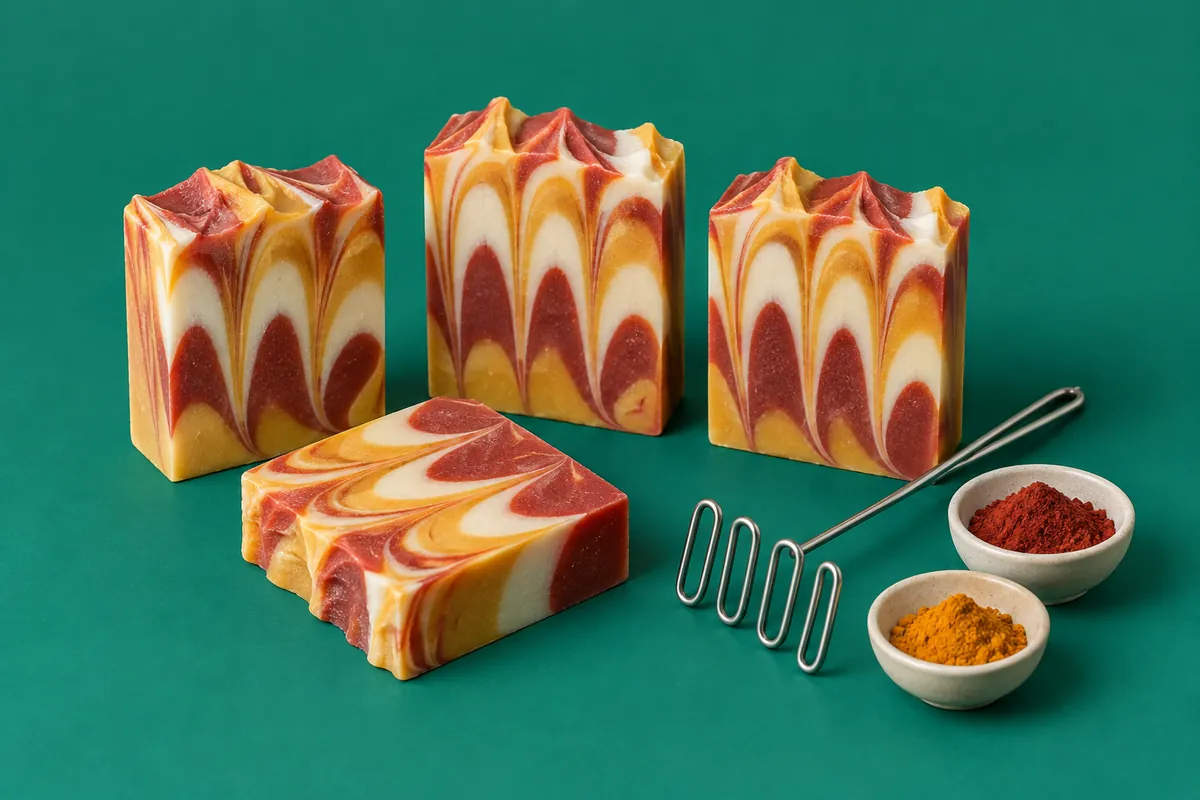
Brick red, ochre and white poured in thin layers and pulled into loops with a bent-wire hanger, so every bar carries a row of warm arches. The oils are our slow swirl blend, and these three colours blend to peach and orange where they meet, never to mud.
- Skill
- Intermediate
- Method
- Cold process
- Batch
- 900 g of oils about 1340 g of batter
- Hands-on
- 1 h 30 min
- Cure
- 6 weeks
- Gel phase
- Yes insulate the mould
What you need
For 900 g of oils, which fills a 25 × 9 cm loaf mould filled 6 cm deep (about 1.4 litres), with a wire hanger tool. Weigh everything, liquids included.
| Olive Oil · 45.0 % | 405 g | 14.29 oz |
| Coconut Oil · 25.0 % | 225 g | 7.94 oz |
| Sunflowerseed Oil - High Oleic Acid · 20.0 % | 180 g | 6.35 oz |
| Shea Butter · 10.0 % | 90 g | 3.17 oz |
| Sodium hydroxide (NaOH) · the lye, 100 % pure | 125.3 g | 4.42 oz |
| Distilled water · for a 31 % lye solution | 278.8 g | 9.84 oz |
| Titanium dioxide · 1.25 tsp, white portion, dispersed in 20 g of the recipe's olive oil | 5.9 g | 0.21 oz |
| Yellow iron oxide · 0.75 tsp, ochre portion, dispersed in 14 g of the recipe's olive oil | 1.5 g | 0.05 oz |
| Red iron oxide · 0.38 tsp, brick portion, dispersed in 14 g of the recipe's olive oil | 1.6 g | 0.06 oz |
| Lavender oil · 2.0 % of the oils, at trace | 18 g | 0.63 oz |
| Peppermint oil · 1.0 % of the oils, at trace | 9 g | 0.32 oz |
- Superfat
- 5 %
- Temperatures
- Oils and lye solution at 32 to 38 °C (90 to 100 °F)
Method
-
Bend the hanger tool
Bend a wire coat hanger, or a length of coated 10-gauge copper wire, into a flat loop whose bottom run spans the inside width of the mould, 9 cm, less a few millimetres, with a handle rising at one side above the rim. Wrap the loop in tape, or slip aquarium tubing over it, for bolder loops. -
Get ready
Put on goggles, gloves and long sleeves and open a window. Line the mould, set it level, and stand the hanger in it with the loop flat on the bottom against one end wall and the handle up; placed now, it leaves no drag mark. -
Disperse the colours
Weigh the olive oil and take 48 g of it for the colours. Stir the titanium dioxide into 20 g in a small cup, the yellow oxide into 14 g in one jug and the red oxide into the last 14 g in another, until a smear on a white plate shows no grains. -
Make the lye solution
Where the air moves, pour the 125.3 g of sodium hydroxide slowly into the 278.8 g of water, never the reverse, and stir until clear. Leave it labelled and out of reach to cool to 32 to 38 °C (90 to 100 °F). -
Melt and scent the oils
Melt the coconut oil and shea butter gently, add the rest of the olive oil and the sunflower oil, and cool to 32 to 38 °C (90 to 100 °F) while the oils stay clear. Stir in the lavender and peppermint oils. -
Blend to light trace
Pour the lye solution in down the blender shaft, tap out trapped air, and blend in short pulses with stirring between until light trace: thin custard that holds a faint line for a few seconds. -
Split and colour
Weigh 385 g of batter into the ochre jug and 385 g into the brick jug and whisk each smooth. Whisk the white into the batter left in the pot, about 510 g. -
Pour thin layers
Pour about 100 g of brick along the whole length of the mould from just above the surface, then 100 g of ochre, then 130 g of white, and repeat until all three are used, about four rounds. Keep the spout low so each colour spreads as a layer instead of plunging. -
Swirl with the hanger
Starting at the end where the loop lies, lift it to just under the surface and push it back to the bottom a finger's width further along. Repeat all the way to the far end, keeping the loop under the surface the whole time. -
Lift it out and finish the top
Lift the hanger straight out at the far end. Draw a chopstick through the top 1 cm in a zigzag across the width, working down the length, or leave the top as it is. -
Cover so it gels
Tap the mould, cover it with a board or lid and wrap it in a towel, two if the room is below about 24 °C (75 °F), for a day, so the whole loaf gels and the oxides come out deep. At a 31 % lye solution a full gel leaves the white clear of glycerin rivers. -
Unmould and cut
Unmould with gloves on after 2 to 3 days, once firm: a liquid-oil recipe sets slowly. Cut bars about 2.5 cm (1 in) thick across the loaf, so each face shows the loops. -
Cure
Stand the bars on edge with air between them, out of direct sun, for 6 weeks, turning them every few days.
Tips
- Practise the stroke in the empty mould first: the loop must lie flat and clear the walls, or it drags colour up the sides.
- Red oxide is strong. Keep it to about ½ teaspoon per 450 g (1 lb) of soap in any portion, or it tints the lather.
- If the batter thickens before the last round, spoon the rest on in dollops; the hanger still pulls loops through thicker layers, just broader ones.
- Once you have the up-and-down stroke, try Fisher's other patterns with the same pour: a horizontal zigzag, a plunge and swoop, or curls.
The oils
| Oil | Share |
|---|---|
| Olive Oil (virgin / refined / olive oil) | 45.0 % |
| Coconut Oil | 25.0 % |
| Sunflowerseed Oil - High Oleic Acid | 20.0 % |
| Shea Butter | 10.0 % |
How it is made
| Process | Cold process |
| Alkali | NaOH |
| Superfat | 5 % |
| Water | lye water at 31 % |
| Iodine value | 62 |
| INS | 143 |
Why make it
A design project first: thin layers pulled into rows of loops with a bent wire, the technique makers use to move from simple pours to controlled patterns. The warm palette is chosen so the colours blend to peach and orange where they touch rather than to mud, and the iron oxides and titanium dioxide are mineral pigments, listed for cosmetics by the US Food and Drug Administration, that hold steady in lye. Underneath it is a slow, palm-free everyday bar, cleansing 17 and conditioning 63 on our scale, mild with a modest lather, scented with lavender and a little peppermint. Leave the scent out for sensitive skin. All that liquid oil makes it soft at first, so it needs the full six weeks.
Sources
- Summary of color additives for use in the United States in foods, drugs, cosmetics, and medical devices · U.S. Food and Drug Administration, 2025
What tradition, makers' experience and research say about soaps like this, each labelled for what it is. It is not medical advice, and no soap treats a skin condition: if you have one, ask a doctor or pharmacist.
What the numbers say
- Lauric acid 12.3 %
- Myristic acid 4.7 %
- Palmitic acid 9.5 %
- Stearic acid 7.1 %
- Oleic acid 54.2 %
- Linoleic acid 8.5 %
- Other 5.3 %
Saturated : unsaturated 37 : 63
Computed from the fatty acids of the fats above. The bands are what the craft has settled on, not chemistry — a bar outside one is not wrong.
From the guides
All guides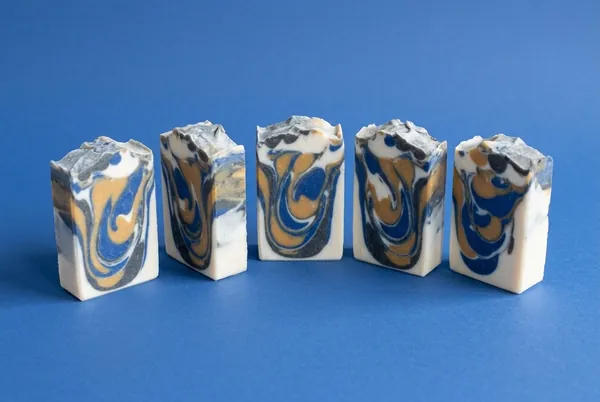
Swirl techniques: in the pot, drop, hanger, spoon and Taiwan
Seven cold-process swirls step by step, with the batter, recipe and temperatures that keep soap fluid, and why swirls turn muddy or lumpy.
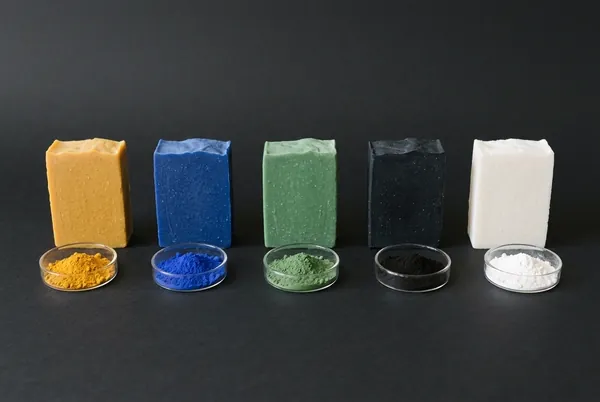
Colouring soap: micas, oxides, ultramarines and pigments
Which colourants survive cold-process soap, how much to use per 500 g of oils, how to disperse and split colour, and what the EU, UK and US rules ask.
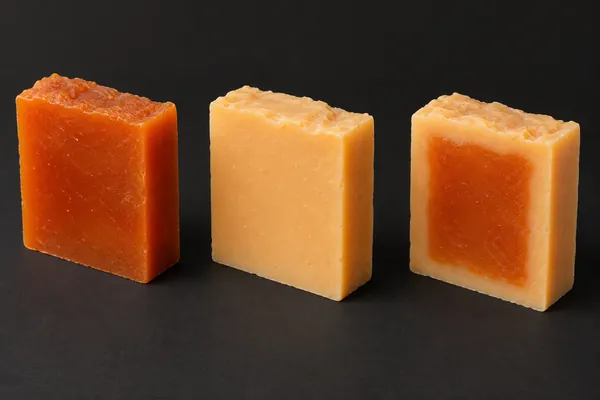
Gel phase: to insulate or keep it cool
What gel phase is, why a loaf turns dark and translucent, how gelled and ungelled bars differ, why partial gel is cosmetic, and how to cause or prevent it.
Where these proportions come from
The slow palm-free recipe from our swirl guide, mostly liquid oils with no castor, at a 31 % lye solution for working time; the hanger swirl follows David Fisher's up-and-down pattern, with the tool set in the empty mould first as Anne-Marie Faiola does.
Formulation adapted from The Complete Photo Guide to Soap Making by David Fisher (Creative Publishing International, 2018); Soap Crafting by Anne-Marie Faiola (Storey Publishing, 2013). The method and notes are ours.