In short
- Saponification gives off heat. A loaf that keeps enough of it turns dark and translucent from the middle outwards: that is gel.
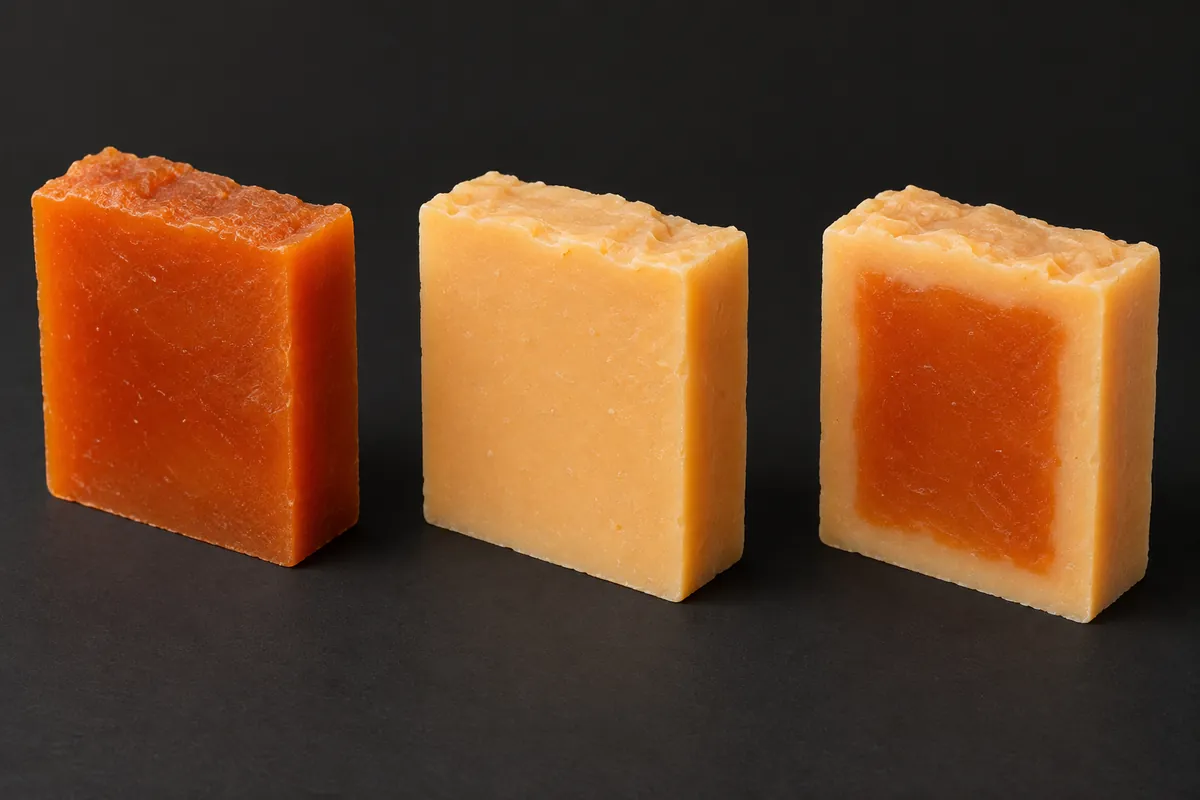
- Gelled and ungelled soap are equally safe and, once cured, equally hard. Gel is mostly about looks: brighter colours and a slight sheen, where ungelled soap is paler and creamier-looking.
- A dark centre inside a pale ring is partial gel: the edges lost their heat first. It is only cosmetic, and makers differ on whether it can be evened out afterwards.
- To gel, soap warmer and insulate, or use a warm oven switched off. To prevent it, soap cooler, use small moulds or chill the mould straight after pouring.
- Keep soaps with milk, honey, sugar, purées, beer or wine cool: they add heat of their own and scorch.
On this page
Saponification gives off heat, and a loaf of soap is good at keeping it. Within a few hours of pouring, the middle of an insulated loaf can get hot enough to turn dark, glossy and translucent, like jelly, and the change spreads outwards towards the edges. Soapmakers call it gel phase, or just gel. Over the next day the loaf cools, turns opaque again and firms up, and you cut it just as you would a loaf that never gelled. Whether yours gels is up to you. This guide explains what decides it and how to steer it.
What gel is
Anne-Marie Faiola describes gel as the soap reaching and holding a temperature 22 to 33 °C (40 to 60 °F) above the one it was poured at. In her later Pure Soapmaking she gives it as a temperature: soap “typically gels when it reaches a temperature above 140°F (60°C) in the mold”, and most recipes mixed at 49 °C (120 °F) or above gel without help. Whether a loaf gets there depends on how much heat it makes and how fast it loses it:
- Size and shape. A big loaf keeps its heat; a thin slab or a single-bar mould loses it quickly. Individual cavity moulds seldom gel on their own; Alicia Grosso helps them by stacking the filled moulds in a lidded plastic box, the soaps above clear of those below, and wrapping the box in towels.
- The mould. A thick wooden mould, a lined box and anything wrapped in towels keep heat in; thin silicone and plastic less so.
- The starting temperature and the water. Batter poured warm reaches gel sooner, and so, Dunn found, does batter with more water in it.
- The room. A warm room lets the loaf keep its heat; a cold one draws it away.
- The recipe. Sugars, honey and milk add heat as they react; so, in makers’ experience, do some fragrances and spices.
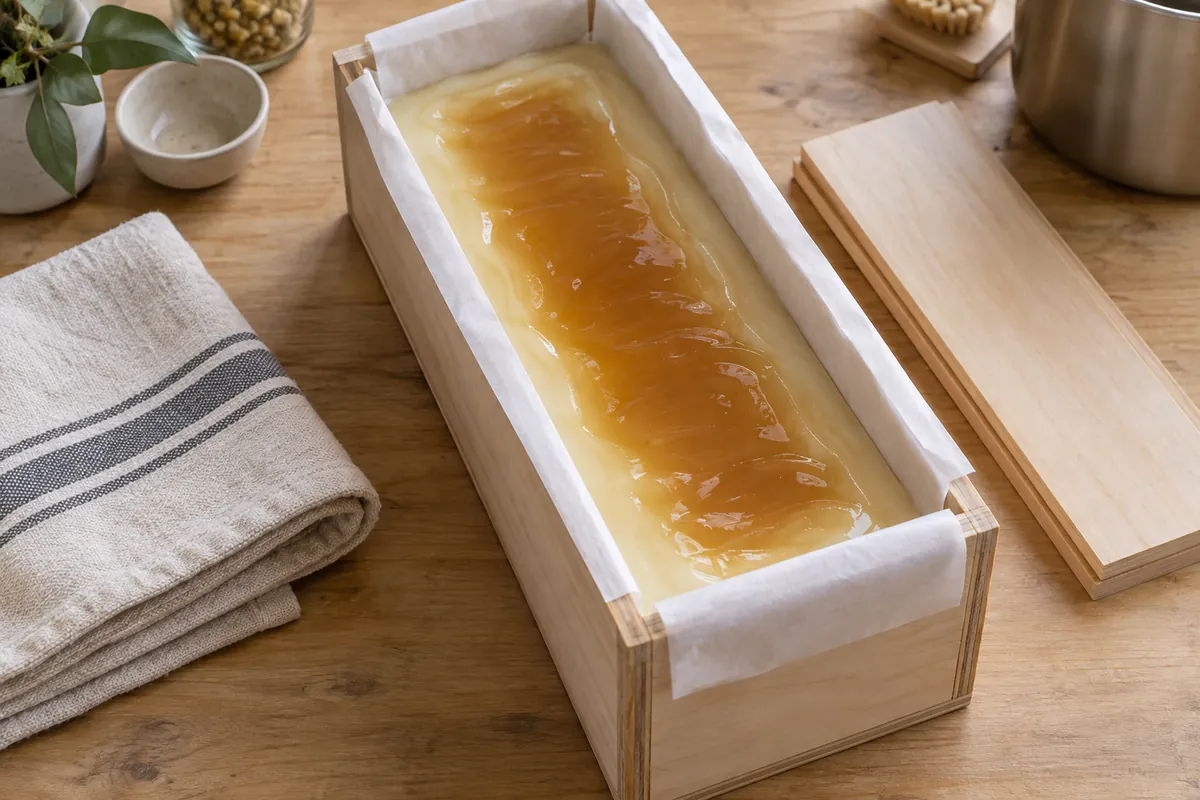 Gel under way: the middle of the loaf has turned dark and translucent, and the change is spreading towards the pale edges.
Gelled or ungelled: what changes
| Gelled | Ungelled | |
|---|---|---|
| Look | A slight sheen and translucency; colours deeper and brighter | Matte and opaque; colours paler and more pastel |
| Hardness | The same once cured; some makers find it firms up a little sooner | The same once cured; can feel a little softer for the first few days |
| Soda ash | Less likely | More likely |
| Safety | The same | The same |
From Faiola, Cable and Kevin Dunn’s tests. Anne Watson, testing her own recipes, found no difference in texture.
Neither is the better soap. Dunn made one recipe at different starting temperatures, so that some bars gelled and some did not, and found the same consistency, alkalinity and hardness; they differed only in how they took up water when soaked. Gel is mostly a matter of looks: brighter colours if you want them, a whiter bar if you don’t. Cable finds gelled soap dries a little faster, but both need the usual four to six weeks of cure. A loaf does not have to gel to become soap; kept cool, it just gets there more slowly. If you want the whitest bar you can get, for a plain white soap or a milk soap, keep it cool, because gel darkens the base colour.
Partial gel
When the middle of a loaf gels and the outside doesn’t, the cut bars show a darker, glossier centre inside a paler ring, or darker streaks through the middle. The outside of the loaf lost its heat to the air and the mould before the gel could spread that far. It is purely cosmetic: the soap is as safe and as good as a bar that gelled all the way or not at all.
Makers differ on whether it can be fixed. Cable says there is no fix once it has happened. Classic Bells warms partially gelled soap, cut bars included, at the oven’s lowest setting (about 63 to 77 °C, 145 to 170 °F) for an hour or so, and finds the ring may soften, though it may not disappear. Either way, next time insulate more so the whole loaf gels, or keep it cool so none of it does. Cable, for one, often likes the look.
How to make a loaf gel
- Soap at the warm end of your recipe’s temperature window.
- Cover the mould with its lid or a board and wrap it in a towel or a blanket, or set it inside a cardboard box. Cable’s rule of thumb: in a room above about 24 °C (75 °F), a lid and a towel are enough; below that, use a blanket or two or three towels. Our three-colour hanger swirl bar is wrapped this way so its oxides come out deep, and our madder and alkanet swirl so its madder turns red, not mauve.
- For extra warmth, Faiola sets the wrapped mould on a heating pad on low for 30 minutes, then switches the pad off and leaves the soap on it. Madder, alkanet and indigo show their best colour only after a hot gel, so for those she soaps at 49 to 54 °C (120 to 130 °F), insulates, and runs the pad on medium for 30 minutes to an hour, checking often for cracks, bubbling or the soap rising.
- Or use the oven, a method known as cold process oven process (CPOP). Put the mould, covered with its lid or a sheet of baking paper, in an oven at about 77 °C (170 °F), then turn the oven off and leave the door shut while it cools. Anne Watson holds it at that heat for two hours first; Cable leaves it until the whole loaf has gone dark. Use only oven-safe moulds (silicone, not cardboard), and Watson warns that some wooden moulds darken in the oven.
How to keep a loaf from gelling
- Soap at the cool end of the window, but warm enough that the hard fats stay melted (see false trace).
- Use small or individual moulds, which lose heat quickly.
- Leave the mould uncovered or lightly covered in a cool room. A fan helps.
- Chill it straight after pouring. Heidi Corley Barto puts her loaves in the fridge overnight, uncovered for the first 30 minutes and covered after that; Faiola uses the freezer for soaps with purées, and puts her buttermilk and honey soap in it straight after pouring so the sugars can’t scorch; her almond and coconut milk soaps stay there 8 to 12 hours, then stand a day or two at room temperature before unmoulding. Let the soap come back to room temperature before you unmould and cut it, and let any condensation dry off before you store the bars.
Soap kept cold sets more slowly, so it may need an extra day in the mould, and Faiola finds cold soap more prone to soda ash.
When to keep it cool
Milk, honey, sugar, fruit and vegetable purées, beer, wine and juice add heat of their own. In a gelling loaf they can overheat the batch, which discolours and can smell burnt, and the loaf can crack or even erupt from the mould. Cable doesn’t insulate any of these and soaps them cooler, as our goat milk, oat and honey bar and pumpkin spice bar do; David Fisher mixes heat-prone batches at 32 to 38 °C (90 to 100 °F) and doesn’t over-insulate them. He counts some essential oils and spices among the ingredients that heat a batch, so try a new scent in a small, uninsulated batch first. The guides to milk soap, purées and other liquids cover each.
When gel goes too far
An overheated loaf shows it: cracks across the top, a raised and wrinkled surface that makers call alien brains, a volcano where hot soap has broken through, or tunnels inside the loaf. Translucent streaks called glycerin rivers are related; Faiola links them to heat together with titanium dioxide and oxide colours, and suggests soaping about 5 °C (10 °F) cooler. Most of this is cosmetic, and the glycerin rivers and cracks guide goes through it. If you catch a loaf overheating, uncover it and move it somewhere cool or into the fridge, as Cable advises, and be ready for it to overflow.
Recipes to try
All recipesSources
- Soap Crafting . Anne-Marie Faiola, Storey Publishing , 2013. Gel as a loaf holding 40 to 60 °F above its pouring temperature; gelled and ungelled bars compared; a heating pad to force gel, the freezer to prevent it; cold rooms and soda ash; glycerin rivers.
- Pure Soapmaking . Anne-Marie Faiola, Storey Publishing , 2016. Gel above 140 °F (60 °C) in the mould, natural in most recipes mixed at 120 °F or above; madder, alkanet and indigo soaped at 120–130 °F with a heating pad on medium for 30 to 60 minutes; the freezer straight after pouring for a buttermilk and honey soap, and for 8 to 12 hours for almond and coconut milk soaps.
- Smart Soapmaking . Anne L. Watson, Shepard Publications , 2013. Gel is not needed for soap to set; no texture difference in the author's tests; the oven method at about 77 °C (170 °F) for two hours.
- The Natural Soap Making Book for Beginners . Kelly Cable, Althea Press , 2017. Partial gel is cosmetic with no fix; insulating by room temperature; forcing an even gel in a 170 °F oven; no insulation for sugar-rich soaps.
- The Everything Soapmaking Book, 3rd edition . Alicia Grosso, Adams Media , 2013. Gelling soap in cavity moulds by stacking them in a lidded, towel-wrapped box.
- Time and Temperature in Soapmaking . Kevin M. Dunn, lecture to the Handcrafted Soapmakers Guild , 2009. Soaps from one recipe, gelled and ungelled, had the same consistency, alkalinity and hardness, and differed only when soaked in water; the mould, starting temperature, water, oils and additives decide the peak temperature.
- Rescue oven processing . Classic Bells, Soapy Stuff . Warming set soap, cut bars included, at the oven's lowest setting (145-170 °F) for an hour or so may soften the ring of a partial gel; no guarantee it disappears.
- The Natural Soap Chef . Heidi Corley Barto, Ulysses Press , 2012. Preventing gel by refrigerating the poured loaf overnight; bringing it back to room temperature before unmoulding.
- The Complete Photo Guide to Soap Making . David Fisher, Creative Publishing International , 2018. Heat-prone ingredients, mixing at 32 to 38 °C (90 to 100 °F), and the signs of an overheated loaf.
- Structure of the Liquid-Crystal Phases of the Soap-Water System: Middle Soap and Neat Soap . Luzzati V., Mustacchi H., Skoulios A., Nature 180, 600-601 , 1957. The liquid-crystalline phases soap and water form when heated together.
- Beyond Clean: Unraveling Phase Behavior and Rheology of Soaps . Joshi Y. M., Moaddel T., Raut J. S., Annual Review of Chemical and Biomolecular Engineering 17 , 2026. Soap-water phases from micellar to liquid-crystalline, and how they flow.