In short
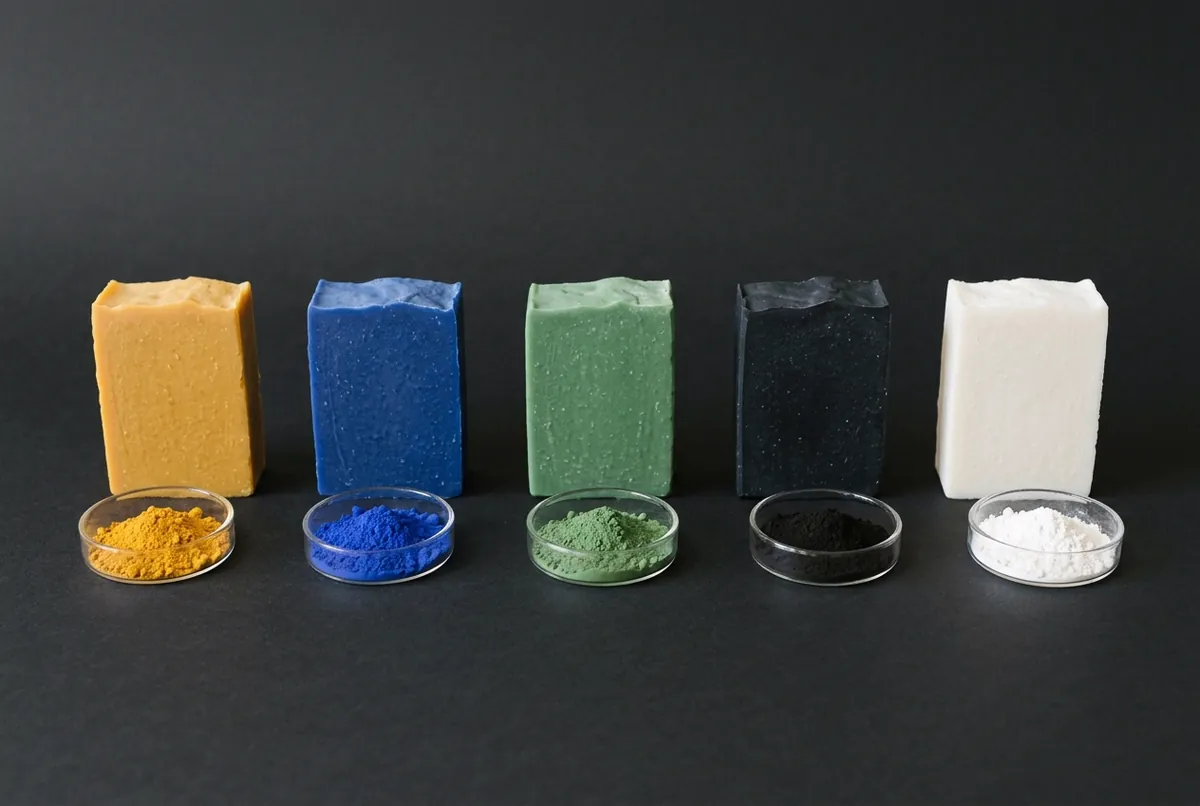
- Oxides, ultramarines, chromium greens and titanium dioxide are stable in soap. Dyes bleed, lake colours come apart in alkali, and a mica behaves like its coating.
- For a full colour through 500 g of oils, start near 1 teaspoon of an oxide or ultramarine, 3 of mica or 1½ of titanium dioxide, and weigh when you can.
- Disperse every powder before it meets the batter: 1 teaspoon in 1 tablespoon of liquid oil taken out of the recipe.
- A colour portion gets the dose for its share of the batter: a quarter of the batter, a quarter of the colour.
- Gel phase deepens colour. Glycerin rivers come with a weak lye solution and a full gel, and pigment, titanium dioxide above all, makes them show.
- In the EU and UK every colourant must be on Annex IV and is labelled by CI number. In the US a true soap is outside the cosmetic colour rules; a soap with cosmetic claims is not.
On this page
- What survives soap’s alkali
- Oxides, chromium greens and ultramarines
- Micas
- Dyes and lakes
- The ones that fail outright
- How much to use
- Dispersing powders
- Splitting the batter into colour portions
- Titanium dioxide
- Glycerin rivers
- The cracking myth
- The powder itself
- Test the colour, and expect gel to change it
- What the law asks
- EU and UK
- US
Most colour problems in soap come from a colourant that cannot survive the alkali, or from a dose worked out for the wrong amount of batter. This guide takes the families first, then the doses, then the practical part: dispersing the powder and splitting the batter. Plant colours and clays have their own guide, natural colourants.
What survives soap’s alkali
Cold-process batter is strongly alkaline until the lye is used up, and a cured bar still measures around pH 9 to 10 (the pH guide explains why). A colourant for soap has to tolerate that, and the heat of gel phase on top. The mineral pigments do. Many organic dyes do not.
| Family | Examples, with CI numbers | In cold-process soap |
|---|---|---|
| Iron oxides | red CI 77491, yellow CI 77492, black CI 77499 | Stable. Strong, matte colour; specks if not dispersed; too much colours the lather |
| Chromium greens | chromium oxide green CI 77288, hydrated chromium oxide green CI 77289 | Stable. The hydrated one is the brighter, bluer green |
| Ultramarines | blue, violet and pink, all CI 77007 | Stable in alkali. Acid breaks them down |
| White pigments | titanium dioxide CI 77891, zinc oxide CI 77947 | Stable. Titanium dioxide is much the stronger white |
| Micas | mica coated with titanium dioxide, iron oxides or dyes | As stable as the coating |
| Dyes | FD&C and D&C colours, often sold as concentrated liquids | Bleed across lines and swirls; many change or fade in fresh soap |
| Lake colours | a dye fixed on aluminium hydroxide | The aluminium hydroxide dissolves in alkali and the dye comes off |
| Manganese violet | CI 77742 | Destroyed by strong alkali; turns grey |
Stability as the colour suppliers and the books in the sources report it. The lake mechanism is from Desai and colleagues (1993); manganese violet from ColourLex.
Oxides, chromium greens and ultramarines
These are the workhorses. The iron oxides sold for cosmetics are made synthetically, and US rules allow only synthetic ones in cosmetics (21 CFR 73.2250), because mined oxides carry heavy metals such as lead and arsenic. They give colour that does not move or morph, like the brick red and ochre of our three-colour hanger swirl bar. Their faults are physical: they clump, and a clump that reaches the batter shows as a coloured speck in the cut bar or a streak in the lather.
Ultramarines are pigments fired at over 700 °C, and they are the most dependable blues and violets for cold process. Their weakness is acid, not alkali: acid breaks them down and releases hydrogen sulfide, the rotten-egg smell. That matters in acidic products, not in soap.
Micas
A cosmetic mica is a flake of the mineral with a coating that carries the colour and the shine. The coating decides how it behaves, and, as Susan Miller Cavitch explains, its thickness decides the colour: the tint of a pearlescent mica comes from how thick its layer of titanium dioxide or iron oxide is. A gold mica can be three-quarters mica and a quarter titanium dioxide with a little iron oxide, and coatings like that hold in soap. Micas tinted with dyes, lakes or carmine are the ones that shift: Faiola lists blues that turn purple, greens that turn coral, and micas that fade to nothing. A good supplier says whether a mica is stable in cold process; if yours doesn’t, test it.
Shimmer needs light to travel into the soap and back, so mica sparkles in clear melt and pour and looks muted in opaque cold process. It still gives colour, and it shows best on tops and in pencil lines, where it sits on a surface.
Craft glitter, craft micas, crayons, candle dyes, fabric dyes and paints are not made to cosmetic purity and have no place in soap.
Dyes and lakes
Dyes dissolve, so in soap they travel: a crisp line of dye-coloured batter blurs into its neighbours. That can be the design (Faiola builds an ombre loaf on exactly this bleed), but it rules dyes out for sharp swirls and layers. Many FD&C dyes also change or lose their colour in fresh soap, so test each one in your own recipe.
A lake is a dye made insoluble by fixing it on aluminium hydroxide. Lakes are built for products near neutral: aluminium hydroxide dissolves in strong alkali, and as it goes the dye bleeds away. In cold process, expect lakes to bleed and fade.
The ones that fail outright
Manganese violet, a cosmetic purple pigment, goes grey in cold process, because strong alkali destroys it. Bright neon colourants vary by make: read the supplier’s notes on cold-process stability and on where each is permitted before you build a design around one.
How much to use
A dose only means something against the amount of batter it colours. The figures below are the doses the lye calculator fills in when you add a colourant, from the suppliers’ published rates, worked out for 500 g (17.6 oz) of oils in a batch of about 725 g: the palm-free classic at a 33 % lye solution with 3 % fragrance. Each is for a full colour through the whole batch. Less gives a lighter shade.
| Colourant | For 500 g of oils | Disperse in |
|---|---|---|
| Titanium dioxide, oil-dispersible | 1½ tsp (7.6 g) | liquid oil |
| Titanium dioxide, water-dispersible | 1 tsp (3 g) | water |
| Red iron oxide | ¾ tsp (3.4 g) | liquid oil |
| Yellow iron oxide | 1 tsp (2.2 g) | liquid oil |
| Black iron oxide | 1 tsp (5.2 g) | liquid oil |
| Ultramarine blue, violet or pink | 1 tsp (4.6 g) | liquid oil |
| Chromium oxide green | 1 tsp (5.4 g) | liquid oil |
| Mica | 3 tsp (5 g) | liquid oil or glycerin |
| Activated charcoal | ⅜ tsp (0.9 g) | liquid oil |
Suppliers’ rates per pound of oils or of soap, as the calculator applies them to this batch. The grams come from each powder’s published bulk density.
The red figure is lower than the other oxides’ because Wholesale Supplies Plus advises half as much red or brown oxide as other colours, and half a teaspoon per pound of soap at most. The spoon measures are the least reliable part of the table: a level teaspoon of yellow oxide can weigh 1 g and one of black oxide 6 g, depending on the grade and how it packs. A scale that reads to 0.01 g, sold for jewellery, costs little and makes colours repeatable. Heavy doses of any pigment start to colour the lather.
Oxides mix like paints: yellow and blue for green, red and blue for purple, yellow and red for orange. Letcavage and Buck start with the lighter colour and blend the darker into it. Purple is the hard case. Alicia Grosso finds violet greys out against the yellowish tint of fresh soap, but warns against overcorrecting, because the yellow fades as the soap cures.
Dispersing powders
Pigments are fine enough to clump, and a dry clump stirred into batter never breaks up. Every powder should be wetted and dispersed before it meets the batter, ideally before you mix the lye and oils, because once the batter is made the clock is running.
- Measure the powder into a small cup, one cup per colour.
- Add the liquid. Oxides, ultramarines, micas, charcoal and oil-dispersible titanium dioxide take about 1 tablespoon (15 mL) of light liquid oil per teaspoon of powder. Clays and water-dispersible titanium dioxide go into water instead, about three times their weight, held back from the recipe’s water.
- Wet it before you mix. Push the powder under the liquid with the head of a mini frother or a spoon before you switch on, so it does not puff into the air.
- Mix until smooth. Smear a drop on a white plate: you should see no grains.
- Stir again just before use. Pigment settles as the cup stands.
Books differ on the liquid. Anne-Marie Faiola, like this guide, uses 1 part pigment to 3 of light oil. Letcavage and Buck stir oxide into three times its volume of glycerin at least 24 hours ahead, “in order to fully hydrate the dry powder colorant”. Grosso wets a pinch in a teaspoon of warm water, then blends in 2 tablespoons of traced batter before stirring it back.
Faiola keeps leftover oil dispersion in the fridge and throws it out after a month. Clay slurries do not keep: wet clay can grow mould, so mix it fresh. Glycerin disperses micas and most pigments well and adds no oil, but avoid it for titanium dioxide in a high-water recipe, where glycerin makes glycerin rivers worse.
For a solid colour through the whole batch, stir the dispersion into about 2 cups (500 mL) of batter first, then pour that back into the pot and stir it through. Colour added straight to a full pot tends to come out blotchy. For a batch all of one colour, Grosso stirs oxide or ultramarine into the lye water instead, so it spreads through everything; stir it again before it goes in, because pigment settles.
Splitting the batter into colour portions
A swirl or a layered bar is one batch split into portions, each coloured separately. Doing the split by weight rather than by eye is what makes a design repeatable, and it tells you exactly how much colour each portion needs.
Start from the whole batter: oils, lye solution and fragrance together. The calculator shows it as the batch weight; for 500 g of oils in the recipe above it is about 725 g. Then choose the split. Faiola’s linear swirl uses a 40 % base and three 20 % accents; her fire-drop swirl pours 75 % as a white base and divides the other 25 % among five squeeze bottles. Half base and two quarters is an easy start:
| Portion | Share | Batter | Colour |
|---|---|---|---|
| White base | 50 % | 362 g | ¾ tsp titanium dioxide (3.5 g) |
| Blue | 25 % | 181 g | ¼ tsp ultramarine blue (1 g) |
| Gold | 25 % | 181 g | ¾ tsp mica (1.2 g) |
The colour follows the portion: a portion that is a quarter of the batter takes about a quarter of the full-batch dose from the table above for the same depth of colour. Our blue and gold drop swirl bar uses these three colourants.
Stand each jug on the scale, tare it and pour its share. Add the dispersed colour and whisk. Use the stick blender only in short pulses, and only if specks remain, because blending thickens batter fast; Faiola gives each jug about 2 seconds, working from the lightest colour to the darkest. If your fragrance is new to you or known to speed trace, colour the portions first and add the fragrance last, so that a batch which thickens is at least evenly coloured.
Let the calculator do the grams. This link loads the 500 g recipe with the three colours above; it converts the teaspoons to grams and checks each against its sources.
Open it in the calculatorTitanium dioxide
Titanium dioxide is the white in white soap and the base that makes swirl colours stand out. It is also the cleaner way to a pastel: a little white dispersion in a coloured portion gives a clearer tint than simply using less colour, which lets the soap’s own ivory show through. Our ombre layers bar steps from deep blue to white by mixing a blue oil and a white oil in set proportions.
It dissolves in neither oil nor water. Pigment makers treat the particle surfaces so that one grade disperses in oil and another in water, which is why the calculator lists them separately. Use each in its own liquid. Titanium dioxide is also prone to clumping, and undispersed powder shows as white specks, so give it longer with the frother than the other colours.
The calculator suggests 1 teaspoon per pound of soap for a full white, which is about 1½ teaspoons (7.6 g) for 500 g of oils, and one supplier gives the same figure as the most to use.
Glycerin rivers
Glycerin rivers are translucent, branching veins through a pale or coloured bar, easiest to see against titanium dioxide. Tests reported by Wholesale Supplies Plus found them only when a weak lye solution, below about 31 %, met a full gel, with a pigment in the soap to show them. The longer the soap stayed in gel the bigger the rivers grew, and pigment dispersed in glycerin made them worse. So the remedies follow: a lye solution of 31 to 33 %, keeping the loaf out of a full gel, and dispersing in oil. Faiola adds soaping about 5 °C (10 °F) cooler. The bar is perfectly sound either way; glycerin rivers and cracks has the detail.
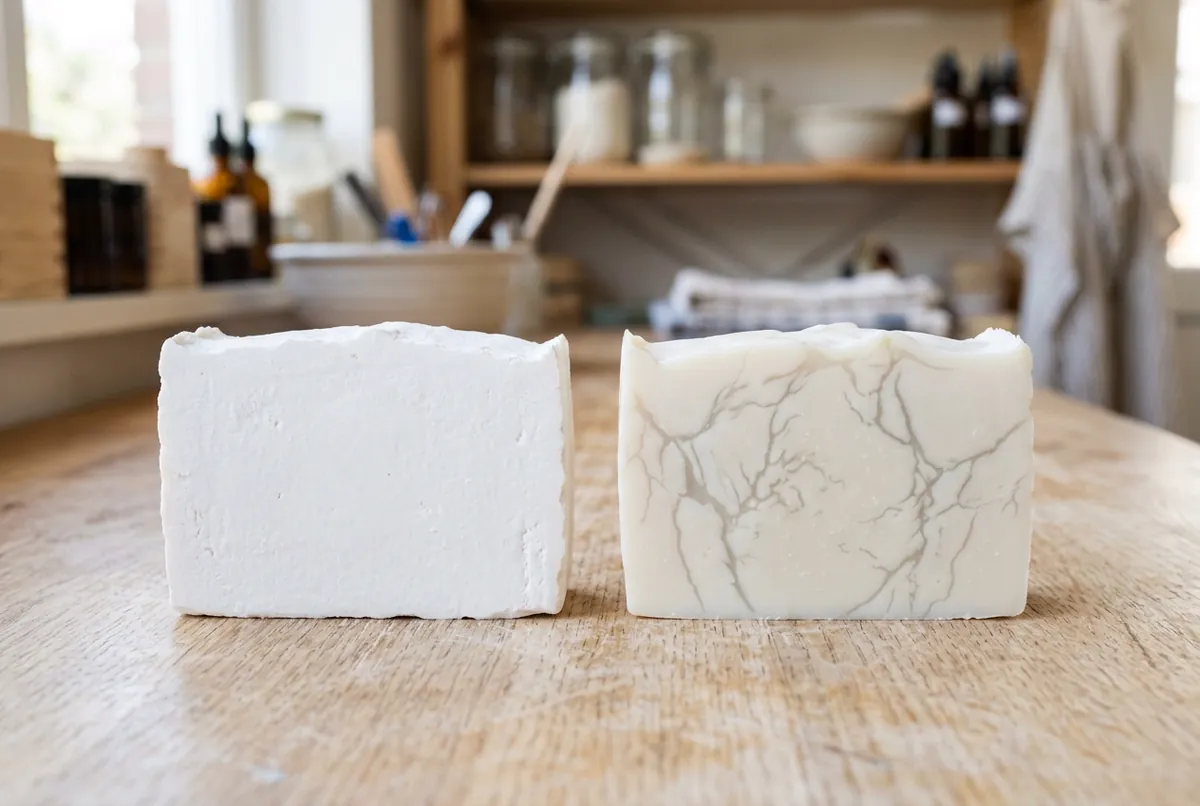 Glycerin rivers (right): translucent veins that show against a titanium dioxide white after a hot, high-water gel.
The cracking myth
You will read that titanium dioxide makes soap crack. The veined, crazed look people have in mind is glycerin rivers: a visual effect in the bar, not a crack through it. Real cracks come from heat, when a loaf overheats in gel, and from drying the top with too much alcohol spray. A white soap cracks for the same reasons as any other.
The powder itself
The safety question about titanium dioxide is breathing the dry powder. In 2019 the European Commission classified some powder forms as suspected of causing cancer by inhalation; the EU General Court annulled that classification in November 2022, and the Court of Justice upheld the annulment on 1 August 2025. EU cosmetics rules still keep titanium dioxide and zinc oxide powders out of products whose use could get them into the lungs. None of this concerns a bar of soap, which cannot be breathed in. It concerns you, measuring fine powder: scoop gently, wet it under oil before switching the frother on, and wear a dust mask when you handle any dry pigment.
Test the colour, and expect gel to change it
The colour at trace is not the colour of the bar. Gelled soap is more translucent, and its colours come out deeper and brighter; soap that stays out of gel looks paler and creamier. Faiola stands some bright designs on a heating pad for 30 minutes to push them into a hotter gel. A loaf that gels only in the middle shows a darker centre and paler edges, so decide on gel or no gel for the whole loaf (gel phase explains how to control it).
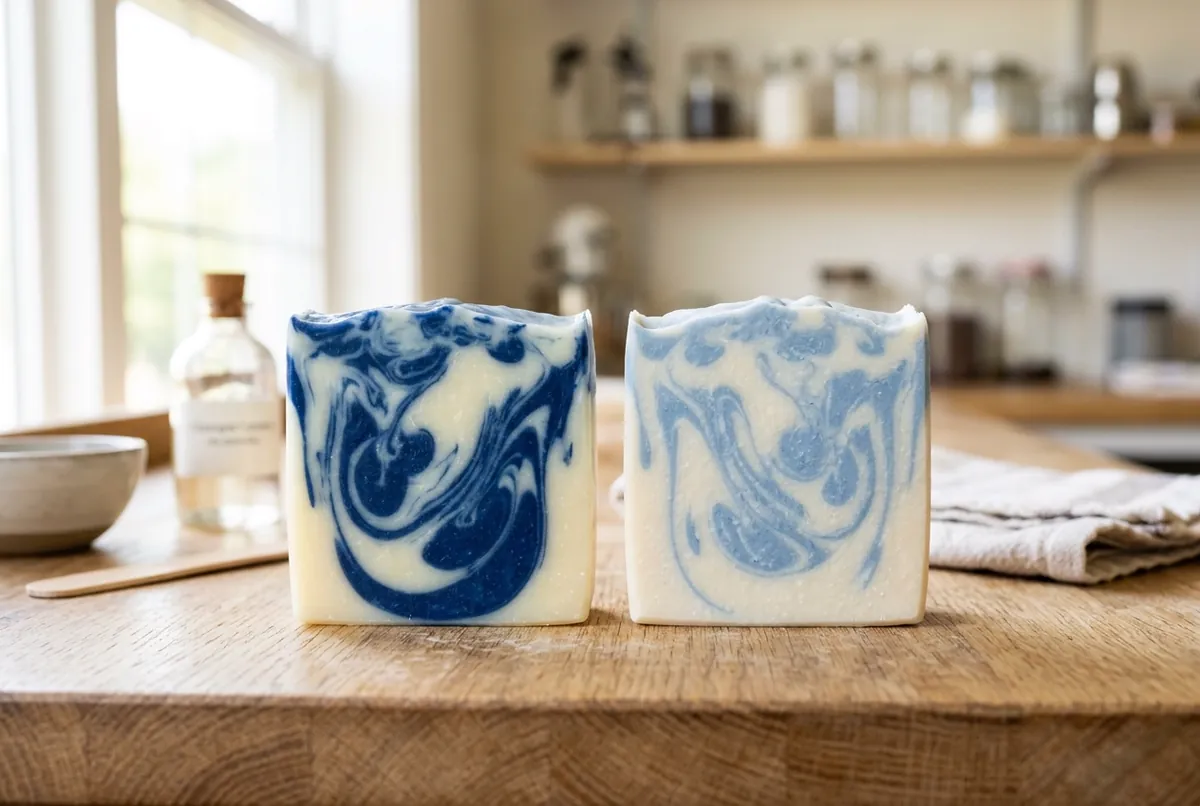 The same batter, gelled (left) and kept cool (right).
Colour keeps moving after the cut. An unstable mica can drift over the first days. Light fades some colourants faster than others: Grosso ranks mineral pigments the most lightfast, then micas, then cosmetic dyes and food colours, and tests a sample by covering half of it with opaque paper and leaving it in the sun. Vanillin, in most vanilla and bakery fragrances, turns batter tan to dark brown over a few weeks, so a white base needs a fragrance without it. Natural colours fade, which the natural colourants guide covers.
Test before committing a new colourant to a loaf. Pour 50 g of batter into each of a few small silicone cups, add the colour in weighed steps, and make two of each. Put one set in an oven held at about 77 °C (170 °F) for two hours and then switched off, which takes them through gel, and the other in the fridge. Look again after a week. Write the doses down in grams; “a pinch” cannot be repeated.
What the law asks
EU and UK
Soap is a cosmetic in the EU and the UK. A colourant, meaning any substance used mainly to colour the product, is allowed only if it is on the Annex IV list and used within that entry’s conditions. On the label, colourants are named by their Colour Index number (CI 77891 for titanium dioxide, CI 77491 for red iron oxide) and may be listed in any order after the other ingredients. Mica itself is not on Annex IV: it is declared as Mica, and the pigments coating it by their own CI numbers, which your supplier should state. Every colourant has to be covered by the product’s safety assessment.
US
A true soap is not a cosmetic under US law. If the product is made mainly of alkali salts of fatty acids, its cleaning comes from them, and it is labelled and sold only as soap, FDA leaves it to the Consumer Product Safety Commission. Once a bar claims to moisturise, deodorise or do anything else cosmetic, it is a cosmetic, and every colour additive in it must be approved for that use. Synthetic iron oxides, titanium dioxide and mica are approved for cosmetics generally; ultramarines and chromium oxide greens for externally applied cosmetics. Turmeric and spirulina extract are listed as colour additives for food only.
The label maker writes CI numbers and US colour names for the colourants the calculator knows, and the labelling guide covers the rest of the label.
Recipes to try
All recipesSources
- Soap Crafting: Step-by-Step Techniques for Making 31 Unique Cold-Process Soaps . Anne-Marie Faiola, Storey Publishing , 2013. Colourant families, dispersing with a mini mixer, test batches, gel and colour, splits for multi-colour designs.
- The Complete Photo Guide to Soap Making . David Fisher, Creative Publishing International , 2018. One tablespoon of oil per colour; titanium dioxide for white soap.
- Natural Soap Making . Elizabeth Letcavage and Melissa Harden, Stackpole Books , 2013. Colouring about two cups of batter first, then folding it back for an even colour.
- Pure Soapmaking . Anne-Marie Faiola, Storey Publishing , 2016. Oxides dispersed 1 part to 3 of light oil, kept in the fridge and discarded after a month; colour portions blended about 2 seconds each, lightest to darkest.
- Basic Soap Making . Elizabeth Letcavage and Patsy Buck, Stackpole Books , 2009. Oxide hydrated in three times its volume of glycerin at least 24 hours ahead; mixing shades from the lighter colour up.
- The Everything Soapmaking Book, 3rd edition . Alicia Grosso, Adams Media , 2013. Purple greying against yellowish fresh soap; pigment in warm water, then in a little traced batter; oxides in the lye water for a one-colour batch; lightfastness from mineral pigments down to dyes, and a half-covered sun test.
- The Natural Soap Book . Susan Miller Cavitch, Storey Publishing , 1995. Pearlescent colour set by the thickness of the titanium dioxide or iron oxide layer on the mica.
- Regulation (EC) No 1223/2009 on cosmetic products, Articles 2, 14 and 19 and Annex IV . European Parliament and Council , 2009. Definition of a colorant, the Annex IV list and the CI numbering on labels. Mica is not an Annex IV colorant.
- 21 CFR 701.20, Detergent substances, other than soap, intended for use in cleansing the body . US Code of Federal Regulations .
- 21 CFR Part 73 Subpart C, Color additives exempt from certification: cosmetics . US Code of Federal Regulations . Iron oxides (73.2250, synthetic only), titanium dioxide (73.2575), mica (73.2496), ultramarines (73.2725), chromium oxide greens (73.2327).
- Frequently Asked Questions on Soap . US Food and Drug Administration .
- The effect of aluminum hydroxide dissolution on the bleeding of aluminum lake dyes . Desai A. et al., Pharmaceutical Research 10(10) , 1993.
- Press release No 99/25: the Court of Justice upholds the annulment of the classification of titanium dioxide in certain powder forms as a carcinogenic substance . Court of Justice of the European Union , 2025.
- Manganese violet . ColourLex .
- Chemistry 101: Glycerin Rivers . Wholesale Supplies Plus , 2025. Supplier article; the rivers appeared only below about 31 % lye concentration, in fully gelled soap with a pigment.
- Comprehensive guide to soap colorants . Wholesale Supplies Plus . Supplier rates behind the calculator's titanium dioxide and red oxide doses; Mad Micas and Soap Queen supply the others (see the calculator's additive sources).