Loofah soap rounds
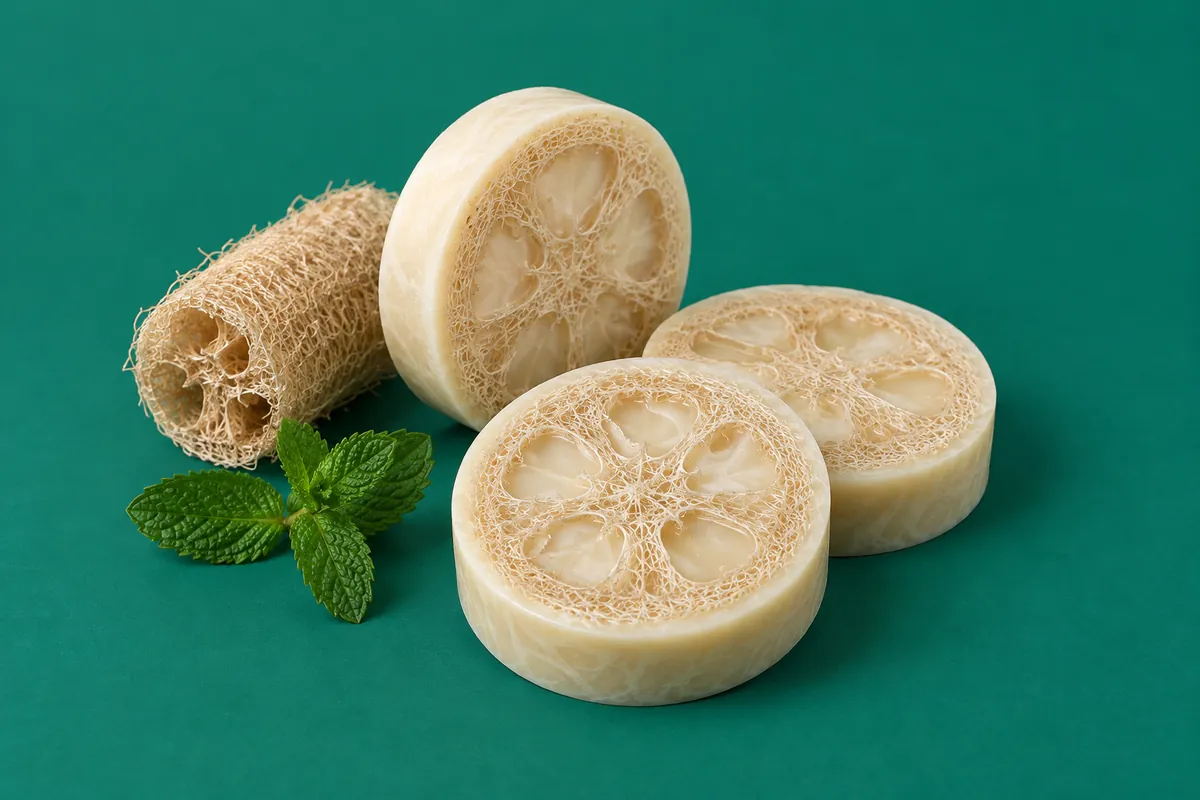
Round bars with a slice of loofah running right through each one, made by pouring soap around whole pieces of dried loofah in a capped plastic pipe. The soap is a mild olive and cocoa butter bar scented with peppermint and eucalyptus; the loofah does the scrubbing.
- Skill
- Intermediate
- Method
- Cold process
- Batch
- 800 g of oils about 1187 g of batter
- Hands-on
- 1 h 20 min
- Cure
- 4 weeks
- Gel phase
- Either way gel or not, both work
What you need
For 800 g of oils, which fills a 7.5 cm (3 in) plastic pipe 30 cm long with an end cap, about 1.3 litres, lined. Weigh everything, liquids included.
| Olive Oil · 45.0 % | 360 g | 12.70 oz |
| Coconut Oil · 25.0 % | 200 g | 7.05 oz |
| Cocoa Butter · 15.0 % | 120 g | 4.23 oz |
| Shea Butter · 10.0 % | 80 g | 2.82 oz |
| Castor Oil · 5.0 % | 40 g | 1.41 oz |
| Sodium hydroxide (NaOH) · the lye, 100 % pure | 110.3 g | 3.89 oz |
| Distilled water · for a 34 % lye solution | 218.8 g | 7.72 oz |
| Sodium lactate (60 % solution) · 2 tsp, stirred into the lye solution once it has cooled | 13.1 g | 0.46 oz |
| Dried loofah sponge · one loofah about 7 cm across, cut into two lengths of 13 cm; weight varies | 25 g | 0.88 oz |
| Peppermint essential oil · 1.5 % of the oils, at trace | 12 g | 0.42 oz |
| Eucalyptus radiata essential oil · 1.0 % of the oils, at trace | 8 g | 0.28 oz |
- Superfat
- 6 %
- Temperatures
- Oils and lye solution each at 35 to 38 °C (95 to 100 °F)
Method
-
Prepare the pipe
Line a 7.5 cm (3 in) plastic pipe about 30 cm long with a rolled sheet of freezer paper, shiny side in, or wipe the inside with a thin film of oil, then fit the end cap firmly. Stand it upright in a jug or a box so that it cannot tip. -
Fit the loofah
Cut a dried loofah about 7 cm across into two lengths of 13 cm with a serrated knife, shake out any seeds, and trim the sides so the pieces slide into the pipe with a snug fit. Stand them in the pipe one on top of the other. -
Get ready and weigh
Open a window and put on splash goggles, nitrile gloves and long sleeves. Weigh 200 g coconut oil, 120 g cocoa butter and 80 g shea butter into the pot, 360 g olive oil and 40 g castor oil into a jug, 12 g peppermint and 8 g eucalyptus essential oil into a small glass, and 13.1 g (2 tsp) sodium lactate into a cup. -
Make the lye solution
Weigh 218.8 g distilled water into the lye jug and 110.3 g sodium hydroxide into a dry container. At an open window or under the extractor fan, pour the lye slowly into the water, never the reverse, stir until clear and leave it to cool, labelled and out of reach. -
Add the sodium lactate
When the lye solution has cooled to below about 40 °C (104 °F), stir in the sodium lactate. -
Melt the fats
Melt the coconut oil, cocoa butter and shea butter on the lowest heat, then pour in the olive and castor oils. Let the oils and the lye solution each come to 35 to 38 °C (95 to 100 °F), with the oils fully clear. -
Blend to light trace only
Pour the lye solution into the oils down the shaft of the stick blender and pulse in short bursts, stirring between them, just to light trace, then stir in the essential oils by hand. The batter must stay thin enough to run down through the loofah, so stop there. -
Pour slowly
Pour about three quarters of the batter in a thin stream into the middle of the pipe, so it runs down through the loofah and fills from the bottom, pushing the air up ahead of it. Pause now and then to let it settle. -
Release the air and top up
Tap the pipe firmly on the worktop a few times, then push a thin skewer down through the loofah in several places and draw it out slowly to free trapped bubbles. Pour in the rest of the batter, which should cover the loofah by about 1 cm. -
Leave it to set
Lay a square of baking paper over the top and leave the pipe upright, out of reach, for two to three days. A narrow log may gel only in the centre; that is cosmetic. -
Clean up
With your gloves still on, wipe the batter off the pot and tools with paper towels into the bin, then wash everything in hot soapy water. -
Push out the log
Put your gloves back on, take off the end cap and push the log out from the bottom with a jar or a rolling pin. If it won't budge, freeze the pipe overnight, push the log out while frozen and let it come back to room temperature for several hours before cutting. -
Cut into rounds
Peel off the paper and cut the log into rounds about 2.5 cm (1 in) thick with a long, sharp knife, pressing straight down through the soap; where the blade meets tough loofah fibre, a few short sawing strokes take it through. -
Cure
Stand the rounds on edge on a rack with air around them, out of the sun, for four to six weeks, turning them every few days.
Tips
- The sodium lactate is 40 % water, and the calculator counts it: that is why the plain water here is 218.8 g rather than the full water target.
- No pipe? Pour the batter into a lined loaf mould at light trace and press a 2 cm slice of loofah into each future bar with a spatula straight after pouring, then cut between the slices.
- Stand the rounds on a dish that drains between uses: the loofah holds water and dries more slowly than the soap around it.
The oils
| Oil | Share |
|---|---|
| Olive Oil (virgin / refined / olive oil) | 45.0 % |
| Coconut Oil | 25.0 % |
| Cocoa Butter (Theobroma Oil) | 15.0 % |
| Shea Butter | 10.0 % |
| Castor Oil | 5.0 % |
How it is made
| Process | Cold process |
| Alkali | NaOH |
| Superfat | 6 % |
| Water | lye water at 33 % |
| Iodine value | 55 |
| INS | 151 |
Why make it
The soap and the scrubber in one: a mild olive and cocoa butter bar, cleansing 17 and conditioning 55 on our scale, poured round a slice of loofah that does the exfoliating. Loofah is the dried, fibrous skeleton of a gourd, used as a bath sponge for generations, and people reach for it for rough elbows, knees and heels; the tube-poured rounds also make a good gift. The American Academy of Dermatology suggests short, light strokes with any sponge and notes that mechanical scrubbing can be too much for dry or sensitive skin, so this is no bar for the face. The fibre also stays damp longer than the soap, and a 1994 study found that wet loofahs readily grow bacteria (Bottone et al.). Let each round dry on a draining dish between uses.
Sources
- How to safely exfoliate at home · American Academy of Dermatology
- Loofah sponges as reservoirs and vehicles in the transmission of potentially pathogenic bacterial species to human skin · Bottone E. J., Perez A. A. and Oeser J. L., Journal of Clinical Microbiology 32(2):469–472, 1994
What tradition, makers' experience and research say about soaps like this, each labelled for what it is. It is not medical advice, and no soap treats a skin condition: if you have one, ask a doctor or pharmacist.
What the numbers say
- Lauric acid 12.3 %
- Myristic acid 4.7 %
- Palmitic acid 12.8 %
- Stearic acid 11.4 %
- Ricinoleic acid 4.4 %
- Oleic acid 43.0 %
- Linoleic acid 7.3 %
- Other 5.0 %
Saturated : unsaturated 45 : 55
Computed from the fatty acids of the fats above. The bands are what the craft has settled on, not chemistry — a bar outside one is not wrong.
From the guides
All guides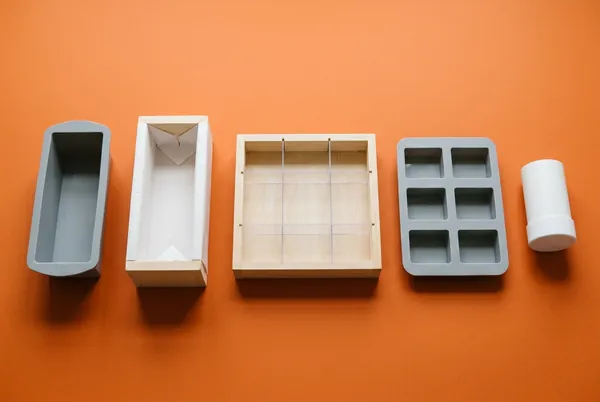
Soap moulds: choosing one and sizing a recipe to fit
Silicone, wood, slab, cavity, tube and improvised soap moulds; lining with freezer paper; and how to size a recipe to a mould, with a worked example.
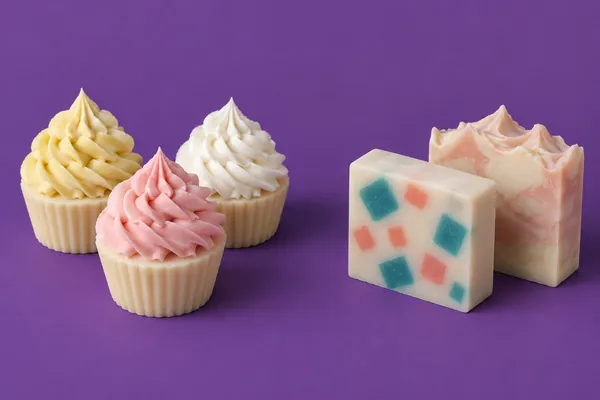
Embeds, textured tops and piping
Soap embeds that stay put and don't bleed, textured and botanical tops, piped frosting and soap cupcakes, and how to keep soda ash off the top.
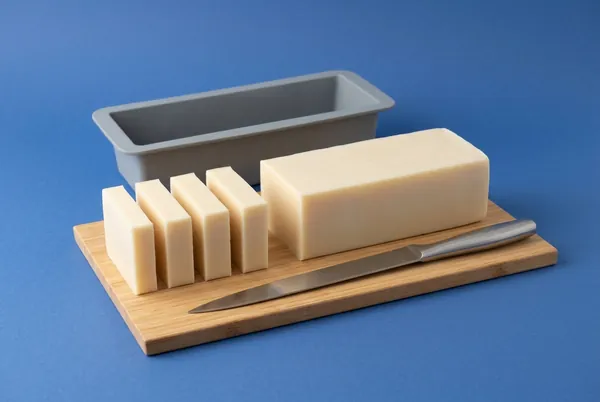
Unmoulding and cutting soap
When cold process soap is ready to come out of the mould, how to release it from silicone, lined and cavity moulds, and how to cut, bevel and stamp even bars.
Guides with this recipe
Where these proportions come from
Our own formulation: olive oil with a quarter coconut oil, cocoa and shea butters and a little castor oil at a 6 % superfat, liquid enough at light trace to run down through a loofah, with sodium lactate at a teaspoon per pound of oils so the log hardens and slides out of the pipe.