In short
- Silicone needs no lining but releases slowly; wood keeps heat in and needs a liner; slabs show off a swirl; cavity moulds save cutting.
- Never aluminium, copper, zinc, tin or brass: lye attacks them.
- Each millilitre of mould holds about a gram of batter. The calculator turns that batch weight into oils, lye and water in your recipe's own proportions.
- The old rule, cubic inches × 0.4 = ounces of oil, matches a recipe with a 33 % lye solution closely and drifts with more water, salt or other heavy additions.
- A bar's weight is its thickness times the loaf's cross-section: 2.2 cm of a 9 × 6 cm loaf is about 120 g.
On this page
- Mould types and their trade-offs
- What a mould must not be
- Lining a mould with freezer paper
- How the mould changes the heat
- Measuring what a mould holds
- From volume to recipe
- The rule of thumb
- What the rule hides
- What the calculator does
- A worked example
- Calibrate once
- Partly filling a mould
- Bar count and bar weight
A mould decides three things about a batch: how the soap comes out, how hot it gets while it sets, and how much recipe you need. This guide takes them in that order, and ends with the arithmetic from mould to recipe to bars, worked through for a common loaf mould.
Mould types and their trade-offs
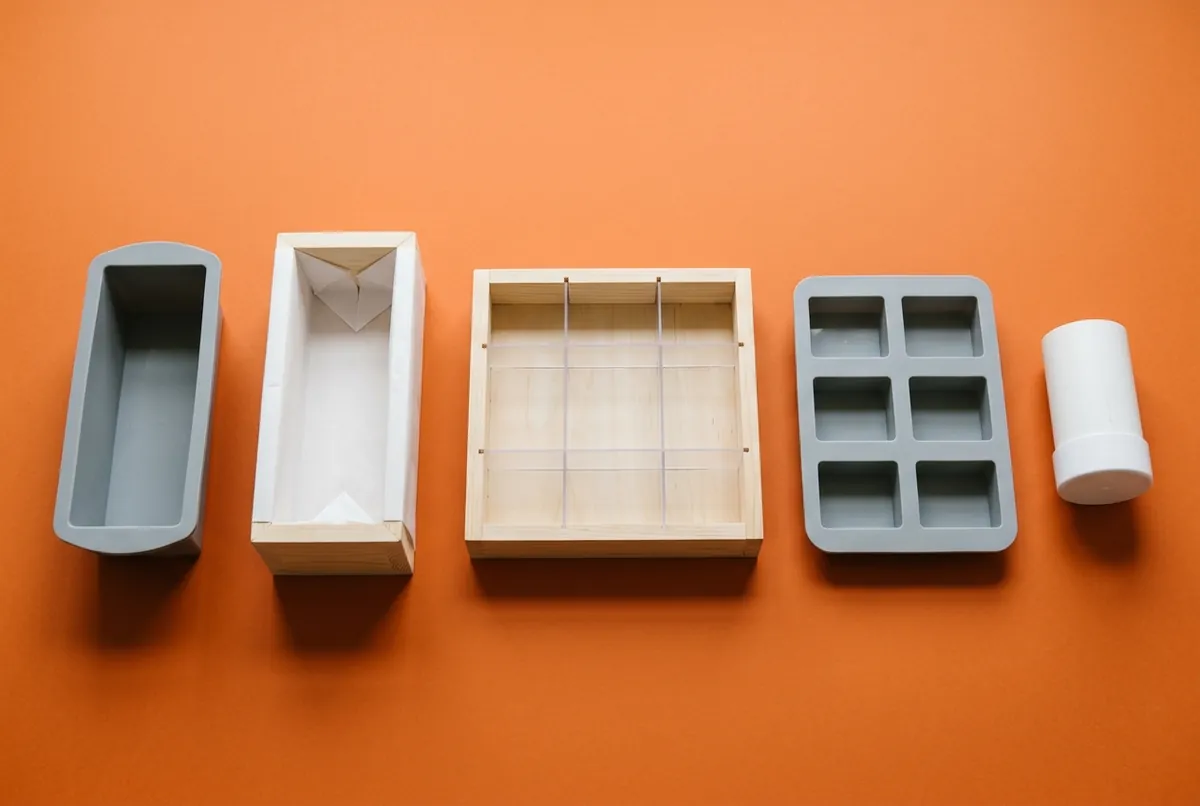
| Mould | Good for | Watch for |
|---|---|---|
| Silicone loaf | A first batch; no lining; clean sides | Soft recipes can take two or three days to release; long, floppy ones can bow outwards when full, so support the sides |
| Wooden loaf, lined | Even heat and gel; straight, rigid sides | Needs a liner every time |
| Slab | Swirls you see from above; bars one layer thick; dividers | A big surface that loses heat and gathers soda ash; needs a slow recipe to swirl |
| Cavity (single bars) | Shaped bars with no cutting | Little heat, so rarely gels; slowest of all to release |
| Tube or column | Round bars, cylinder pours | Needs a liner or a film of oil, an end cap, and a way to push the log out |
| Improvised | Free: milk cartons, food tubs, a lined shoebox | Line anything porous; check for foil; support thin sides |
From Faiola, Fisher, Watson and Letcavage and Harden.
Silicone is the easy start. It needs no lining and gives smooth sides. Its drawback is patience: silicone holds on until the soap is firm, and Faiola notes that soft recipes in individual silicone cavities can take up to a week to release. Freezing a stubborn mould helps, and so does a little less water or some sodium lactate next time; the unmoulding guide has the methods. Keep silicone batches moderate in temperature, too: Faiola soaps below 49 °C (120 °F) in silicone, because soap that overheats in it can come out pock-marked, a flaw of looks only.
Wood holds the heat of the setting soap, which makes an even gel likely. Wood is porous, so it has to be lined.
Slab moulds make a wide, shallow sheet of soap one bar thick, often with dividers that cut the bars for you. A swirl poured into a slab shows on the face of every bar.
Cavity moulds make each bar in its own shape. They stay cool, so the soap rarely gels and comes out paler and softer; give them extra days before unmoulding.
Tubes are lengths of plastic pipe with an end cap. Faiola fits a plastic liner or coats the inside with a little mineral oil, then pushes the log out from one end, freezing the whole tube overnight if it won’t come. Alicia Grosso prefers threaded screw-on caps, which come off most easily, pushes the log out with a disc of wood on a stick, and stands the capped end in a container while she pours in case the seal gives way, a sensible precaution with caustic batter. Our loofah soap is made in a tube like this.
Improvised moulds work well. A waxed milk carton is Watson’s first mould; Faiola uses milk cartons, yogurt tubs and a shoebox lined with a single sheet from a plastic bag, so there are no seams to leak. Plastic food tubs need no lining, though airtight ones grip the soap by suction. Test any plastic you are unsure of before soap day: Grosso stands it in the sink, fills it with boiling water and rejects anything that melts or warps, because “pouring time is too late”. To free soap from a carton, Faiola nicks the top edge and tears the card away in a spiral, putting it back in the freezer for a couple of hours if it clings. Whatever you use, it needs some give, or another way to get the soap out.
What a mould must not be
Sodium hydroxide attacks aluminium, copper, zinc, lead and their alloys, brass among them, and the soapmaking books add tin. None of them belongs in a mould, even under a liner, as Faiola stresses for aluminium, and neither does a carton lined with foil. Glass dishes are a poor choice for another reason: soap rarely lets go of them.
Lining a mould with freezer paper
Freezer paper has a plastic coating on one side. That side faces the soap; the plain paper side faces the mould. Baking parchment works too. Waxed paper does not: Faiola warns that it flakes into the soap.
- Measure the inside of the mould: length, width and height.
- Cut one sheet as long as the length plus twice the height plus 4 cm, and as wide as the width plus twice the height plus 4 cm. The extra 2 cm on each side sticks up above the rim, to lift the loaf out by.
- Mark the base. Lay the sheet coated side up and draw the mould’s base rectangle in the middle of it.
- Fold up the sides along the lines, creasing each fold hard, so the coated side is on the inside.
- Fold the corners. At each corner the spare paper forms a triangle. Fold it flat against the end, as you would when wrapping a present, and tape it on the outside only.
- Drop it in and smooth it into the corners.
One sheet, folded, has no seams at the bottom to leak.
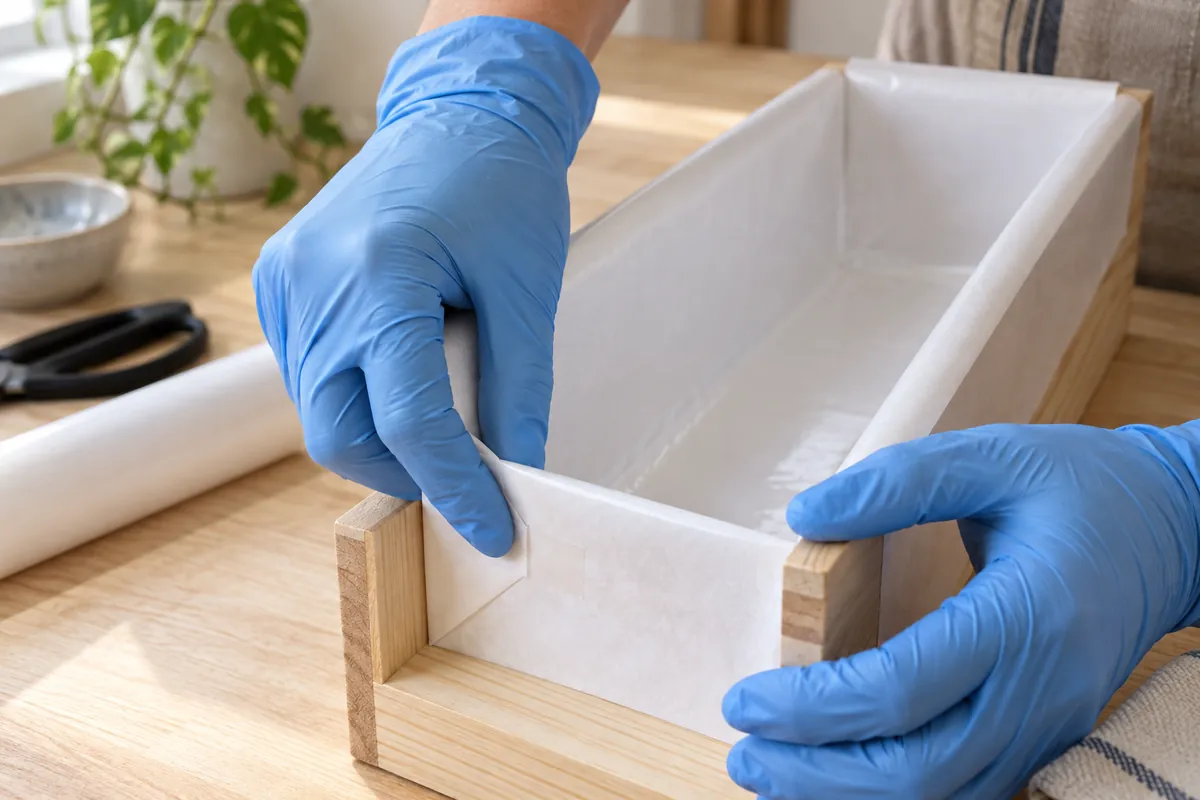 A corner folded like a gift wrap: coated side in, tape only on the outside.
How the mould changes the heat
A loaf heats itself as it saponifies, and the mould decides how much of that heat it keeps. A big loaf in a wooden mould, wrapped in a towel, holds enough to gel; a thin slab or a cavity mould loses it and usually doesn’t. The mould you choose partly chooses the look of the bar (gel phase). The opposite risk comes with size: Watson warns that a very large batch poured into one mould can overheat, so split big batches between moulds of a sensible size.
Measuring what a mould holds
You need the volume the batter will fill, measured on the inside, up to the height you will actually pour to. Leave a few millimetres below the rim.
- Loaf or slab: length × width × pour height. A loaf 25 cm long and 9 cm wide inside, poured 6 cm deep, holds 25 × 9 × 6 = 1,350 mL.
- Tube: π × (diameter ÷ 2)² × pour height. A pipe 7.5 cm across, poured 25 cm deep, holds 3.1416 × 3.75 × 3.75 × 25 = 1,104 mL. Halve the diameter before squaring it: using the full diameter gives four times the real volume, and treating the tube as a square box gives 27 % too much.
- Cavity mould: the volume of one cavity × the number of cavities. Twelve cavities of 100 mL hold 1,200 mL; our pink salt spa bar uses two six-cavity moulds like that.
- Anything else: stand the empty mould on the scale, zero it, and fill it with water to the pour line. Each gram of water is a millilitre, near enough. Empty it and dry it well before soap goes in.
In imperial units, 1 cubic inch is 16.39 mL, and a US fluid ounce of water is 1.8 cubic inches.
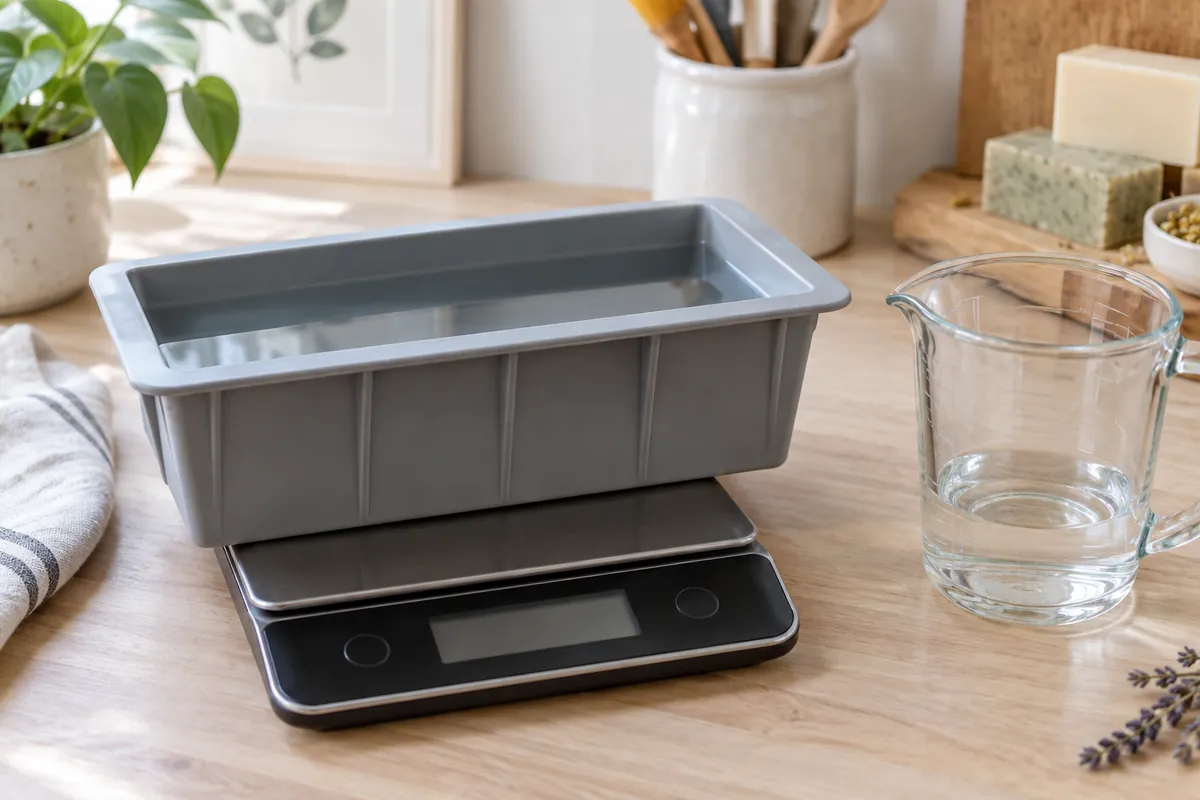 Measuring an awkward mould: fill it with water on a zeroed scale, and the grams are its volume in millilitres.
From volume to recipe
The rule of thumb
Several craft books give the same rule: multiply the length, width and height in inches, then multiply by 0.4, and the answer is the ounces of oil to use. Faiola gives it as L × W × H × 0.4; Fisher adds that you should then run the oils through a lye calculator. For the 25 × 9 × 6 cm loaf, 82.4 cubic inches × 0.4 = 33 oz, or 934 g, of oils.
In metric the same rule says 0.69 g of oils for every millilitre of mould. Fisher’s metric version uses 0.75, which asks for about 8 % more oil than his own imperial rule; they are not the same rule.
What the rule hides
A gram of oil does not fill the mould alone. It arrives with its lye, its water and its fragrance, and how much of those it brings depends on the recipe. The rule fixes the oil per millilitre, which quietly fixes everything else too: it matches a batter weighing about 1.05 g per mL made with water at 38 % of the oils and no fragrance. Change the water or add something heavy, and the same oils make a different amount of batter.
What the calculator does
The calculator works the other way round. The mould holds a volume; fresh batter has a density close to that of water; so the mould holds a known weight of batter. It then divides that batter among oils, lye, water, additives and fragrance in exactly the proportions your recipe makes:
- batter = volume × batter density × fill
- oils = batter ÷ (1 + lye per gram of oil + water per gram of oil + additives per gram of oil + fragrance per gram of oil)
The density starts at 1.0 g per mL, and Fill starts at 100 %; you can change either. In the lye calculator it is the panel Size the batch to a mould, and Use this oil weight puts the answer into your recipe.
A worked example
The 25 × 9 × 6 cm loaf, filled with the palm-free classic at a 5 % superfat and a 33 % lye solution, with fragrance at 3 % of the oils:
- Batter the mould holds: 1,350 mL × 1.0 g/mL = 1,350 g.
- What each gram of oil brings: 0.138 g of sodium hydroxide, 0.281 g of water and 0.030 g of fragrance, so each gram of oil makes 1.450 g of batter.
- Oils: 1,350 ÷ 1.450 = 931 g.
- The rest: 128.9 g of sodium hydroxide, 261.8 g of water and 28 g of fragrance. Together, 1,350 g.
The rule said 934 g, so for this recipe, fragrance included, the two agree to within a few grams; unscented, the mould takes 951 g. They part company when the recipe changes:
| Recipe in the same mould | Oils, calculator | Oils, × 0.4 rule |
|---|---|---|
| 33 % lye solution, 3 % fragrance | 931 g | 934 g |
| 30 % lye solution | 905 g | 934 g |
| Water at 38 % of the oils | 872 g | 934 g |
| Water at 25 % of the oils | 952 g | 934 g |
| Salt bar, salt at half the oil weight | 797 g | 934 g |
The palm-free classic with 3 % fragrance, except the last row: our salt bar recipe, with the batter density set to 1.16 g/mL.
The salt bar shows the rule at its worst. Salt weighs 2.17 g per cm³, more than twice as much as water, so a batter carrying salt at half the oil weight comes out at about 1.16 g per mL (worked out from the ingredients, ignoring air). The rule’s 934 g of oils makes about 1,830 g of that batter, which needs some 1,580 mL: 17 % more than the mould holds. The same happens, more mildly, with any recipe that carries a lot of additives, such as clays, purées or exfoliants: the rule has no place to put them.
The worked example. 931 g of oils fills the 25 × 9 × 6 cm loaf with the palm-free classic and 3 % fragrance. Open it, then try the mould panel with your own mould.
Open it in the calculatorCalibrate once
After your first batch in a mould, weigh how much batter it really took: weigh the empty mould, then the filled one, and subtract. Divide by the mould’s volume and you have your batter’s density. Put it in the density field and every later batch comes out right. Whipped batter is lighter; a salt bar is heavier.
Whatever you do, keep a small spare mould ready for the batter that is left over. Fisher does, and so does Faiola.
Partly filling a mould
Fill is for batches that should not fill the mould to the pour line: a layer of a layered soap poured as its own batch, or a loaf that will also hold embeds, where 300 g of embeds leaves about 78 % of the 1,350 mL for batter. Our soap embed bar, made from the same oils as the worked example, plans its base this way.
Bar count and bar weight
A bar cut from a loaf weighs its thickness times the loaf’s cross-section, times the batter’s density. In the 25 × 9 × 6 cm loaf the cross-section is 9 × 6 = 54 cm², so:
- A 2.2 cm bar is 54 × 2.2 = 119 g. Eleven of them take 24.2 cm of the loaf; 1,350 g makes eleven 120 g bars with 30 g to spare.
- A 2.5 cm bar is 135 g, and the loaf cuts into ten.
The ends of a loaf are often uneven, and many makers trim them, so plan on losing a slice. If you know the bar you want rather than the mould, the calculator can work backwards: Resize this recipe, by bars, takes the number of bars and the weight of each and scales the whole recipe to suit.
Bars lose weight as they cure. A freshly cut bar of the recipe above is about a fifth water (262 g of water in 1,350 g), and much of that leaves over the following weeks, so a bar cut at 120 g weighs noticeably less by the time it is sold. Weigh a few bars when you cut them and again at the end of the cure, as the curing guide describes, and put the cured weight on the label; the labelling guide covers weight statements.
Recipes to try
All recipesSources
- Soap Crafting: Step-by-Step Techniques for Making 31 Unique Cold-Process Soaps . Anne-Marie Faiola, Storey Publishing , 2013. The L × W × H × 0.4 rule; milk-carton, tub, shoebox and pipe moulds; lining a box with one sheet of plastic; slow release from silicone.
- The Complete Photo Guide to Soap Making . David Fisher, Creative Publishing International , 2018. Mould types; volume of rectangular, round and odd moulds; the water method; factors of 0.4 (ounces per cubic inch) and 0.75 (grams per cubic centimetre).
- Pure Soapmaking . Anne-Marie Faiola, Storey Publishing , 2016. Silicone kept below 120 °F (49 °C) against pock marks; no aluminium moulds even lined; waxed paper flakes into soap; tearing a milk carton away in a spiral.
- The Everything Soapmaking Book, 3rd edition . Alicia Grosso, Adams Media , 2013. The boiling-water test for plastic moulds; PVC tube moulds with screw caps, a wooden-disc plunger and a container under the tube while pouring.
- The Natural Soap Book . Susan Miller Cavitch, Storey Publishing , 1995. A 25½ × 13½ × 4 inch slab tray holding a 12-pound (5.45 kg) batch, cut into 40 bars about 1 inch thick; the base area decides the bar thickness.
- Smart Soapmaking . Anne L. Watson, Shepard Publications , 2013. Milk-carton moulds; 850 g of fat needing at least 1.2 litres of mould; large batches in one mould overheating.
- Natural Soap Making . Elizabeth Letcavage and Melissa Harden, Stackpole Books , 2013. Liner paper with its shiny side towards the soap; plastic containers needing no lining.
- Caustic Soda Handbook . OxyChem , 2026. Aluminum, copper, zinc, lead and their alloys are not suitable for handling caustic soda.
- Standard for Olive Oils and Olive Pomace Oils (CXS 33-1981) . Codex Alimentarius Commission (FAO/WHO) . Relative density of olive oil, 0.910 to 0.916.
- Sodium chloride: density . PubChem, from the CRC Handbook of Chemistry and Physics . 2.17 g/cm³ at 25 °C.