Men's cedar and orange bar
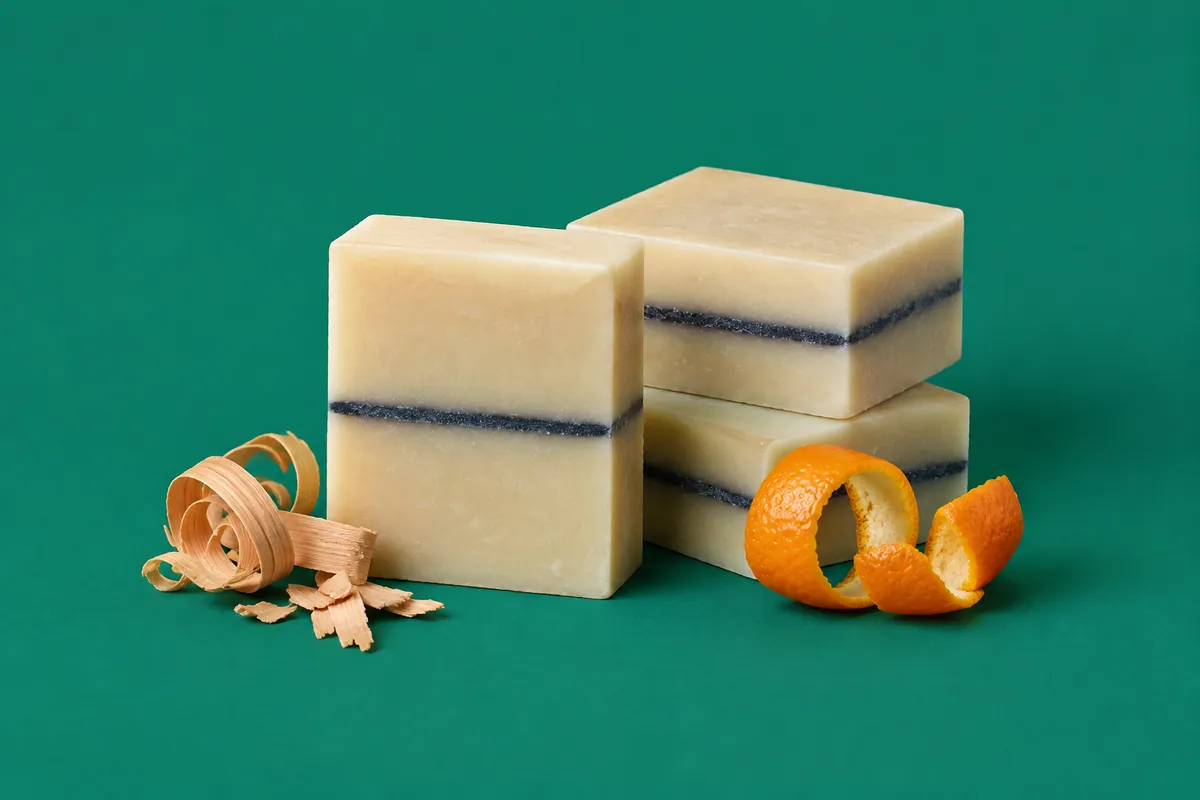
A hard, palm-free bar scented with sweet orange over Virginian cedarwood, with a fine black line of activated charcoal across the middle of every bar. Cocoa and shea butter make it last in a wet shower, and coconut oil gives a quick, full lather.
- Skill
- Intermediate
- Method
- Cold process
- Batch
- 1000 g of oils about 1453 g of batter
- Hands-on
- 1 h 15 min
- Cure
- 4 weeks
- Gel phase
- Either way gel or not, both work
What you need
For 1000 g of oils, which fills a 1.5 litre loaf mould. Weigh everything, liquids included.
| Olive Oil · 40.0 % | 400 g | 14.11 oz |
| Coconut Oil · 25.0 % | 250 g | 8.82 oz |
| Cocoa Butter · 20.0 % | 200 g | 7.05 oz |
| Shea Butter · 10.0 % | 100 g | 3.53 oz |
| Castor Oil · 5.0 % | 50 g | 1.76 oz |
| Sodium hydroxide (NaOH) · the lye, 100 % pure | 139.5 g | 4.92 oz |
| Distilled water · for a 33 % lye solution | 283.2 g | 9.99 oz |
| Activated charcoal · 0.25 tsp, sifted as a thin line between the two pours | 0.6 g | 0.02 oz |
| Sweet orange essential oil · 2.0 % of the oils, at trace | 20 g | 0.71 oz |
| Virginian cedarwood essential oil · 1.0 % of the oils, at trace | 10 g | 0.35 oz |
- Superfat
- 5 %
- Temperatures
- Oils and lye solution each between 38 and 43 °C (100 and 110 °F)
Method
-
Get ready
Put on splash goggles, nitrile gloves and long sleeves, open a window or turn on the extractor fan, and keep children and pets out of the room. Besides the usual tools you need a tea strainer or small fine sieve for the charcoal. -
Weigh the oils, scent and charcoal
Weigh 200 g cocoa butter, 100 g shea butter and 250 g coconut oil into the pot, and 400 g olive oil and 50 g castor oil into a jug. Weigh 20 g sweet orange and 10 g Virginian cedarwood essential oil into a small glass cup, and put a quarter teaspoon of activated charcoal into the tea strainer, resting on a saucer. -
Make the lye solution
Weigh 283.2 g distilled water into a heat-safe jug and 139.5 g sodium hydroxide into a dry container. In a well-ventilated spot, pour the lye slowly into the water, never the water onto the lye, stir until clear and leave it to cool, labelled and out of reach. -
Melt the butters
Melt the cocoa butter, shea butter and coconut oil together on the lowest heat until clear, then pour in the olive and castor oils. -
Check the temperatures
Carry on when both the oils and the lye solution are between 38 and 43 °C (100 and 110 °F). Cocoa butter sets quickly below that and thickens the batter before it has traced. -
Combine and blend to light trace
Pour the lye solution into the oils down the shaft of the stick blender and tap the blender to let trapped air out. Pulse and stir until a drizzle leaves a faint line on the surface. -
Add the scent
Stir the orange and cedarwood oils through by hand, then pulse briefly until the batter reaches medium trace, like thin pudding: thick enough to hold the charcoal on its surface. -
Pour the first layer
Pour half the batter, about 725 g, into the mould and tap it level. Before you go on, it should hold a faint mark when touched with the spatula. -
Sift the charcoal line
Hold the strainer just above the batter and tap it gently as you move along the mould, until the whole surface is evenly veiled in grey-black. Stop there even if charcoal is left over: a thick layer keeps the two halves from sticking together. -
Pour the top layer
Pour the rest of the batter slowly over the back of a spatula held just above the surface, starting at one end, so it settles on top without breaking the line. Smooth the top, cover it with a lid or board and a folded towel, and leave it for a day. -
Unmould and cut
After 24 to 48 hours, when the loaf is firm, unmould it with gloves on. Cut straight down into bars about 2.5 cm (1 in) thick, so the line runs level across each one. -
Cure
Stand the bars on edge in a dry, airy room for four to six weeks, turning them every few days.
Tips
- Less charcoal makes a better line. Too much keeps the layers from bonding, and the bars can split along it; a veil you can just see the batter through is enough.
- If the charcoal sinks and disappears into the first layer, the batter is too thin: wait a minute or two for it to thicken before you sift.
- Sweet orange fades during the cure. For more orange, raise it to 30 g rather than adding more cedarwood, which quickly takes over the blend.
- Sift the charcoal away from open windows and fans: it is a very light powder and drifts everywhere.
The oils
| Oil | Share |
|---|---|
| Olive Oil (virgin / refined / olive oil) | 40.0 % |
| Coconut Oil | 25.0 % |
| Cocoa Butter (Theobroma Oil) | 20.0 % |
| Shea Butter | 10.0 % |
| Castor Oil | 5.0 % |
How it is made
| Process | Cold process |
| Alkali | NaOH |
| Superfat | 5 % |
| Water | lye water at 33 % |
| Iodine value | 53 |
| INS | 153 |
Why make it
There is nothing male about the soap itself: here "men's" means a woody citrus scent and a plain look with a single black line. What makes it good in a busy shower is the formula. Thirty per cent cocoa and shea butter make it hard, 43 on our scale, so it lasts, while a quarter coconut oil gives a quick, full lather without being harsh, cleansing 17 at a 5 % superfat. That balance suits most skin for daily washing. The charcoal line is decoration: at a quarter teaspoon it colours the bar and does nothing else. Virginian cedarwood and sweet orange are a scent many people enjoy, and the cedarwood keeps it going as the orange softens over the weeks. A good first layered soap, and an easy gift.
What tradition, makers' experience and research say about soaps like this, each labelled for what it is. It is not medical advice, and no soap treats a skin condition: if you have one, ask a doctor or pharmacist.
What the numbers say
- Lauric acid 12.3 %
- Myristic acid 4.7 %
- Palmitic acid 13.5 %
- Stearic acid 12.9 %
- Ricinoleic acid 4.4 %
- Oleic acid 41.3 %
- Linoleic acid 6.8 %
- Other 4.9 %
Saturated : unsaturated 47 : 53
Computed from the fatty acids of the fats above. The bands are what the craft has settled on, not chemistry — a bar outside one is not wrong.
From the guides
All guides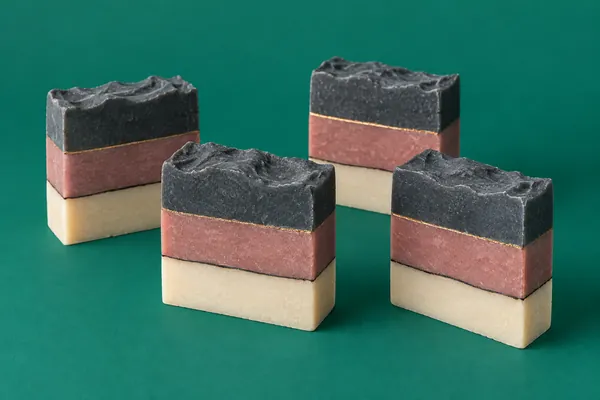
Layers, mica lines and pencil lines
Layered cold-process soap: batter thickness, pouring over a spatula, working out each layer from the mould, and pencil lines that don't split the bar.
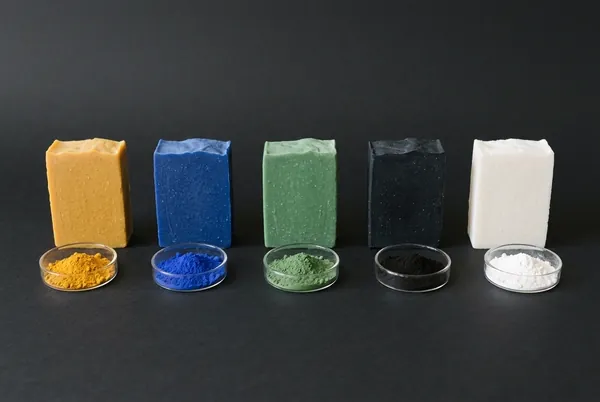
Colouring soap: micas, oxides, ultramarines and pigments
Which colourants survive cold-process soap, how much to use per 500 g of oils, how to disperse and split colour, and what the EU, UK and US rules ask.

Scenting soap: essential oils and fragrance oils
How much essential or fragrance oil to use in soap, what ounces per pound mean in percent, the IFRA limits for common essential oils, and EU allergen labelling.
Where these proportions come from
Our own formulation: 30 % cocoa and shea butter make a hard palm-free bar, 25 % coconut oil gives a quick, full lather, and Virginian cedarwood sits under sweet orange, which fades fast on its own.