Nettle shampoo bar
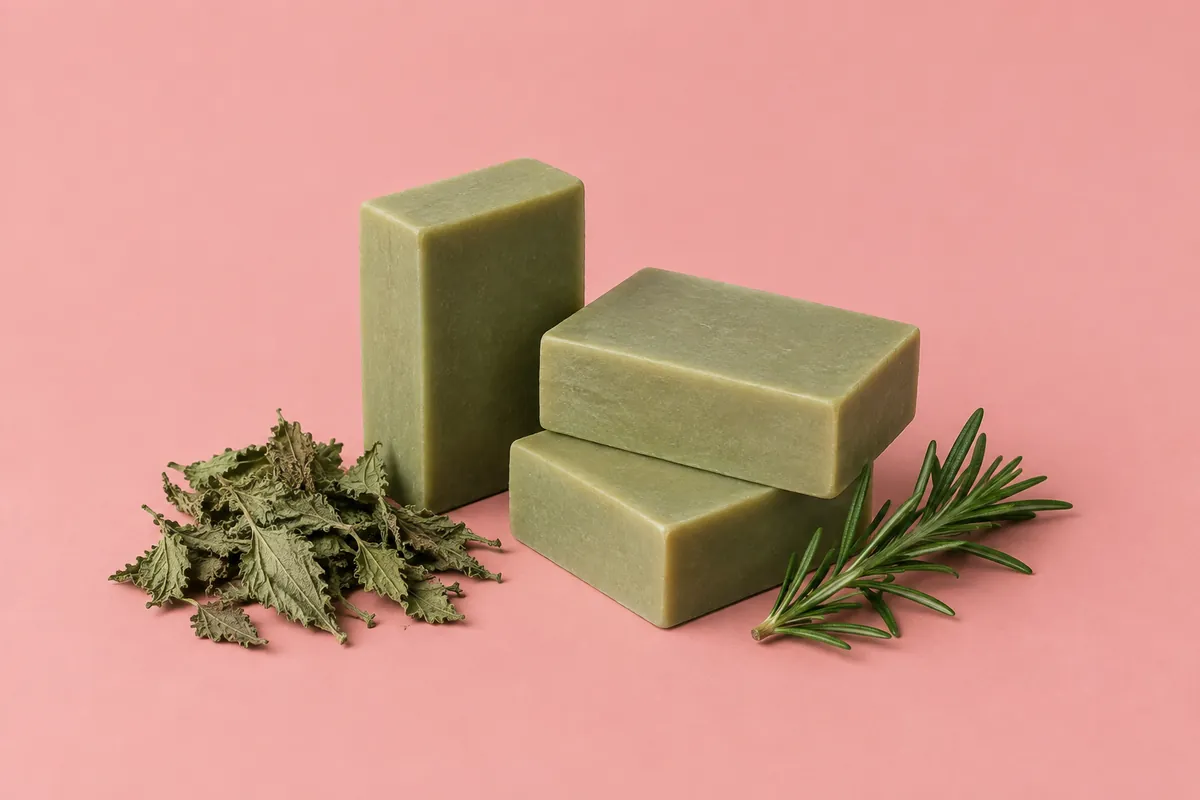
A true-soap shampoo bar: olive oil infused with nettle leaf for a soft green, a quarter coconut oil for lather and 15 % castor oil to hold it, scented with rosemary and cedarwood. Use it with a vinegar or citric acid rinse, which clears the film soap leaves in hard water.
- Skill
- Intermediate
- Method
- Cold process
- Batch
- 1000 g of oils about 1450 g of batter
- Hands-on
- 1 h 15 min
- Cure
- 6 weeks
- Gel phase
- Either way gel or not, both work
What you need
For 1000 g of oils, which fills a 1.5 litre loaf mould. Weigh everything, liquids included.
| Olive Oil · 40.0 % | 400 g | 14.11 oz |
| Coconut Oil · 25.0 % | 250 g | 8.82 oz |
| Castor Oil · 15.0 % | 150 g | 5.29 oz |
| Shea Butter · 10.0 % | 100 g | 3.53 oz |
| Cocoa Butter · 10.0 % | 100 g | 3.53 oz |
| Sodium hydroxide (NaOH) · the lye, 100 % pure | 138.5 g | 4.89 oz |
| Distilled water · for a 33 % lye solution | 281.3 g | 9.92 oz |
| Dried nettle leaf · infused in 440 g of olive oil a day ahead and strained out; weigh 400 g of the oil for the recipe | 12 g | 0.42 oz |
| Olive oil for the nettle infusion · 400 g of the strained oil is the recipe's olive oil; the rest stays in the leaves and the filter | 440 g | 15.52 oz |
| Vinegar (5 %), for the hair rinse · at each wash, stirred into a mug (250 ml) of water; or a quarter teaspoon of citric acid | 1 tbsp | |
| Rosemary essential oil · 2.0 % of the oils, at trace | 20 g | 0.71 oz |
| Atlas cedarwood essential oil · 1.0 % of the oils, at trace | 10 g | 0.35 oz |
- Superfat
- 5 %
- Temperatures
- Oils and lye solution at about 38 °C (100 °F), cooler than usual because castor oil speeds trace
Method
-
Infuse the olive oil a day ahead
Warm 440 g of olive oil with 12 g of dried nettle leaf in a double boiler or a slow cooker on low for 1 to 4 hours, never over a direct flame and never unattended. Strain it through a coffee filter until no bits are left and weigh out 400 g, topping up with plain olive oil if you are short. -
Get ready
Put on goggles, gloves and long sleeves, open a window and line a 1.5 litre loaf mould. Weigh 250 g coconut oil, 100 g shea butter and 100 g cocoa butter into the pot, the 400 g of nettle oil and 150 g castor oil into a jug, 281.3 g distilled water into the lye jug and 138.5 g sodium hydroxide into a dry container. -
Make the lye solution
Pour the sodium hydroxide into the water, never the water onto the lye, and stir until it runs clear, keeping your face away from the vapour. Let it cool to about 38 °C (100 °F). -
Melt and combine the oils
Melt the coconut oil, shea butter and cocoa butter until just clear, then stir in the nettle oil and castor oil and let the oils settle at about 38 °C (100 °F). Castor oil speeds trace, which is why this bar is soaped cooler than most. -
Mix the essential oils
Weigh the rosemary and cedarwood oils into a small glass and stir them together. -
Blend to light trace
Pour the lye solution into the oils and stick blend in short pulses, stirring between them, until a drizzle leaves a faint line on the surface. Add the essential oils and blend for a few seconds more. -
Pour and cover
Pour into the mould, tap it on the worktop to let air out, and cover it with a lid or board and a folded towel. It may gel into a darker, glossy centre, which is fine either way. -
Unmould and cut
After 24 to 48 hours, when the loaf is firm, unmould it with gloves on and cut it into twelve bars, or into smaller pieces that are easy to hold against wet hair. -
Cure for four to six weeks
Stand the bars on a rack with air between them for four to six weeks, out of direct sun, which fades the green. A young bar is harsher and wears away faster. -
Wash your hair
Wet your hair through, rub the bar over it a few times or lather it between your hands, and work the lather into the scalp. Rinse for longer than you would a liquid shampoo. -
Finish with an acid rinse
Stir 1 tablespoon (15 ml) of ordinary 5 % vinegar, or a quarter teaspoon of citric acid, into a mug (250 ml) of water. Pour it through your rinsed hair and work it in, keeping it out of your eyes, then rinse again with water if you like. -
Let the bar dry
Stand it on a draining dish between washes so it stays firm.
Tips
- How well a soap shampoo bar suits your hair depends mostly on your water. In hard water, soap leaves a dull, waxy film of calcium soap on hair; that film, not a 'transition' or a 'detox', is what the heavy feel of the first weeks usually is, and the acid rinse is what lifts it. If your water is very hard, a syndet bar may suit you better.
- The nettle is there for colour: a soft green that mellows towards khaki as the bar cures and fades in daylight. On a label, say what it is, such as 'coloured with nettle-infused olive oil', and claim nothing more for it.
- Castor oil at 15 % gives the lather its body. Past about 20 % a bar stays soft and tacky however long it cures.
The oils
| Oil | Share |
|---|---|
| Olive Oil (virgin / refined / olive oil) | 40.0 % |
| Coconut Oil | 25.0 % |
| Castor Oil | 15.0 % |
| Shea Butter | 10.0 % |
| Cocoa Butter (Theobroma Oil) | 10.0 % |
How it is made
| Process | Cold process |
| Alkali | NaOH |
| Superfat | 5 % |
| Water | lye water at 33 % |
| Iodine value | 58 |
| INS | 147 |
Why make it
A plastic-free shampoo that travels well, for people happy to change their routine a little. Castor oil at 15 % gives a fuller, creamier lather, 30 bubbly and 34 creamy on our scale, and a quarter coconut oil cleans the scalp. Soap is alkaline, and a review of shampoo pH found that alkaline washes leave the hair surface more negatively charged, raising friction between the fibres (Gavazzoni Dias et al.), which is why the method ends with an acid rinse. How well a soap shampoo suits you depends mostly on your water: in soft water many people love it, while hard water leaves a dull film of calcium soap that the rinse helps lift. Nettle has a long place in country hair rinses; here it simply colours the bar green. If your water is very hard, a syndet bar may suit you better.
Sources
- The Shampoo pH can Affect the Hair: Myth or Reality? · Gavazzoni Dias M. F. R. et al., International Journal of Trichology 6(3):95–99, 2014
- The Role of Detergents in Shampoos · Powers D. H. and Fox C., Journal of the Society of Cosmetic Chemists 10(2):116–122, 1959
What tradition, makers' experience and research say about soaps like this, each labelled for what it is. It is not medical advice, and no soap treats a skin condition: if you have one, ask a doctor or pharmacist.
What the numbers say
- Lauric acid 12.3 %
- Myristic acid 4.7 %
- Palmitic acid 11.0 %
- Stearic acid 9.8 %
- Ricinoleic acid 13.3 %
- Oleic acid 38.3 %
- Linoleic acid 7.0 %
- Other 4.9 %
Saturated : unsaturated 41 : 59
Computed from the fatty acids of the fats above. The bands are what the craft has settled on, not chemistry — a bar outside one is not wrong.
From the guides
All guides
Shampoo bars: what true soap does to hair
Soap shampoo bars, honestly: what alkaline soap and hard water do to hair, why an acid rinse helps, when a syndet bar is the better choice, and a recipe.
Herbs, flowers and infusions in soap
What dried herbs, petals, infused oils and herbal teas really do in soap: which survive lye, how to infuse an oil, and which claims a herbal soap can make.
Soap in hard water: scum, chelators and rinse
Why soap turns to scum in hard water, how much soap each litre wastes, what a chelator in the bar can and cannot do, and why coconut soap copes best.
Where these proportions come from
Adapted from the shampoo bar in Kelly Cable's Natural Soap Making Book for Beginners: her olive, coconut and castor oils with shea and cocoa butter, without the beeswax and jojoba, which are waxes that barely saponify, with coconut oil at a quarter of the oils as our shampoo bar guide suggests, and at an everyday 5 % superfat in place of her 15 % lye discount.
Formulation adapted from The Natural Soap Making Book for Beginners by Kelly Cable (Althea Press, 2017). The method and notes are ours.