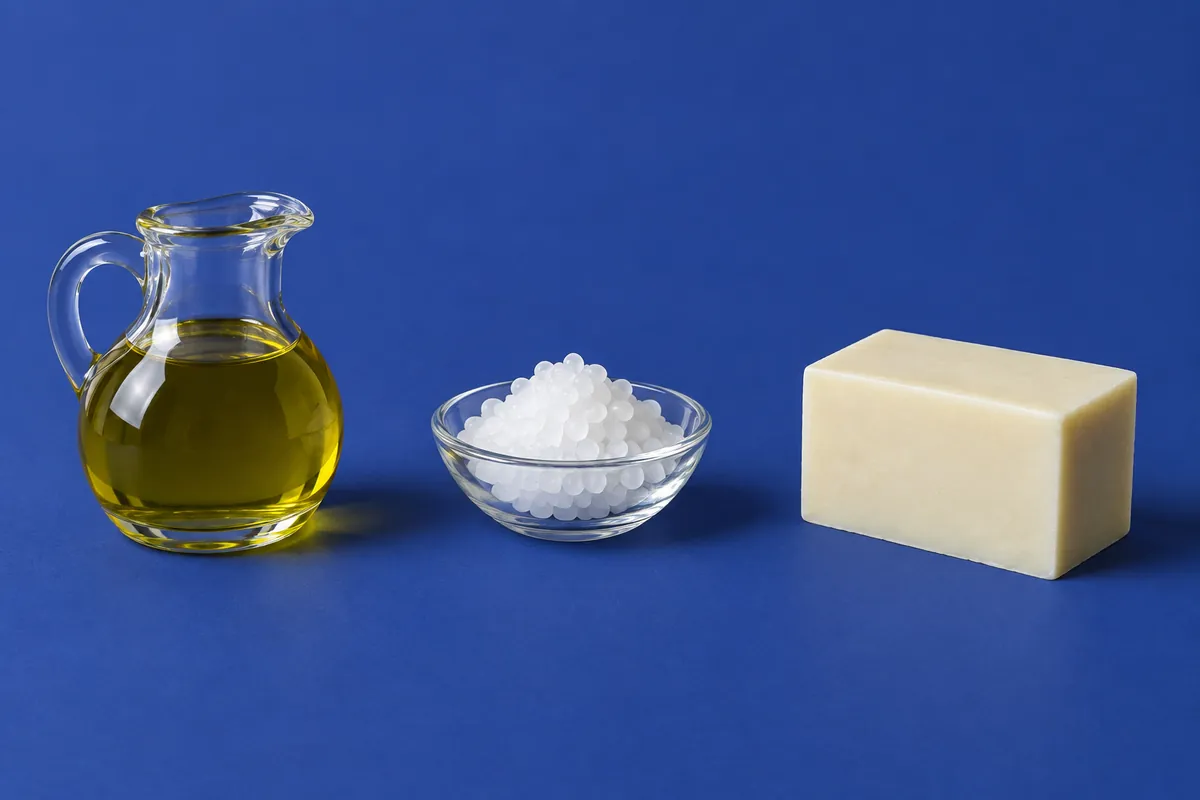
In short
- Soap is what a fat becomes when a strong alkali (lye) splits it: three soap molecules and one glycerin molecule from every fat molecule.
- Sodium hydroxide makes hard bars; potassium hydroxide makes soft and liquid soap.
- Each oil needs its own amount of lye, set by its saponification (SAP) value. That is why soap is always calculated, never guessed.
- Handmade soap keeps all its glycerin. The reaction is mostly over in a day or two; curing is about water leaving the bar.
On this page
Soap is not a mixture of oil and lye. It is a new substance that oil and lye turn into, and nothing of either is left in a well-made bar except a little of the oil, on purpose. This guide explains what happens in the pot, with the real numbers, so the steps in the other guides make sense rather than feeling like rules.
What oils and fats are made of
Olive oil, coconut oil, shea butter and lard look different, but chemically they are the same kind of thing: triglycerides. A triglyceride is one small molecule, glycerol, holding three long chains called fatty acids. Almost all of a soaping oil is triglyceride; the rest, usually a percent or two (more in shea butter), is other things (vitamins, sterols, waxes) that lye cannot turn into soap and that simply stay in the bar.
What makes one oil different from another is which fatty acids it carries. Olive oil is mostly oleic acid, a chain of 18 carbons with one bend in it. Coconut oil is mostly lauric acid, a straight chain of 12. Those chains decide almost everything about the soap: how hard it is, how it lathers, how gentle it feels and how long it keeps. The fatty acids guide goes into that; for now, the chains are the part that becomes soap.
What lye does to them
Lye is a strong alkali: sodium hydroxide (NaOH) for bar soap, potassium hydroxide (KOH) for soft and liquid soap. Dissolved in water, it attacks the link that holds each fatty acid to the glycerol. The chain comes away carrying a negative charge and pairs up with the sodium; the glycerol comes away as glycerin. The reaction is called saponification, from the Latin for soap. Until the early nineteenth century soap was thought to be a simple mixture of fat and alkali; the chemist Michel Chevreul showed that it is a chemical change that splits the fat into fatty acids and glycerol, the work that Simmons and Appleton’s 1908 handbook credits with putting soapmaking on a scientific basis.
Two things about this reaction matter every time you make soap.
It is exact. One fat molecule takes exactly three hydroxide molecules, no more and no fewer. Too little lye leaves some oil unreacted, which is harmless and is what makers do deliberately (see superfat, below). Too much leaves free lye in the bar, which is caustic and is the one mistake soap calculators exist to prevent.
It gives off heat. The batter warms itself as it saponifies, which is why a loaf wrapped in a towel can heat up enough to go translucent in the middle (the gel phase), and why recipes rich in sugars, milk or honey can overheat. Dissolving the lye in water gives off heat as well, separately and quickly: a freshly mixed lye solution can pass 90 °C (194 °F).
Sodium makes bars, potassium makes liquid soap
The soap molecule is the same fatty-acid chain either way; only the partner changes. Sodium soaps pack into firm crystals, so sodium hydroxide gives the hard bars most people mean by “soap”. Potassium soaps are far more soluble in water, so potassium hydroxide gives a soft paste that can be diluted into liquid soap. Shaving soaps and cream soaps often use a blend of both, which the calculator handles as dual lye.
The two are not interchangeable gram for gram. A potassium atom is heavier than a sodium atom, so it takes 56.1 g of KOH to do the work of 40.0 g of NaOH. The calculator converts between them with those molar masses.
How much lye: the saponification value
Every oil needs its own amount of lye, and the number that says how much is its saponification value, or SAP value: the milligrams of potassium hydroxide needed to saponify one gram of that oil. It is measured in a laboratory by a standard method (AOCS Cd 3-25), and food standards publish the range each oil falls in.
| Oil | SAP value (mg KOH/g) | NaOH per 100 g of oil |
|---|---|---|
| Olive | 184–196 | 13.1–14.0 g |
| Coconut | 248–265 | 17.7–18.9 g |
| Palm | 190–209 | 13.5–14.9 g |
| Cocoa butter | 188–198 | 13.4–14.1 g |
| Lard | 192–203 | 13.7–14.5 g |
| Castor | 176–182 | 12.5–13.0 g |
Ranges from the Codex food standards and the other primary documents on each oil’s page. The NaOH column is the KOH figure times 39.997 ÷ 56.106.
Why does coconut oil need a third more lye than olive oil? Because its chains are shorter. A gram of coconut oil holds more fat molecules than a gram of olive oil, and every molecule needs its three hydroxides. You can check it from the molecules alone: pure trilaurin (three lauric chains) works out at 263 mg KOH/g, and pure triolein (three oleic chains) at 190, which is where coconut and olive oil actually sit.
A recipe’s lye is the sum over its oils: each oil’s weight times its SAP value. That is the whole of the arithmetic, and it is why no one should make soap from a recipe that has not been run through a calculator with the oils actually in the pot. Coconut oil takes about 35 % more lye than olive oil, so put olive oil in its place, keep the old lye figure, and the bar is caustic.
Work it out yourself. 1000 g of olive oil needs 135.4 g of sodium hydroxide to saponify completely. At a 5 % superfat, the calculator asks for 128.7 g.
Open it in the calculatorWhy makers use less lye than the oils need
Almost every recipe uses a few percent less lye than the oils could take. The shortfall is the superfat: at 5 %, the lye is enough for 95 % of the oils, and the other 5 % stays in the bar as oil. There are three good reasons for it.
- SAP values are ranges, not constants. Olive oil can be anything from 184 to 196. A calculator has to pick a figure, and the superfat covers the difference between that figure and your particular bottle.
- Scales, lye purity and spills are not perfect. A few percent of margin means a small weighing error gives a slightly softer bar rather than a harsh one.
- A little free oil feels better on the skin. Most everyday bars sit between 3 and 8 %.
The superfat guide covers when to go higher (salt bars) or lower (laundry and liquid soap).
Where the glycerin goes
In the diagram above, every 100 g of olive oil released about 10 g of glycerin. In cold process and hot process soap it all stays in the bar, where it attracts moisture and is part of why handmade soap feels different from most commercial bars.
Industrial soap has traditionally been made by the full-boiled process instead: the fat is boiled with lye and then salted out, which makes the soap float up as curds while the glycerin and spent lye drain away below, and the soap is then boiled again with an excess of lye to finish the reaction. The glycerin is sold separately. Until the early 1800s soap boilers ran those lyes down the drain as waste; by 1908, Simmons and Appleton wrote, they had become “the chief source of profit in the manufacture of cheap soaps”. Nothing is wrong with that soap; it is simply a different product.
Why soap cleans
A soap molecule has two ends that want different things. The charged end, where the sodium sits, is drawn to water. The long fatty-acid tail is drawn to oil and grease. In water, soap molecules crowd around a drop of oil with their tails in it and their charged heads facing out, forming a tiny ball called a micelle that water can carry away. The soap itself does this work. Simmons and Appleton’s 1908 handbook reports the test that showed it, Hillyer’s: dilute alkali emulsified cottonseed oil only while the oil still held free fatty acid for it to turn into soap, and did nothing to acid-free oil or kerosene, while a solution of sodium oleate, a soap, emulsified both.
This is also why soap is mildly alkaline. It is the salt of a weak acid (the fatty acid) and a strong base, so a solution of perfectly made soap measures around pH 9 to 10. That is what soap is, not a sign of leftover lye; the test for free lye is a different one, covered in the soap pH guide.
How long the reaction takes, and what curing is for
In cold process soap, most of the lye is used up within the first day or two, and faster if the loaf gels. By the time a loaf is firm enough to cut, it is soap. The four to six weeks of curing that follow are mostly about water: a bar that starts out a fifth to a quarter water loses much of it, gets harder, lasts longer in the shower and becomes milder as its crystal structure settles. Hot process soap is cooked until the reaction is complete, so it is safe sooner, but it still benefits from the same weeks for the water to leave.
That leaves only the practical questions, which the rest of the beginner path answers in order: handling lye safely, the equipment you need, and your first batch, which makes our first-batch palm-free bar.
Recipes to try
All recipesSources
- Scientific Soapmaking: The Chemistry of the Cold Process . Kevin M. Dunn, Clavicula Press , 2010.
- AOCS Official Method Cd 3-25, Saponification Value of Fats and Oils . American Oil Chemists' Society .
- Standard for Named Vegetable Oils (CXS 210-1999) . Codex Alimentarius Commission (FAO/WHO) .
- Standard for Olive Oils and Olive Pomace Oils (CXS 33-1981) . Codex Alimentarius Commission (FAO/WHO) .
- Atomic weights of the elements 2013 . IUPAC, Pure and Applied Chemistry 88(3) , 2016.
- The Handbook of Soap Manufacture . W. H. Simmons and H. A. Appleton, Scott, Greenwood & Son (Project Gutenberg edition) , 1908. Soap once thought a mere mixture until Chevreul showed fats split into fatty acids and glycerol; the full-boiled process step by step; the glycerine lyes, once run to waste, the chief source of profit in cheap soap; Hillyer's experiments showing soap, not alkali, emulsifies oil.
- Evaluation of pH of Bathing Soaps and Shampoos for Skin and Hair Care . Tarun J. et al., Indian Journal of Dermatology 59(5) , 2014.