In short
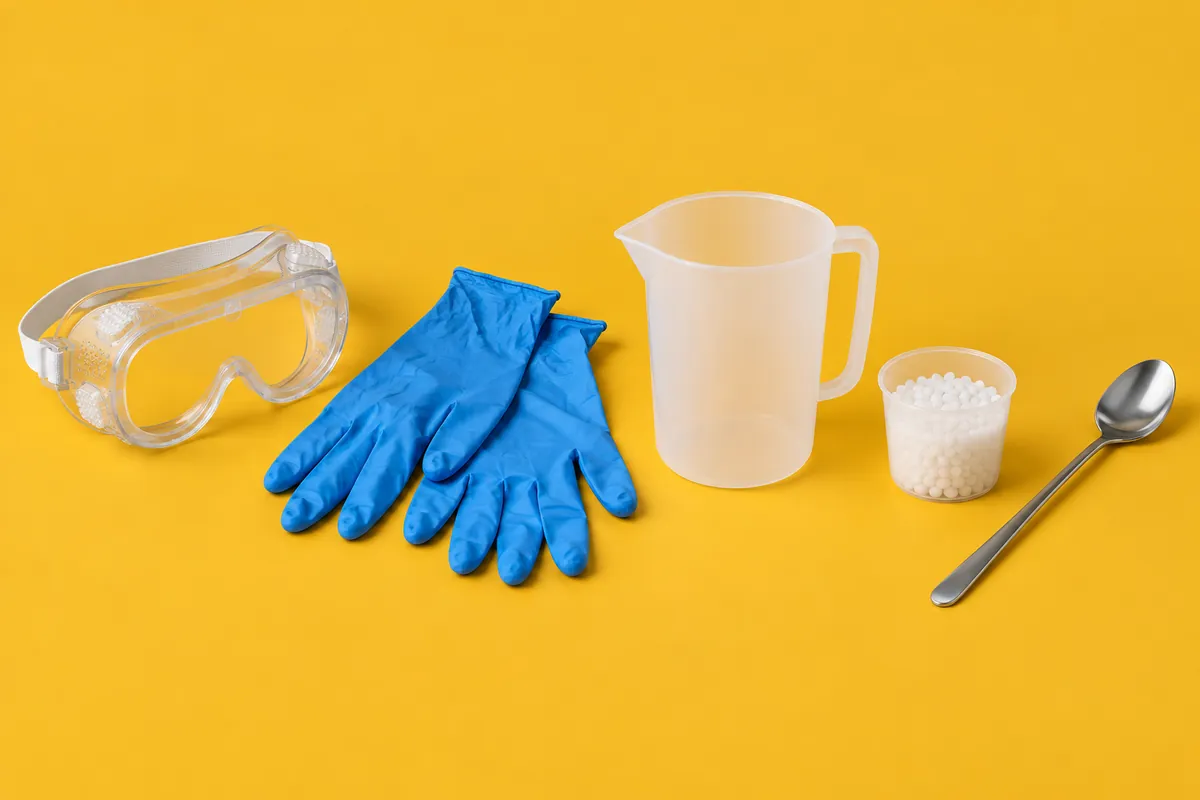
- Wear splash goggles (not glasses), nitrile gloves and long sleeves from the moment you open the lye until the soap is out of the mould.
- Always pour lye into water, never water onto lye, in a polypropylene or stainless steel jug. Never aluminium.
- Fresh lye solution can pass 90 °C within moments. Mix it where air moves and never leave it alone.
- On skin, rinse under running water at once for at least 15 minutes, longer for a real splash. In an eye, rinse for at least 30 minutes with the lids held open while someone gets help. Never vinegar.
- Keep lye sealed, labelled and locked away. It soaks up water and carbon dioxide from the air.
On this page
Sodium hydroxide, the lye that makes bar soap, comes as small white beads or flakes that look like sugar and behave nothing like it. It burns skin, it can blind, and dissolving it in water makes a solution hot enough to scald. None of that makes soapmaking a dangerous hobby, because the risks are known in advance and the precautions are the same every time. This guide goes through them with the reasons behind each, and what to do if something goes wrong. Potassium hydroxide, the lye for soft and liquid soap, is handled in exactly the same way.
Why lye burns
Sodium hydroxide is a strong alkali, and the reaction that turns oil into soap in your pot works just as well on the fats in your skin. Lye saponifies them and dissolves the proteins that hold the tissue together. The damaged tissue softens instead of sealing over, so the alkali keeps working its way down for as long as it stays there. That is why the UK Health Security Agency warns that sodium hydroxide can cause deep, full-thickness burns, and why the treatment is so simple: wash the lye away, straight away, and keep washing.
Two things catch people out. A lye burn may not hurt at first, so the absence of pain tells you nothing. And lye solution feels slippery between the fingers, like soap, because it is turning the oils in your skin into soap. If anything on your skin feels slippery while you work, go to the tap.
Eyes are the serious case. Alkali can penetrate every layer of the eye, and UK clinical guidance treats any alkali in the eye as an eye emergency. Every other rule in this guide matters less than wearing goggles.
What to wear
| What | Choose | Why |
|---|---|---|
| Eyes | Chemical splash goggles that seal around the eyes, with covered (indirect) vents. In the UK and EU the frame is marked 3 under EN 166; in the US, D3 under ANSI Z87.1 | Glasses, safety specs and sunglasses leave gaps that a splash goes straight through |
| Hands | Nitrile gloves, disposable or reusable, long enough to cover the wrist | Thin nitrile exam gloves resisted 50 % sodium hydroxide for more than eight hours in their maker’s permeation test. They tear easily, so change any glove that splits or gets splashed |
| Arms and legs | Long sleeves pulled down over the glove cuffs, and long trousers | Sleeves over the cuffs stop a splash running down inside the glove |
| Feet | Closed shoes | Caustic soda breaks down leather quickly, so wipe any splash off leather shoes at once |
| Front | An apron or old clothes | A splash can mark or ruin clothing, wool and silk especially |
What to wear, from a caustic soda maker’s handling advice and a glove maker’s test data.
Put all of it on before you open the lye, and keep it on until the soap has been unmoulded and cut. Anyone helping wears the same: Anne-Marie Faiola tells readers that a friend who helps them pour must “fully suit up”, gloves and goggles included. Raw soap batter is caustic too until the lye in it has reacted, which in a well-made batch takes a day or two. Tie back long hair.
Where to mix
Choose somewhere air moves: next to an open window with the cooker hood running, or outdoors on a still day. For the first minute or so, dissolving lye gives off a cloud of steam that carries a fine mist of lye with it, and that mist catches the throat. Stir with your face turned away and wait for the cloud to clear before you lean over the jug.
Mix in or beside the sink, on a clear, steady surface, well back from the edge. The sink contains a spill, the cold tap is your first aid, and a basin of cold water in it will cool the jug afterwards.
Keep children and pets out of the room for the whole session: the beads look like sugar and fresh soap batter looks like cake mix. Never leave a jug of lye solution alone, even for a minute. If the doorbell goes, either the door waits or the jug goes somewhere no one can reach it.
Lye into water, never water into lye
Dissolving sodium hydroxide gives off a great deal of heat. Pour the lye into the water and that heat is shared by all the water at once. Pour water onto a heap of lye and the first splash meets a lot of lye with very little water to carry the heat away: it boils where it lands and spits hot, concentrated lye out of the jug. In 2003 a soapmaking book was recalled in the US, through the Consumer Product Safety Commission, because its instructions combined the lye and the water in the wrong order and the mixture could bubble over.
Make mixing a fixed routine, the same every time:
- Dress first. Goggles, gloves and sleeves go on before any container of lye is opened.
- Water in the jug. Weigh cold water into a heat-safe polypropylene jug that holds at least twice the volume of the finished solution, and stand the jug in the sink. Cold matters: lye added to hot liquid, Grosso warns, takes it “dangerously close to or over the boiling point in no time”.
- Lye in a dry cup. Weigh the lye into a separate dry cup to the gram, then close the lye tub at once.
- Lye into the water. Tip the lye slowly into the water while stirring with a stainless steel spoon, face turned away, until no beads are left on the bottom.
- Cool it where it cannot be knocked. Leave the jug standing in a basin of cold water in the sink, label it as lye, and keep it in sight until you use it.
- Rinse straight away. Rinse the cup and spoon under running water, and wipe the scale and the worktop for stray beads.
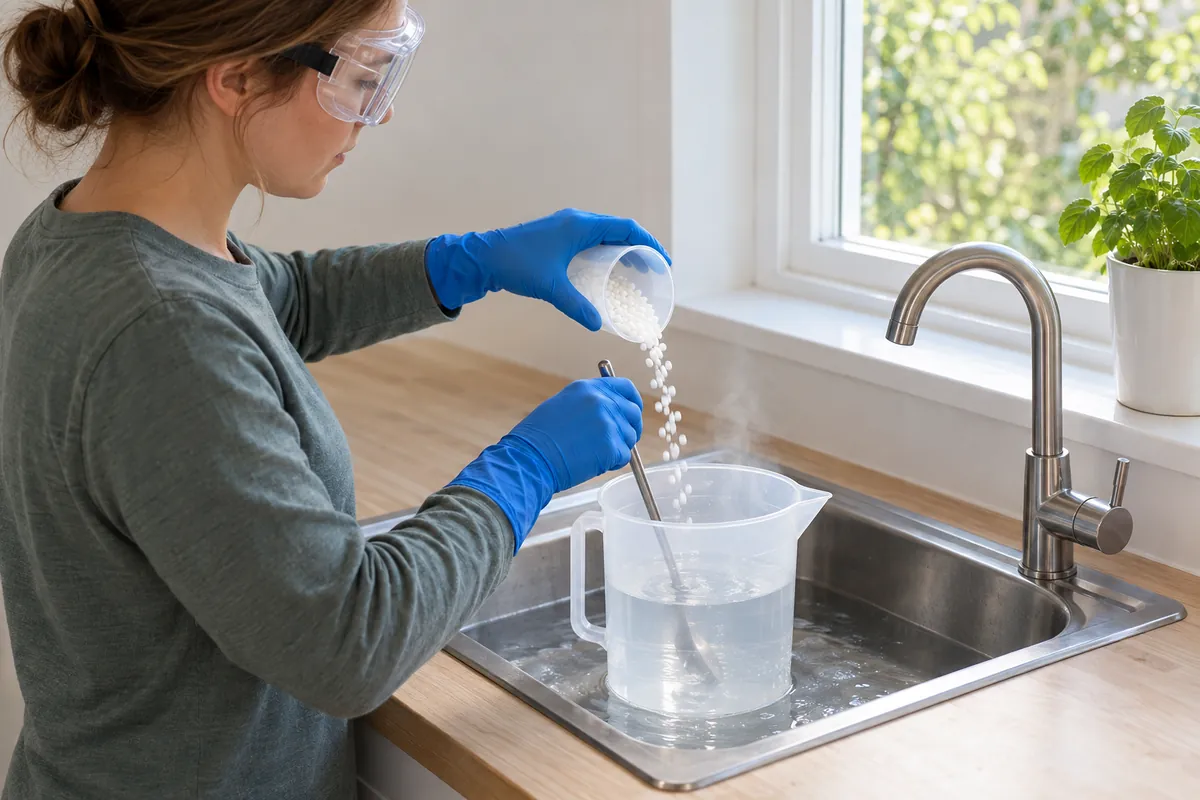 Lye into water, in the sink, face turned away: goggles on, gloves under the sleeves, and the jug standing in cold water to cool.
Within moments of mixing, the solution can pass 90 °C (194 °F); Fisher and Failor both measured about 93 °C (200 °F). That is hot enough to scald even before you count the lye in it, and hot enough to soften the wrong kind of plastic, which is why the next section matters. Cool it in the basin of cold water. Never drop ice into the solution itself: that adds water the recipe did not ask for.
Milk, beer, juice and other liquids need their own methods, because sugars and proteins react with hot lye. The liquids guide and the milk soap guide cover them.
What lye can touch
| Material | For lye? | Why |
|---|---|---|
| Polypropylene (PP, recycling code 5) | Yes: the best jug | Rated excellent against strong lye, and labware makers rate it for use up to 135 °C |
| High-density polyethylene (HDPE, code 2) | For storing dry lye | Resists lye, but softens when hot (its heat deflection temperature is 65 °C); lye is usually sold in it |
| Stainless steel | Yes | A caustic soda maker rates 304 and 316 stainless for solutions up to 93 °C (200 °F) |
| Aluminium, including foil | Never | Lye attacks it and gives off hydrogen, a flammable gas |
| Tin, zinc (galvanised metal), copper, brass | Never | All are attacked by lye; tin and zinc also give off hydrogen |
| Polycarbonate and PETG (the clear “unbreakable” plastics) | Never | Rated for immediate damage by strong sodium hydroxide |
| PET (drinks bottles, code 1) | Never | The same polyester family as PETG, and lye in a drinks bottle can be mistaken for a drink |
| Glass | Better avoided | Hot alkali slowly etches glass, and a hot glass jug can crack when it is cooled suddenly |
Suitability from a labware maker’s chemical resistance chart, a caustic soda handbook and the UKHSA hazard compendium.
Look for the code 5 or the letters PP moulded into the base of a jug, and choose a thick, rigid one with a pouring spout. The equipment guide covers the rest of the kit.
If lye gets on you
Those times are minimums. The US Agency for Toxic Substances and Disease Registry’s guidelines for sodium hydroxide say to “flush exposed areas with water for at least 15 minutes” and to “flush exposed or irritated eyes with plain water or saline for at least 30 minutes”. Canada’s CCOHS asks for “at least 60 minutes” for skin and eyes alike, with “DO NOT INTERRUPT FLUSHING”, and the NHS says about an hour for any chemical burn, and to call 999. Lukewarm water makes a long rinse bearable.
Plan the first-aid route before you start: a tap you can get under at once, a clean towel nearby, and, as Grosso advises, the emergency and poison-centre numbers written up where you can see them.
Why not vinegar
The idea of pouring vinegar on a lye burn comes straight from school chemistry: an acid neutralises a base. On a person it is the wrong treatment. Neutralisation releases heat, right where the tissue is already damaged, and the minutes spent finding a bottle are minutes in which the lye keeps working. Water is already running, and it dilutes the lye, carries it away and cools the skin all at once. A caustic soda maker’s own handbook says not to use any kind of neutralising solution on a burn, least of all in the eyes, and ATSDR’s guidelines are blunt: “Neutralizing substances should not be used.”
The myth survives because older soapmaking books printed it, some older chemical data sheets still add “then rinse with dilute vinegar” after the flushing, and vinegar does have a proper use in soapmaking: wiping a worktop after a spill has been mopped up. Keep it for the worktop.
Spills and cleaning up
Dry beads. Sweep them up with a dustpan and brush, gloves on, into a dry plastic container, then wipe the spot with plenty of water. Beads bounce and cling to things by static, so check the floor, the scale and your sleeves before you take your gloves off.
Lye solution. Soak it up with paper towels or an old cloth and put them in the bin, then wipe the surface down with plenty of water. A final wipe of diluted vinegar on a hard surface is fine; industry handles spill residue the same way, with dilute acid and then plenty of water.
Batter and tools. Raw soap batter is caustic until it has saponified. Scrape the pot and wipe the tools with paper towels into the bin before you wash anything, or leave the pot and utensils somewhere safe for a day or two until the film on them has turned to soap, then wash them in hot water with your gloves on. Do not pour raw batter down the sink, where it can set in the pipe. A little leftover batter can go into a spare mould or a lined box: it becomes soap like the rest.
Never test a bar by touching it to your tongue. The old “zap test” means deliberately tasting something that may still be caustic; the soap pH guide covers the safer checks: phenolphthalein, a pH meter or titration.
Buying lye
Buy sodium hydroxide that is 99 % pure or better, as beads or flakes, from a soapmaking supplier or sold as food grade or technical grade. The label should say sodium hydroxide and nothing else. Clean lye is plain white; a tub with specks or a tint in it goes back.
Drain cleaner is only usable if its label says 100 % sodium hydroxide. Crystal drain cleaners are usually blends: the safety data sheet for one big brand’s crystals lists sodium nitrate, salt and aluminium granules with the lye, and aluminium reacts with lye, fizzing and heating up. Gels and liquids are mixtures too. None of those belong in soap.
Potassium hydroxide looks almost the same, and it takes about 40 % more of it by weight to do the same work. Use it where a recipe means sodium hydroxide and you get a soft mess; do the reverse and the soap is badly lye-heavy. Label every tub clearly. The lye calculator asks which one you are using and how pure it is, and the calculator guide explains both settings.
In England, Wales and Scotland the law has a say too. Sodium hydroxide, and anything with more than 12 % of it, is a corrosive product under the Offensive Weapons Act 2019, and since 6 April 2022 it may not be sold to anyone under 18. A seller who sells it online or by phone must check the buyer’s age and may not deliver it to a home or a parcel locker, so expect to collect it with ID, or to have it sent to a business address. Potassium hydroxide is not on the Act’s list.
Storing lye
Keep lye in the container it came in, with the lid screwed down between every scoop. Sodium hydroxide pulls water and carbon dioxide out of the air: an open tub clumps, and part of it slowly turns into sodium carbonate, so the lye gets weaker and the amount the calculator gave you is no longer quite right.
Store it labelled and locked away, or at least out of reach of children and pets, and apart from food, acids and anything aluminium. Grosso suggests a lidded, labelled plastic box, never the cupboard under the kitchen sink, and warns against a high shelf if you keep more than a few pounds, because a heavy tub is easily dropped. Never decant it into a food container or a drinks bottle, and never put a jug of lye solution in the fridge.
Lye solution made ahead to cool overnight needs the same care: a label, a place no one else can reach, and a tight lid. Susan Miller Cavitch covers hers because, left open, the air slowly weakens it into sodium carbonate.
Getting rid of lye
The simplest way to have no lye to get rid of is to mix only what the recipe calls for. If some solution is left over, keep it for the next batch in a tightly closed polypropylene or HDPE bottle, labelled as lye with its strength and the date, and store it like the dry lye. The calculator’s master batch setting weighs out a stored solution of any strength; the water and lye guide explains it.
Solution you will not use, and dry lye you no longer want, go to your council’s household hazardous-waste collection, not down the sink and not into the bin. Water companies ask for chemicals to go there, and some recycling centres accept chemicals only in their original, labelled container, so ask before you take a jar of homemade solution.
Handled this way, lye goes from its tub to the jug and from the jug to the pot, nowhere else, and a correctly calculated recipe uses all of it up. Next on the beginner path: the equipment you need, then choosing the oils for your first soap.
Sources
- Sodium hydroxide: incident management (Compendium of chemical hazards) . UK Health Security Agency , 2024. How alkali burns form (saponification of fats, liquefaction), painless onset, alkali in the eye as an emergency, reaction with aluminium, tin and zinc, carbon dioxide uptake, GB CLP classification.
- Medical Management Guidelines for Sodium Hydroxide (NaOH) . Agency for Toxic Substances and Disease Registry (ATSDR), US Centers for Disease Control and Prevention , 2014. Skin: "Quickly remove contaminated clothing and flush exposed areas with water for at least 15 minutes." Eyes: "Flush exposed or irritated eyes with plain water or saline for at least 30 minutes. Remove contact lenses if easily removable without additional trauma to the eye." Burns: "Neutralizing substances should not be used." Swallowed: do not induce vomiting; 4 to 8 ounces of milk or water if the person can swallow.
- OSH Answers chemical profile: Sodium hydroxide . Canadian Centre for Occupational Health and Safety (CCOHS) , 2023. Skin: "Immediately flush with gently flowing water for at least 60 minutes. DO NOT INTERRUPT FLUSHING." Eyes: "Immediately flush the contaminated eye(s) with gently flowing water for at least 60 minutes, occasionally lifting the upper and lower eyelids. If a contact lens is present, DO NOT delay flushing or attempt to remove the lens." Burns may not hurt at first.
- Acid and chemical burns . NHS , 2024. UK first aid: brush off dry chemical, remove contaminated clothing, cool or lukewarm running water for about an hour, put nothing else on the burn, call 999.
- First aid for poisonings . Poison Control (National Capital Poison Center, US) . Swallowed caustic: a small amount of water or milk, do not induce vomiting. US helpline 1-800-222-1222.
- International Chemical Safety Card 0360: Sodium hydroxide . International Labour Organization and World Health Organization , 2010. First aid, storage in the original container away from food, acids and metals, sweeping up spilled solid into plastic containers.
- NIOSH Pocket Guide to Chemical Hazards: Sodium hydroxide . US National Institute for Occupational Safety and Health . Incompatible with water, acids and metals such as aluminium, tin and zinc; first aid by immediate water flushing.
- Caustic Soda Handbook . Occidental Chemical Corporation (OxyChem) , 2026. Close-fitting chemical splash goggles, gloves with sleeves over the cuff, leather attacked by caustic, no neutralising solutions on burns, suitable and unsuitable materials, spill residue neutralised with dilute acid then flushed.
- Chemical, electrical, and radiation injuries . Friedstat J, Brown DA, Levi B. Clinics in Plastic Surgery 44(3) , 2017. Neutralising agents are not recommended on chemical burns because the reaction is exothermic and delays irrigation; alkali burns may need irrigation for two hours or more.
- Recall of a soapmaking book whose instructions mixed lye and water in the wrong order (release 04-010) . US Consumer Product Safety Commission , 2003.
- Sodium hydroxide solution (CAMEO Chemicals) . US National Oceanic and Atmospheric Administration . Dilution with water can liberate enough heat to cause local boiling and spattering. Its first-aid text still suggests a vinegar rinse after flushing, which current guidance (NHS, UKHSA, ATSDR, OxyChem) does not.
- Nalgene plastic labware chemical resistance reference guide . Thermo Fisher Scientific . Polypropylene and HDPE rated excellent against 50 % sodium hydroxide; polycarbonate and PETG (a PET copolymer) rated for immediate damage; polypropylene's maximum use temperature 135 °C, HDPE's heat deflection temperature 65 °C.
- Nitrile gloves chemical resistance guide . Kimberly-Clark Professional , 2015. Thin nitrile exam gloves: breakthrough time for 50 % sodium hydroxide more than 480 minutes.
- EN 166:2001 Personal eye-protection: specifications . European Committee for Standardization (CEN) , 2001. Field-of-use symbol 3 on the frame marks protection against liquid droplets (goggles) and splashes (face shields).
- ANSI/ISEA Z87.1 Occupational and educational personal eye and face protection devices . American National Standards Institute and International Safety Equipment Association , 2020. The D3 marking identifies droplet and splash protection.
- Atomic weights of the elements 2013 . IUPAC, Pure and Applied Chemistry 88(3) , 2016. NaOH 39.997 g/mol and KOH 56.106 g/mol: potassium hydroxide takes about 40 % more by weight to do the same work.
- Offensive Weapons Act 2019, sections 1 to 3 and Schedule 1 . legislation.gov.uk , 2019. Schedule 1: "Sodium hydroxide (CAS RN 1310-73-2) | 12% w/w"; potassium hydroxide is not listed. Section 1: no sale of a corrosive product to anyone under 18. Section 3: a seller who is not in the buyer's presence commits an offence by delivering it, or arranging its delivery, to residential premises or a locker. In force in England, Wales and Scotland from 6 April 2022 (S.I. 2022/418); not commenced in Northern Ireland.
- Statutory guidance: Offensive Weapons Act 2019 . Home Office , 2022. Buyers of corrosive products sold remotely "will be subject to age verification checks when they collect the corrosive product instore or from a collection point"; ticking a box is not an age check.
- Safety data sheet: Drano Kitchen Crystals . SC Johnson Professional , 2024. Section 3: sodium hydroxide 50 to 75 %, sodium nitrate 20 to 30 %, sodium chloride 10 to 20 %, aluminium 1 to 5 %.
- Bin it: what not to put down toilets and sinks . Thames Water . "Take any chemicals, solvents, engine oil and paint to your local refuse or recycling site."
- Household chemical disposal . North Northamptonshire Council , 2026. Recycling centres take drain cleaners; chemicals "must be in their original container" and labelled, and "Unidentifiable chemicals will not be accepted."
- The Complete Photo Guide to Soap Making . David Fisher, Creative Publishing International , 2018. A freshly mixed lye solution heats to nearly 93 °C (200 °F) almost immediately; a lye jug should hold at least twice the volume of the solution.
- Making Transparent Soap . Catherine Failor, Storey Publishing , 2000. The water rises to 200 °F (about 93 °C) moments after the caustic soda goes in, and the steam carries lye.
- Smart Soapmaking . Anne L. Watson, Shepard Publications , 2013. Stray beads scattered by static; never leave a lye solution unattended.
- The Everything Soapmaking Book, 3rd edition . Alicia Grosso, Adams Media , 2013. Lye always into cold liquid; stronger, water-discounted solutions burn faster; emergency numbers posted; a labelled, lidded lye box, not under the sink and not on a high shelf.
- Pure Soapmaking . Anne-Marie Faiola, Storey Publishing , 2016. Lye solution up to 200 °F (93 °C); a helper who pours fully suited up in gloves and goggles.
- The Natural Soap Book . Susan Miller Cavitch, Storey Publishing , 1995. Lye solution cooled overnight kept tightly covered, because air weakens it into sodium carbonate.