Blue and gold drop swirl bar
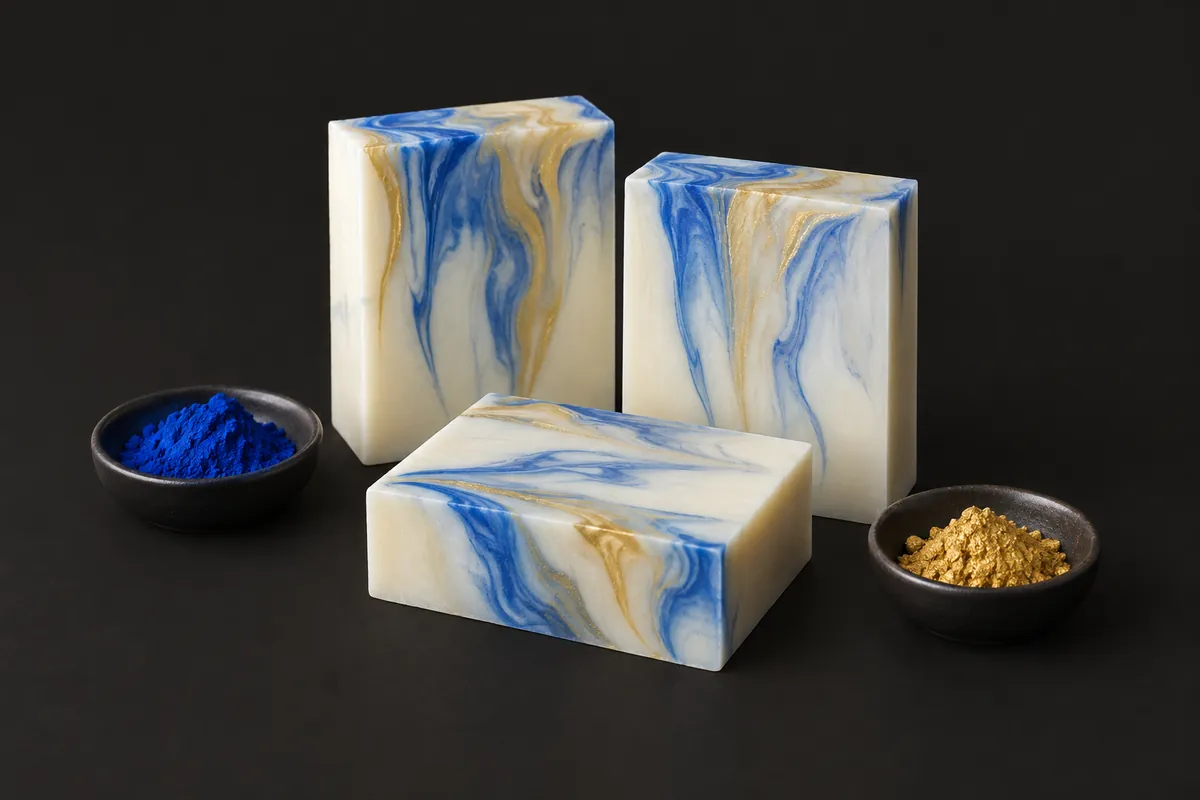
Thin blue and gold batter dropped from a height into a white base, so the colours plunge through the loaf and leave long streaks down every cut face. Slow oils, extra water and no scent keep the batter fluid for the whole pour.
- Skill
- Intermediate
- Method
- Cold process
- Batch
- 900 g of oils about 1330 g of batter
- Hands-on
- 1 h 15 min
- Cure
- 6 weeks
- Gel phase
- No keep it cool
What you need
For 900 g of oils, which fills a 25 × 9 cm loaf mould filled 6 cm deep (about 1.4 litres). Weigh everything, liquids included.
| Olive Oil · 50.0 % | 450 g | 15.87 oz |
| Coconut Oil · 25.0 % | 225 g | 7.94 oz |
| Rice Bran Oil · 15.0 % | 135 g | 4.76 oz |
| Shea Butter · 10.0 % | 90 g | 3.17 oz |
| Sodium hydroxide (NaOH) · the lye, 100 % pure | 125.5 g | 4.43 oz |
| Distilled water · for a 30 % lye solution | 292.8 g | 10.33 oz |
| Titanium dioxide · 1.5 tsp, white base, dispersed in 27 g of the recipe's olive oil | 7 g | 0.25 oz |
| Ultramarine blue · 0.5 tsp, blue portion, dispersed in 14 g of the recipe's olive oil | 2.1 g | 0.07 oz |
| Gold mica · 1.5 tsp, gold portion, dispersed in 14 g of the recipe's olive oil; one sold as stable in cold process | 2.3 g | 0.08 oz |
- Superfat
- 5 %
- Temperatures
- Oils and lye solution at 32 to 35 °C (90 to 95 °F)
Method
-
Get ready
Put on goggles, gloves and long sleeves and open a window. Line the mould and set it level on a worktop low enough that you can pour from 30 cm (12 in) above it, with two spouted jugs, a small cup and a chopstick in reach. -
Disperse the colours
Weigh the olive oil and take 55 g of it for the colours. Stir the titanium dioxide into 27 g in the cup, the ultramarine into 14 g in one jug and the gold mica into the last 14 g in the other, until a smear on a white plate shows no grains. -
Make the lye solution
Where the air moves, pour the 125.5 g of sodium hydroxide slowly into the 292.8 g of water, never the reverse, and stir until clear. Leave it labelled and out of reach to cool to 32 to 35 °C (90 to 95 °F). -
Melt the oils
Melt the coconut oil and shea butter gently, add the rest of the olive oil and the rice bran oil, and cool to 32 to 35 °C (90 to 95 °F) while the oils stay clear. -
Blend to emulsion only
Pour the lye solution in down the blender shaft, tap out trapped air, and blend in short pulses only until the batter is smooth and opaque with no oily streaks, thin as single cream. Stop there: the colours must sink when they land. -
Split and colour
Weigh 315 g of batter into the blue jug and 315 g into the gold jug and whisk each smooth. Whisk the white into the batter left in the pot, about 630 g. -
Pour half the white
Pour about 330 g of the white into the mould, half of it, and let it settle flat. -
Drop the blue and the gold
Hold the blue jug about 30 cm (12 in) above the mould and pour about 110 g in a thin, steady stream along its length. Do the same with about 110 g of gold, this time in a zigzag. -
Add white and repeat
Pour about 110 g of white along the mould from just above the surface, then repeat the blue drop, the gold drop and the white twice more until every jug is empty. -
Leave it, or swirl once
Leave the loaf as it fell, or draw a chopstick once along the middle, to the bottom, from end to end. Tap the mould gently on the worktop. -
Keep it out of gel
Leave the mould uncovered for 30 minutes, then cover it and chill it overnight in a fridge kept apart from food. Kept cool, the white stays bright and, at this 30 % lye solution, free of glycerin rivers. -
Unmould and cut
Let the loaf come back to room temperature and unmould it with gloves on after 2 to 3 days, once firm. Cut bars about 2.5 cm (1 in) thick across the loaf. -
Cure
Stand the bars on edge with air between them, out of direct sun, for 6 weeks, turning them every few days.
Tips
- The height of the pour, the size of each drop and the thinness of the batter set the size of the streaks. Write down what you did, so a loaf you like can be made again.
- If the batter reaches light trace before you finish, the drops start to sit on top: pour the rest from lower down and draw the chopstick through once, and it becomes a gentle in-the-mould swirl.
- Want scent? Lavender essential oil at 3 % of the oils, 27 g, behaves well; stir it into the melted oils before the lye goes in.
- Pick a gold mica its supplier sells as stable in cold process. Micas coloured with dyes can fade or change colour in soap.
The oils
| Oil | Share |
|---|---|
| Olive Oil (virgin / refined / olive oil) | 50.0 % |
| Coconut Oil | 25.0 % |
| Rice Bran Oil | 15.0 % |
| Shea Butter | 10.0 % |
How it is made
| Process | Cold process |
| Alkali | NaOH |
| Superfat | 5 % |
| Water | lye water at 30 % |
| Iodine value | 65 |
| INS | 141 |
Why make it
Make this one for the look and for the practice. A drop swirl is one of the simplest designs that still surprises you when you cut the loaf, and this slow, mostly liquid-oil base gives you time to pour it. As a soap it is a mild everyday bar, cleansing 17 and conditioning 60 on our scale, with a gentle lather and no scent, so it also suits people who avoid fragrance. The colours are mineral pigments, titanium dioxide, ultramarine and mica, all listed for use in cosmetics by the US Food and Drug Administration, and they hold their colour in lye where many plant colours fade. The cost is a night in the fridge and a six-week cure.
Sources
- Summary of color additives for use in the United States in foods, drugs, cosmetics, and medical devices · U.S. Food and Drug Administration, 2025
What tradition, makers' experience and research say about soaps like this, each labelled for what it is. It is not medical advice, and no soap treats a skin condition: if you have one, ask a doctor or pharmacist.
What the numbers say
- Lauric acid 12.3 %
- Myristic acid 4.8 %
- Palmitic acid 12.2 %
- Stearic acid 6.7 %
- Oleic acid 47.6 %
- Linoleic acid 11.9 %
- Other 5.3 %
Saturated : unsaturated 40 : 60
Computed from the fatty acids of the fats above. The bands are what the craft has settled on, not chemistry — a bar outside one is not wrong.
From the guides
All guides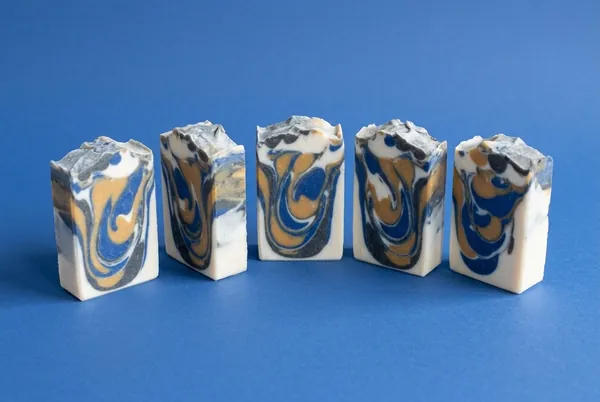
Swirl techniques: in the pot, drop, hanger, spoon and Taiwan
Seven cold-process swirls step by step, with the batter, recipe and temperatures that keep soap fluid, and why swirls turn muddy or lumpy.
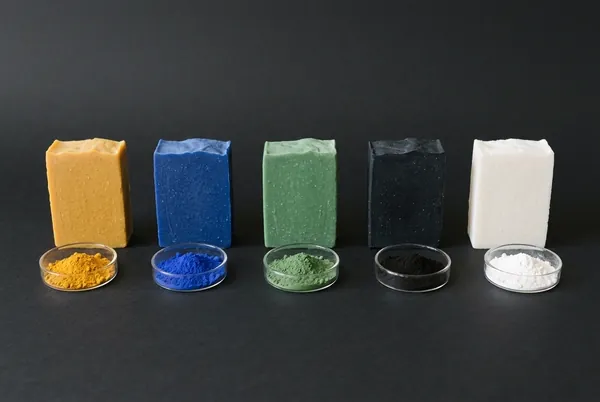
Colouring soap: micas, oxides, ultramarines and pigments
Which colourants survive cold-process soap, how much to use per 500 g of oils, how to disperse and split colour, and what the EU, UK and US rules ask.
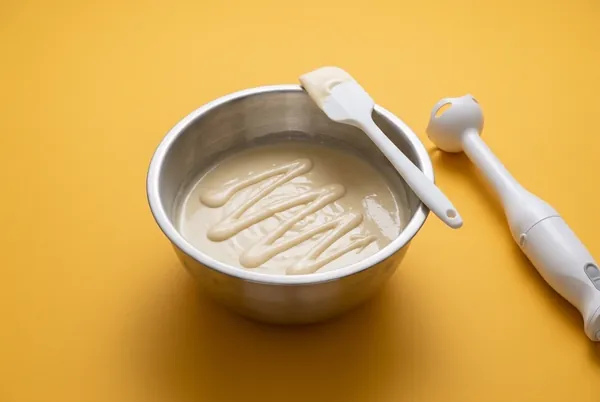
Trace: how to tell when soap batter is ready
What trace is, how to read emulsion, light, medium and thick trace, how to spot false trace, and what makes soap batter thicken faster or slower.
Where these proportions come from
Our own slow palm-free blend, three quarters liquid oil, at a 30 % lye solution and left unscented so the batter stays thin; the colours are dropped from a height into barely traced batter so they sink, the way Kelly Cable drizzles her accent colours from about a foot above the mould.
Formulation adapted from The Natural Soap Making Book for Beginners by Kelly Cable (Althea Press, 2017). The method and notes are ours.