Apricot seed scrub bar
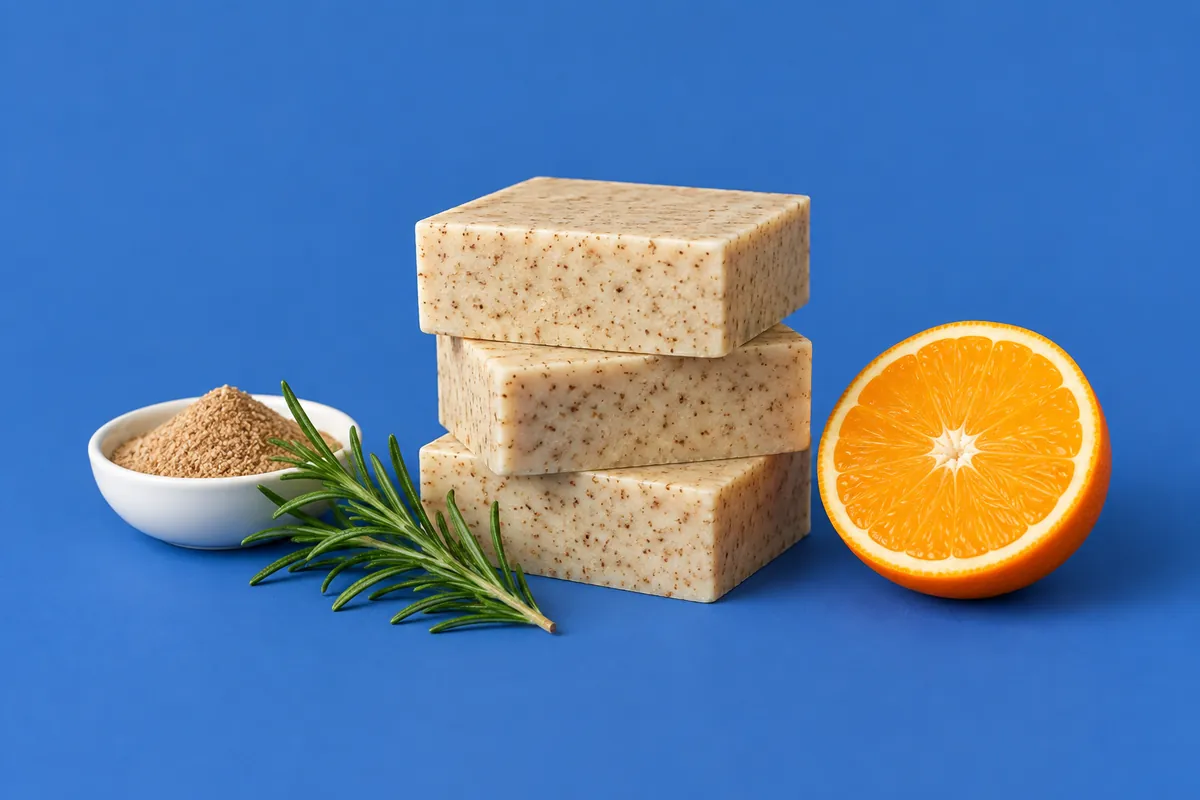
A firm, creamy scrub bar of olive, coconut, palm and castor oils, flecked all through with apricot seed powder for a medium to firm scrub, and scented with sweet orange and rosemary. It is made for elbows, knees, heels and hands, not faces.
- Skill
- Beginner
- Method
- Cold process
- Batch
- 1000 g of oils about 1440 g of batter
- Hands-on
- 1 hour
- Cure
- 5 weeks
- Gel phase
- Either way gel or not, both work
What you need
For 1000 g of oils, which fills a 1.5 litre loaf mould. Weigh everything, liquids included.
| Olive Oil · 40.0 % | 400 g | 14.11 oz |
| Coconut Oil · 25.0 % | 250 g | 8.82 oz |
| Palm Oil · 25.0 % | 250 g | 8.82 oz |
| Castor Oil · 10.0 % | 100 g | 3.53 oz |
| Sodium hydroxide (NaOH) · the lye, 100 % pure | 139.3 g | 4.91 oz |
| Distilled water · for a 35 % lye solution | 258.7 g | 9.13 oz |
| Apricot seed powder · stirred into 30 g of the recipe's olive oil first, and added once the batter has thickened a little | 12 g | 0.42 oz |
| Sweet orange essential oil · 2.0 % of the oils, at trace | 20 g | 0.71 oz |
| Rosemary essential oil · 1.0 % of the oils, at trace | 10 g | 0.35 oz |
- Superfat
- 6 %
- Temperatures
- Oils and lye solution each at 38 to 43 °C (100 to 110 °F)
Method
-
Get ready
Put on splash goggles, gloves and long sleeves, open a window and keep children and pets out of the room. Line a 1.5 litre loaf mould or set out a silicone one. -
Weigh the oils
Stir the tub of palm oil right through, since its hard and soft parts separate, then weigh 250 g palm oil and 250 g coconut oil into the pot. Weigh 400 g olive oil and 100 g castor oil into a jug, and pour 30 g of that olive oil into a small bowl for the scrub. -
Weigh the rest
Weigh 12 g apricot seed powder, and 20 g sweet orange and 10 g rosemary essential oil into a small glass. Weigh 258.7 g distilled water into a heatproof jug and 139.3 g sodium hydroxide into a dry container. -
Make the lye solution
At the open window, pour the sodium hydroxide slowly into the water, never the water onto the lye, and stir until clear, keeping your face out of the vapour. This is a fairly strong solution and runs hot, so leave it to cool somewhere safe and labelled. -
Wet the scrub
Stir the apricot seed powder into the 30 g of olive oil until there are no dry lumps. Wetting it first stops it clumping in the batter. -
Melt the fats
Melt the palm and coconut oils on a low heat until clear, then stir in the rest of the olive oil and the castor oil. Let the oils and the lye solution each come to 38 to 43 °C (100 to 110 °F), warm enough to keep the palm oil fully melted. -
Blend to light trace
Pour the lye solution into the oils down the shaft of the stick blender and pulse in short bursts, stirring between them, until a drizzle leaves a faint line on the surface. Castor oil speeds trace a little, so check often. -
Add the scent
Stir in the essential oils with a spatula. -
Thicken and add the scrub
Pulse a few more times, until the batter is like thin custard and holds a drizzle on top for a moment; thinner batter lets the grains sink. Stir in the scrub paste by hand until the specks are even. -
Pour and cover
Pour into the mould, tap it firmly on the worktop and smooth the top. Cover it with a board and a folded towel; it may gel into a darker centre, which evens out as it cures. -
Clean up
With your gloves still on, wipe the batter off the pot and tools with paper towels into the bin, then wash everything in hot soapy water. -
Unmould and cut
After 24 to 48 hours, when the loaf is firm, put your gloves back on, unmould it and cut it into bars about 2.5 cm (1 in) thick. -
Cure
Stand the bars on a rack with air around them, out of the sun, for four to six weeks, turning them every few days.
Tips
- Apricot seed powder is a medium to firm scrub. For a gentler bar halve it; for a bar for heels and hands, double it. Grades vary from fine to coarse, and the fine one is the one to start with.
- Other scrubs work in the same base at similar amounts. For oats see our oatmeal and honey scrub bar, for cornmeal our cornmeal and juniper scrub bar, and for pumice, which is for feet and hands only, our peppermint foot scrub bar.
- Buy RSPO-certified palm oil, and refined rather than red palm oil, which would turn the bar orange. The list under Try it differently swaps the palm oil for tallow, lard or a butter and opens each in the calculator with its own lye; add the scrub and scent there rather than swapping fats by weight.
- Sweet orange is the first scent to fade in soap. A five-fold or ten-fold orange oil lasts longer at the same weight.
The oils
| Oil | Share |
|---|---|
| Olive Oil (virgin / refined / olive oil) | 40.0 % |
| Coconut Oil | 25.0 % |
| Palm Oil | 25.0 % |
| Castor Oil | 10.0 % |
How it is made
| Process | Cold process |
| Alkali | NaOH |
| Superfat | 6 % |
| Water | lye water at 35 % |
| Iodine value | 58 |
| INS | 150 |
Why make it
A scrub bar for arms, legs, elbows, heels and working hands. The formula is a balanced everyday bar, hardness 39, cleansing 17 and conditioning 58 on our scale, with castor oil at a tenth of the oils for a creamy lather that carries the grit. Apricot seed powder is ground stone-fruit pit, and Fisher counts it among the scrubbier exfoliants. Makers have long stirred ground seeds, meal and shells into soap for rough skin and dirty hands; the appeal is the feel, not any chemistry. The American Academy of Dermatology notes that scrubbing can be too irritating for dry, sensitive or acne-prone skin, can leave dark spots on darker skin, and that the harder you scrub the less often you need to. So keep this bar off the face and off broken skin, and use it gently.
Sources
- The Complete Photo Guide to Soap Making · David Fisher, Creative Publishing International, 2018
- How to safely exfoliate at home · American Academy of Dermatology, 2026
What tradition, makers' experience and research say about soaps like this, each labelled for what it is. It is not medical advice, and no soap treats a skin condition: if you have one, ask a doctor or pharmacist.
What the numbers say
- Lauric acid 12.4 %
- Myristic acid 5.0 %
- Palmitic acid 18.8 %
- Stearic acid 3.3 %
- Ricinoleic acid 8.9 %
- Oleic acid 39.9 %
- Linoleic acid 8.4 %
- Other 5.0 %
Saturated : unsaturated 42 : 58
Computed from the fatty acids of the fats above. The bands are what the craft has settled on, not chemistry — a bar outside one is not wrong.
Try it differently
20 variationsThe same soap with one thing moved. Each opens in the calculator ready to change again.
- Edible Tallow (beef/mutton dripping) instead of Palm Oil
- Lard (pure rendered pork fat) instead of Palm Oil
- Shea Butter instead of Palm Oil
- Kokum Butter instead of Palm Oil
- Cocoa Butter (Theobroma Oil) instead of Palm Oil
- Mango Butter instead of Palm Oil
- 5 % superfat
- 8 % superfat
- Edible Tallow (beef/mutton dripping) instead of Palm Oil and 5 % superfat
- Edible Tallow (beef/mutton dripping) instead of Palm Oil and 8 % superfat
- Lard (pure rendered pork fat) instead of Palm Oil and 5 % superfat
- Lard (pure rendered pork fat) instead of Palm Oil and 8 % superfat
- Shea Butter instead of Palm Oil and 5 % superfat
- Shea Butter instead of Palm Oil and 8 % superfat
- Kokum Butter instead of Palm Oil and 5 % superfat
- Kokum Butter instead of Palm Oil and 8 % superfat
- Cocoa Butter (Theobroma Oil) instead of Palm Oil and 5 % superfat
- Cocoa Butter (Theobroma Oil) instead of Palm Oil and 8 % superfat
- Mango Butter instead of Palm Oil and 5 % superfat
- Mango Butter instead of Palm Oil and 8 % superfat
From the guides
All guides
Soap additives: salt, sugar, sodium lactate, clays, oats, silk and more
What common soap additives do, how much to use and when they go in: sourced doses for sodium lactate, salt, sugar, honey, citric acid, clays, oats and silk.
Trace: how to tell when soap batter is ready
What trace is, how to read emulsion, light, medium and thick trace, how to spot false trace, and what makes soap batter thicken faster or slower.
Your first cold process soap, step by step
A complete first batch of cold process soap: one simple recipe with exact lye and water for 500 g and 1 kg of oils, and every step from goggles to cure.
Where these proportions come from
Our own construction: olive, coconut, palm and castor oils at a 6 % superfat and a 35 % lye solution, a firm, balanced bar with enough lather to carry a scrub. The scrub goes in at trace as an additive, not as an oil; here it is apricot seed powder at about the rate Fisher suggests starting from, 1 to 2 teaspoons per pound of oils.