High-castor lather bar
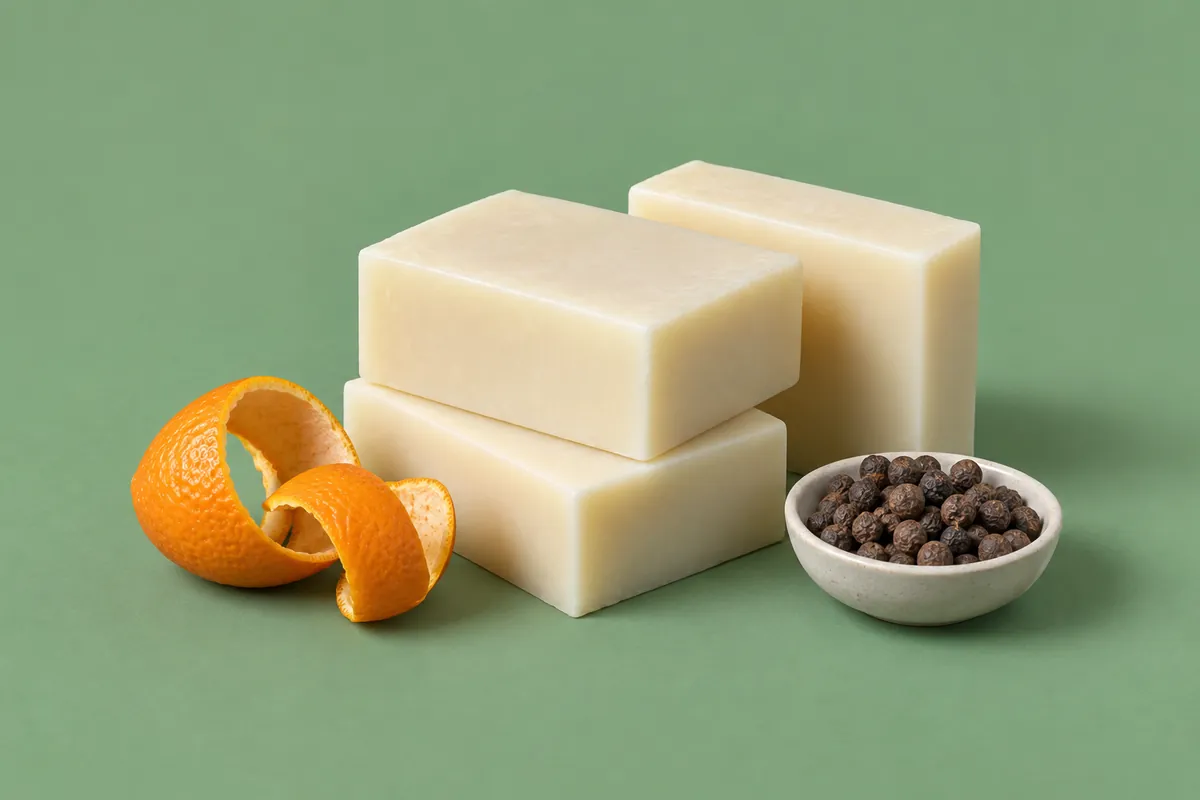
An olive, coconut and palm bar with castor oil at 15 % and a little sugar for about as much creamy lather as an everyday bar can carry. Scented with sweet orange and May Chang, it shows exactly how far castor oil can go before a bar turns sticky.
- Skill
- Beginner
- Method
- Cold process
- Batch
- 1000 g of oils about 1463 g of batter
- Hands-on
- 1 hour
- Cure
- 6 weeks
- Gel phase
- Either way gel or not, both work
What you need
For 1000 g of oils, which fills a 1.5 litre loaf mould. Weigh everything, liquids included.
| Olive Oil · 40.0 % | 400 g | 14.11 oz |
| Coconut Oil · 25.0 % | 250 g | 8.82 oz |
| Palm Oil · 20.0 % | 200 g | 7.05 oz |
| Castor Oil · 15.0 % | 150 g | 5.29 oz |
| Sodium hydroxide (NaOH) · the lye, 100 % pure | 140.1 g | 4.94 oz |
| Distilled water · for a 33 % lye solution | 284.5 g | 10.03 oz |
| Sugar · 2 tsp, dissolved in the water before the lye, for more lather | 8.4 g | 0.30 oz |
| Sweet orange essential oil · 2.0 % of the oils, at trace | 20 g | 0.71 oz |
| Litsea (May Chang) essential oil · 1.0 % of the oils, at trace | 10 g | 0.35 oz |
- Superfat
- 5 %
- Temperatures
- Oils and lye solution each between 35 and 43 °C (95 and 110 °F)
Method
-
Get ready
Put on splash goggles, nitrile gloves and long sleeves, open a window or turn on the extractor fan, and keep children and pets out of the room. Line the mould and set it where it can stay level for two days. -
Melt and stir the palm oil
Warm the whole tub of palm oil until it is liquid and stir it well before weighing any, since it separates as it stands. -
Weigh the oils and the scent
Weigh 200 g palm oil and 250 g coconut oil into the pot, and 400 g olive oil and 150 g castor oil into a jug. Weigh 20 g sweet orange and 10 g litsea essential oil into a small glass cup. -
Dissolve the sugar
Weigh 284.5 g distilled water into a heat-safe jug and stir in two level teaspoons of sugar until it has dissolved completely. -
Make the lye solution
Weigh 140.1 g sodium hydroxide into a small dry container. In a well-ventilated spot, pour it slowly into the sugar water, never the water onto the lye, and stir until clear; a pale yellow tinge from the sugar is normal. Leave it to cool, labelled and out of reach. -
Melt the hard oils
Melt the palm and coconut oils together on low heat until clear, then pour in the olive and castor oils and stir well, since the thick castor oil tends to sink. -
Check the temperatures
Carry on when the oils are clear and both they and the lye solution are between 35 and 43 °C (95 and 110 °F). Sugar makes soap run warmer, so there is no need to soap any hotter than that. -
Combine and blend to light trace
Pour the lye solution into the oils down the shaft of the stick blender, tap the blender to let trapped air out, then pulse and stir until a drizzle leaves a faint line on the surface. The castor oil brings trace on a little sooner than usual, so check after every few pulses. -
Add the scent
Stir the orange and litsea oils through by hand with the spatula, then give the batter one short pulse to even them out. -
Pour and cover
Pour into the mould, tap it on the worktop to raise air bubbles, and cover it with a lid or board and a folded towel. Check it after a couple of hours: if the top has started to crack or rise in the middle, take the towel off. -
Clean up with your gloves on
Wipe the raw batter off the pot and tools with paper towels into the bin, then wash everything in hot soapy water. -
Unmould and cut
After 24 to 48 hours, when the loaf is firm and no longer sticky to a gloved finger, unmould it and cut it into bars about 2.5 cm (1 in) thick. Castor oil keeps it a little softer than most at first, so give it another day if it needs one. -
Cure
Stand the bars on edge in a dry, airy room for six weeks, turning them every few days. They feel slightly tacky at first and firm up as they dry.
Tips
- If the loaf is still tacky at 48 hours, put the whole mould in the freezer for a couple of hours: cold soap releases cleanly. Then let the bars come back to room temperature before cutting.
- Sweet orange fades during the cure, and the litsea is there to hold the citrus note. Do not raise the litsea above 20 g: its citral is limited under the IFRA standard.
- To feel what castor oil does, make this beside Everyday bar, the usual three, which has none. For castor oil at 10 % in a much firmer bar, see Fast-curing bar.
The oils
| Oil | Share |
|---|---|
| Olive Oil (virgin / refined / olive oil) | 40.0 % |
| Coconut Oil | 25.0 % |
| Palm Oil | 20.0 % |
| Castor Oil | 15.0 % |
How it is made
| Process | Cold process |
| Alkali | NaOH |
| Superfat | 5 % |
| Water | lye water at 33 % |
| Iodine value | 59 |
| INS | 148 |
Why make it
Castor oil is the oil makers add for lather. Its ricinoleic acid makes a soap that dissolves quickly into a dense, lasting foam, and here it is at 15 %, with a little sugar in the lye water to help further. On our scale that gives bubbly 31 and creamy 33 at a modest cleansing 17: a bar that lathers readily even in a quick rinse, which makes it a good shower or hand-washing bar. It is also a lesson in limits. Anne-Marie Faiola keeps castor oil at 8 % or less to avoid tackiness, and at 15 % the bar is a little soft and tacky for its first weeks; above about 20 % a bar stays sticky however long it cures. Give it the full six weeks and a dish that drains.
Sources
- Pure Soapmaking, by Anne-Marie Faiola · Storey Publishing, 2016
What tradition, makers' experience and research say about soaps like this, each labelled for what it is. It is not medical advice, and no soap treats a skin condition: if you have one, ask a doctor or pharmacist.
What the numbers say
- Lauric acid 12.3 %
- Myristic acid 5.0 %
- Palmitic acid 16.7 %
- Stearic acid 3.2 %
- Ricinoleic acid 13.3 %
- Oleic acid 38.1 %
- Linoleic acid 8.2 %
- Other 5.0 %
Saturated : unsaturated 40 : 60
Computed from the fatty acids of the fats above. The bands are what the craft has settled on, not chemistry — a bar outside one is not wrong.
Try it differently
18 variationsThe same soap with one thing moved. Each opens in the calculator ready to change again.
- Edible Tallow (beef/mutton dripping) instead of Palm Oil
- Lard (pure rendered pork fat) instead of Palm Oil
- Shea Butter instead of Palm Oil
- Kokum Butter instead of Palm Oil
- Cocoa Butter (Theobroma Oil) instead of Palm Oil
- Mango Butter instead of Palm Oil
- 7 % superfat
- Edible Tallow (beef/mutton dripping) instead of Palm Oil and 4 % superfat
- Edible Tallow (beef/mutton dripping) instead of Palm Oil and 7 % superfat
- Lard (pure rendered pork fat) instead of Palm Oil and 4 % superfat
- Lard (pure rendered pork fat) instead of Palm Oil and 7 % superfat
- Shea Butter instead of Palm Oil and 4 % superfat
- Shea Butter instead of Palm Oil and 7 % superfat
- Kokum Butter instead of Palm Oil and 4 % superfat
- Kokum Butter instead of Palm Oil and 7 % superfat
- Cocoa Butter (Theobroma Oil) instead of Palm Oil and 4 % superfat
- Cocoa Butter (Theobroma Oil) instead of Palm Oil and 7 % superfat
- Mango Butter instead of Palm Oil and 7 % superfat
From the guides
All guides
Fatty acids and soap qualities: what the numbers mean
The eight fatty acids behind how a bar behaves, how the five quality numbers are summed from them, where the usual ranges came from and when to ignore them.
Designing your own soap recipe: purpose, acids, oils
A method for building a soap recipe from scratch: decide what the bar is for, set the fatty acids that follow, choose the oils, then test and refine.
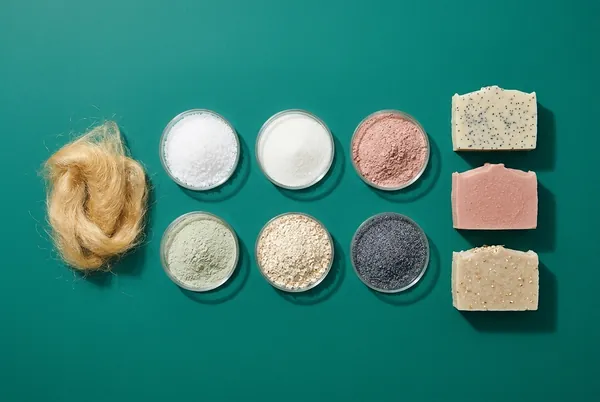
Soap additives: salt, sugar, sodium lactate, clays, oats, silk and more
What common soap additives do, how much to use and when they go in: sourced doses for sodium lactate, salt, sugar, honey, citric acid, clays, oats and silk.
Where these proportions come from
Our own construction: an olive, coconut and palm base with castor oil at 15 %, near the top of the usual range, for about as much lather as a bar can carry before it starts turning sticky. Two teaspoons of sugar in the lye water, close to the rate Anne-Marie Faiola gives for more lather, add to it.